📖 11 min read YUPSENI Team
Vinyl Fence in High-Heat, Dry Climates: Will It Warp or Fade?
Table of Contents
A white vinyl fence post and panel in direct sun. Whether heat damages a fence is decided by formulation and installation, not by the latitude of the yard.
A vinyl fence that spends July at 45°C is being tested in ways a factory lab rarely reproduces. Buyers in Arizona, Nevada, the Gulf Coast, and the Middle East ask the same two questions before ordering. Will the pickets sag? Will the white go yellow? Both have answers, and neither is a simple yes or no. Browse the vinyl fence profile range while you read.
Heat affects vinyl in two separate ways, and the industry tends to lump them together. One is physical, covering expansion, sag, and rail deflection. The other is chemical, covering the slow breakdown of the surface layer under ultraviolet light. These two failures look different, get fixed differently, and a given fence can suffer badly from one while being almost immune to the other.
This article separates them, identifies the three components that fail first in a desert summer, and sets out the specifications that hold up when the thermometer stays above 40°C for weeks at a time.
I. The Short Answer: Vinyl Moves in Heat - Just Not the Way Wood Does
Vinyl is not wood, and that single fact removes most of the heat problem before it starts. Timber swells, twists, and checks because it takes on and releases moisture through the seasons, a process that has nothing at all to do with temperature. Rigid PVC takes on no water. Its movement is purely thermal, which makes it predictable, measurable, and easy to design around.
In a hot, dry climate this matters more than in a temperate one, because dry air is the condition vinyl was built for. No rot, no warping from humidity, no annual oiling. The one real vulnerability is heat itself, and that vulnerability has a narrow, well-understood trigger.
It triggers when the material is held rigid while it tries to grow.
Panels that are allowed to float in their channels handle a 30-degree temperature swing without a visible change. Panels that are pinned do not.
II. Thermal Expansion: Why the Same Panel Grows a Few Millimetres in July
Every material expands as it warms. What differs is how much. Rigid PVC moves about five times more than softwood across the same temperature range, at roughly 0.05 millimetres per metre for every degree Celsius of change. On a 2.4-metre panel, a 30-degree swing between a January night and a July afternoon produces close to 3.6 millimetres of growth.
That figure is small, and it is exactly why most vinyl fences handle heat without complaint. The panel is designed to slide. Pickets sit in routed channels in the top and bottom rails, and the rails slip over the post. Give the assembly room and the expansion disappears into the joints. Drive a screw through the rail and into a picket, and the same 3.6 millimetres becomes a buckle.
There is a second variable that has nothing to do with air temperature, and it is the one most buyers miss. Solar gain. A dark vinyl fence in full sun can reach a surface temperature far above the ambient reading, commonly 25 to 35 degrees hotter than the surrounding air. That surface heat, not the weather forecast, is what softens the material and lets a long rail sag under its own weight.
Worth knowing: Ambient temperature tells you how the day feels. Surface temperature tells you what the fence is doing. The two numbers can differ by more than thirty degrees on a still, cloudless afternoon.
A picket fence has dozens of small joints. Each one absorbs a fraction of the panel's expansion, which is why airflow and free movement matter more than stiffness.
III. Three Components That Fail First in a Desert Summer
Failures are not random. They follow load. Three parts of a vinyl fence carry the most stress in hot weather, and they are the three to inspect first when something looks wrong.
The top rail. It is the longest unsupported span in the assembly and the one that takes the most solar load. Once the surface temperature climbs into the softening range, a long rail stops behaving like a beam and starts behaving like a rope. Light colours tolerate this well. Dark colours do not, and the result shows up as a gentle downward bow between posts.
The gate. A gate is the heaviest moving element in any fence, and it works to the tightest tolerance. Warm vinyl is more flexible than cool vinyl, so a gate that closes cleanly at 20°C can drag on its latch at 45°C. The answer is design rather than luck. A gate frame that carries its own weight, with hinges bolted through a reinforcement instead of through the vinyl, keeps working when the surrounding material softens.
The post cap and the picket tops. These small parts absorb the most direct sun per square centimetre and have the least material available to manage the expansion they generate. A cap that is only a press fit will work loose after a few summers. A cap seated with a flexible adhesive or a mechanical lock does not.
The exposed tops of pickets take the most direct solar load in the entire fence. They are also the cheapest detail to specify correctly.
IV. Fading Is Chemistry, Not Temperature
Heat does not yellow a fence. Ultraviolet light does. A UV photon carries enough energy to break a carbon-chlorine bond in the PVC chain, and once that happens the polymer rearranges into new double bonds that absorb blue light. The eye reads that shift as a move toward yellow. Repeat the reaction a few thousand times on the same square centimetre and a bright white surface becomes off-white, then pale amber.
The defence is a two-part formulation. Titanium dioxide pigment in the rutile crystal form scatters and absorbs UV before it reaches the polymer. Hindered amine light stabilisers, listed as HALS on a technical datasheet, interrupt the chemical chain reaction that follows. A white fence with a well-built UV package changes colour slowly, and often the change is only obvious when a new panel is placed beside an eight-year-old one. The breakdown of UV resistance in vinyl fencing goes deeper into the stabiliser chemistry.
Chalking is the second visible symptom, and it is routinely mistaken for fading. What happens is that the outermost polymer layer degrades and releases, leaving titanium dioxide particles sitting loose on the surface as a fine white powder. Wipe it away and the colour underneath is usually still close to original. Chalking is a cosmetic nuisance rather than a structural failure, and a wash with a soft brush and mild soap removes most of it.
V. What Installers in Phoenix and Dubai Do Differently
Installing a vinyl fence in a hot climate is mostly about giving the material room and keeping it cool during the build. A handful of field habits travel well between Arizona, Nevada, and the Gulf states.
Work in the early morning. Vinyl is easier to handle below 30°C, and a picket that slides into a channel at seven in the morning will slide more easily than one that has been sitting in the sun since noon. On a large job, shade the stack of panels if the site allows it.
Leave the expansion gaps open. Panels are meant to float. Do not drive fasteners through a rail and into a picket. Use the routed channels and the retaining clips the manufacturer supplies, and keep the specified gap at each end of every panel rather than pushing panels tight against the posts.
Choose light colours. This is the single largest decision on the list. White, beige, and light grey reflect most of the incoming solar radiation. Charcoal and black absorb it, and that difference can push the surface temperature twenty degrees higher on the same afternoon.
Reinforce the spans that carry load. The bottom rail on a gate, and any rail spanning more than about 1.8 metres, benefits from an aluminium insert. It gives stiffness without changing how the fence looks. Installers working in extreme UV conditions often take the same approach for the fence line itself.
Let the hardware do the work. Stainless steel hinges and latches, bolted through an aluminium gate frame, keep the moving parts working after the vinyl around them softens. Coastal installations face an overlapping set of demands, and the coastal durability notes on salt, UV, and wind cover where the two climates differ.
Long runs in open sun are where rail stiffness and colour choice matter most. An aluminium insert in the bottom rail is cheap insurance on any span over 1.8 metres.
VI. Reading a Datasheet for Heat: The Four Lines That Matter
Manufacturer datasheets are written for engineers, and most buyers skip them entirely. For a hot, dry climate, only four lines carry real weight. Everything else is marketing.
| Datasheet line |
What a solid number looks like |
Why it matters in heat |
| Heat deflection temperature |
70°C or higher |
Above this point a rail can sag under its own load |
| Linear thermal expansion |
Around 0.05 mm per metre per °C |
Tells you how much gap to leave at each post |
| TiO₂ content and stabiliser package |
Rutile grade, HALS stated on the sheet |
Sets how fast the surface colour shifts |
| Colour change after weathering |
Delta E under 3 after 2,000 hours |
Predicts whether fading is visible over a decade |
A supplier who cannot state these four figures is not hiding a secret. They usually do not know them, which means nobody on their side measured the batch either. That is the real risk, and it has nothing to do with the climate you are building in.
A lattice top adds airflow and shadow but little rigidity. On a long run, the bottom rail and the posts are still doing the structural work in the heat.
VII. A Ten-Year Projection, Honestly Stated
Take a white vinyl fence with a proper UV package, installed with open expansion gaps in a climate that spends a month above 40°C. Colour shifts slightly and slowly, and after ten years the change is usually invisible unless you hold a new panel against an old one. Structure holds, with no warping where the gaps were respected and only minor rail movement on unusually long spans. Light chalking may appear around year eight and washes off with soap and water. Twenty years is a realistic service life, and in practice the gate hardware is usually the first thing to need attention rather than the fence itself.
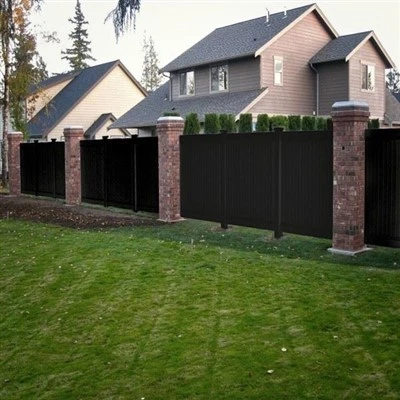
Now take the same fence in charcoal. Fading is less visible on dark colours, since the pigment change is masked by the base tone, but the surface gets considerably hotter and chalk film shows up as a pale haze against a dark background. Sag risk on long rails is real rather than theoretical. The practical guidance for dark vinyl in extreme heat is to keep runs short, support them well, and treat the fence as a design element rather than a long uninterrupted barrier.
If the requirement is a maintenance-free barrier holding precise alignment for thirty years in sustained 45°C conditions with extreme UV, no vinyl grade will fully deliver that, and it is worth saying so plainly. The honest limits of PVC are documented for exactly this reason.
So the answer to the headline question is more specific than yes or no. A vinyl fence in a hot, dry climate will not warp if it was specified and installed for the climate it stands in, and it will fade slowly if the formulation behind it is sound. Both outcomes are decided long before the first post goes into the ground. The installation sequence that puts those decisions into practice is set out in the step-by-step PVC fence installation guide.
A fence that stays straight for two decades in the desert is not a lucky fence. It is a specification, an installation method, and a colour choice that agreed with each other on day one.
Frequently Asked Questions About Vinyl Fence in Hot Climates
Straight answers on warping, fading, colour choice, expansion, and service life in extreme heat.
Q1: Will a vinyl fence warp at 45°C?
A: It will not warp if the panel is allowed to move. Vinyl expands with heat, and the panel is designed to release that movement into the routed channels and the slip fit at the posts. Warping almost always traces back to an installation that held the material rigid, or to a dark colour that pushed the surface temperature into the softening range under load.
Q2: Does white vinyl fencing turn yellow in strong sun?
A: It can shift colour over many years, but the change is normally slow and gradual when the formulation is good. Titanium dioxide in the rutile form blocks UV, and hindered amine light stabilisers slow the chemical reaction behind discolouration. Fences that go visibly yellow within two or three years usually have a thin or poorly designed UV package.
Q3: What colour vinyl fence performs best in a hot, dry climate?
A: White, beige, and light grey are the safest choices, because they reflect most incoming solar radiation. Dark colours absorb it and can run twenty degrees hotter on the surface, which raises both the sag risk on long rails and the rate of surface chalking. If a dark colour is required for design reasons, keep the runs short and reinforce the spans.
Q4: How much does a vinyl fence actually expand in summer?
A: Rigid PVC moves about 0.05 millimetres per metre for each degree Celsius of change. A 2.4-metre panel facing a thirty-degree swing between a winter night and a summer afternoon grows by roughly 3.6 millimetres. That is small enough to disappear into a properly designed joint and large enough to buckle a panel that has been pinned in place.
Q5: What are the signs that a vinyl fence is struggling in the heat?
A: Look at the top rail between posts for a downward bow, check whether a gate still latches cleanly in the afternoon, and press on the post caps to see whether they are still seated. These three checks take less than a minute and cover the components that carry the most stress in sustained heat.
Q6: Is it better to install a vinyl fence in summer or winter?
A: In a hot climate, work early in the day. Handling is easier below 30°C, and pickets slide into channels more readily before the material has absorbed a full day of sun. The season matters less than the hour, and the expansion gaps should be set the same way regardless of when the fence goes in.
Specifying a Vinyl Fence for a Hot, Dry Climate?
Tell us your peak summer temperature, sun exposure, and colour preference. We will recommend the right formulation, rail reinforcement, and expansion gap before the order is placed.
Request a Specification Review Browse Fence Profiles
YT
YUPSENI Team
23 years in PVC building material manufacturing and supply chain. We help importers, contractors, and project buyers source fencing, SPC flooring, foam boards, and wall panels that pass compliance the first time. More about YUPSENI
Disclaimer: The information in this article is for general informational purposes only and does not constitute professional advice. Product specifications may vary by region and production batch. Heat performance depends on formulation, colour, installation method, and local conditions. Always request current datasheets before making procurement decisions.
© 2026 YUPSENI. All rights reserved.