Replacing One Vinyl Fence Picket: What Each Fence System Allows | YUPSENI
Sep 15, 2026
Replacing One Damaged Vinyl Fence Picket: What the System Allows
8 min read
By YUPSENI Team
On This Page
A mower throws a stone, a car clips the corner, a ball lands badly. One picket in a fence breaks, and the owner expects to swap it out in ten minutes. Half the time that is exactly what happens. The other half, the top rail has to come off, the posts have to be released, and a two-minute job becomes a two-day one.
The difference is not the quality of the fence. It is how the picket is held. Vinyl fencing uses several capture methods, and they vary enormously in how much of the panel has to come apart to free a single piece. The PVC fencing range covers more than one of these systems, so the answer is worth knowing before the order rather than after the damage.
This piece sets out how each system works, which ones allow a clean single-picket swap, and what to order alongside the fence so that the repair is a repair rather than a rebuild.
I. What Easy to Repair Actually Promises
Vinyl fencing is marketed on low maintenance, and low maintenance is usually taken to include repairability. Those are two different claims, and only one of them is reliably true.

Pickets are captured between the top and bottom rails. Everything about repairability follows from that arrangement.
Low maintenance is a material claim, and it holds. Vinyl does not rot, does not need painting, and does not attract insects. A fence installed correctly will look the same in year ten as it did in year one, apart from some colour fade.
Repairability is an assembly claim, and it depends on the profile design. A picket is held between two rails, and both rails are fixed to posts. To remove one picket in the middle of a panel, either the picket has to slide out past a rail, or a rail has to come off. Which of those is possible is decided at the factory when the profile is cut, not on site when the damage happens.
II. The Three Ways a Picket Is Captured
Almost every vinyl fence on the market uses one of three capture methods, and they behave differently when a single picket has to come out.
| System | How the picket is held | Single picket removal |
|---|---|---|
| Routed rail | The rail carries a groove and the picket sits in it | Usually requires the top rail to be released |
| Notched picket | The picket has notches that clip over the rail | Often possible without disturbing the rail |
| Bracket and rail | Rails are held to the posts by brackets, pickets sit in routed channels | Rail lifts out of the brackets, freeing the pickets |

How the rail meets the post determines whether the rail can be lifted, and whether a picket can be freed without dismantling the panel.
The bracket system is the one that genuinely delivers on the repair promise, and it is worth understanding why. When a rail is held by brackets rather than set into routed holes in the post, releasing two brackets lets the entire rail be lifted clear. With the top rail out, every picket in that bay is free, and a single damaged one can be replaced and the rail dropped back in.
Where the rail is set into a routed post, that option disappears. The rail cannot be lifted without moving the post, and moving a post means digging out a concrete footing. This is the single detail that separates a fence that can be repaired from one that cannot, and it is not visible in a photograph of a finished installation.
III. Systems Where One Picket Comes Out Cleanly
With a notched picket system, the picket itself carries a pair of notches cut into its edges. The picket is offered up to the rail, flexed slightly, and the notches snap over the rail profile. The rail does not move and the picket is captured by its own geometry.
Removal is the installation sequence in reverse. The damaged picket is flexed, the notches are worked off the rail, and the picket comes free. A replacement goes in the same way. In warm weather this is a genuinely quick job, and it can usually be done from one side without disturbing anything else in the panel.
Two conditions apply, and both matter. The picket has to be flexible enough to flex without cracking, which is a function of the formulation and the temperature. Vinyl becomes noticeably more brittle in cold weather, and a picket that flexes easily at twenty degrees may crack at zero. And the notches have to be cut to the right depth. A picket notched too shallow will not clip over the rail. One notched too deep weakens the section at exactly the point where wind load concentrates.
Some systems add a mechanical lock, usually a screw driven through the rail into the picket, to stop the pickets being lifted out from outside. That lock has to be removed first, and on a long fence it is worth knowing how many there are and where, because a single missed screw turns a ten-minute repair into an afternoon of confusion.
IV. When the Top Rail Has to Come Off First
On a routed rail system, the picket is sitting in a channel that runs the length of the rail. There is no flexing it out, because the rail surrounds it on three sides. The rail has to move.

Where pickets sit in routed channels, a single replacement usually means releasing a rail and working from above.
If the rail is bracket-fixed, this is manageable. The brackets are released, the rail lifts, the picket is swapped, and the rail goes back. It is a two-person job and it takes an hour rather than a day, but it does not require touching the posts or the footings.
If the rail is set into routed post holes, the options narrow considerably. The rail cannot come up without the post moving, and the post cannot move without the footing being excavated. At that point the realistic approaches are to cut the damaged picket out and fit a replacement that is split or sleeved over the rails, or to accept that the panel is replaced as a unit.
Both are legitimate repairs, and both are visible on close inspection. A cut-and-sleeved picket leaves a seam. A replacement panel against a weathered fence leaves a colour difference. Neither is a defect in the fence. Both are consequences of a profile decision made at the specification stage, months before anyone hit it with a mower.
V. Matching a New Picket to an Ageing Fence
There is a second problem that arrives with any repair, and it has nothing to do with mechanics. A new picket will not match an old fence.
Vinyl fencing changes colour as it weathers, and the change is slow but cumulative. A picket that has been outside for five years is a different shade from one that came off a production line last month, even if both are described as the same colour. On a white fence the difference is subtle. On a tan or grey fence it is often obvious.
There are three practical responses. Replace the whole panel rather than the single picket, which contains the mismatch inside one bay and makes it read as a design feature rather than a patch. Check whether the supplier stocks a weathered or pre-aged finish, which some manufacturers offer for exactly this reason. Or accept the difference and let it even out, which takes several years and does eventually happen.
The fourth option is the one that actually solves the problem, and it is taken before the fence is ordered. Include a small quantity of spare pickets, rails and brackets with the original shipment, drawn from the same production run. They will match on the day they are needed because they have weathered alongside the fence. The cost is a few percent of the order. The alternative is a repair that is permanently visible.
VI. What to Check Before You Buy
Four questions, all answerable before the order and all difficult to change afterwards.
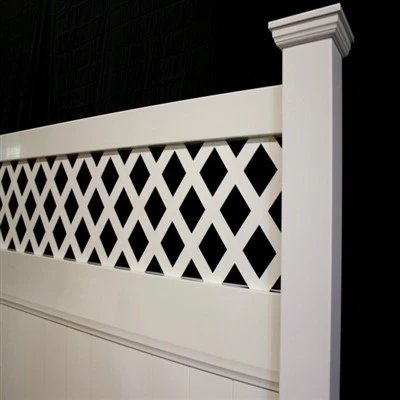
The connection between rail and post is the detail that decides whether a single picket can ever be replaced cleanly.
First, whether the rails are bracket-fixed to the posts or set into routed holes. This is the question that determines everything else. Second, whether the pickets are notched or routed into the rail, and whether any of them carry a mechanical lock. Third, whether spare pickets and rails can be supplied from the same production run as the main order. Fourth, whether the profile is likely to still be in production in five or ten years, because a profile that has been discontinued cannot be repaired at any price.
None of these appear on a standard quotation, and all of them are cheap to resolve at the ordering stage. A fence is bought once and repaired many times. The purchase decision that looks like it is about appearance is really a decision about what happens in year six.
Frequently Asked Questions
Vinyl Fence Repair Questions
Repair, replacement and spare parts questions from homeowners, installers and distributors.
Can one picket be replaced without removing the whole panel?
It depends on the capture method. With a notched picket system, usually yes, and the replacement can often be done from one side. With pickets set into routed rails, the top rail has to be released first. Where that rail is bracket-fixed, the job is manageable. Where it is set into routed post holes, a clean single-picket replacement is generally not possible.
Will a replacement picket match the rest of the fence?
Rarely, if the fence has been installed for more than a year or two. Vinyl lightens and yellows with exposure, and a fresh picket will be visibly brighter. Replacing the whole panel contains the difference within one bay. Ordering spares with the original fence avoids the problem entirely, because the spares weather alongside the rest of the installation.
How many spare pickets should be ordered?
A working figure is two to three percent of the picket count, rounded up, plus at least one spare rail and a set of brackets. On a small residential fence that is a handful of pieces. On a commercial or perimeter installation it is worth calculating properly, because the cost of carrying spares is a fraction of the cost of a mismatched repair or a discontinued profile.
Is a damaged picket covered by warranty?
Impact damage from a mower, a vehicle or a ball is not a manufacturing defect and is not normally covered. Warranties typically address fading, cracking, warping and discolouration under normal exposure. Read the warranty wording on what counts as normal exposure, since some policies exclude damage from extreme weather events and others do not.
Can pickets be replaced in cold weather?
Notched pickets need to flex, and vinyl becomes more brittle as the temperature drops. Below about five degrees, flexing a picket into place carries a real risk of cracking it, particularly on a profile that has been outside for several years. If a repair is needed in cold conditions, warm the picket indoors first and work quickly, or wait for milder weather.
What happens if the profile is discontinued?
The fence becomes unrepairable in the original profile, and the options reduce to cutting and sleeving, or replacing entire bays with a current profile. This is worth checking at the ordering stage rather than later. Ask how long the profile has been in production and whether the supplier expects to keep it. A profile with several years of history behind it is a safer bet than one introduced last season.
Buying for the Repair, Not the Photograph
A fence is specified from a photograph and repaired in a driveway. The two moments have almost nothing in common, and the decision that determines how the second one goes is made during the first.
Ask how the rails meet the posts, ask how the pickets are captured, and order spares from the same production run. Three questions, asked once, and the fence stays repairable for as long as it stands.
Ordering Fencing With Spares
We can supply spare pickets, rails and brackets from the same production run as your main order. Ask when you request a quotation.
Request a QuotationYUPSENI Team
23 years in PVC building material manufacturing and supply chain. We help importers, distributors, and project buyers source fencing, decking, flooring and wall panels that pass compliance the first time. More about YUPSENI
© 2026 YUPSENI. All rights reserved. The information in this article is for general informational purposes only and does not constitute professional advice. Product specifications and warranty terms vary by region and production batch. Always request current datasheets before making procurement decisions.