

PVC Ceiling Expansion Gap: Stop Panels From Bowing & Lifting | YUPSENI
Oct 23, 2026
PVC Ceiling Panels Move: The Expansion Gap That Stops a Flat Ceiling From Bowing
On This Page
The PVC ceiling goes up in spring and looks flawless - flat, tight, every joint closed. Then the first heat wave arrives and a ripple appears down the middle of the room. By autumn, a seam has opened near the wall.
The installer insists the panels were straight. He is right. They moved.
I. The Ceiling That Was Perfect Until Summer
Most ceiling failures are not discovered at installation. They are discovered three or four months later, after the room has been through a full swing of temperature, and the owner looks up one day to find a wave in what used to be a flat surface.
The instinct is to blame the material. The panels must have been warped, or cheap, or badly made. But the panels were straight when they went up, and they would still be straight if the ceiling had been given the one thing it was never given: room to move.
The panels didn't fail. The room got warmer.
What looks like a material defect is usually a physics problem wearing a ceiling's face - and the physics is simpler than most installers ever admit.
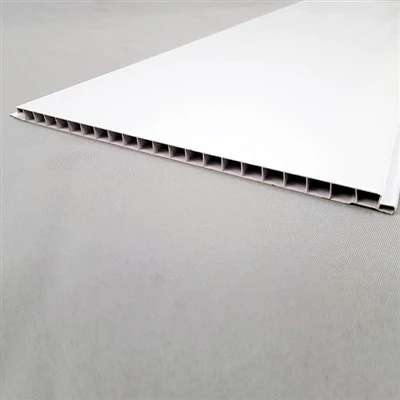
A flat, tight ceiling in spring is not proof of a good install - it may just be a ceiling that hasn't met summer yet.
II. PVC Moves More Than the Ceiling Lets On
Every material expands when it warms and contracts when it cools. What separates them is how much, and PVC sits near the top of that list.
| Material | How much it moves with temperature |
|---|---|
| Wood | Low - expands and contracts slowly and little |
| Steel and aluminium | Moderate |
| PVC | High - roughly an order of magnitude more than wood |
The reason is buried in the structure of the material. PVC is a thermoplastic: a long chain of molecules held together loosely enough that heat makes the whole assembly vibrate more, push further apart, and take up more space. Wood, by contrast, is a stiff, cross-braced natural structure that barely budges. Steel is dense and ordered, and holds its shape better still.
This is not a flaw in PVC. It is simply how the material behaves, and it is predictable, measurable, and completely manageable - if the installation is designed around it. The trouble begins when a ceiling is treated as if it were made of something that does not move, and the panels are locked in place with nowhere to go.
A PVC panel is not weak. It is just alive, in the sense that every degree of temperature change makes it grow or shrink a little. The installation that forgets this is the one that fails.
PVC moves roughly ten times more than wood with the same temperature change. A ceiling built as if it were made of wood is a ceiling built to fail.
III. Why the Ceiling Is the Worst Place to Forget the Gap
If PVC moves so much, why is the ceiling the place where everyone forgets it? Because of three habits that conspire against the material.
The ceiling is the hottest surface in the room. Warm air rises, so the ceiling experiences the largest temperature swings of any surface in the space. In a room under a hot roof, the space above the ceiling can heat far beyond the living temperature below, and the panels feel every degree of it.
Floor gaps are common knowledge; ceiling gaps are not. Ask any installer about expansion gaps under a floor and they will explain it instantly - flooring moves, so you leave a perimeter gap. Ask about the ceiling and the conversation goes quiet. The same physics, one surface higher, and suddenly the rule evaporates.
Overhead work rewards tightness. An installer working above their head wants the panels to look closed, flush, and finished right now, because that is what the customer sees and pays for. Leaving a gap feels like leaving a mistake. So panels get butted hard against the wall, fastened down, and praised for looking perfect - until the temperature changes.
Three habits, one result: the one surface in the room that moves the most is the one most likely to be installed with no room to move at all.

Warm, humid rooms above head height - the exact conditions that make PVC panels move the most.
IV. What the Missing Gap Actually Does
When a PVC panel has nowhere to go, the movement does not disappear. It gets redirected into the weakest available place, and the ceiling tells you exactly where that is.
| Season | What the panel is doing | What appears on the ceiling |
|---|---|---|
| Summer - heating up | Expanding, growing longer and wider | Bowing, rippling, edges lifting, clips pulling loose |
| Winter - cooling down | Contracting, shrinking shorter and narrower | Seams opening, panels pulling away from the trim, creaking |
The summer failure is the more dramatic of the two. Expansion does not cancel itself out; it pushes. Every panel that grows against a wall it cannot move is pushing against its neighbour, and the combined force has to go somewhere. Since the edges are trapped and the middle is not, the middle rises - the classic ripple running down a ceiling, a long gentle bow that appeared in a week of hot weather.
Think of it as a train with nowhere to run. If every carriage expands against the buffers at both ends, the only place the extra length can go is up. A ceiling panel trapped against the wall does exactly the same thing, and the wave it throws is not a defect in the plastic - it is the plastic doing what physics told it to do, in the only direction left open.
The winter failure is quieter but just as real. As panels contract they pull away from the walls and from each other, opening seams and exposing the dark gap behind. The expansion gaps and clip spacing that should have absorbed this movement were never there, so the movement carved its own space instead.

Summer pushes the middle up; winter pulls the seams apart. Both trace back to the same missing gap.
V. The Gap That Has to Be Somewhere
The fix is not complicated. The movement has to go somewhere, so the installation has to give it somewhere to go - and then hide the evidence.
Leave a perimeter gap. The panels should never touch the wall. A small gap around the entire room, covered by trim or edge moulding, gives the whole field room to expand and contract without pushing against anything. As a rough rule, allow half a millimetre to a millimetre of movement per metre of panel for every ten degrees of temperature change, and size the gap for the worst swing the room will see.
Let the panels slide. The fixing system should hold the panels up without locking them rigidly. Clips and channels that allow the panel to slide slightly as it grows and shrinks are the difference between a ceiling that flexes and one that fights itself.
Break up large fields. A long, uninterrupted run of ceiling is the most vulnerable, because the total movement adds up across the whole length. In big rooms, the field should be divided into smaller sections with intermediate movement joints, so no single run ever accumulates enough expansion to bow.
None of this shows in the finished result. The trim hides the perimeter gap, the clips stay invisible, and the ceiling still looks tight and complete. The only difference is that, six months later, it still looks the same. For a room-by-room look at how these rules play out in practice - including the batten, clip, and gap sequence in a real install - the gap is always the part that separates a ceiling that lasts from one that waits for summer.

The gap is there, out of sight behind the trim, doing its quiet job all year round.
The Ceiling That Moves Is the Ceiling That Lasts
There is a temptation, when a ceiling bows or a seam opens, to look for something that failed. But a PVC ceiling that moves was never broken - it was doing exactly what the material is supposed to do. The failure belonged to the installation that pretended the movement would not happen.
The best ceiling is not the one that is screwed down hardest. It is the one that is given a little room to breathe, hidden behind trim, and allowed to expand and contract in peace. Leave the gap, let the panels slide, and the ceiling you put up in spring will still be flat when the next summer arrives - because you never gave it a reason to fight its own nature.
Build the gap into the plan, not into the surprise
Ask about expansion clearances and clip systems before your ceiling goes up.
Request a Quotation Browse PVC CeilingsFrequently Asked Questions About PVC Ceiling Expansion
Answers to the questions that come up when a flat ceiling develops a wave.
Q1: Do PVC ceiling panels expand and contract?
A: Yes, and more than most materials. PVC is a thermoplastic that grows when it warms and shrinks when it cools, roughly ten times more than wood for the same temperature change.
Q2: What happens if you don't leave an expansion gap in a PVC ceiling?
A: In summer the panels bow, ripple, lift at the edges, and pull clips loose. In winter they contract, opening seams and pulling away from the trim. The movement has to go somewhere.
Q3: How much expansion gap does a PVC ceiling need?
A: As a rough rule, allow half a millimetre to a millimetre of movement per metre of panel for every ten degrees of temperature change, sized for the worst swing the room will see.
Q4: Where should the expansion gap go in a ceiling?
A: Around the entire perimeter where the panels meet the wall, hidden by trim or edge moulding. Long rooms should also be divided with intermediate movement joints.
Q5: Can an expansion gap be hidden?
A: Yes. The perimeter gap sits behind the trim, and sliding clips stay invisible. A correctly built ceiling with a hidden gap looks as tight as a wrongly built one - it just stays that way.
YUPSENI Team
23 years in PVC building material manufacturing and supply chain. We help importers, distributors, and project buyers source SPC flooring, PVC foam boards, wall panels, and fencing that pass compliance the first time. More about YUPSENI
© 2026 YUPSENI. All rights reserved. The information in this article is for general informational purposes only and does not constitute professional advice. Product specifications may vary by region and production batch. Always request current datasheets before making procurement decisions.


