


Waterproof UV Marble Sheet
Waterproof UV marble sheet for bathroom, kitchen and commercial wet walls. Non-porous PVC marble panel with sealed joints and no grout. 1x40HQ MOQ.
- Fast Delievery
- Quality Assurance
- 24/7 Customer Service
Product Introduction
Waterproof UV Marble Sheet - PVC Artificial Marble Wall Panel for Wet Areas
A UV-coated marble sheet is a rigid PVC panel with a printed stone face sealed under a cured coating. The sheet itself will not absorb water, will not swell, and will not support mould, which is why it gets specified for bathrooms, kitchens and commercial washrooms where tile grout has become a maintenance problem.
There is a catch, and it is the reason wet-area installations fail. A waterproof panel does not make a waterproof wall. The sheet is one layer in an assembly, and the places where water actually gets through are the joints, the perimeter, and the penetrations. Everything on this page is about that distinction, because it decides whether the installation is still dry in five years.

A 1220 x 2440mm sheet with continuous veining. On a wet wall, the fewer joints there are, the fewer places there are to seal.
Sheet Size
1220 x 2440 mm
Thickness
1.3 – 6.0 mm
Water Absorption
Non-porous
Joint Type
Adhesive, no grout
Product Specification
| Parameter | Specification |
|---|---|
| Product Name | UV-Coated Waterproof Artificial Marble Sheet |
| Core Material | Virgin PVC resin with limestone powder filling |
| Surface Construction | UV-cured topcoat over printed decorative film |
| Standard Sheet Size | 1220 x 2440 mm |
| Thickness Range | 1.3 mm to 6.0 mm, tolerance ±0.05 mm |
| Water Behaviour | Non-porous through the full sheet; no swelling, no water uptake |
| Surface Patterns | Marble, stone, wood grain, solid colour; custom matching available |
| Fixing Method | Adhesive bond to substrate; aluminium or PVC trim at edges |
| Certification | ISO 9001, ISO 14001, ISO 45001, SGS, ASTM |
| Minimum Order Quantity | 1 x 40HQ |
| Packing | PE bag or pallets, consolidated with other product categories |
The Sheet Is Waterproof. The Joint Is the Question.
Immerse a sheet of UV marble panel in water for a month and nothing happens to it. That part is genuinely settled. What is not settled is the assembly around it, and every real-world failure traces back to one of four places.
Joints Between Sheets
A butt joint that is left open is a line for water to travel down behind the panel. It needs sealing, and it needs sealing with the right product.
The Perimeter
The bottom edge against a shower tray or basin is the highest-risk line in the whole installation. So is the top edge under a mirror or cabinet.
Penetrations
Shower valves, pipe entries, soap dishes and grab rails all interrupt the sheet. Each one is a hole in a surface that was previously continuous.
The Substrate Behind
Water that reaches the wall behind the panel has nowhere to drain. The panel does not protect the substrate; it only hides it.
That last point is the one worth stating plainly, because it contradicts a common assumption. The marble sheet is the visible finish on a wet wall. It is not the waterproofing layer. In shower enclosures and wet rooms, most building codes require a continuous waterproofing membrane or tanking system behind the finish, and the panel sits on top of that. A supplier who tells you the panel replaces tanking is either misinformed or selling around a requirement. Either way the responsibility lands on the installer when the ceiling below starts to stain.
The distinction in one line
The sheet stops water reaching the substrate from the room side. Tanking stops water reaching the room below if it gets past the sheet. A wet wall normally needs both.
Building a Wall That Stays Dry
Five steps, in this order. Skipping the first one is the most common mistake, and it is also the only one that cannot be corrected later.
Inspect and prepare the substrate before anything else. It must be dry, sound, and flat. Sealing a panel onto a damp or crumbling wall traps the problem behind a surface that looks perfect, which is the worst possible outcome because nobody investigates a wall that looks fine.
Complete any tanking or membrane work in shower and wet room areas first, and let it cure fully. This is a separate trade and a separate inspection in most jurisdictions. It has to be signed off before the decorative finish goes anywhere near the wall.
Bond with a water-resistant adhesive applied as a full bed, not in spots. A dotted bond leaves voids behind the panel where condensation can collect and where the panel can flex under hand pressure, cracking the sealant line above it.
Cover exposed edges and joints with trim, then seal the remaining lines with a neutral-cure sealant. Acid-cure silicone can attack the coating it is applied against, so it is the wrong product here even though it is the one most often on the shelf.
Give the adhesive a full day before sealing the joints. Sealant applied over an adhesive that is still moving will crack along the bond line within weeks, and the crack will be in exactly the place water wants to go.
The same sequence applies to commercial washrooms and kitchen splashbacks, just with less tanking. Where the panel meets a stainless steel bench or a commercial sink unit, the joint is the failure point and it is worth specifying a trim rather than relying on sealant alone at a high-movement junction. The rules for installing PVC wall panels cover adhesive selection and joint preparation in more detail than most installation guides bother with.
UV Marble Sheet vs Tile vs Painted Plaster in Wet Areas
The comparison that matters in a bathroom is not appearance. It is how much continuous sealant the installation contains, and what happens when one part of it fails.
| UV Marble Sheet | Ceramic Tile | Painted Plaster | |
|---|---|---|---|
| Water absorption | None, non-porous sheet | Tile is non-porous, grout is not | Absorbs, blisters, peels |
| Area needing sealant | Few linear joints | Large grout area | None, but no barrier either |
| Mould risk | Low, no organic substrate | Grout supports mould growth | High in a damp room |
| Cleaning | Wipe, no scrubbing | Grout needs brushing | Recoating |
| Time to install | Fast, no curing or grouting | Adhesive and grout curing time | Drying between coats |
| Repair | Replace the affected sheet | Chasing out and matching tile | Recoat the whole wall |
| Removal | Pry off, substrate mostly intact | Destructive | Surface preparation again |
The sealant-area row is the one that decides long-term cost. A tiled shower wall has grout across every square metre, and grout is a permeable cementitious material that needs cleaning and periodic resealing. A panelled wall has a handful of linear joints. In a hotel with two hundred bathrooms, that difference is the whole maintenance budget. Builders who have priced both approaches tend to reach the same conclusion, which is set out in the comparison of vinyl wall panels and ceramic tile in wet areas.
Where It Works, and Where It Does Not
Suitable
Bathroom wall surfaces above the tray or bath, excluding the floor itself
Kitchen splashbacks and the wall behind a hob, where grease wipes off a smooth face
Commercial washrooms, changing rooms and food preparation areas
Healthcare and clinic interiors where a wipeable, joint-light surface is preferred
Not suitable
Shower floors and wet room floors, where the load and slip requirements fall outside what a decorative wall panel is designed for
External facades and any surface in prolonged direct sunlight without a UV-stable coating specification
Areas of continuous standing water, including plant rooms and service voids
Any wet wall where the substrate is already damp and cannot be dried out first
Where the wall needs more than a decorative face, a panel system with an integrated acoustic layer is often specified alongside it. The PVC ceiling board range uses the same adhesive and trim logic, which means one crew can work across the walls and ceiling of a wet room without changing method.
Surface Options for Wet Areas
Gloss level matters more in a wet room than in a dry one. A high-gloss face reflects every light fitting and shows water spots clearly at raking angles. A matte or lower-sheen finish hides water marks and fingerprints, which is why it is usually the better choice for a bathroom rather than a lobby.
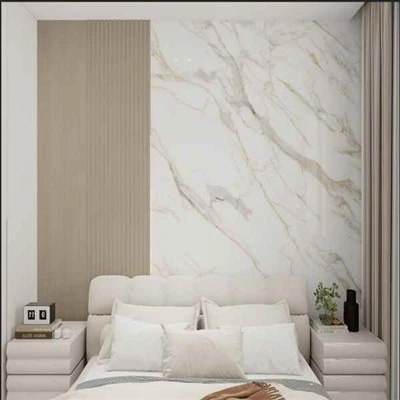
Marble and Stone
The default for bathrooms. A printed stone face on a non-porous sheet gives the appearance of a tiled wall without the grout area to maintain.

Solid Colour
Flat colour for commercial washrooms and back-of-house areas where a stone pattern would be inappropriate and replacement sheets need to be easy to match.

Wood Grain
Used above splash height in cloakrooms and hotel bathrooms, where timber warmth is wanted without timber's behaviour in a damp room.
Frequently Asked Questions
Waterproof UV Marble Sheet Questions
Water resistance, wet-area installation, sealing and ordering questions.
Is UV marble sheet actually waterproof?
The sheet is non-porous and will not absorb water, swell or delaminate when wet. What it will not do on its own is stop water reaching the wall behind it through an unsealed joint or an open perimeter gap. The material is waterproof. The installation has to be made watertight.
Can it be used inside a shower?
On the walls, yes, and it is widely used there. The shower floor is a different matter and should be specified as a floor system with the appropriate load and slip rating. For the walls, a tanking membrane behind the panel is required in most codes, with the panel as the decorative finish on top of it.
Does it need waterproofing behind it in a bathroom?
In a shower enclosure or wet room, assume yes until your local authority tells you otherwise, and confirm the requirement with them before fixing anything. In a general bathroom away from the shower, the requirement is usually lighter. The panel is the finish, not the waterproofing layer.
What sealant should be used at the joints?
A neutral-cure sealant. Acid-cure silicone is the most common product on a hardware shelf and it is the wrong one here, because the acid can attack the coating it is applied against. Seal only after the adhesive has fully set, typically a day after fixing.
Will mould grow on it?
Not on the panel itself. Mould needs organic material and moisture, and a PVC marble sheet provides neither. Where mould appears on a panelled wall it is usually growing in residual adhesive or on the substrate behind the panel, which points back to preparation and sealing rather than the sheet.
Can it be used in a commercial kitchen?
Yes, and it is a common specification for wall surfaces behind preparation and wash areas where a smooth, wipeable face is easier to clean than grout. Joints against stainless benches and sinks should be detailed with a trim rather than relying on sealant at a high-movement junction.
What are the ordering terms?
Minimum order is one 40HQ container. Payment is 30% in advance with the balance against a copy of the bill of lading at sight, by T/T or L/C. Delivery runs 10 to 25 days after the advance clears, and panels can be consolidated with other PVC building materials in the same container.
Related Reading
- Marble UV Wall Panels: Stone-Look Walls That Cost A Tenth Of The Real Thing
- Vinyl Wall Panels: What They Are And Why They're Replacing Tile And Paint
- Vinyl Wall Panels vs Tiles: 7 Reasons Builders Are Ditching Ceramic In Wet Areas
- Waterproof PVC Cabinet Panels for Kitchens, Bathrooms & Wet Areas
- Installing PVC Wall Panels? Don't Touch That Glue Until You Read These 6 Rules
- Request a Sample and Quotation
Hot Tags: Waterproof UV Marble Sheet, China, manufacturers, factory, customized, wholesale, free sample


