


I. The Designer in Bangkok Who Runs a Blind Test on Every New Client
The Bangkok designer's sample test started as a way to manage client expectations. Early in her career, she specified natural marble for a hotel lobby feature wall - a twelve-meter expanse behind the reception desk that was supposed to be the first thing a guest noticed upon entering. The stone arrived from the fabricator in six slabs. Two of them did not match the other four in veining density, and the difference was visible enough from the reception seating area that the hotel's general manager flagged it during the pre-opening walkthrough. The fabricator's position, technically correct, was that natural stone varies and that the order had been fulfilled to specification. The hotel's position, equally correct, was that a feature wall is not a specification - it is a visual statement, and the statement had a typographical error running through its middle two slabs. The designer absorbed the cost of sourcing two replacement slabs from a different batch, paying for express air freight from Italy, and commissioning a local stone mason to remove and replace the offending panels without damaging the four that were already installed. She told me she still has the invoice framed in her office.
That experience taught her something that the marble industry's marketing does not volunteer: the variability that the stone trade calls "character" is, in a commercial interior design context, a quality-control liability. A material that cannot be produced to a consistent visual standard across an order is a material that generates site-level decisions - which slab goes where, which adjacent pairings are acceptable, which panels get relegated to the stockpile - that no specification document can anticipate. Every one of those decisions costs time, and in a commercial project with a phased handover deadline, time on site costs more than any material.
When she discovered marble-effect UV wall panels roughly a decade ago - a product category that was then in its infancy, with lower print resolution and less sophisticated embossing than today's offerings - she recognized the direction of travel immediately. The panels were not yet good enough to fool anyone at close range. But the underlying value proposition was already intact: a wall covering that looked like marble from a normal viewing distance, weighed a fraction of the stone, installed with adhesive instead of masonry, and repeated its visual quality identically from panel to panel and from batch to batch. She began specifying them for projects where the budget could not stretch to real stone and gradually, as the technology improved, for projects where the budget could but the client preferred predictability over pedigree. Today she estimates that marble-look PVC panels account for roughly two-thirds of the stone-look feature walls her firm specifies, with natural marble reserved almost exclusively for clients who explicitly request it and accept the variability and maintenance obligations in writing.
II. What Four Layers of Polymer, Ink, and Light Do to Fool the Eye at Two Meters
A marble UV wall panel is not a photograph glued to a plastic board. It is a four-layer composite in which each layer performs a different job, and the performance of the whole depends on all four layers working in register. Understanding the stack makes it easier to evaluate whether a given panel is built to last or built to a price.
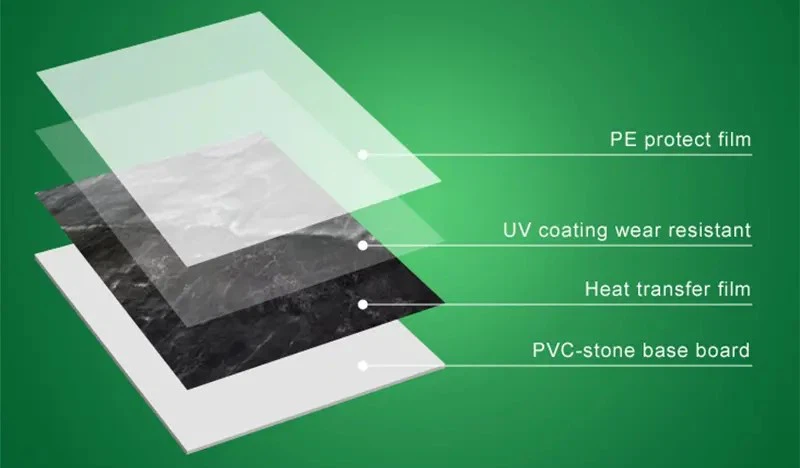
The four functional layers of a marble UV wall panel. The PVC substrate provides rigidity and waterproofing. The print layer carries the marble pattern at resolutions exceeding 1200 DPI. The embossed texture creates physical topography aligned with the printed veins. The UV-cured topcoat seals and protects everything underneath.
The base layer is a rigid PVC foam sheet - the same material family as the boards used in cabinetry, signage, and construction formwork, but formulated here for dimensional stability and a surface receptive to ink adhesion. A higher-density board in the 0.60 to 0.70 grams per cubic centimeter range provides the flatness that a feature wall demands; a lower-density board risks developing a visible wave across a large uninterrupted span, particularly in rooms where one side of the wall faces a heat source or a sun-exposed window. The PVC substrate is intrinsically waterproof, which means the panel can be installed in bathrooms, kitchens, and laundry rooms without the moisture-barrier precautions that a wood-based or gypsum-based wall panel would require.
Above the substrate sits the printed decorative layer. A high-definition digital scan of a real marble slab - Carrara, Calacatta, Statuario, Emperador, or any stone in the reference library - drives a UV-curable inkjet printer that lays down the pattern at resolutions above 1200 dots per inch. The printer uses multiple ink channels to reproduce not just the color of the marble veining but the translucent depth that makes real stone look like it has visual mileage beneath the surface. A panel printed at 600 DPI looks plausibly like marble from across a room. A panel printed at 1200-plus DPI, with the color gamut calibrated to a physical reference sample rather than to a digital file alone, holds the illusion at arm's length.
The third layer is the one that most distinguishes a premium panel from a budget one: the embossed texture. A synchronized embossing cylinder, carrying a surface relief pattern that was digitally generated from the same scan file that drives the printer, presses into the panel surface immediately after the ink is laid down. The result is physical texture - the fine grain of the stone, the subtle depression along a vein line - that aligns with the printed pattern beneath it. When a fingertip traces a dark vein across the panel surface, it feels a slight change in topography at exactly the point where the eye sees the vein. This is the detail that makes the Bangkok designer's blind test work. A panel with flat surface gloss but no aligned texture looks like a photograph of marble. A panel with aligned embossing feels like stone, and the brain trusts tactile confirmation more than it trusts visual input alone.
The top layer - the one that gives the product its "UV" designation - is a clear coating cured under ultraviolet light. The UV curing process transforms a liquid coating into a hard, cross-linked polymer film in seconds, without the solvent evaporation and extended drying time that conventional coatings require. The cured surface has a hardness approaching automotive clear-coat specifications, a gloss level that can be formulated from matte to high-gloss depending on the desired look, and a chemical resistance that allows the panel to be cleaned with the same disinfectants and degreasers used elsewhere in a kitchen or bathroom. The coating is what prevents the printed layer from yellowing over time - a failure mode that plagued early-generation printed wall panels and gave the category a reputation for looking cheap after three or four years of light exposure.
III. A Ten-Year Invoice for Real Marble - And Why Most of the Cost Isn't the Stone
The price tag on a natural marble slab is the smallest line item on the invoice that arrives at the end of a decade. What makes marble expensive is not the quarry price per square foot. It is the structural engineering assessment that determines whether the wall can carry the weight. It is the reinforced framing and the specialized mounting hardware. It is the professional installer who charges a premium because marble does not forgive mistakes - a chip at the edge of a slab during handling is a financial loss, not a sandable imperfection. And it is the maintenance: the sealing, the polishing, the stain removal, the etching repair, the annual professional service visit.
Consider a single feature wall measuring roughly three meters wide by two and a half meters high - the kind of wall that anchors a living room or a hotel reception area. In natural marble, the material alone, at a mid-range slab price, runs between four thousand and fourteen thousand dollars before any labor is added. The structural reinforcement, if the wall is not already backed by masonry, adds another fifteen hundred to five thousand. Professional installation by a stone mason and a helper adds two to four thousand. The first professional sealing treatment adds several hundred. Over ten years, the cumulative maintenance - resealing every six to twelve months, professional polishing after an etching incident, stain treatment after a dinner party spill - adds roughly three to eight thousand, depending on the room's exposure to moisture and acidic substances. The ten-year total for a single feature wall in a moderately trafficked room: somewhere between eleven thousand and thirty-one thousand dollars. The stone itself accounts for perhaps forty percent of that total. The rest is everything the stone needs to stay on the wall and keep looking like stone.
The same wall in marble UV panels carries a material cost roughly eighty to ninety-five percent lower - a few hundred to a couple of thousand dollars, depending on the panel grade. There is no structural reinforcement because a panel weighing roughly a pound and a half per square foot loads the wall less than the mirror that will hang in the adjacent room. Installation is an adhesive application and a day of work for a general contractor rather than a specialist stone mason. The ten-year maintenance total rounds to zero - the surface is non-porous, chemically inert against common household acids, and requires nothing beyond wiping with a damp cloth. The ten-year total for the same feature wall in a UV marble panel: roughly fifteen hundred to four thousand dollars, including installation. The visual result, from the viewing distance at which most people experience a feature wall - standing in the room, not pressing their nose against the surface - is indistinguishable from stone to the untrained eye.
The calculation changes if the wall is in a museum gallery where visitors will examine the surface from thirty centimeters away, or in a heritage building where the material provenance is part of the architectural narrative, or in a client's home where the knowledge that the wall is real stone carries a personal value that outweighs the cost difference. For the other ninety-plus percent of feature walls in the built environment, the math points in one direction. The question the Bangkok designer poses to her clients is not "which material do you prefer?" It is "what are you paying for - the look, or the mineral composition?"
Interestingly, the weight difference alone changes the economics of an installation in ways that designers working on upper-floor apartments or buildings with access constraints learn to appreciate quickly. A natural marble slab for a feature wall in a penthouse condominium must be craned up the side of the building or carried up the stairwell by a team of laborers - both options adding cost and schedule risk. A box of marble-look PVC panels rides up in the service elevator, carried by one person. The material's lack of weight is not just a structural convenience. For a significant subset of projects, it is the difference between a feasible installation and one that the building's logistics cannot accommodate at any price.
IV. Against Tile, Paint, and the Real Thing - Where UV Marble Panels Sit in the Specification Book
Four wall surface materials compete for the feature-wall specification in a mid-to-high-end interior, and the choice between them is rarely made on a single dimension. What follows is a comparison across the criteria that determine total cost of ownership rather than upfront material price.
| Performance Dimension | Marble UV Wall Panel | Natural Marble Slab | Ceramic / Porcelain Tile | Paint / Wallpaper |
|---|---|---|---|---|
| Material Cost (per sq ft) | $3–$15 | $40–$200+ | $5–$30 | $1–$5 |
| Weight (per sq ft) | 1–2 lb - no structural reinforcement needed | 10–13 lb - structural assessment required; may need reinforced framing | 3–5 lb - standard backing adequate | Negligible - no structural consideration |
| Water & Moisture Resistance | Fully waterproof - non-porous PVC substrate; zero moisture absorption | Porous - absorbs water; requires periodic sealing; vulnerable to staining and freeze-thaw in some climates | Tile body waterproof; grout lines are the weak point - require sealing and maintenance | Paint: none; wallpaper: peels in humidity - neither suitable for wet areas |
| Acid & Chemical Resistance | Inert - unaffected by citric acid, vinegar, wine, coffee, household cleaners, and most disinfectants | Etches on contact with mild acids - lemon juice, vinegar, some soaps cause permanent dull spots requiring professional repolishing | Glazed tile body resistant; grout vulnerable to chemical degradation over time | Stains and degrades under chemical exposure; not suitable for kitchen or bathroom without protection |
| 10-Year Maintenance Burden | Near zero - wipe with damp cloth; no sealing, no polishing, no specialist servicing | High - reseal every 6–12 months; professional repolishing after etching; specialist stain removal; annual service cost adds thousands over a decade | Moderate - grout cleaning and re-sealing; occasional tile replacement for cracks; grout discoloration is progressive | Paint: repaint every 3–7 years; wallpaper: replace every 5–10 years; neither repairable - full redo required |
| Appearance Consistency | Uniform - manufactured to consistent specification; panel-to-panel and batch-to-batch color and pattern consistency | Highly variable - every slab is unique; matching across a large wall requires careful slab selection and sequencing; replacement slabs rarely match originals | Good - manufactured with controlled color consistency; shade-lot variation between production runs possible | Good for paint; wallpaper pattern matching can be complex and waste-generating at seams |
| Service Life | 15–25 years - UV topcoat protects printed layer from fading; PVC substrate remains structurally stable | 50+ years - if maintained; damage from impact, etching, or staining is permanent unless professionally restored | 20–50 years - tile body extremely durable; grout and sealant degrade faster and require intervention | 3–10 years - shortest service life of any wall finish; damage from moisture, impact, or UV exposure triggers full replacement |
The pattern that emerges from the table is not that marble UV panels are the best material in every dimension - natural marble wins on prestige and ultimate service life, tile wins on impact resistance, paint wins on upfront cost. The pattern is that marble-look PVC panels are the only material in the comparison that does not carry a hidden cost category. Natural marble carries hidden maintenance cost. Tile carries hidden grout-maintenance cost. Paint and wallpaper carry hidden replacement-frequency cost. The UV marble panel's cost profile is front-loaded: the purchase and installation are the only expenditures the owner will make across the product's service life. The panel does not generate a recurring line item in a maintenance budget, and in commercial projects where every recurring maintenance dollar is a drag on operating profit, that absence of ongoing cost is a more powerful differentiator than any visual characteristic.
V. No Mason, No Mixer, No Minimum Two-Week Wait
A natural marble feature wall installation begins with a structural engineer, proceeds through a stone fabricator's shop, involves a crane or a stair-climbing team, requires a specialist stone mason and a helper for a minimum of several days, and ends with a professional sealing treatment that must cure before the room can be used. The timeline from slab selection to finished, sealed wall runs three to six weeks on a project where nothing goes wrong.
A marble UV panel installation begins with a box of panels arriving at the job site, proceeds through a substrate-quality check that takes roughly the time needed to run a straightedge across the existing wall surface, and ends with an adhesive application that a general contractor's crew can complete in a day. The timeline from panel delivery to finished wall runs twenty-four to forty-eight hours, with the longer end accounting for adhesive curing time in humid conditions. Nothing needs to be craned. Nothing needs to be sealed. Nobody needs to return to the site six months later for a maintenance visit. The wall is finished, and it stays finished.
The adhesive method - the standard approach for permanent installations - works on any substrate that is clean, dry, and flat: existing drywall, plaster, cement board, or plywood sheathing. A high-quality construction adhesive or a PVC-specific panel adhesive is applied in vertical beads to the back of each panel, the panel is pressed into position, and temporary bracing holds it flat against the wall while the adhesive cures, typically overnight. The seams between adjacent panels are closed tight - the closer the seam, the more continuous the marble pattern reads across the joint. For installations in wet areas, a bead of neutral-cure silicone sealant along the panel edges prevents moisture from reaching the wall cavity behind the panels. The silicone is a precaution, not a necessity - the PVC substrate does not absorb water regardless - but it protects the wall assembly behind the panel, which is typically drywall or cement board that benefits from staying dry.

A single installer positions a full-size marble-effect panel during a bathroom renovation. The panel weighs under two pounds per square foot - light enough for one person to handle without assistance, no lifting equipment required, no structural reinforcement needed behind the drywall.
There is a second installation method worth knowing about for commercial projects where the interior layout may change over time. A mechanical fixing system - aluminum or timber battens screwed to the wall substrate, with the panels clipped or screwed to the battens - creates a removable installation. When the tenant changes and the feature wall needs to move or be replaced, the panels come off without damaging the wall behind them. The fasteners are hidden behind cover strips or within the panel joint profile. This method adds cost and installation time compared to the adhesive approach, but in retail, hospitality, and office fit-out projects where lease terms run shorter than the panel's service life, the ability to demount and reuse the panels can justify the additional upfront work.
The one installation detail that separates a wall that reads as continuous stone from a wall that reads as a grid of plastic panels is seam planning. The installer should lay out the panels before applying adhesive, shifting them left or right by small increments until the marble veins appear to flow naturally from one panel to the next across the seam. This is not a precision operation - the veins do not need to align perfectly, because real marble veins do not align perfectly across a book-matched slab pair either - but the veins should not dead-end abruptly at a panel edge with no continuation on the adjacent panel. Ordering an extra panel or two beyond the measured square footage gives the installer the material buffer to make these layout adjustments without running short. The extra panel cost is a small fraction of the total installation budget and buys a visual result that the untrained eye accepts as stone rather than product.
VI. The Rooms Where These Panels Win, and the Two Where They Don't
Marble UV wall panels earn their place in any room where the combination of visual luxury and practical durability matters and where the substrate's limitations do not become liabilities. That description covers most of the rooms in a residential or commercial interior, but not all of them.
Bathrooms are the strongest application. The humidity, the water spray from the shower, the cosmetic products on the vanity, the occasional splash of nail polish remover - a bathroom subjects its wall surfaces to a chemical and moisture assault that natural marble absorbs and that paint and wallpaper cannot survive. A marble-look PVC panel on the wall behind the vanity or as a feature surface in the shower enclosure delivers the stone aesthetic in precisely the environment where real stone performs worst. The panel does not need sealing, does not etch when a bottle of perfume tips over, and wipes clean with the same cloth the homeowner uses on the mirror.
Kitchens are the second-strongest application, but with a thermal caveat. A marble-effect panel as a backsplash behind the cooktop or as a feature surface on the island fascia puts a stone look in the splash zone without introducing the stain-and-etch vulnerability of real marble. Red wine, olive oil, turmeric, tomato sauce - the substances that permanently mark a natural marble surface - sit on top of the UV-cured coating until wiped away. The caveat is proximity to heat. The PVC substrate softens at sustained temperatures above roughly seventy degrees Celsius, which means the panel should not be installed in direct contact with a cooktop surround, an uninsulated oven housing, or a fireplace hearth. An air gap or a heat shield between the heat source and the panel - a detail that any kitchen designer can accommodate - eliminates the risk. This is not a material defect. It is a thermal constraint shared by every rigid PVC product, and for a backsplash positioned at a normal distance from a cooktop, the panel operates well within its safe temperature range.
Living rooms, bedrooms, corridors, and commercial reception areas are the broad middle of the application range where the panel's visual performance and its practical characteristics align without qualification. A television feature wall in a living room, a headboard wall in a bedroom, the wall behind the reception desk in a hotel lobby - these are high-visibility surfaces where the marble aesthetic justifies the panel's cost premium over paint and where the panel's light weight eliminates the structural complications of real stone. In a hotel corridor where luggage carts strike the walls regularly, the PVC panel's impact resistance - a function of the foam core's ability to absorb energy without fracturing - outperforms both tile, which cracks, and paint, which chips and requires patching.
The two rooms where marble UV panels should not be specified are straightforward. The first is any space where the wall surface will be subjected to direct, sustained flame or radiant heat exceeding the substrate's softening point - fireplace surrounds, the wall immediately behind a commercial cooking line, the interior of a sauna. The second is a space where the material provenance is the entire point of the specification - a heritage restoration, a museum gallery, the private study of a client for whom the mineral authenticity of the wall is non-negotiable. In the first case, the limitation is thermal. In the second, it is philosophical. For every other room in the building, the panel is a legitimate specification option, and the decision reduces to a cost-and-maintenance calculation that favors the panel in almost every scenario involving moisture, acidic substances, weight constraints, or a maintenance budget that the owner would prefer to spend on something other than wall care.


