I. The Kitchen in Bukit Timah That Changed How a Cabinet Maker Looks at Substrates
The story that converted the Singapore cabinet maker to PVC board happened not in his workshop but in a client's kitchen. A dishwasher supply hose had been installed with a twist in the rubber gasket - the kind of installation error that every plumber has made at least once and most have learned to check for. The hose leaked, slowly, for an estimated three months before the homeowner noticed a faint musty smell when opening the cabinet under the sink. The cabinet box was plywood - marine-grade, properly edge-banded, purchased from a reputable supplier at a price the cabinet maker considered appropriate for a kitchen billed as premium.
The damage was localized to the base panel directly under the sink and the lower hundred millimeters of the side panels. The upper structure was untouched. But the repair required replacing the entire cabinet box because the moisture had wicked upward through the plywood veneers, delaminating the internal glue lines beyond the visible damage zone. The cabinet maker absorbed the cost of the replacement - the client had been a repeat customer, and the relationship mattered - but the experience rewired his material selection logic. He started searching for a cabinet substrate that could sit in standing water for three months and emerge dimensionally unchanged.
That search ended at PVC cabinet board. Not the generic PVC foam sheet sold by the kilogram for sign-making - the product that the advertising industry calls Foamex or Celuka - but a specific grade formulated for cabinetry: higher density, tighter cell structure, surfaces engineered to hold screws at the edge rather than just in the face, and a formulation that carries formaldehyde-emission certifications acceptable for interior fitted furniture in occupied spaces. The distinction between these two products - advertising board and cabinet board - is the distinction that most of this article exists to clarify, because the price difference between them is real, and the temptation to substitute the cheaper product is the single largest source of avoidable cabinet failures in the PVC segment.
II. What a PVC Cabinet Board Actually Is - and Why It's Not Just a Thicker Advertising Board
PVC cabinet board belongs to the rigid foamed PVC sheet family - the same polymer base as the boards used for exhibition stands, sign panels, and point-of-purchase displays. The material starts as polyvinyl chloride resin compounded with a blowing agent, stabilizers, processing aids, and mineral fillers, extruded through a die and calibrated to a precise thickness. The blowing agent decomposes under extrusion heat, releasing gas that forms a closed-cell foam structure throughout the core. The result is a panel with roughly half the weight of an equivalent volume of solid PVC, retaining useful mechanical properties while being light enough for a two-person installation team to handle without lifting equipment.
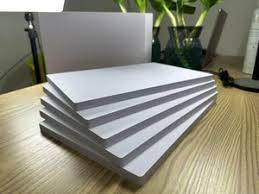

The internal architecture of a cabinet-grade PVC foam board. The cells are closed, uniform, and small - typically under 0.3 mm in diameter in the core, with a densified skin layer at the surface. Water cannot migrate from cell to cell. This is the structural basis of every performance claim the material makes.
But the cabinet-grade product diverges from advertising-grade board in several ways that are invisible to the eye but decisive in service. The density is higher - cabinet board typically lands between 0.60 and 0.75 grams per cubic centimeter, compared to the 0.35-to-0.55 range common in display applications. The cell structure is finer and more uniform, which improves screw-holding capacity because there is more solid material for the screw thread to engage. The surface skin - formed by the Celuka process, in which the extruded board passes through a chilled calibrator that solidifies the outer layer before the core has finished expanding - is thicker and harder than on advertising board. And the formulation itself is different: cabinet board contains a higher loading of mineral filler, which increases rigidity and reduces the coefficient of thermal expansion, and the stabilizer package is selected for long-term indoor exposure rather than the UV-resistance priorities of outdoor signage.
One more difference matters for indoor air quality, and it is the first thing a furniture buyer serving regulated markets should verify. Cabinet-grade PVC board should carry formaldehyde-emission certification - typically E1 or equivalent - confirming that the board contributes negligible formaldehyde to the indoor environment. Advertising-grade board is not always tested to this standard because it is not expected to be installed in occupied living spaces. The raw materials, the formulation, the manufacturing line, and the quality-control paperwork are all different for a reason. The four key indicators for selecting PVC foam board - density, surface quality, formaldehyde grade, and screw-holding strength - were covered in our earlier guide, and the cabinet application demands all four at elevated thresholds.
A practical way to think about the distinction: advertising board is engineered for printability and short-term display. Cabinet board is engineered for structural joinery in wet environments. The two products share a polymer family name and an extrusion process. They do not share a performance envelope.
III. Three Numbers That Separate Cabinet-Grade Board From Everything Else in the Warehouse
If a supplier cannot produce three numbers for the board they are offering as cabinet material, the board is probably not cabinet material. These numbers are not arcane laboratory values; they are the translation of real-world cabinet demands into measurable physical properties.
Density is the first and most informative. A cabinet board below 0.55 grams per cubic centimeter will not hold a screw reliably at the panel edge, where most cabinet joinery concentrates its fasteners. The failure mode is not dramatic - the screw simply strips its thread during installation, or the hinge plate loosens over the first year of door cycling, or the shelf pin works its hole wider with every seasonal humidity cycle until the shelf drops. Cabinet-grade board from reputable suppliers sits in the 0.60-to-0.75 range. Below that, the board may still make a serviceable cabinet back panel or drawer bottom, where loads are distributed and fasteners are not concentrated at edges, but it should not be used for cabinet sides, door stiles, or any component that carries a hinge.
The shop-floor check for density requires no instrument. Take a sample offcut - the supplier should provide one, and a refusal to do so is itself a signal - and drive a wood screw into the narrow edge of the board, about ten millimeters from the face, using a hand screwdriver rather than a powered driver. The resistance should build steadily and then hold firm. If the screw spins before seating fully, or if the surrounding material bulges outward as the screw advances, the board is too soft for cabinet joinery. This is not a manufacturing defect; it is the physical consequence of a density grade chosen for a different application.
Water absorption, expressed as a percentage of weight gain after a standardized immersion period, is the second number. Cabinet board should absorb less than one percent of its own weight after twenty-four hours of full submersion in water at room temperature. The number matters because it predicts what happens at the one vulnerable point in every cabinet installation: the cut edge. Even with edge banding, a cabinet installed under a sink or beside a dishwasher will eventually expose a cut edge to moisture - through a gap in the silicone seal, through a plumbing leak, through years of condensation cycles. If the board absorbs water at that edge, it swells. If it swells, the edge banding lifts. If the edge banding lifts, more water enters, and the cycle accelerates. A sub-one-percent water-absorption figure means the board stops this cycle before it starts - the water sits on the surface rather than migrating into the cell structure, and the edge banding stays bonded.
The third number is surface hardness, measured on the Shore D durometer scale. Cabinet board should register at least 65 on Shore D. This is the number that determines whether a dropped kitchen utensil leaves a visible mark on the cabinet interior, whether a vacuum cleaner bump produces a dent, and whether the cabinet surface resists the kind of slow abrasion that comes from five years of pots and pans sliding in and out of base units. High-density Celuka-process cabinet board typically lands between 68 and 75 Shore D - harder than most solid wood species used in cabinetry, approaching the surface hardness of some engineering plastics. A board that feels like it yields under firm thumbnail pressure is not cabinet-grade, regardless of what the invoice says.
| Property | Advertising-Grade PVC Board | Cabinet-Grade PVC Board | Why It Matters for Cabinetry |
|---|---|---|---|
| Density | 0.35–0.55 g/cm³ | 0.60–0.75 g/cm³ | Screw holding at panel edges; hinge durability over years of door cycles |
| 24-hr Water Absorption | >2% (open surface cells) | <1% (sealed surface + closed cells) | Edge swelling under sink; edge-banding bond integrity in wet zones |
| Surface Hardness | Shore D 50–60 | Shore D 65–75 | Scratch and dent resistance; day-to-day kitchen wear |
| Formaldehyde Emission | Often untested | E1 or equivalent certified | Indoor air quality in occupied living spaces; regulatory compliance |
| Cell Structure | Coarse; some open cells at surface | Fine; fully closed; dense surface skin | Water migration resistance; uniform screw engagement |
There is a fourth number that does not appear on most specification sheets but that an experienced cabinet maker learns to estimate from the three above: the hinge-cycle rating. A cabinet door in a family kitchen opens and closes somewhere between ten and thirty times a day, across all the doors in the kitchen. Over ten years, that is between thirty-six thousand and over a hundred thousand cycles per door, and every cycle loads the hinge mounting screws in the cabinet side panel. A substrate that gradually loosens its grip on those screws is a substrate that generates a service call, and the cost of that call erases whatever savings the cheaper board delivered at the point of purchase.
IV. Water, Steam, and Spilled Cooking Oil - The Substrate That Doesn't Care
Wood-based cabinet boards fail in wet environments through two mechanisms that operate on different timescales. The fast mechanism is direct water contact: a plumbing leak, a spilled pot of water, a floor mopping that pushes water against the cabinet toe kick. The wood fibers absorb moisture, swell, and lose mechanical integrity within hours to days. The slow mechanism is humidity cycling: the ambient moisture in a kitchen or bathroom airspace migrates into the wood substrate over months and years, causing gradual dimensional changes that loosen joints, warp door panels, and create the conditions for mold growth inside the cabinet box. Marine plywood and moisture-resistant MDF slow these processes. They do not stop them.
PVC cabinet board stops them. The polymer matrix is intrinsically hydrophobic - water does not chemically bond to PVC, and the closed-cell foam structure means there are no capillary pathways for water to migrate through the material thickness. A cut edge left unsealed will absorb a small amount of water into the cells that were opened by the saw blade, but that absorption is limited to the depth of those ruptured cells - typically a fraction of a millimeter - and does not propagate into the intact cells behind them. This is a fundamentally different behavior from wood-based substrates, where a single unsealed edge provides a wicking pathway that can carry moisture centimeters into the panel over time.
What this means in a real kitchen: the cabinet under the sink, which in a plywood kitchen is the component most likely to fail first, becomes unremarkable. The area around the dishwasher, where steam and heat cycle daily, stays dimensionally stable. The bathroom vanity, subjected to the highest humidity spikes in the house, does not develop the slow door misalignment that signals substrate swelling. The material is not waterproof in the absolute sense - nothing is - but it is hydrophobic enough that the water-related failure modes familiar to every cabinet maker who works with wood become functionally irrelevant. The failures that remain are installation failures, not material failures, and they are preventable.
Interestingly, the edge-banding adhesive bond on PVC cabinet board actually benefits from the substrate's zero-moisture-movement characteristic. On a wood-based panel, seasonal humidity cycles create a shear stress at the adhesive interface as the substrate expands and contracts against the edge banding. Over years, this cyclic stress fatigues the adhesive bond, and edge banding delamination begins. On a PVC panel with negligible moisture-driven dimensional change, the adhesive interface stays static. The edge banding stays bonded not because the adhesive is stronger, but because the substrate is not constantly trying to peel it off. Our guide to daily maintenance and care for PVC foam board covers edge-sealing and cleaning practices that preserve this dimensional stability over the cabinet's full service life.
One limitation worth acknowledging: PVC cabinet board is not rated for continuous exposure to temperatures above roughly seventy degrees Celsius. This means the board should not be installed in direct contact with oven housings, cooktop surrounds, or uninsulated heating pipes. The material softens at elevated temperatures - the Vicat softening point for rigid PVC formulations sits in the 75-to-85-degree range - and sustained heat exposure can cause localized deformation. For the cabinet boxes immediately adjacent to cooking appliances, a heat shield or an air gap is standard practice. This is not a material defect; it is a thermal constraint shared by every rigid PVC product, and it is easily managed during kitchen design.
V. Building a Cabinet Out of Foam Plastic Sounds Wrong. Here's How It Actually Holds Together.
Most people who have handled a piece of lightweight PVC foam board - the kind used for school project displays or trade show signage - have difficulty imagining the same material supporting a loaded kitchen cabinet. The disconnect is real, and it comes from handling the wrong grade. Pick up a cabinet-grade PVC board at 0.70 density, in an 18-millimeter thickness, and the first reaction is usually surprise at the weight. A standard sheet measuring 1220 by 2440 millimeters at this density and thickness weighs close to forty kilograms. It feels solid in the hands - closer to a high-quality plywood panel than to the exhibition board people expect.
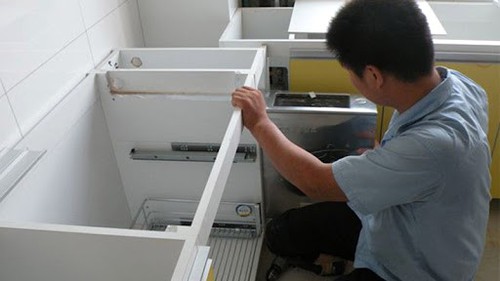

Cabinet box assembly using PVC cabinet board in a production workshop. The joinery techniques - screws, dowels, adhesives - are identical to those used with wood-based panels. What changes is the absence of the post-assembly waiting period for the substrate to acclimatize, because PVC board does not arrive from the supplier carrying residual moisture.
The joinery of a PVC cabinet follows the same mechanical logic as a plywood or particle-board cabinet. Panels are cut to size on a panel saw, edges are banded with PVC or ABS edge-banding tape applied by hot-melt adhesive, and the box is assembled using confirmat screws, dowels, or cam-lock fittings - the same hardware that the flat-pack furniture industry has standardized on. The difference is what happens after assembly. A wood-based cabinet needs time to acclimatize to the installation environment; the substrate expands or contracts as its moisture content equilibrates with the ambient humidity, and doors that fit perfectly in the workshop can bind or gap after delivery. A PVC cabinet arrives at the installation site with the same dimensions it had when it left the workshop, and it keeps those dimensions indefinitely. The installer spends less time adjusting door hinges on site, and the homeowner does not experience the seasonal door-alignment drift that is so common with wood cabinetry that many people accept it as normal.
Screw-holding in the cabinet board's edge is the joinery detail that most concerns first-time users, and the concern is legitimate - foam plastic sounds like it should crumble under screw pressure. In practice, a high-density Celuka board with a dense skin layer and a uniform fine-cell core holds a screw in the edge nearly as well as a medium-density particle board, and better than low-density MDF. The key is pilot-hole diameter. A pilot hole drilled at roughly seventy percent of the screw's major diameter - a standard rule of thumb for wood screws in hardwood - provides enough material engagement for the threads to bite without so much displacement that the material bulges or cracks. The screw should be driven slowly, preferably by hand for final tightening, because the frictional heat from a powered driver at high speed can briefly soften the PVC around the thread and reduce ultimate holding strength. This is not a mysterious material behavior; it is the same thermal sensitivity that makes PVC pipe threading a controlled-speed operation.
For cabinet doors, the hinge-mounting screws that attach the hinge base plate to the cabinet side panel are the most highly loaded fasteners in the entire cabinet. A standard cup hinge on a full-height pantry door carries a lever-arm load that concentrates significant withdrawal force on the two or four wood screws securing the base plate. In PVC cabinet board above 0.65 density, these screws hold reliably for the life of the cabinet, provided the pilot holes are correctly sized and the screws are not overtightened to the point of thread stripping. Some cabinet makers add a drop of medium-viscosity cyanoacrylate adhesive to the pilot hole before driving the hinge screws - not because the PVC needs the adhesive for initial holding strength, but because the adhesive eliminates any microscopic clearance between the screw thread and the substrate, preventing the slow loosening that can occur over tens of thousands of door cycles in any material.
VI. PVC Cabinet Board vs. Everything Else Your Builder Might Quote
When a cabinet maker presents a material quote to a client, the options on the table typically include three or four substrate types at different price points. Understanding where PVC cabinet board sits in that lineup - not just on cost, but on the performance dimensions that determine long-term satisfaction - turns an abstract specification into a decision.
Plywood, particularly the marine-grade variant, has been the default premium cabinet substrate for decades. It holds screws well, it is familiar to every cabinet maker, and its layered veneer construction provides dimensional stability that is superior to solid wood. Its weakness in wet environments is its adhesive. The moisture-resistant glues used in marine plywood slow water damage; they do not prevent it. A plywood cabinet box installed under a kitchen sink will eventually absorb enough moisture through its cut edges and surface veneers to begin delaminating, and the repair - as the Singapore cabinet maker discovered - is a full box replacement. Plywood also carries formaldehyde from the phenolic or urea-formaldehyde resins used in its manufacture, and while low-emission grades exist, they command a price premium that narrows the gap with PVC.
Particle board - the substrate inside most mass-market flat-pack kitchen cabinets - is the budget option with the most predictable failure mode. It absorbs water aggressively, swells irreversibly, and loses all structural integrity once wet. A particle-board cabinet in a bathroom or under a kitchen sink is a warranty claim waiting to happen. Its screw-holding capacity is the lowest of any common cabinet substrate, and every hinge adjustment, every shelf pin relocation, every hardware change degrades the screw hole slightly. The material's only genuine advantage is its upfront cost, which can be less than half that of cabinet-grade PVC. The calculation that matters is not cost per cabinet at installation but cost per year of trouble-free service. On that metric, particle board in a wet area is among the most expensive choices a homeowner can make.
| Property | PVC Cabinet Board | Marine Plywood | Moisture-Resistant Particle Board | Stainless Steel |
|---|---|---|---|---|
| Water Resistance | Excellent - intrinsically hydrophobic; <1% absorption | Good - resists but ultimately absorbs water at edges | Poor - swells irreversibly on water contact | Excellent - impervious to water |
| Screw Holding (Edge) | Good - at 0.65+ density with correct pilot hole | Very good - the reference standard for cabinetry | Poor - degrades with each fastener cycle | Excellent - with machine-thread fasteners |
| Formaldehyde Risk | Negligible - E1 certified; PVC is formaldehyde-free | Present - from phenolic/UF resin adhesives | Highest - UF resin binder is primary formaldehyde source | None - inert metal |
| Dimensional Stability | Excellent - near-zero moisture movement | Good - but seasonal movement is measurable | Moderate - stable until moisture exposure | Excellent - no moisture movement |
| Fabrication Familiarity | Growing - same tools as wood; learning curve is real | Universal - every cabinet shop knows it | Universal - standard in mass-production cabinetry | Specialist - requires metal fabrication equipment |
| Cost per Linear Meter (relative) | Mid-range - between plywood and premium board | Mid-to-high - varies by grade and origin | Lowest upfront - highest lifecycle cost in wet zones | Highest - 3–5× other options |
Stainless steel cabinetry deserves a mention because it occupies the extreme end of the water-resistance spectrum: it is genuinely impervious to water and chemically inert. It is also expensive, requires specialist fabrication, offers limited design flexibility, and produces a kitchen that looks and sounds like a commercial catering facility. For residential applications, stainless steel tends to be specified in one of two situations: where hygiene requirements override all other considerations - hospital kitchens, commercial food preparation areas - or where a previous water-damage experience has left the homeowner unwilling to consider any organic substrate. In most residential kitchens and bathrooms, PVC cabinet board provides the water resistance that the application demands without the cost, weight, and aesthetic constraints of metal.
VII. The Installation Mistakes That Turn a Waterproof Board Into a Service Call
A waterproof substrate installed with water-admitting details is not a waterproof cabinet. The most common installation errors that compromise PVC cabinet performance are not unique to PVC - they apply to any cabinet installation in a wet environment - but they are worth cataloguing because a cabinet maker who has switched from plywood to PVC is often working with a material whose failure modes are different from the ones they have spent years learning to avoid.
The first mistake is treating edge banding as optional. On a plywood cabinet, missing or poorly applied edge banding leads to visible veneer delamination and moisture wicking at the exposed edge. On a PVC cabinet, the cosmetic damage is less dramatic - there is no veneer to delaminate - but the functional consequence is the same: water entering the open cells at the cut edge, where the saw blade has ruptured a surface layer of foam cells. The water does not migrate deep into the board as it would in plywood, but it does create a zone of reduced mechanical integrity immediately behind the edge, and that zone is exactly where hinge screws and shelf pins are located. Edge banding on a PVC cabinet is not decorative. It is a functional moisture barrier, and it should be applied to every cut edge that will be exposed to the cabinet interior, regardless of whether that edge is visible after installation.
The second mistake is replicating plywood pilot-hole practices without adjustment. A cabinet maker accustomed to plywood may drill an undersized pilot hole and rely on the wood fibers to compress around the screw, providing a tight interference fit. PVC does not compress like wood. An undersized pilot hole in PVC causes the material around the screw to yield - not by compaction, but by localized deformation that can bulge the surface or initiate a micro-crack at the hole perimeter. The correct pilot-hole diameter for PVC is slightly larger than what the same screw would require in plywood: roughly seventy to seventy-five percent of the screw major diameter, rather than the sixty-to-seventy-percent rule common in hardwood. The screw should advance with steady resistance but without requiring high torque. If the installer feels the need to lean into the screwdriver, the pilot hole is too small.
The third mistake - and this one is specific to kitchen installations - is neglecting the silicone seal at the junction between the cabinet base and the floor. In a kitchen with a tiled floor and a PVC cabinet, the base panel sits on or slightly above the floor surface, and the gap between them is an invitation for mop water. A bead of neutral-cure silicone sealant along this junction, tooled smooth and allowed to cure before the kitchen is put into service, prevents water from pooling under the cabinet and rising by capillary action into the gap between the base panel and the floor. This is not a PVC-specific requirement; it is good practice for any kitchen cabinet installation. The difference is that a plywood cabinet without this seal will fail spectacularly - swollen base, delaminated veneer, visible damage that forces replacement - while a PVC cabinet without it may develop a slow, invisible degradation that goes unnoticed until the cabinet is moved years later and the underside of the base panel is found to be stained and softened. The PVC board's water resistance means the damage stays hidden longer, which makes the preventive seal more important, not less.
One final detail that separates a professional PVC cabinet installation from an amateur one: all cut edges that will be hidden after assembly - the back edges of cabinet side panels, the bottom edges of base panels, the raw edges of shelf stock - should be sealed even if they will not receive edge banding. An edge-sealing paint, a thin coat of PVC-compatible adhesive, or a pass with a solvent-based primer closes the open cells left by the saw blade. The process adds minutes to the fabrication time per cabinet box and eliminates a moisture entry path that no amount of surface waterproofing can address after installation. The shop that skips this step is betting that water will never find the unsealed edge. In a kitchen, that is a bet the house always wins.