

SPC Flooring Sourcing Guide 2026: Compliance, Custom Formats & Supplier Vetting for Importers
May 29, 2026
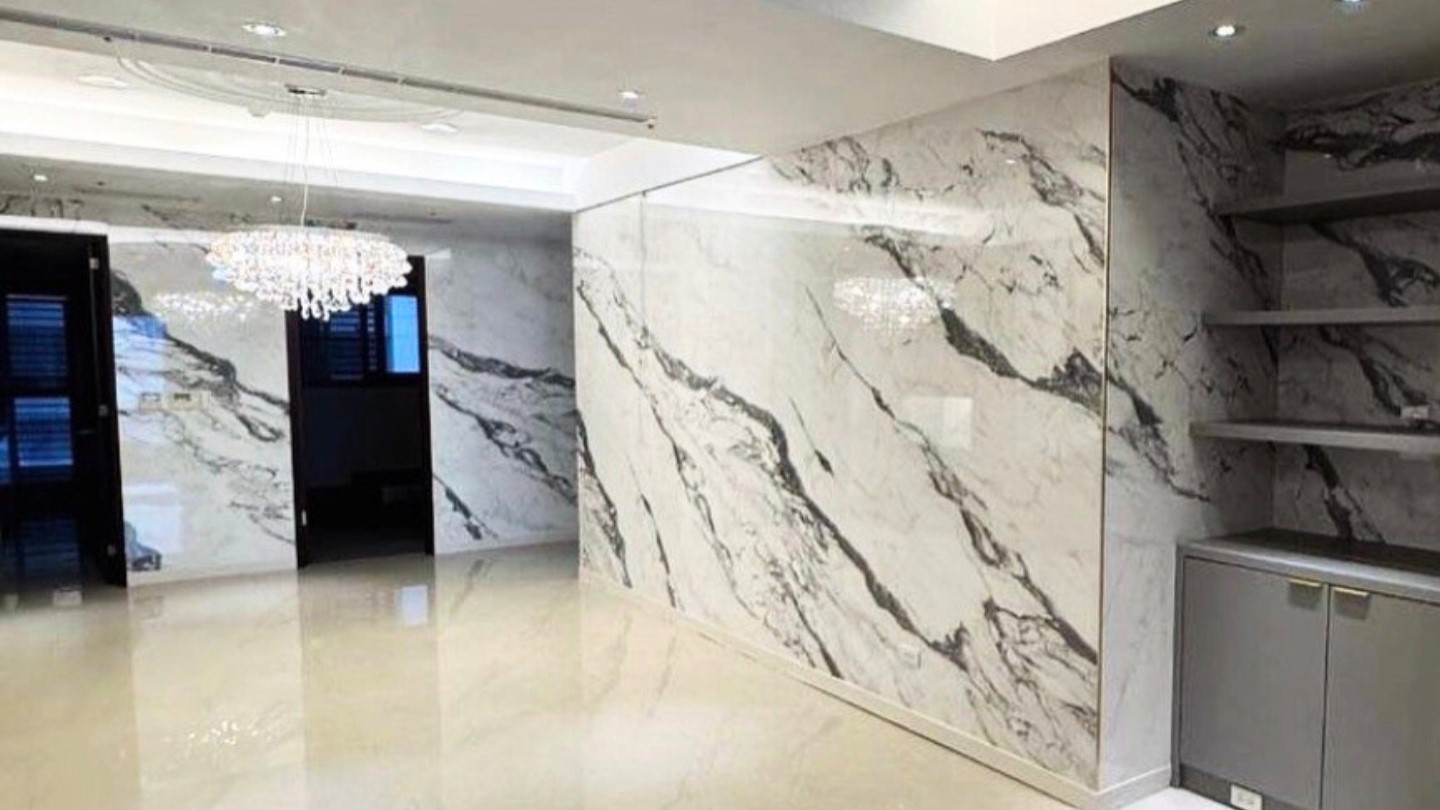
A sample rack in a distributor showroom tells you more about where the SPC category is going than a market report does.
On This Page
- I. The laminate buyer who switched to SPC and never told his supplier
- II. Compliance is now a cost center
- III. A 9-by-72-inch plank and the margin nobody else can touch
- IV. What changed in Chinese extrusion between 2020 and 2025
- V. Six questions a container hides until someone opens it
- VI. The supplier who volunteers test data nobody asked for yet
A distributor in Rotterdam I spoke with last quarter runs a flooring business his father started in 1987. For thirty-five years, the warehouse stocked laminate, engineered wood, and carpet tiles. Eighteen months ago he added SPC. Today SPC is a third of his revenue and climbing. The laminate racks are still there. They are just getting quieter.
His story is not unusual, which is what makes it worth examining. The SPC flooring category has crossed a threshold where the question facing importers and distributors shifted from "should we carry this?" to "how do we carry this without becoming interchangeable with every other distributor in the same postcode?" The answer involves compliance positioning, format differentiation, and a supply chain that has matured faster than most buyers realize. It also involves a few uncomfortable facts about what happens when a container of the wrong product lands and the locking system does not lock.
The numbers behind the shift are large and well-publicized: a global market approaching $30 billion by the early 2030s, China's domestic SPC segment alone crossing RMB 47 billion, export volumes climbing at over 20% annually. But the number that actually matters to a distributor is smaller and harder to find. It is the margin difference between a commodity plank that three competitors also stock and a custom SPC flooring specification that only one distributor in the region offers. That number does not appear in a market report. It appears on an invoice.
I. The Laminate Buyer Who Switched to SPC and Never Told His Supplier
The migration from laminate to SPC is not happening because SPC is cheaper. At the container level, a mid-grade SPC plank and a mid-grade laminate plank are within striking distance on price, and once freight and duties are factored in, the difference shrinks further. The migration is happening because the end customer-the contractor, the property manager, the homeowner standing in a showroom-has internalized a fact about water that the laminate industry spent two decades trying to engineer around: laminate and moisture do not mix, and the kitchen and the bathroom and the basement and the laundry room and the entryway are all places where moisture happens.
SPC does not care about water. Its core is limestone and PVC. There is no wood flour to swell, no fiberboard to delaminate. A plank submerged for 24 hours comes out dimensionally unchanged. This single property reclassifies the product from a flooring option to a flooring default for any room that has ever seen a spill. The reclassification took roughly five years to complete, and by 2026 it is effectively settled. Distributors who noticed early built inventory. Distributors who did not are now competing on price against inventory that someone else built earlier and cheaper.
The second thing driving the migration is less discussed because it makes everyone in the supply chain slightly uncomfortable: SPC eliminates a class of callback that laminate could never fully eliminate. A laminate floor that cups after a dishwasher leak is a warranty claim. An SPC floor after the same leak is a floor. The contractor does not get a call. The distributor does not get a call from the contractor. The absence of the call is worth something, and over hundreds of installations per year, it is worth a lot. For the broader comparison across materials and what the standard comparison charts leave out, our breakdown of SPC versus wood and tile quantifies the callback differential that laminate-versus-SPC debates tend to gloss over.
II. Compliance Is Now a Cost Center
Three years ago, a distributor could ask a supplier "is this phthalate-free?" and a "yes" was enough. Nobody asked for a test report because nobody downstream was asking the distributor for a test report. That changed. It changed because large European and North American retail chains began enforcing phthalate limits at the point of entry, not at the point of sale. A container that arrives without documentation does not get unloaded until the paperwork arrives. The paperwork delay costs storage fees. The storage fees eat margin that was calculated assuming the goods would clear in three days.
The practical implication for an importer in 2026 is that environmental compliance has stopped being a marketing checkbox and become an operational line item. A supplier who cannot produce a third-party phthalate test report, a VOC emissions certificate from a recognized lab, and a clear statement on recycled content percentage is a supplier whose product will cost more to clear than the invoice suggests. The product itself may be identical to a compliant product. The cost of proving compliance is the variable.
SPC flooring occupies an unusual position in this regulatory landscape. Its core material composition is inherently low-VOC because the manufacturing process does not require the formaldehyde-based binders that laminate and engineered wood depend on. Its recycling rate exceeds 95% in closed-loop production. Its carbon footprint runs roughly 40% lower than conventional flooring materials on a per-square-meter basis. These are not marketing claims. They are material properties that align with regulatory direction in the EU, North America, and increasingly in the Middle East and Southeast Asia. A distributor who builds compliance documentation into the sourcing process now is front-running a requirement that will be universal within a few regulatory cycles. A deeper look at the recyclability question and why it matters for procurement decisions appears in our analysis of PVC building material recyclability.
III. A 9-by-72-Inch Plank and the Margin Nobody Else Can Touch
A standard SPC plank in a 7-by-48-inch format sells at a price that every distributor in a given market knows within a few cents. The price is transparent because the product is transparent. Anyone can reverse-engineer the freight cost, the duty rate, and the factory-door price and arrive at the same number. Margins on standard formats have been compressing for three years and will continue compressing because there is no mechanism to stop them. The mechanism that stops margin compression is differentiation, and in SPC flooring, differentiation lives in the format and the surface.
A 9-by-72-inch plank with an embossed-in-register wood grain and a matte ceramic-bead wear layer is not a commodity. It is a product that only a handful of factories can extrude consistently, because the wider format demands tighter thickness tolerances across the width of the extrusion die and the longer format demands a locking system that holds its profile under thermal expansion across a longer span. The tooling costs more. The scrap rate is higher. The production speed is slower. Fewer factories run it. Fewer distributors stock it. The margin survives.
The same logic applies to surface design. A terrazzo-look SPC plank with a UV-cured coating that reproduces the depth and irregularity of real stone aggregate is not interchangeable with a standard wood-look plank from a different supplier. It is a visual asset that a distributor can present to architects and designers as an exclusive. Exclusivity is the antibiotic for price compression. The stone-look surface technology that has been maturing in the wall panel category is now crossing into SPC flooring, and the factories that invested in the embossing and UV-curing capability early are the ones that can deliver a custom design in a single production run rather than asking for a minimum order quantity that makes customization theoretical.
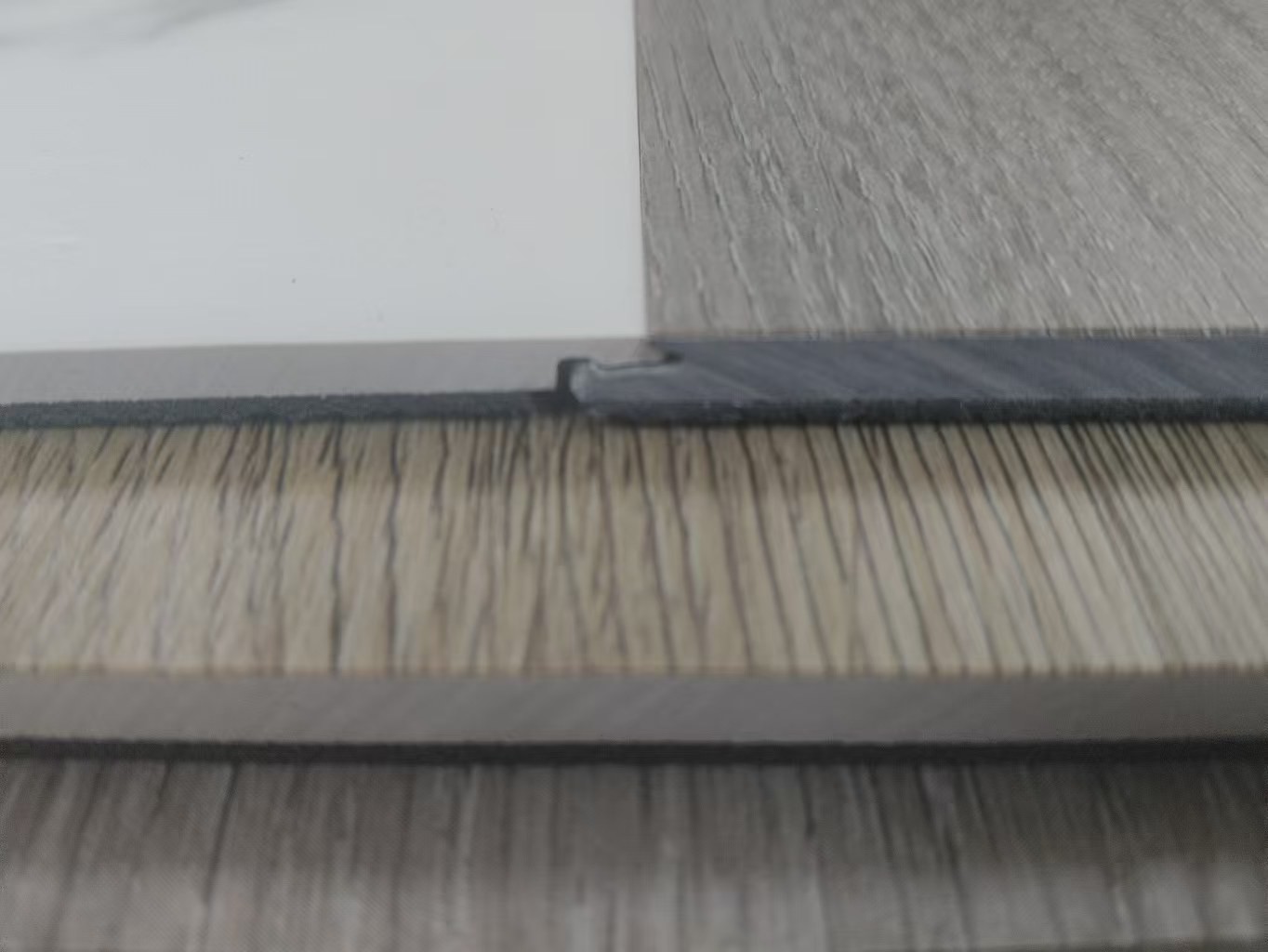
The locking profile that holds a wide-format plank together across a long span is where extrusion precision and tooling investment converge.
IV. What Changed in Chinese Extrusion Between 2020 and 2025
Five years ago, the phrase "Made in China" in SPC flooring carried a specific set of associations: inconsistent plank thickness, locking systems that required a mallet, delivery timelines that drifted, and quality that varied between the first container and the third. Some of those associations were earned. Most of them are now outdated, and the speed at which they became outdated is itself a story about capital investment.
Between 2020 and 2025, the leading tier of Chinese SPC manufacturers replaced semi-automated extrusion lines with fully automated systems that control temperature across multiple barrel zones, sheet thickness via laser gauging, and embossing registration via optical alignment. In-house testing moved from a caliper and a scale to environmental chambers, abrasion-testing rigs, and pull-apart jigs that measure locking strength in newtons per millimeter. The investment was driven by export demand from buyers who specified ASTM and EN compliance and had the procurement volume to enforce it. The factories that made the investment can now produce a plank that is dimensionally more consistent than some European re-branders were getting from their previous local suppliers. The factories that did not make the investment are still in business, and their pricing reflects the difference.
For a distributor evaluating suppliers in 2026, the relevant question is not whether a factory is Chinese. It is whether the factory belongs to the tier that made the capital investment. The signals are not subtle: extruder age, presence of in-house testing equipment, willingness to share batch-level test data, and whether the factory produces multiple product categories under one roof. A vertically integrated operation producing SPC alongside PVC foam board, fence profiles, and ceiling panels has quality systems that a single-product trading desk cannot replicate because the quality system has to work across different extrusion parameters and material formulations. It has been tested by variety. For a systematic approach to evaluating whether a manufacturer's claims hold up under scrutiny, the vetting framework in our guide to factory capability verification applies the same logic across PVC and related product categories.
V. Six Questions a Container Hides Until Someone Opens It
A pre-shipment sample is a single plank from a single production run, selected by the manufacturer, shipped in a box that protects it from heat and humidity, and inspected in an air-conditioned office. It is honest and useless. A container is 2,000 cartons of planks that spent three weeks in a steel box crossing the equator, stacked ten high, with the bottom carton compressed by the weight of nine cartons above it and the internal temperature cycling between 20°C at night and 55°C at noon. The difference between the sample and the container is why distributors develop a set of questions they ask before the container leaves the factory, not after it arrives.
The first question is about thickness and what it buys. A 4mm plank works for light residential with a perfectly flat subfloor. A 5.5mm plank handles most residential installations. A 6.5mm plank starts to forgive minor subfloor irregularities. An 8mm plank handles light commercial foot traffic and resists point-load deflection under furniture legs. Each millimeter costs material, and the cost is linear, but the performance improvement across the range is not. The jump from 4mm to 5.5mm matters more than the jump from 5.5mm to 6.5mm, because the 4mm plank has a locking profile so thin that installation over anything less than a perfectly leveled substrate produces locking-mechanism failure within months. Understanding what each thickness tier actually delivers on the jobsite, rather than in the spec sheet, is covered in detail across the SPC thickness breakdown that maps millimeter ranges to application types.
The second question is about the locking system. Unilin and Valinge are licensed click systems with decades of field data. Proprietary systems can be as good or better, but they require pull-apart test data to verify. A locking joint that separates at less than 300 newtons per millimeter under tensile loading will open up under thermal cycling within the first year. The data exists or it does not. Ask for the number.
The third question concerns the wear layer. A 0.3mm wear layer handles residential bedrooms and low-traffic living areas. A 0.5mm layer handles general residential including hallways and kitchens. A 0.7mm layer with ceramic bead enhancement handles commercial footfall in retail and hospitality environments. The number on the specification sheet is the total thickness. What matters additionally is whether the wear layer is UV-cured, because UV curing produces a harder, more cross-linked surface than conventional thermal curing, and the cross-linking directly correlates with scratch resistance and gloss retention over time.
The fourth question is about the pre-attached underlayment. An IXPE or EVA foam layer bonded to the underside of the plank provides impact sound reduction in the range of 15 to 18 decibels. The number matters for multi-story buildings with acoustic requirements and for any installation where footfall noise traveling through the floor assembly is a complaint that the distributor will eventually hear about. A 1mm pad is standard. A 1.5mm pad is an upgrade that costs marginally more and delivers disproportionately better acoustic performance in mid-frequency ranges where footfall noise concentrates.
The fifth question addresses underfloor heating compatibility. The thermal resistance of the plank and underlayment combined must stay below 0.15 m²K/W for the heating system to transfer energy efficiently into the room. Above that threshold, the heating system runs longer to achieve the same surface temperature, and the energy cost differential accumulates over years. The maximum operating temperature at the floor surface should not exceed 27°C for SPC, not because the plank will melt, but because sustained temperatures above that threshold accelerate dimensional change across the length of each plank, and the cumulative expansion across a room can close the expansion gap that was left at the perimeter. The installation sequence that prevents this failure mode is detailed in our guide to SPC over underfloor heating.
The sixth question involves the warranty and what it actually covers. A residential warranty of 15 to 25 years is standard and signals confidence in the wear layer and locking system. A light commercial warranty of 5 to 10 years is less common and signals that the manufacturer has tested the product under conditions that simulate retail or office footfall. A heavy commercial warranty requires abrasion group classification and is rare outside of products specifically engineered for commercial specification. The warranty document is the last page of the supplier evaluation. The test data behind it is the first page, and if the test data does not exist, the warranty is a marketing promise with no engineering behind it.
VI. The Supplier Who Volunteers Test Data Nobody Asked for Yet
There is a signal in the SPC supply chain that separates suppliers more reliably than price, more reliably than samples, and more reliably than a factory visit. It is whether the manufacturer publishes technical data that the buyer has not specifically requested. A supplier who sends a phthalate test report before the buyer asks for it has already been asked by someone whose order was larger. A supplier who includes locking-strength data in the standard quotation package has already lost a customer over a locking system that failed. A supplier who offers batch-level dimensional stability data without being prompted has quality systems that generate that data routinely, and a quality system that generates data routinely is a quality system that detects problems before they ship.
The inverse is also true. A supplier who answers every technical question with "no problem" and cannot produce a test report within 48 hours is not technically competent. They are commercially responsive. The difference is not subtle, and it becomes expensive at the moment the container arrives and the distributor discovers that the locking system was not, in fact, no problem.
Distributors who have sourced SPC for more than two or three container cycles develop a shortlist of suppliers based on this signal alone. The price spread between the top and the middle of the market is not large enough to justify the cost of a bad container. The cost of a bad container-return freight, lost sales, reputational repair with contractors who installed the product-is roughly ten times the price difference between a factory that tests and a factory that does not. The arithmetic is brutal and correct. For the contract-grade segment where failure is not an option, the analysis in our commercial SPC flooring guide examines the warranty and testing requirements that separate retail-spec from contract-spec products.
Frequently Asked Questions About SPC Flooring Sourcing in 2026
Practical answers to the questions distributors and importers raise during the supplier evaluation process, drawn from container-level sourcing experience.
Q1: What is the minimum wear layer thickness for a rental property installation?
A: A 0.5mm wear layer is the practical minimum for rental-grade installations where tenant turnover means furniture being dragged and the floor seeing higher abrasion than an owner-occupied unit. A 0.3mm layer handles bedrooms and low-traffic areas adequately but will show wear patterns in hallways and living areas within three to five years of rental use. The cost difference between 0.3mm and 0.5mm wear layers is small relative to the cost of replacing flooring between tenancies.
Q2: Can SPC flooring be installed directly over existing tile?
A: Yes, provided the tile surface is flat to within 3mm over a 2-meter straightedge and the grout lines are filled level with the tile surface. Uneven grout lines will telegraph through SPC planks over time, particularly in thinner formats below 5.5mm. The subfloor flatness tolerance is the single most important installation variable, and it is more important with SPC than with laminate because SPC is thinner and less forgiving of vertical variation.
Q3: What locking system should an importer specify?
A: Unilin and Valinge are the two licensed systems with the longest field history and the most installation data across climate zones. Proprietary drop-lock systems can perform equivalently, but they require independent pull-apart test data showing a minimum tensile resistance above 300 N/mm. Ask for the test report, not the marketing name of the system. A supplier who cannot produce the report within 48 hours is a supplier who has not tested the joint strength of their own product.
Q4: How do I verify phthalate-free claims before shipment?
A: Request a third-party test report from an ISO 17025-accredited laboratory that specifically tests for the six phthalates restricted under EU REACH and US CPSC regulations. A manufacturer's internal test report is not sufficient for customs clearance in regulated markets. The report should be dated within twelve months and should reference the specific product grade and production line. If the manufacturer cannot provide this within a week of the request, factor potential clearance delays into the delivery timeline.
Q5: Is a factory audit necessary for a first container order?
A: For a single container of a standard product from a supplier with verifiable export history and third-party certifications, a detailed pre-shipment inspection by an independent third party may be sufficient. For a multi-container commitment or a customized product with exclusive tooling, a factory audit is justified. The audit should verify extruder condition and maintenance records, in-house testing equipment calibration, raw material storage practices, and the production records of a recent order for a customer in a regulated market. A supplier who resists an audit is protecting information that matters.
Q6: What is the typical lead time for a customized SPC order from China?
A: For a standard product with existing tooling, four to six weeks from order confirmation to container loading is typical. For a customized format requiring new embossing plates or a custom color run, add three to five weeks for tooling fabrication and color matching approval. The embossing plate lead time is the critical path item. Rush orders are possible but the quality risk on rush runs is higher because production scheduling compresses the time available for in-line quality checks. A supplier who promises a custom order in under five weeks without explaining how they manage the embossing plate timeline is either sitting on unused capacity or cutting corners.
Build a 2026 SPC collection that your competitors cannot price-match from a catalog
Our SPC flooring ships with batch-level test data for phthalate content, locking strength, dimensional stability, and wear-layer thickness. Custom formats, custom embossing, custom underlayment-produced on automated extrusion lines with in-house quality verification that runs before the container closes, not after it opens. Send us your target format, wear-layer specification, and compliance requirements. We return a quotation, a pre-production sample timeline, and the test reports for the last production batch of the grade you are ordering.
The Number That Does Not Appear in a Market Report
A market report will tell you the SPC flooring category is growing at a compound annual rate with a total addressable market in the tens of billions. It will tell you the Asia-Pacific region dominates production and North America and Europe dominate consumption. It will not tell you that the margin on a commodity 7-by-48-inch plank is now thin enough that one delayed container wipes out the profit on three that arrived on time. It will not tell you that the margin on a custom 9-by-72-inch plank with an exclusive embossing pattern is protected by the simple fact that the embossing plate cost and the minimum-order quantity create a barrier that most of your competitors will not cross.
The flooring distributors who are building durable positions in this category are not the ones who placed the earliest orders. They are the ones who built supplier relationships that include test data, customization capability, and batch-level quality documentation as standard line items rather than negotiated concessions. The supplier relationship is the product as much as the plank is, because the plank is a physical object with measurable properties and the supplier relationship is what ensures the plank that arrives in month twelve is the same plank that arrived in month one.
The category is large enough to absorb every serious entrant. The margin compression at the commodity end is accelerating. The way through is not to find a cheaper plank. It is to find a plank that cannot be compared on price because no one else stocks it, and to back it with documentation that makes the comparison irrelevant.
YUPSENI Team
Twenty-three years manufacturing PVC and SPC flooring products, PVC foam board, fence profiles, and ceiling panels under a single vertically integrated quality system. Our SPC flooring ships to distributors in North America, Europe, Australia, and the Middle East with batch-level documentation covering phthalate content, locking strength, dimensional stability, and wear-layer verification. Browse SPC flooring products or about our manufacturing operations.
The information in this article is for general informational and educational purposes only. Market data cited is drawn from publicly available industry analyses and should be verified against current reports at the time of procurement. Product specifications, compliance requirements, and testing protocols must be confirmed against the manufacturer's technical documentation for the specific product grade, production batch, and intended regulatory jurisdiction. No content here constitutes a warranty or guarantee of performance. Product images are for illustrative purposes. All trademarks belong to their respective owners. © 2026 YUPSENI. All rights reserved.


