I. A Flat in Oslo, a Gas Bill, and the Floor That Was Costing €200 Extra Every Winter
I want to stay with Oslo for a moment, because that apartment contains almost everything you need to understand about SPC flooring and underfloor heating in a single case study.
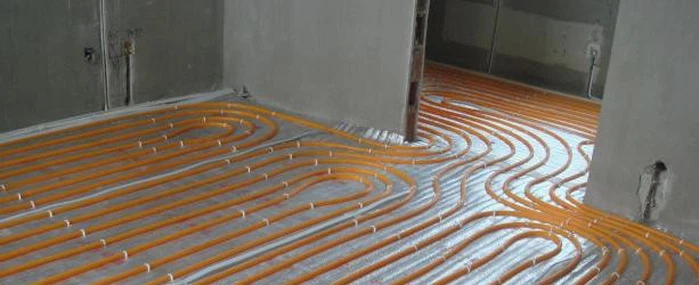
The apartment was on the third floor of a building completed in 2019. The underfloor heating system was a standard water-based setup: PEX pipes embedded in a 50 mm cementitious screed, designed to run at a supply temperature between 35°C and 45°C depending on outdoor conditions. The original floor covering throughout the apartment was ceramic tile - thermally ideal, with a thermal resistance near zero. When the homeowner decided to renovate, he wanted something warmer underfoot than tile, something that felt more like wood but would not warp or gap the way engineered timber does when heated and cooled in seasonal cycles. SPC was the obvious recommendation. The retailer sold him 5.5 mm planks with an attached IXPE underlayment. The installation was straightforward. The floor looked great.
Then winter arrived. The boiler, which had cycled comfortably with the old tile floor, began running longer. The floor surface temperature, measured with an infrared thermometer, was reaching only 23°C–24°C in the main living area - warm enough to notice, but not warm enough to feel genuinely comfortable under bare feet. The thermostat was set to 22°C room temperature, but the boiler was working noticeably harder to maintain it. The gas meter confirmed what the feet suspected: consumption was up.
This is the moment when most homeowners blame the flooring product. The product was not at fault. The SPC planks were performing exactly as their thermal properties predicted. The fault - if you can call it that - was in the underlayment selection. The retailer had recommended a comfort underlayment designed for acoustic isolation and footfall cushioning, not for thermal transmission. The homeowner had no reason to question the recommendation. The retailer had no reason to question the specification. And so a floor that should have delivered efficient, responsive warmth delivered a compromised thermal performance that cost real money, every month, in perpetuity.
The lesson is not that SPC is unsuitable for underfloor heating. The lesson is that the floor covering is only one component in a thermal system, and the underlayment sitting beneath it matters just as much as the planks themselves - sometimes more. For specification-grade SPC products with documented thermal performance data, browse the YUPSENI SPC range →
II. What Makes a Floor Material "Underfloor-Heating-Friendly" - and Why Wood Keeps Losing This Fight
Heat traveling upward from a water pipe or an electric cable encounters a sequence of materials: the screed that encases the heating element, the underlayment that separates screed from floor, and the floor covering itself. Each material resists the passage of heat to some degree. The measure of that resistance - thermal conductivity, expressed in watts per meter-kelvin - determines how much of the heating system's output actually reaches the room, and how much stays trapped in the screed.
Wood, for all its aesthetic warmth, is a thermal insulator. Solid hardwood and engineered timber have thermal conductivities hovering between 0.10 and 0.15 W/(m·K). That means heat moves through them reluctantly. To compensate, the underfloor heating system must run at a higher supply temperature - often 5°C to 10°C hotter than it would need to be under a more conductive floor covering - and the room still takes longer to reach the thermostat setpoint. The heating system works harder. The energy bill rises. And the wood itself, subjected to repeated heating and cooling cycles, expands and contracts enough to open gaps at the seams or, in extreme cases, to cup or warp.
Laminate flooring sits in the middle. Its HDF core is denser than solid wood and conducts heat slightly better - thermal conductivity around 0.15–0.20 W/(m·K). But HDF is hygroscopic. It absorbs and releases moisture with seasonal humidity changes. When you add the thermal cycling of underfloor heating, the dimensional swings become significant. Over five or six years of winter heating and summer cooling, laminate seams can begin to open, and the locking profiles - already more brittle than SPC - can develop micro-cracks that eventually become visible gaps.
SPC occupies a different position in the thermal hierarchy. Its core is roughly 60–75% calcium carbonate - limestone powder - by weight. Limestone is a mineral; it conducts heat roughly 20 times better than wood fiber. The thermal conductivity of the CaCO₃ component alone is in the range of 2–3 W/(m·K). The PVC resin that binds the limestone powder conducts heat less readily - around 0.16–0.19 W/(m·K) - but the composite material, weighted toward the mineral content, achieves an overall thermal performance that sits well above wood and laminate. This is not a laboratory curiosity. It translates directly into two things the homeowner experiences every winter: faster floor warm-up time, and a lower supply-water temperature for the same room comfort level.
The dimensional stability argument runs parallel to the thermal argument. SPC's linear thermal expansion coefficient, suppressed by the high mineral content, is roughly half to one-third that of HDF laminate. In a room where the floor surface temperature swings from 18°C in summer to 30°C or more in midwinter under active heating, that difference determines whether the seams stay closed or begin to separate after a few seasonal cycles. SPC stays closed. That is not a marketing claim. It is a consequence of putting that much limestone into a polymer matrix.
III. The 0.15 Number That Determines Whether Your Feet Are Warm or Your Boiler Is Working Overtime
If you read nothing else in this guide, read this section. It contains the single most important number in the entire SPC-underfloor-heating conversation, and it is a number that most flooring retailers either do not know or choose not to discuss.
Thermal resistance, denoted R-value and measured in m²·K/W, quantifies how strongly a material resists the flow of heat. The higher the R-value, the more the material acts as an insulator. For underfloor heating systems, the total thermal resistance of everything sitting above the heating element - screed, underlayment, floor covering - directly determines how hard the heating system must work to achieve a given room temperature. European standard EN 1264 for water-based underfloor heating and the corresponding IEC guidance for electric systems both set a recommended maximum total thermal resistance for the floor covering and underlayment assembly of 0.15 m²·K/W. The optimal target is 0.10 or lower.
Here is what those numbers mean in terms of actual products you can buy:
| Floor Assembly Component | Thickness | Approximate R-Value (m²·K/W) | Status |
|---|---|---|---|
| SPC plank (thin) | 4.0 mm | 0.03–0.05 | Excellent for UFH |
| SPC plank (standard) | 5.5 mm | 0.05–0.07 | Good - verify underlayment |
| SPC plank (thick) | 8.0 mm | 0.08–0.11 | Marginal - use thinnest underlayment only |
| Standard IXPE underlayment | 2.0 mm | 0.05–0.07 | Adds too much resistance with thick SPC |
| Thin导热 underlayment | 1.0 mm | 0.01–0.03 | Ideal for UFH |
| Cork or EPE foam underlayment | 2–3 mm | 0.06–0.10 | Do not use over underfloor heating |
Now, add the numbers together. A 5.5 mm SPC plank at 0.06 R-value combined with a 2 mm standard IXPE underlayment at 0.06 gives you 0.12 m²·K/W total - technically under the 0.15 limit, but high enough that the floor surface temperature will run 3°C–5°C cooler than it would with a total R-value of 0.09 or below. That temperature drop might sound trivial. It is not. To compensate, the boiler raises its supply temperature. A boiler running 5°C hotter - say, 45°C instead of 40°C - consumes roughly 10–20% more energy over a heating season. On a mid-sized European home's gas bill, that is €150–350 extra per winter, recurring annually, for as long as that floor remains installed.
The underlayment problem is made worse by marketing language. Products labeled "underfloor heating compatible" or "thermally optimized" often describe their mechanical properties - they will not melt, they will not deform, they are safe to use with underfloor heating - without disclosing their actual thermal resistance. Being "safe" for underfloor heating is not the same as being "good" for it. A 2 mm cork underlayment is safe. It will not catch fire. It will not degrade. It will also choke the heat transfer from your floor to your room by enough to raise your heating bill by double-digit percentages.
The single most useful thing you can do before purchasing SPC flooring for an underfloor-heated room is to request the thermal resistance values for both the flooring and the underlayment, add them together, and confirm the total is at or below 0.10 m²·K/W if you want optimal efficiency, or at minimum below 0.15. If the retailer cannot provide these numbers, find a retailer who can. The alternative - guessing, and then paying for the guess on every heating bill - is not a risk worth taking. For SPC products supplied with documented thermal performance data, see YUPSENI's SPC flooring specifications →
IV. The Four-Phase Installation Sequence - Skip One and the Floor Remembers Forever
Installing SPC over underfloor heating is not the same as installing it over a passive subfloor. The heating system introduces thermal energy into the assembly. That energy causes materials to expand. It drives residual moisture out of the screed. It creates thermal gradients between the bottom and top of each plank. A floor installed without accounting for these forces will fail - not immediately, but within the first full heating season, when the system reaches its operating temperature and the floor discovers that the space it needs to expand into does not exist.
The installation sequence that follows is not a guideline. It is a sequence of physical prerequisites. Each phase addresses a specific failure mechanism. Skip a phase, and you reintroduce the failure mechanism it was designed to prevent.
4.1 Phase One - Screed Curing and Moisture Verification
After the underfloor heating pipes or cables are laid and the cementitious screed is poured, the screed must cure. This is not a matter of days. Standard cement-based screed requires a minimum of 21 days of natural curing - no artificial acceleration, no cranking the heating to "dry it out faster." Accelerated drying introduces thermal stresses and surface cracking that permanently compromise the screed's structural integrity.
After the curing period, conduct a moisture test. For cementitious screeds, the residual moisture content must be below 2.5% CM method or the equivalent threshold under the applicable national standard. For wood-based subfloors with underfloor heating retrofitted between joists, the wood moisture content must be below 10–12%. A moisture meter reading taken in one corner of the room is not sufficient - measure at multiple points across the entire heated area. The screed dries unevenly; the warmest spots nearest the heating pipes dry fastest, and the areas between pipe loops retain moisture longest.
4.2 Phase Two - Initial Heat-Up Without the Floor
This is the phase most frequently skipped, and the phase whose absence causes the most expensive failures. Before a single plank of SPC enters the room, the underfloor heating system must be commissioned and run through a full heating-and-cooling cycle.
The protocol: starting from the lowest possible supply-water temperature, raise the temperature by no more than 5°C per day until you reach the design operating temperature - typically 45–50°C maximum for water-based systems. Hold at the design temperature for at least 72 continuous hours. This sustained heating period allows the screed to reach thermal equilibrium, expels residual moisture that the curing phase did not eliminate, and - critically - allows the screed to undergo its initial thermal expansion and stress-relief cycle before the flooring is installed on top of it. After the 72-hour hold, reduce the temperature by no more than 5°C per day until the system returns to ambient temperature.
During this entire phase, the floor area must be empty. No SPC. No underlayment. No furniture. The screed is doing its thermal settling alone, without constraint.
4.3 Phase Three - Flooring Installation at Ambient Temperature
Once the system has cooled to the 15–25°C range, you can install the floor. The SPC planks must have been acclimatizing in the same room, stacked flat, for a minimum of 24 hours - 48 hours if the transport or storage temperature differed from the room temperature by more than 10°C. The underlayment is laid directly on the cooled screed. The SPC planks are installed using the standard click-lock procedure.
The expansion gap is where underfloor-heating installations differ from passive ones. Because the floor will experience a larger thermal swing - from perhaps 18°C in summer to 30°C or more at the plank surface in winter - the perimeter gap must be wider than the standard recommendation. Where a normal SPC installation might call for 6–8 mm of perimeter clearance, an underfloor-heated installation should use 10–12 mm around all walls and fixed vertical surfaces. For continuous runs exceeding 8–10 meters in any direction, install an expansion break with a T-molding transition strip to divide the floor into independently floating sections. For a comprehensive explanation of expansion physics in floating floors, read our expansion gap guide →
4.4 Phase Four - Gradual Heating Commissioning
The floor is installed. The baseboards are on. The room looks finished. The temptation to turn the heating to full power and enjoy the result is enormous. Resist it.
Wait at least 24–48 hours after installation before activating the heating system. Then follow the same gradual ramp-up protocol used in Phase Two: start at the lowest temperature, increase by no more than 5°C per day, hold at the design temperature. The SPC planks need time to accommodate the thermal expansion incrementally. A sudden temperature spike - cold floor to full heating in an hour - can cause the planks to expand faster than the floating assembly can distribute the movement, concentrating stress at the weakest seam and either opening a gap or fracturing a locking ridge. The damage may not be visible on the day it happens. It will become visible weeks or months later, when the seam that was overstressed finally separates under foot traffic.
V. Expansion, Acclimatization, and Electricity: Three Rules That Do Not Announce Themselves Until They Are Broken
Beyond the four-phase installation sequence, there are three operational details that sit at the intersection of SPC flooring and underfloor heating. None of them are complicated. All of them are routinely overlooked until the consequences appear - usually in mid-January, when the heating is running at full load and the floor is experiencing its maximum thermal stress.
5.1 The Expansion Gap Is Not "Set and Forget"
The 10–12 mm perimeter expansion gap you left during installation has enemies. Baseboard installers who nail the baseboard through the gap into the wall, pinching the floating floor. Kitchen fitters who install cabinet legs that press down through the gap. Furniture with heavy, narrow feet that sit directly over the perimeter and restrict local movement. A floor that cannot expand freely will expand somewhere else - usually upward, in the middle of the room, creating a visible peak or ridge that will not settle until the pressure is relieved.
Before each heating season, walk the perimeter. Check that the expansion gap is clear. Verify that no baseboard nails have drifted into contact with the plank edges. Confirm that the gap is not packed with debris, pet hair, or construction dust that has accumulated over the summer. The gap is not a passive feature. It is an active mechanical clearance that enables the floor to survive winter.
5.2 Acclimatization Timing Shifts With the Seasons
A standard SPC acclimatization recommendation - 24 hours in the installation room - assumes moderate temperature and humidity conditions. In winter, when the heating is running and the indoor air is dry, that 24-hour period may not be sufficient for planks that have been transported in a cold truck or stored in an unheated warehouse. The thermal gradient between a cold plank and a warm room is larger in winter, and the dimensional adjustment the plank must make is correspondingly larger. For winter installations, extend acclimatization to 48 hours as standard practice. The planks should be stacked flat in the room where they will be installed, with the cartons opened only at the time of installation.
5.3 Electric Underfloor Heating Has Its Own Rulebook
Water-based underfloor heating operates within a relatively narrow and self-limiting temperature range - the water rarely exceeds 45–50°C, and the thermal mass of the screed buffers temperature fluctuations. Electric systems - heating cables, heating mats, carbon-film elements - can generate higher local temperatures at the heating element surface, and they respond to thermostat calls almost instantly, with less thermal buffering.
For electric underfloor heating beneath SPC, three additional rules apply. First, the system must include a floor-surface temperature sensor and limiter set to a maximum of 27°C at the plank surface - some manufacturers recommend 26°C as a conservative ceiling. Second, avoid high-wattage-density systems; the heating element spacing must be specified according to the manufacturer's temperature-rise tables, not chosen for maximum heat output. Third, confirm with the heating system manufacturer that the surface temperature beneath the floor covering will remain within the SPC manufacturer's stated continuous-temperature tolerance - typically around 40–45°C at the underside of the plank. Exceeding this tolerance will not cause immediate failure, but it will accelerate wear-layer degradation, increase the risk of locking-ridge deformation, and potentially void the flooring warranty.
VI. When SPC Over Underfloor Heating Is the Wrong Answer - and Knowing That Is as Important as Knowing When It Works
No flooring material is universal. SPC performs superbly over underfloor heating in the vast majority of residential applications. But there are boundary conditions where specifying SPC is a mistake - not because the product is flawed, but because the operating conditions exceed what the product was designed to handle. Recognizing these conditions before installation is the difference between a floor that lasts 20 years and one that develops problems in its second heating season.
Condition one: supply temperatures consistently above 55°C. Older underfloor heating systems, particularly those retrofitted into existing buildings with high heat-loss rates, may require supply-water temperatures in the 55–65°C range to achieve adequate room heating. At these temperatures, the underside of the SPC plank may exceed the manufacturer's continuous-temperature rating. The wear layer will not melt - but it may gradually lose adhesion to the decorative film, and the locking profiles, subjected to sustained heat, may lose a fraction of their mechanical grip. For these high-temperature systems, ceramic tile or stone remains the technically correct specification.
Condition two: electric underfloor heating without precise temperature control. A basic electric heating mat with a simple on/off thermostat and no floor-surface temperature sensor will overshoot the safe temperature range for SPC. The mat heats to its maximum output, the thermostat eventually registers the air temperature rise and cuts power, but by then the floor surface has already exceeded 30°C - potentially reaching 35°C or more directly above the heating cable. Repeated overshoot cycles will degrade the flooring prematurely. If the electric system cannot hold the plank surface below 27°C with precision, choose a different floor covering.
Condition three: subfloor moisture that cannot be resolved. If the screed moisture content cannot be brought below the required threshold - because of ground moisture ingress in a slab-on-grade without an effective damp-proof membrane, or because the construction schedule does not allow adequate curing time - SPC should not be installed, regardless of whether underfloor heating is present. The trapped moisture will not damage the SPC plank itself, but it will create a persistent microclimate beneath the floor that can degrade the underlayment, promote mold growth, and produce odors that migrate upward through the perimeter gaps. The floor is waterproof; the assembly beneath it is not.
When any of these three conditions is present, the correct decision is not "try SPC and hope." It is "choose a floor covering rated for the actual operating conditions of this specific installation." That is not a failure of SPC. It is a disciplined approach to specification - the same discipline that prevents the Oslo homeowner's gas bill problem before it begins.