

PVC Foam Board for Engraving: Density Guide for CNC & Laser Sign Making | YUPSENI
Jul 11, 2026
PVC Foam Board for Engraving: Why Density, Not Thickness, Decides How Clean Your Cut Looks
Read time: 6 minutes | By: YUPSENI Team

Engraving-grade expanded PVC with a smooth matte surface on both faces - the substrate that lets the engraved surface itself become the finished product.
On This Page
- I. The One Number Sign Shops Forget to Ask About
- II. CNC or Laser? The Board Doesn't Care - But the Density Does
- III. A Quick Density Cheat Sheet
- IV. What to Confirm Before You Order a Container
Every sign shop that has ever cut expanded PVC has had the same bad afternoon: a batch of board that routes fuzzy, leaves a soft cell-textured channel where the V-bit passed, and forces a round of hand-sanding on work that was supposed to come off the machine finished. The board was the right thickness. It was the right color. It looked identical to the last batch. And it engraved badly anyway.
The variable nobody checked was density. A PVC foam board for engraving lives or dies on how tightly its cell structure is packed, and that single property is the difference between a clean cut and a reprint.
I. The One Number Sign Shops Forget to Ask About
Expanded PVC is a foam. Its interior is a matrix of gas-filled cells, and how small and how tightly packed those cells are is set at the extrusion line by the density grade. A 0.45 g/cm³ board has large cells and routes fast, but the walls of an engraved channel show that cell structure - a slightly ragged, matte texture that reads as "cheap" up close. Push the density to 0.55 or 0.60 g/cm³ and the cells shrink. The channel walls come out smooth, the edge holds detail down to roughly 0.5 mm line width, and the board comes off the router looking finished.
This is why two boards of the same thickness can behave completely differently under the same tool. Thickness tells you how deep you can cut. Density tells you how clean the cut will look. For an engraving buyer, density is the specification that matters most, and it is the one most commonly left off the purchase order.
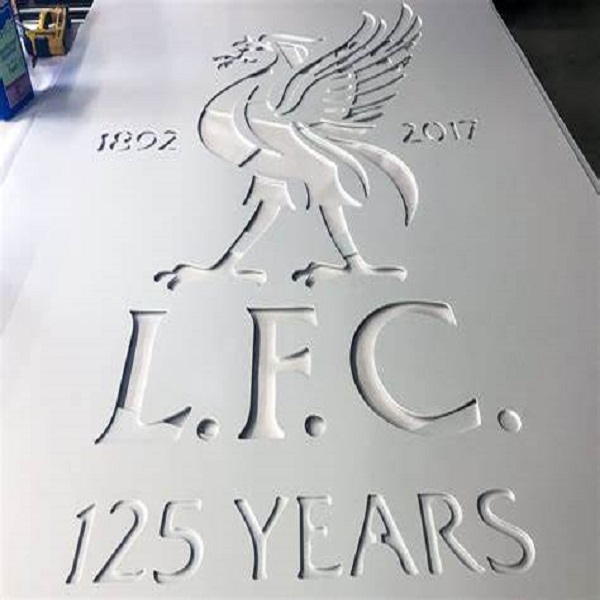
Higher density means smaller cells, which means an engraved channel that holds fine detail without a fuzzy edge.
II. CNC or Laser? The Board Doesn't Care - But the Density Does
Both cutting methods work on the same board, but they reward slightly different density windows. On a CNC router, a 60° or 90° V-bit at 0.55–0.60 g/cm³ gives the cleanest channel walls with a single pass - add chip extraction so the swarf doesn't re-weld into the groove. On a CO² laser, the sweet spot drops slightly to 0.50–0.55 g/cm³: dense enough to vaporize into a crisp channel, light enough that the beam doesn't dwell long enough to melt the surrounding surface.
One safety note that applies to laser work specifically. PVC releases hydrogen chloride gas when it is laser-cut. Adequate fume extraction is not optional - it protects both the operator and the laser optics. This is a known property of the material, not a defect, and every professional shop that laser-processes PVC already runs extraction as standard.

Engraved channels accept acrylic paint fill for contrast - and the same board runs on a UV flatbed printer for hybrid printed-and-engraved signage.
III. A Quick Density Cheat Sheet
| Density | Best For | Trade-off |
|---|---|---|
| 0.45 g/cm³ | Large-format shallow work, event graphics, temporary signage | Some cell texture visible in the channel |
| 0.50–0.55 g/cm³ | Laser engraving standard; light CNC detail | Most popular all-round grade for sign shops |
| 0.55–0.60 g/cm³ | CNC engraving, nameplates, architectural models, permanent signage | Slower routing speed, dulls bits marginally faster |
| 0.70 g/cm³ | Boards that carry mounting hardware or get handled a lot | Heavier shipping weight per sheet |
If you are running a mixed shop - some laser, some router - the 0.55 g/cm³ grade covers the widest range without compromise. It is dense enough for clean CNC channels and still lasers cleanly for text and logos. For a deeper look at how the surface skin forms and why it matters for both engraving and printing, our Celuka versus free-foam comparison is worth ten minutes.
IV. What to Confirm Before You Order a Container
Four things belong on every engraving-board purchase order, and getting them right up front prevents the most common cross-border sourcing dispute - a board that meets the thickness spec but engraves nothing like the sample.
• Density grade in g/cm³ - the number that predicts cut quality. Never order by thickness alone.
• Surface finish - smooth matte is standard for engraving; specify if you need gloss or textured.
• Certification - confirm CE, RoHS, and REACH for EU and North American resale.
• A physical sample at your chosen density before the bulk order. Test it on your own machine, at your own settings.
YUPSENI supplies engraving-grade expanded PVC in density grades from 0.45 to 0.70 g/cm³, thicknesses from 1 mm to 25 mm, in standard 1220 × 2440 mm sheets or custom dimensions. All grades are CE-certified and RoHS-compliant. If you are still deciding between substrates for a sign job, our guide on choosing PVC advertising board by density and print compatibility covers the selection logic in full.
Frequently Asked Questions
Frequently Asked Questions About PVC Foam Board for Engraving
Common questions from sign makers and importers sourcing engraving-grade expanded PVC.
Q1: Which density should I choose for CNC engraving?
A: 0.55–0.60 g/cm³ is the CNC standard. It produces smooth V-groove walls that hold detail to roughly 0.5 mm line width and comes off the router finished without hand-sanding. For laser work, drop slightly to 0.50–0.55 g/cm³. A mixed CNC-and-laser shop is best served by 0.55 g/cm³ as a single all-round grade.
Q2: Can the same board be printed and engraved?
A: Yes. The smooth matte surface that supports clean engraving also gives sharp registration on UV flatbed printers. This makes the board a good fit for hybrid signage where a printed background carries engraved text or a logo. The same closed-cell flatness serves both processes.
Q3: Is laser engraving PVC safe?
A: PVC releases hydrogen chloride gas when laser-cut, so adequate fume extraction is required - it protects both the operator and the laser optics. This is standard practice in any professional shop that laser-processes PVC. With proper extraction in place, laser engraving produces clean, crisp results on 0.50–0.55 g/cm³ board.
Q4: What is the MOQ and can I get a sample first?
A: Standard MOQ is 100 sheets per density grade and color. Free samples are available for qualified buyers, and we recommend testing a sample at your chosen density on your own machine before placing a bulk order. To request a sample or a quote, contact our sales team with your density, thickness, and sheet size.
Order Engraving-Grade PVC Foam Board by Density, Not Guesswork
Grades from 0.45 to 0.70 g/cm³, 1–25 mm thick, smooth matte both sides. CE and RoHS certified. Free sample at your chosen density before you commit.
View the ProductYUPSENI Team
23 years in PVC building material manufacturing and supply chain. We help sign makers, importers, and distributors source PVC foam board, advertising substrates, and rigid sheet that perform right the first time. More about YUPSENI
© 2026 YUPSENI. All rights reserved. The information in this article is for general informational purposes only and does not constitute professional advice. Engraving parameters vary by machine, tooling, and board batch - always test on a sample before production. Laser processing of PVC requires adequate fume extraction. Always request current datasheets before making procurement decisions.


