

WPC Celuka Foam Board Guide: Wood-Look, Waterproof, Screw-Ready
Jul 10, 2026
WPC Celuka Foam Board: The Material That Looks Like Wood, Cuts Like PVC, and Doesn't Care If You Get It Wet
Read time: 9 minutes | By: YUPSENI Team

WPC Celuka foam board in a cabinet door application-the surface has the look and screw-holding feel of wood, but the core is 100% waterproof.
On This Page
- I. A Board That Looks Like Wood and Acts Like Plastic-The Combination That Shouldn't Work Together
- II. Two Words That Do More Work Than Most Spec Sheets: WPC + Celuka
- III. The 20% That Changes the Cut, the Screw, and the Sound
- IV. Where You'd Use It-and Where You'd Still Reach for Something Else
- V. Kitchens. Bathrooms. The Two Rooms That Punish Materials for a Living.
- VI. Under the Hood: How YUPSENI Builds a WPC Celuka Board
- VII. Questions That Tell You Whether the Supplier Knows the Board or Is Just Selling It
There is an unspoken rule in building materials that you can have two of three things: the look of wood, the durability of plastic, or a price that makes sense for production-scale manufacturing. Pick two. The rule has held for decades. MDF and particleboard give you the wood look and the price, but they swell at the first sight of water. Solid PVC foam board gives you waterproof durability and a reasonable price, but it looks unmistakably like plastic. Solid wood gives you the look and the feel, but you already know what it costs, and you already know what happens to it in a kitchen with a leaking dishwasher.
WPC Celuka foam board breaks the rule. It combines roughly 20% wood fiber with PVC resin and processes the mixture through a Celuka extrusion line-the same process that gives premium PVC foam board its hard, smooth outer skin. The result is a board that takes a screw like particleboard, routes like MDF, repels water like pure PVC, and has a surface that can be embossed with wood grain deep enough to feel like grain rather than a photograph of grain printed on plastic. It is not a miracle material. It has real and specific limitations that matter in some applications and do not matter at all in others. But for the applications where it fits-kitchen cabinets, bathroom vanities, outdoor furniture components, interior door skins-it solves a material selection problem that has been forcing compromises since the first particleboard cabinet swelled at the first leak.
This article traces the WPC Celuka foam board from its material composition through its manufacturing process to the procurement decisions that separate a board that holds a cabinet hinge for a decade from one that strips out in year two. For a broader comparison of how the 20% wood fiber content changes the board's behavior relative to pure PVC, see our WPC versus PVC foam board analysis.
I. A Board That Looks Like Wood and Acts Like Plastic-The Combination That Shouldn't Work Together
Wood and water have a relationship that wood always loses. Wood fiber absorbs moisture from the air long before liquid water touches the surface. At 60% relative humidity, wood reaches an equilibrium moisture content of roughly 11%. At that level, a cabinet door that was perfectly flat in February has developed a 2 mm bow by August. The hinge screws that were tight at installation have loosened by half a turn, not because anyone touched them, but because the wood around them expanded and contracted through a full seasonal cycle.
The person who decided to mix wood fiber into PVC resin and extrude it through a Celuka die was, whether they knew it or not, trying to solve exactly this problem. Keep enough wood fiber to give the board the density, the screw-holding torque, and the tactile warmth that make wood feel like wood. But embed that fiber in a PVC matrix that is, at the molecular level, indifferent to water. The fiber is encapsulated. Moisture cannot reach it because PVC surrounds every individual fiber particle. The board looks and machines like a wood-based product, but its dimensional stability is determined by the thermal expansion coefficient of PVC, not the hygroscopic expansion coefficient of cellulose. That single substitution changes everything about how the board behaves in a humid room.
For importers and distributors, the practical consequence is this: a WPC Celuka board shipped in a container from Shandong to a humid port in Southeast Asia arrives flat. An MDF board shipped on the same route arrives with a moisture content that has equilibrated somewhere in transit, and the board may or may not still be flat when the container doors open. The WPC board's moisture indifference is not a marketing claim. It is a logistics advantage that compounds with every nautical mile between the factory and the installation site.
II. Two Words That Do More Work Than Most Spec Sheets: WPC + Celuka
WPC and Celuka are not synonyms. Each describes a separate aspect of the board, and understanding the difference is the difference between ordering the right board for cabinets and ordering a board that is correct on paper but wrong on site.
WPC (wood-plastic composite) describes what goes into the extruder: PVC resin compounded with wood fiber, typically at a loading of 15% to 25% by weight, along with stabilizers, processing aids, and foaming agents. The wood fiber is not sawdust swept off a mill floor. It is a graded cellulose fiber, typically 40 to 80 mesh, dried to below 1% moisture content before it enters the compounder. Moisture in the fiber at the point of extrusion turns to steam inside the barrel, creating voids in the melt that become structural defects in the finished board. The fiber drying step is the single most quality-sensitive operation in WPC production, and it is the first thing to check when a batch of boards arrives with inconsistent density or surface pitting.
Celuka describes how the material exits the extruder. In a Celuka process, the molten compound passes through a die that shapes the board profile while the outer surface is rapidly cooled against a calibrator. The skin solidifies first, forming a dense, hard outer layer typically 0.3 mm to 0.8 mm thick. The core, insulated by the skin, continues to foam, creating a cellular interior with a density roughly 60% to 70% of the skin density. The result is a board with a hard, smooth surface on both faces and a lightweight core. This is the opposite of a free-foam board, where the entire cross-section foams uniformly and both surfaces require sanding before they are smooth enough for printing or laminating. For a detailed comparison of these two processes, see our Celuka versus free-foam comparison guide.
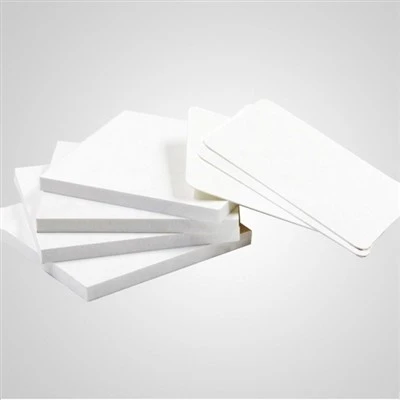
The smooth surface skin of a Celuka-process foam board-this is the dense outer layer that forms when the melt contacts the cooled calibrator before the core foams. The same skin structure on a WPC Celuka board holds screw threads and resists surface abrasion.
Combine WPC formulation with Celuka processing, and the board gets three properties that neither technology delivers alone. The wood fiber increases the board's density and screw-holding capacity relative to pure PVC foam board. The Celuka skin provides a hard, smooth surface that accepts lamination, painting, and printing without pre-sanding. And the PVC matrix encapsulates the fiber, giving the board the moisture resistance that wood-based panels fundamentally lack. Each of these properties has a measurable consequence in a specific application, which is what the next three sections examine.
III. The 20% That Changes the Cut, the Screw, and the Sound
The difference between a WPC Celuka board and a pure PVC Celuka board of the same density is not visible from across a warehouse. The boards are the same color. The surfaces feel similar. The thickness tolerance is the same. The difference only becomes apparent when a fabricator picks one up and works with it.
The first difference is the sound. A pure PVC foam board, when tapped with a knuckle, produces a higher-pitched, slightly hollow tone-the sound of a cellular plastic structure. A WPC board with 20% wood fiber has a lower, deader resonance, closer to the sound of MDF. This is not an acoustic trivia item. It is the first thing a cabinetmaker notices, and it directly influences their perception of the board's quality before they make a single cut. A board that sounds like wood is treated like wood. A board that sounds like plastic is treated with suspicion, even if its mechanical properties are identical.
The second difference is on the saw. Wood fiber is mildly abrasive relative to pure PVC. A carbide-tipped blade cutting WPC Celuka board will dull slightly faster than the same blade cutting pure PVC foam board of the same thickness. The difference is small-a fabricator might get 800 linear meters of cut from a blade on WPC versus 1,000 meters on pure PVC-but it is measurable, and a high-volume shop that processes hundreds of sheets per week will notice it in their blade-change schedule.
The third difference-and the one that sells the board-is screw retention. Pure PVC foam board has a cellular core. When a wood screw is driven into the edge of a pure PVC board, the threads cut through cell walls and the holding strength depends on the shear resistance of the PVC foam structure around the thread. WPC Celuka board embeds wood fiber in that foam structure. The fiber particles act as micro-reinforcements, increasing the local compressive strength around each thread. The practical result: a cabinet hinge screwed into the edge of a WPC Celuka board holds roughly 30% to 50% more withdrawal force than the same hinge in a pure PVC foam board of equivalent density. For a cabinet door that will be opened and closed thousands of times over its service life, that difference is the difference between a hinge that stays tight and one that loosens.
IV. Where You'd Use It-and Where You'd Still Reach for Something Else
No material is universal, and the importer who positions WPC Celuka board as a replacement for every panel product in the catalog will generate returns from the applications where it is the wrong choice. The matrix below is drawn from fabricator feedback and factory application testing, not marketing assumptions.
| Application | Fit | Why |
|---|---|---|
| Kitchen cabinet doors & panels | Ideal | The combination of water resistance, screw retention, and surface finish addresses the three failure modes of MDF cabinets in kitchens. |
| Bathroom vanity units | Ideal | High humidity enclosed space where MDF fails within years. WPC Celuka does not swell at the edges even when the bathroom is unventilated. |
| Interior door skins | Excellent | Lightweight, paintable, dimensionally stable across seasonal humidity swings. Replaces MDF door skins that swell at the bottom edge from floor-level moisture. |
| Outdoor furniture components | Good | Won't rot or absorb water. UV exposure will gradually lighten the surface without a UV-stabilized cap layer. Specify UV-stabilized grade for outdoor use. |
| Retail display fixtures | Good | Routes and finishes well. Lighter than MDF for the same thickness, reducing shipping weight for flat-pack displays. |
| High-precision printing substrates | Conditional | The wood fiber can produce slight surface texture variation that a UV flatbed printer's printhead may detect at very fine resolutions. Pure PVC Celuka is usually preferred for photorealistic direct printing. |
| Structural or load-bearing | Not recommended | WPC Celuka foam board is a furniture and interior panel product, not a structural element. It should not be used where it bears building loads. |
The pattern is clear: WPC Celuka dominates in high-moisture indoor applications where wood-based panels fail. It loses to pure PVC in applications where surface uniformity for direct printing is the critical requirement. This is not a weakness of the product. It is a specification boundary that, when respected, ensures the board is used where it performs best.
V. Kitchens. Bathrooms. The Two Rooms That Punish Materials for a Living.
The kitchen cabinet industry has been searching for an alternative to MDF in wet applications for as long as MDF has been the standard cabinet material. The search is driven by warranty claims. An MDF cabinet door that absorbs moisture along its bottom edge swells by a fraction of a millimeter along that edge. The laminate face does not swell at the same rate because it is not absorbing moisture. The differential expansion delaminates the edge banding. The laminate lifts. The exposed MDF core absorbs more moisture, swells further, and within eighteen months of the first dishwasher leak, the cabinet door is visibly degraded at the bottom corners.
WPC Celuka foam board eliminates this degradation pathway entirely. If the bottom edge of a WPC Celuka cabinet door sits in a puddle of water for an hour, the edge dries and the board is dimensionally unchanged. The PVC matrix does not absorb water. The wood fiber inside it cannot absorb water because it is encapsulated. The edge banding stays bonded because the substrate it is bonded to has not moved. For a cabinet manufacturer, this changes the warranty calculation. An MDF cabinet in a kitchen carries an expected warranty exposure that the manufacturer prices into the product. A WPC Celuka cabinet in the same kitchen carries no moisture-driven warranty exposure at all. The difference in warranty reserve per unit sold is not theoretical. It shows up in the financials of any manufacturer that has switched some or all of its kitchen cabinet line from MDF to WPC.
Bathroom vanities are the same argument, compressed into a smaller space with higher humidity. A bathroom without mechanical ventilation reaches 90% relative humidity within minutes of a hot shower and stays there for an hour. MDF vanity doors in this environment cycle through a daily humidity spike. WPC Celuka doors see the same spike and do not respond to it. For hotel bathroom vanities-installed in hundreds of identical units, exposed to back-to-back guest usage, and expected to look new for the duration of the renovation cycle-the material choice between MDF and WPC Celuka is the choice between planned replacement at year five and no planned replacement at all. See our waterproof PVC cabinet panel guide for a closer look at how these materials perform in kitchen and bathroom environments specifically.
VI. Under the Hood: How YUPSENI Builds a WPC Celuka Board
The specifications below are drawn from the current production datasheet for YUPSENI's WPC Celuka foam board. This is the information a buyer needs to verify that the board matches the application before placing an order.
| Parameter | Specification |
|---|---|
| Material | WPC (PVC resin + wood fiber compound), Celuka extrusion process |
| Wood fiber content | Approximately 20% by weight; graded cellulose fiber, 40–80 mesh |
| Thickness range | 3 mm – 25 mm |
| Standard sheet size | 1220 mm × 2440 mm; custom sizes available |
| Density | 0.55 – 0.70 g/cm³ (varies by thickness) |
| Surface finish | Smooth matte (both sides); embossed woodgrain available on request |
| Color | White, light wood, dark wood; custom colors on order |
| Water absorption (24 hr immersion) | < 0.5% by weight |
| Fire performance | UL 94 V-0 (flame-retardant grade available) |
| Edge treatment | Accepts standard PVC edge banding with hot-melt adhesive |
| MOQ | 100 sheets per size and color |
The specification item that deserves the most attention in a factory audit is the fiber drying system. Wood fiber entering the compounder at above 1% moisture content creates steam voids in the melt. Steam voids become pinholes on the board surface. Pinholes become sites where edge banding fails to bond, where paint fisheyes, where laminate lifts. A supplier who cannot show you their fiber drying protocol and their incoming moisture-content test records is a supplier whose boards will have inconsistent surface quality. This is not a prediction. It is the physics of turning wet fiber into steam inside a 180°C extruder barrel.
The second item is the Celuka calibrator. The calibrator is a water-cooled metal block immediately downstream of the die that sets the board's surface skin before the core foams. Calibrator temperature, water flow rate, and pulling speed together determine skin thickness. A calibrator running too warm produces a thin, weak skin. A calibrator running too cold produces a thick skin with internal stress that can cause the board to bow after cutting. The correct parameters are specific to each thickness and formulation, and they should be documented and traceable per production batch. For more on what separates a Celuka board from a delamination risk across various thickness grades, see our extrusion process variables guide.
VII. Questions That Tell You Whether the Supplier Knows the Board or Is Just Selling It
What is the moisture content of the wood fiber before compounding?
If the supplier cannot answer this question with a number and a test method, they are not controlling the most quality-sensitive step in WPC production. The correct answer is below 1% as measured by a halogen moisture analyzer, tested per batch of incoming fiber, not per week or per shipment.
What is the skin thickness on each side of the board?
A Celuka board's surface performance-scratch resistance, paint adhesion, edge-banding bond strength-is directly determined by skin thickness. The answer should be a range in millimeters, with a tolerance, measured by cross-section microscopy per production shift. A supplier who cannot provide this number is producing Celuka board but not measuring the one variable that most determines downstream fabrication performance.
Does the wood fiber source affect color consistency?
Yes. Different wood species produce fiber with different natural colors, and those colors tint the finished board. A supplier who switches wood fiber sources between production runs without adjusting the pigment formulation will produce boards with batch-to-batch color variation. The correct answer acknowledges this and describes the fiber source stability protocol.
Can you supply matching edge banding?
A WPC Celuka board is only as useful as the edge treatment that finishes it. If the supplier cannot provide PVC edge banding in a color and woodgrain pattern that matches the board surface, the fabricator must source edge banding from a third party and hope the match is acceptable. YUPSENI stocks matching edge banding for its standard WPC Celuka colors. Suppliers who treat edge banding as an afterthought create a procurement problem for their customers at the point where the board becomes a finished product. For the full range including custom colors and embossed finishes, browse the WPC foam board collection.
Frequently Asked Questions About WPC Celuka Foam Board
Frequently Asked Questions About WPC Celuka Foam Board
Questions importers, fabricators, and procurement buyers ask when evaluating WPC Celuka foam board for cabinet, furniture, and interior panel applications.
Q1: What is the difference between WPC Celuka foam board and regular PVC foam board?
A: The difference is the wood fiber content and its effect on fabrication behavior. WPC Celuka board contains approximately 20% wood fiber by weight in the PVC matrix, which increases density, improves screw-holding torque, and changes the acoustic and tactile feel of the board to be closer to wood-based panels. Pure PVC Celuka foam board has no wood fiber-it is entirely PVC resin with processing aids. WPC Celuka routes, screws, and feels more like MDF or particleboard while retaining PVC's waterproof properties. Pure PVC Celuka is lighter and preferred for printing applications where absolute surface uniformity is required. For a detailed comparison, see our WPC versus PVC foam board analysis.
Q2: Is WPC Celuka foam board suitable for outdoor use?
A: With the correct UV-stabilized formulation, yes. The standard indoor-grade WPC Celuka board is not formulated for prolonged direct sun exposure and will gradually lighten in color if used outdoors. For outdoor applications-garden furniture components, exterior sign panels, outdoor cabinetry-specify the UV-stabilized grade at the quotation stage. The UV-stabilized formulation includes increased titanium dioxide loading and organic UV absorbers that significantly slow the surface degradation rate. The board's moisture resistance is inherent to the PVC matrix and applies to both indoor and outdoor grades equally.
Q3: What thicknesses and sheet sizes are available?
A: Standard thickness range is 3 mm to 25 mm, with the most commonly stocked thicknesses for cabinet and furniture applications being 12 mm, 15 mm, and 18 mm. Standard sheet size is 1220 mm × 2440 mm. Custom sheet dimensions and non-standard thicknesses are available on order. Minimum order quantity is 100 sheets per size and color. For current stock availability and lead times, contact the YUPSENI sales team or browse the WPC Celuka foam board product page.
Q4: Can WPC Celuka board be edge-banded like MDF?
A: Yes. WPC Celuka foam board accepts standard PVC edge banding applied with hot-melt adhesive on conventional edge-banding machines. The Celuka surface skin provides a uniform, non-porous bonding surface that produces a strong, consistent bond line. The recommended edge-banding adhesive temperature is the same as for MDF-typically 180°C to 200°C at the application roller. The board's thermal stability at these temperatures is sufficient that the edge does not deform during the banding process. Post-banding trimming and scraping are performed with the same tools used for MDF edge banding.
Q5: Does the board require pre-drilling for screws?
A: For screws driven into the face of the board at thicknesses of 12 mm and above, pre-drilling is not required-the wood fiber content provides sufficient local compression strength for direct screw insertion. For screws driven into the board edge, pre-drilling with a pilot hole approximately 80% of the screw root diameter is recommended, particularly for thicknesses below 15 mm. The edge has less surrounding material to resist the expansion force of the screw, and pre-drilling prevents the edge from splitting. This is the same practice used for MDF and particleboard edge screwing and should be familiar to any cabinet fabricator.
Q6: How does YUPSENI package WPC Celuka boards for export?
A: Boards are stacked face-to-face with a protective PE foam or kraft paper interleaf between each pair to prevent surface scuffing during transit. The stack is placed on a fumigated ISPM 15 timber pallet with rigid backing boards on both faces to distribute strapping pressure evenly. Edge protectors are applied at all strapping contact points. The entire pallet is wrapped in PE film. For mixed-container orders, WPC Celuka boards can be consolidated with PVC cabinet board or other foam board products. Standard MOQ is 100 sheets per size and color. Free samples are available for qualified buyers-request a sample to evaluate the board before placing a container order.
Specify WPC Celuka Foam Board for Your Next Cabinet or Furniture Project
Thicknesses from 3 mm to 25 mm in standard 1220 × 2440 mm sheets. Woodgrain embossed and smooth matte finishes. Custom colors and UV-stabilized outdoor grade available. Matching edge banding stocked for standard colors.
View the ProductYUPSENI Team
23 years in PVC building material manufacturing and supply chain. We help importers, distributors, and project buyers source SPC flooring, PVC foam boards, wall panels, and fencing that pass compliance the first time. More about YUPSENI
© 2026 YUPSENI. All rights reserved. The information in this article is for general informational purposes only and does not constitute professional advice. Product specifications may vary by region and production batch. Always request current datasheets before making procurement decisions. Outdoor applications require UV-stabilized grade; standard indoor grade is not formulated for prolonged direct sun exposure.


