I. The Question Nobody Asks While Loading a Pallet of PVC Trim into the Van
Sustainability in construction is discussed inside a strange paradox. On one side, the industry has embraced lifecycle assessment language - embodied carbon, environmental product declarations, circular economy frameworks - with genuine enthusiasm. On the other side, the decisions that actually determine a building's environmental footprint happen in about eight seconds, in a builder's merchant aisle, based on price, availability, and whether the product "looks right."
PVC building materials - fence profiles, window lineals, soffit boards, wall panels, flooring planks, decorative moulding - occupy an uncomfortable middle ground in this conversation. They are petrochemical-derived thermoplastics, which puts them on the wrong side of the "natural materials" instinct that dominates green-building intuition. Wood feels sustainable. Stone feels sustainable. Plastic, to most people, does not. But intuition is a poor substitute for a material flow analysis.
A few years ago, a materials scientist at a European PVC recycling consortium put it to me this way: "The environmental question about PVC is not 'is it natural?' The question is 'how long does it stay in service, and what happens to the molecule when that service ends?'" Those two questions - service life and end-of-life molecular fate - turn out to be far more useful than the binary "sustainable or not" judgment that dominates casual conversation.
II. What Actually Happens to a PVC Fence Panel at the End of a Building's Life
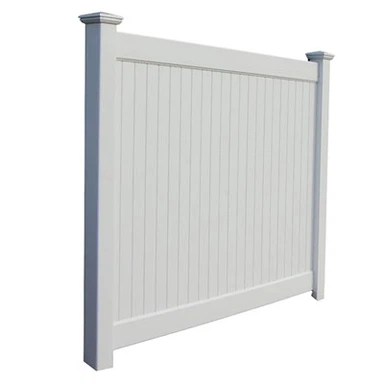
Let us trace a specific product through its entire existence. Take a rigid PVC fence panel - the kind that encloses millions of suburban gardens across North America, Europe, and Australia. It was extruded in a factory, probably in China, Germany, or the United States, from a formulation that is roughly 80% PVC resin and 20% additives: titanium dioxide for UV opacity, calcium-zinc stabilizers for thermal durability, impact modifiers for toughness, and pigments for color. It weighs about 12 kilograms per linear meter. It was installed in 2008. It is still there, still straight, still the same color, having required zero paint, zero preservative treatment, and zero replacement parts for 18 years.
Compare that to a timber fence panel installed in the same year. It has been painted three times - each paint application carrying its own solvent emissions, its own manufacturing footprint, its own disposal stream for cans and brushes. It has had two slats replaced due to rot at the ground-contact point. It will probably need full replacement within the next 5 to 7 years as the posts lose structural integrity below grade. The PVC panel, by contrast, has done nothing except stand there. No new material has entered the system. No maintenance energy has been consumed. No waste has been generated.
This is the sustainability argument that the PVC industry consistently fails to articulate clearly: the most environmentally consequential decision about a building material is not what it is made of, but how many times you have to replace it. For building profiles that deliver this exact multi-decade service logic, see YUPSENI's PVC fence and profile systems →
Now, what happens when that PVC fence panel finally reaches end-of-life - say, in 2045, when the house is demolished for redevelopment? The panel is still chemically intact. PVC does not biodegrade - this is the property that makes environmental critics nervous, and it is also the property that makes mechanical recycling possible. Unlike wood, which has rotted at the ground line and become biologically contaminated waste, or concrete, which has carbonated and cannot be returned to its original state, the PVC polymer chain is still, at the molecular level, exactly what it was when it left the extrusion die in 2008.

Fig. 1 - The PVC building product lifecycle. Service life runs 30–50+ years with near-zero maintenance input. The polymer molecule survives the entire service window intact - making mechanical recycling into second-generation products a technically straightforward process, provided collection infrastructure exists.
III. Durability Is Sustainability - and Here Is the Math Nobody Shows You
The construction industry has an embarrassing blind spot. It obsesses over the embodied carbon of materials at the point of manufacture - the so-called "A1–A3" stages in lifecycle assessment terminology - while almost completely ignoring the replacement frequency multiplier that sits downstream. This is like judging the fuel efficiency of a vehicle by measuring the energy required to build the factory, while ignoring how many kilometers per liter it actually achieves in operation.
Here is what the multiplier looks like in practice:
| Building Product | Typical Service Life (Exterior) | Replacements Over 50 Years | Material × Replacement Multiplier |
|---|---|---|---|
| Timber fence panel (untreated/painted) | 8–12 years | 4–5 replacements | 4–5× |
| Timber fence (pressure-treated) | 15–20 years | 2–3 replacements | 2–3× |
| Rigid PVC fence profile | 30–50+ years | 0–1 replacement | 1× |
| Wood-composite decking | 10–15 years | 3–4 replacements | 3–4× |
| PVC decking / cladding | 25–40 years | 0–1 replacement | 1× |
| Painted softwood window frame | 15–25 years (with regular repainting) | 2–3 replacements + 8–12 repaint cycles | 2–3× + coatings |
| PVC window profile | 35–50+ years | 0–1 replacement | 1× |
The math is not subtle. A material with 50% higher embodied carbon per kilogram that lasts four times as long delivers roughly one-third the lifetime carbon burden of its shorter-lived competitor. This is not an argument against wood. It is an argument against ignoring service life in environmental calculations - something the green-building certification systems are only beginning to address.
A builder I worked with on a multi-unit residential project in Vancouver told me something that has stayed with me for years. He had been a timber purist his entire career - third-generation carpenter - and had resisted PVC trim on principle. The developer insisted on PVC fascia and soffit for a 48-unit townhouse complex to eliminate the repainting line item from the 25-year maintenance reserve fund study. Five years after completion, he went back to walk the site. "The timber-framed windows down the street - a competing development - already had paint peeling at the bottom rail," he said. "Ours looked like the day we installed them. I realized I had been defending a material that created more waste, more solvent emissions, and more truck rolls over its life than the plastic I had been trained to despise."
That kind of cognitive dissonance - a lifetime of craft instinct colliding with field data - is uncomfortable. It is also where genuine learning happens.
IV. The Recyclability Pipeline That Already Exists, Quietly, Across Three Continents
If you ask a typical builder whether PVC building products can be recycled, the answer is usually "no" or "I don't think so." This is factually wrong, and it is wrong in a way that has real environmental consequences - because it means demolition PVC is going to landfill that could be going into a grinder.
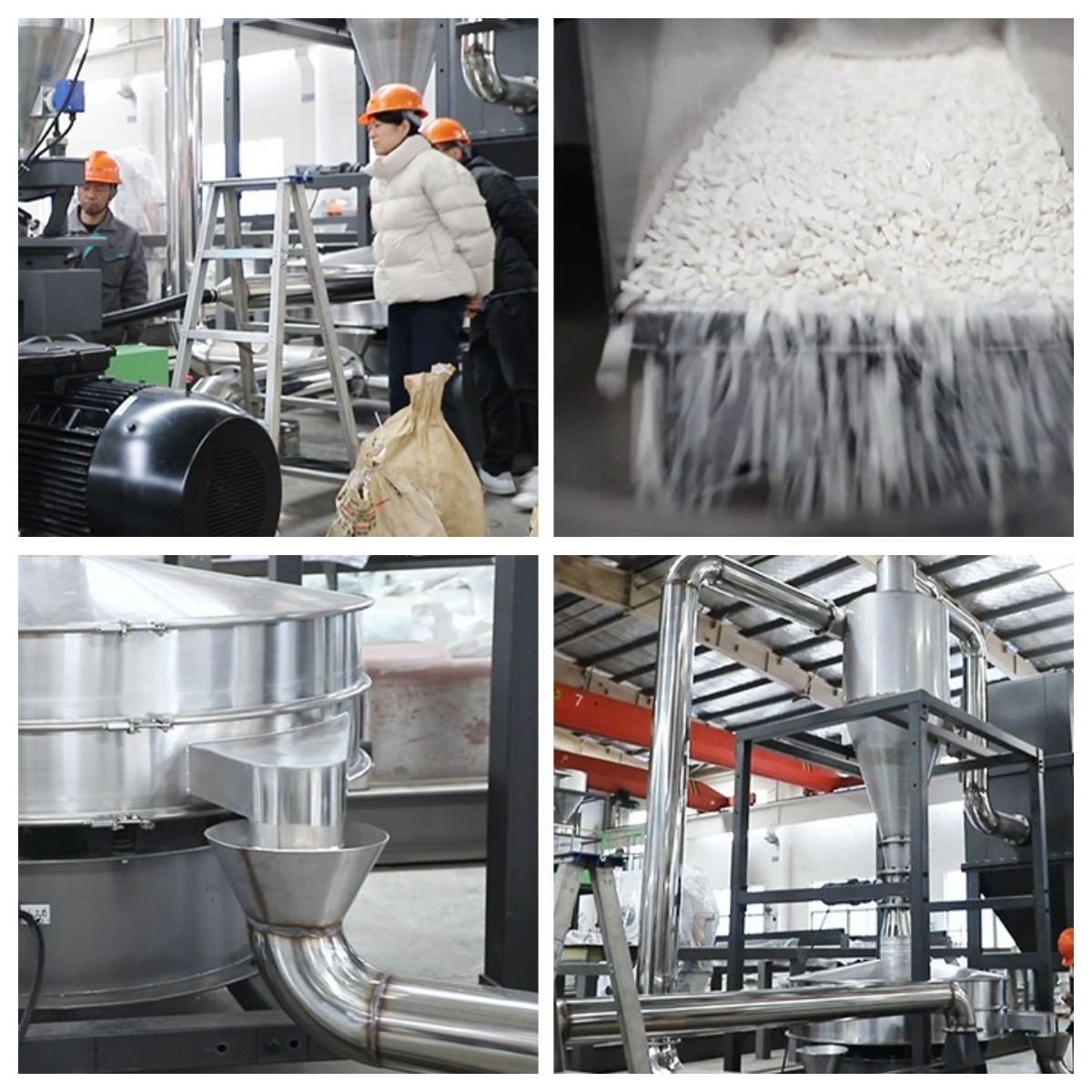
Europe has been operating industrial-scale PVC recycling for construction waste since the early 2000s. The mechanism is called mechanical recycling, and it works like this: post-consumer PVC - window profiles, pipes, fence sections, cladding - is collected at demolition sites, sorted by polymer type using near-infrared spectroscopy, stripped of metal inserts and sealants, ground into chips roughly 3–8 mm in size, washed to remove surface contaminants, dried, and re-compounded into pellet or powder form suitable for re-extrusion. The polymer chain is not broken. The material is not "downcycled" in the sense that it becomes a lower-grade product - properly processed recyclate can be re-extruded into building profiles that meet the same performance specifications as virgin material.
The scale of this infrastructure is larger than most people realize. The European PVC industry's VinylPlus program reported recycling over 810,000 tonnes of PVC in 2023 alone, with window profiles and related building products representing the single largest feedstock stream. Germany, the Netherlands, and the UK operate dedicated PVC recycling facilities that process construction and demolition waste as a distinct material category. Australia's major PVC pipe and profile manufacturers have run take-back schemes for over a decade. In North America, the infrastructure is less developed - more landfill-bound PVC than Europe, fewer dedicated recyclers - but it is growing, driven partly by landfill diversion mandates in states like California and Massachusetts and partly by manufacturers who have realized that recycled PVC feedstock costs less than virgin resin and carries a dramatically smaller carbon footprint.
A recycling plant manager in Dortmund described the economics to me in a way that has reframed how I think about construction waste. "People think recyclers are environmentalists," he said. "We are not. We are manufacturers who have figured out that urban demolition sites are the richest polymer mines in the world. A ton of PVC window profiles contains more usable polymer than a ton of crude oil - and it is already above ground, already polymerized, already compounded. The energy to make the molecule was spent 30 years ago. I am just picking it up and using it again." For indoor and outdoor profiles engineered with end-of-life recyclability in mind, see YUPSENI's PVC building product range →

Fig. 2 - Inside a PVC construction-waste recycling facility: post-consumer profiles are ground into chips, washed to remove surface contamination, separated by density, and re-pelletized into extrusion-grade feedstock. The polymer molecule survives the process intact.
V. Why "Virgin vs. Recycled" Is the Wrong Binary to Argue About
A strange thing happens in sustainability discussions about PVC. The conversation almost immediately polarizes into a purity test: virgin material is "bad" and recycled material is "good," and the goal should be to maximize recycled content at any cost. This binary is superficially satisfying and operationally useless.
The reasons are technical. PVC building products destined for exterior exposure - fence profiles, window lineals, cladding, decking - require precise formulation to deliver multi-decade UV resistance, impact toughness, and color stability. Recycled PVC feedstock, depending on its source, carries a legacy additive profile that is incompletely characterized. A batch of post-consumer window-profile regrind from Germany, where cadmium-based stabilizers were phased out in the 1990s, is chemically very different from a batch sourced from demolition waste in a country with less stringent historical additive regulation. Reformulating around variable recyclate feedstock is not impossible - compounders do it every day - but it requires testing, adjustment, and a margin of performance headroom that some product applications cannot accommodate without risking the very durability that makes PVC environmentally interesting in the first place.
This leads to a nuanced position that does not fit neatly on a sustainability scorecard: the highest-value use of recycled PVC is not always in the product with the highest recycled content percentage. In some cases, the environmentally optimal configuration is a co-extruded profile with a virgin-PVC cap layer for UV protection and color retention, bonded over a core that uses high-recyclate-content material for mechanical bulk. The cap layer - perhaps 0.5 mm thick - contains the UV stabilizers and pigments. The core - the remaining 90% of the profile's mass - carries the recycled content. The entire assembly delivers the 30-to-50-year service life of a virgin product while consuming virgin resin only in the thin functional skin where it is chemically necessary.
This is not greenwashing. It is materials engineering applied to an environmental problem. And it represents a far more sophisticated approach than the crude recycled-content percentage targets that currently dominate procurement specifications.
VI. The Carbon Arithmetic Buried in Every Specification Sheet
Let us close the loop with numbers, because at some point the sustainability conversation must touch the ground of quantifiable comparison. The most useful metric for comparing building materials on environmental grounds is global warming potential per functional unit per year of service life - essentially, how much CO₂-equivalent emission does the material generate, divided by how many years it performs its function before requiring replacement?
For a linear meter of exterior trim - fascia board, for example - the approximate numbers, drawn from published environmental product declarations and lifecycle assessment literature, look like this over a 50-year building lifespan:
| Material | Embodied GWP (kg CO₂e / linear meter) | Replacements Over 50 Years | Maintenance Interventions | GWP Per Meter-Year (kg CO₂e) |
|---|---|---|---|---|
| Painted softwood fascia | ~2.5 | 2–3 | 8–12 repaints | ~0.25–0.35 |
| Fiber-cement fascia | ~5.0 | 1–2 | 4–6 repaints | ~0.20–0.30 |
| PVC fascia (virgin) | ~6.0 | 0 | 0 (wash only) | ~0.12 |
| PVC fascia (co-extruded, recycled core) | ~2.5 | 0 | 0 (wash only) | ~0.05 |
The co-extruded PVC fascia with a recycled core delivers roughly one-fifth to one-seventh the per-year carbon burden of the painted softwood alternative. The virgin PVC fascia - even without recycled content - comes in at roughly half the annualized impact. The overwhelming driver of this result is not the material's embodied carbon at manufacture, but the complete elimination of the replacement and repainting cycles that dominate the total environmental load of shorter-lived materials.
This is not an argument that PVC is the "greenest" material in all applications. It is an argument that sustainability assessments that ignore service life, maintenance frequency, and end-of-life recyclability are measuring the wrong thing - and systematically penalizing durable synthetics in favor of shorter-lived natural materials that impose a heavier total environmental burden over any reasonable time horizon.
Someone once told me - this was a polymer chemist who had spent 30 years in the PVC industry, a man not given to rhetorical flourishes - that the most environmentally destructive word in the English language is "temporary." He meant that every product designed to fail, to be replaced, to cycle through the manufacturing-and-disposal loop on a short clock, multiplies its environmental footprint by its replacement count. The material that stays in place, doing its job without complaint or intervention for half a century, is the material that subtracts the most from the total environmental load - regardless of whether its name sounds "natural" or "synthetic."
For a deeper look at one PVC product category where this longevity logic plays out with particular clarity - SPC flooring, which resolves the water-damage replacement cycle that shortens the life of laminate and hardwood - see our article on how SPC flooring solves wood's water problem →