Rigid SPC Flooring
Rigid core SPC flooring from 4 to 9 mm with 0.2 to 0.7 mm wear layers. Custom decors, formats and backing, with documents issued for your destination market.
- Fast Delievery
- Quality Assurance
- 24/7 Customer Service
Product Introduction
SPC Flooring - Rigid Core Planks from 4 mm to 9 mm
Rigid core plank, angle-click installation, no adhesive and no sealing required.
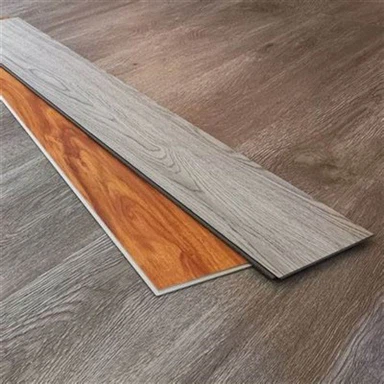
SPC flooring is a rigid core plank built from calcium carbonate and PVC, with a printed decor film and a transparent wear layer bonded above it. The core is dense and does not swell when it gets wet, the planks click together without adhesive, and the finished surface needs no sealing or waxing at any point in its life.
This page sets out what we manufacture, the combinations available, and what determines which of them suits a given project. The technical decisions behind the choice - which thickness, which wear layer, which underlay - are covered in the linked guides rather than repeated here, so that this page stays usable as a reference.
4–9 mm
Overall thickness
0.2–0.7 mm
Wear layer
Click
Angle-click, floating
Custom
Colour, format, finish
The Collection
Thickness and wear layer are chosen separately, and they answer two different questions. Thickness determines how the floor behaves over an uneven substrate and how it feels underfoot. Wear layer determines how long the pattern survives foot traffic. A plank can be thick with a thin wear layer or thin with a heavy one, and the right pairing depends on where it is going.
| Overall thickness | Wear layer | Where this pairing is normally used |
|---|---|---|
| 4 mm and 4.5 mm | 0.2 mm or 0.3 mm | Residential refurbishment over a sound substrate, and rental or light commercial interiors where a low profile avoids trimming doors. |
| 5 mm and 5.5 mm | 0.3 mm or 0.5 mm | General residential and light commercial, including kitchens and bathrooms, where a slightly thicker core bridges minor substrate variation. |
| 6 mm and 6.5 mm | 0.5 mm | Commercial interiors and retail, where the added thickness improves impact behaviour and reduces telegraphing from the substrate. |
| 7 mm to 9 mm | 0.5 mm or 0.7 mm | Heavy commercial, hospitality and public circulation, where both the wear layer and the core are being asked to do more. |
Thicker is not automatically better, and we will say so
A thicker plank costs more, weighs more and adds freight, and in a residential refurbishment over a flat substrate it frequently delivers nothing that a thinner one would not. Where a specification is being written, we will confirm the thickness the application actually needs rather than the one that increases the order value. The reasoning behind that trade-off is set out in our guide to what each SPC thickness delivers.
Thickness and wear layer are independent choices, and each answers a different question about the finished floor.
The full specification sheet for each combination, including plank dimensions, edge type and surface texture, is issued with the quotation. Where a project has a requirement outside the standard ladder, the range can be extended - see sourcing and customisation below.
What Is in the Plank
An SPC plank is a stack of layers, and each one has a job. Understanding which layer does what explains most of the performance questions buyers ask.
| Layer | Function | What it determines |
|---|---|---|
| UV-cured topcoat | The outermost film, cured after the wear layer. | Stain resistance, scuff behaviour and the level of gloss. |
| Wear layer | A transparent film over the printed decor. | How long the pattern survives traffic, and how much abrasion it takes before the print shows through. |
| Decor film | The printed design, wood or stone. | Appearance only. Its thickness is not a performance figure. |
| SPC core | Calcium carbonate and PVC, extruded as a rigid board. | Dimensional stability, indentation behaviour, and whether the floor can bridge a minor substrate variation. |
| Attached underlay | Optional foam backing, cross-linked or EVA. | Impact sound and the tolerance of small substrate irregularities. Not a substitute for a flat floor. |
The decor film thickness is a number buyers ask for and should not
The printed film carries the appearance and nothing else. What protects it is the wear layer above, and what supports it is the core below. A specification that quotes a decor film thickness as a durability figure has measured the wrong layer, and it happens often enough to be worth flagging.
Each layer answers a different question. Confusing them is the most common specification error on this product.
The wear layer is the only layer whose thickness functions as a durability specification, and it is the number worth putting in writing. Its relationship to service life, and why it does not control indentation, is covered in our guide to how long SPC flooring lasts.
Surface, Format and Edge
Appearance is specified in three parts - the decor, the texture applied over it, and the edge profile - and each is ordered separately.
Decor
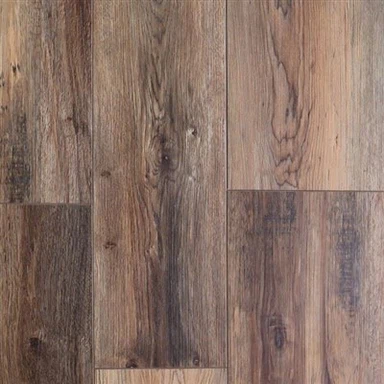
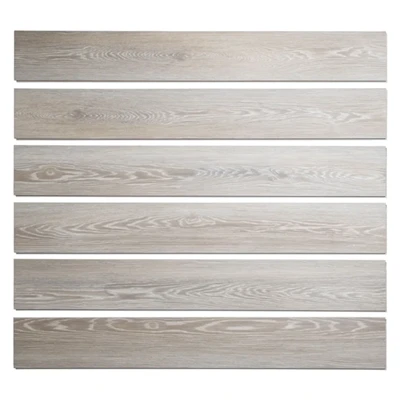
Wood grains across the range from pale ash to dark walnut, stone and marble looks, concrete and textile effects, and solid colours. Where a project is matching an existing surface, a decor can be developed from a physical sample or from a measured colour reference - the process and its limits are set out in our guide to specifying a colour.
Texture
| Texture | Appearance | Note |
|---|---|---|
| Smooth matte | Flat, low sheen. | Easiest to clean and the most forgiving of scuffs. |
| Embossed | A regular texture pressed into the surface. | Adds depth to stone and concrete looks. |
| Registered emboss | The texture is aligned to the grain in the print. | The most convincing wood effect, and the most demanding to produce consistently. |
| Hand-scraped and wire-brushed | Deliberately irregular surface. | Strong character; the texture holds dust more than a smooth finish. |
Format
Standard plank formats include 1220 × 180 mm and 1524 × 228 mm, with tile formats around 600 × 300 mm and herringbone patterns available on some decors. Custom lengths and widths can be produced against a minimum quantity, and the feasibility depends on the decor and the wear layer rather than on the core.
Edge
Square edge gives the flattest finished surface and shows joints least on a level substrate. A micro-bevel defines the plank visually and hides minor substrate variation at the joints. Bevels can be painted or left the colour of the core, and the painted version holds its definition longer where the floor sees heavy traffic.
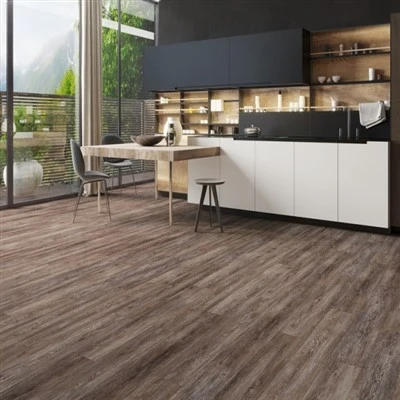
Decor, texture and edge are three separate decisions, and changing one does not change the others.
The Click System
SPC is installed as a floating floor. The planks are angled into each other along the long edge and dropped into the short edge, and the whole floor sits as one connected surface over the substrate rather than being fixed to it.
The click profile is the part of this product most likely to fail in service, and it fails in specific ways. Joints gap when the profile does not hold under load. Joints lift at the ends when the substrate is not flat enough for the plank to sit down fully. Joints pop when the floor has been laid tight to the walls with no allowance for movement. All three are installation or profile issues rather than wear layer issues, and none of them is solved by a heavier wear layer.
Click profiles are not all the same, and some are licensed
A number of click profiles are patented designs with defined pull strength and joint integrity, and a factory using a generic profile is not producing the same joint. Where a project requires a particular profile, it should be named in the specification rather than assumed. The failure modes in detail are covered in our guide to click-lock quality.
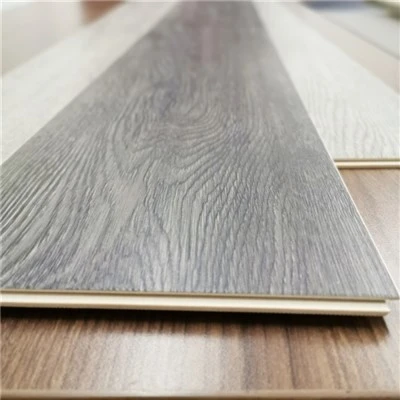
The joint is a mechanical design, and its behaviour is decided by the profile rather than by the thickness of the plank.
Two installation details account for a large share of the problems we are asked about. The first is flatness: the substrate has to be flat within a defined tolerance, and an attached underlay reduces sensitivity to small variation without removing the requirement. The second is the perimeter gap, which allows the floor to move as the room temperature changes. Both are covered in our installation guide, and the underlay question separately in our piece on when underlay is actually needed.
Compliance and Documentation
Documents are issued against the standard the destination market requires, and the set is confirmed per order rather than assumed. The list below covers what is normally available and what each document is used for.
| Document | What it is used for |
|---|---|
| Test reports | Performance against a named standard, issued by a third-party laboratory. |
| Fire classification | Building code submissions and insurance requirements, referenced to the classification system used in the destination market. |
| Slip resistance | Public and commercial floor specifications, and accessibility requirements. |
| Formaldehyde and VOC | Indoor air quality requirements, and declarations for green building schemes. |
| Heavy metals and phthalates | Consumer safety regulations in the destination market. |
| Declaration of conformity | A statement supporting the CE marking where the European market requires one. |
Test reports are specific, and a report for one product does not cover another
A fire report issued for one construction does not automatically transfer to a different thickness or a different backing. Where a project depends on a particular classification, the report should be checked against the exact product being supplied rather than against a similar one. This is a common source of difficulty at the point of delivery, and it is cheaper to resolve at quotation.
The framework behind these documents, including how the different classes are defined and what each one actually tests, is covered in our guides to certification requirements and to sourcing and compliance.
Sourcing and Customisation
We supply SPC flooring to importers, distributors, own-brand programmes and project buyers. Four things are normally agreed before an order is confirmed.
The specification, as a list of values rather than a description - thickness, wear layer, format, texture, edge and colour reference.
The samples and the colour reference, with the approved sample measured and recorded so the reference survives the sample itself.
The quantity, the packing and the shipping terms, quoted against the specification rather than against a generic product.
The document set required for the destination market, confirmed before production rather than requested after it.
Minimum quantity depends on what is being changed
Ordering a standard decor in a standard format carries one minimum. Changing the decor, the format or the backing involves setup, and carries another. Because the figure moves with the specification, we quote it against the actual requirement rather than publishing a number that would be wrong for most enquiries. Sending the specification first is the fastest route to a usable quotation.
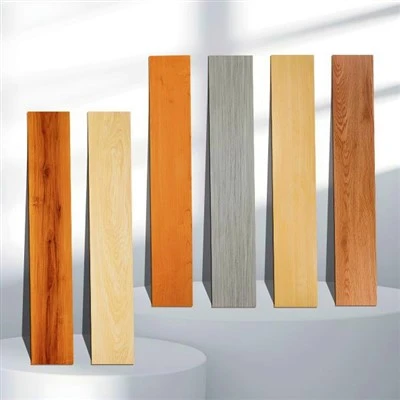
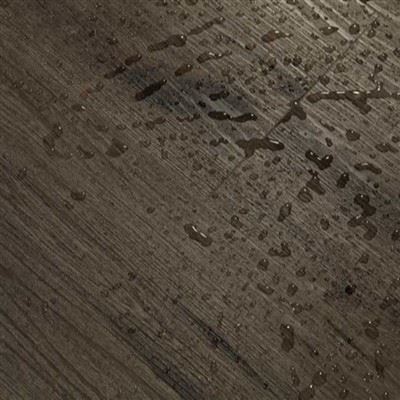
The core does not swell, so the floor is suitable for kitchens, bathrooms and utility areas without a separate product.
The property that most often decides SPC over an alternative is that the core is unaffected by water at the level a domestic floor ever sees. It is not affected by a spill, a leak or a wet mop, and it does not need sealing at the joints to remain so. The detail behind that claim, and where the limits sit, is covered in our guide to waterproof SPC flooring.
Where the project is commercial rather than residential, the requirements shift toward impact behaviour, indentation and the document set rather than toward appearance, and the reasoning is set out in our guide to SPC flooring for commercial spaces.
Where It Is Used
| Sector | Typical specification | What drives the choice |
|---|---|---|
| Residential | 4.5 mm to 5.5 mm, 0.3 mm wear layer | Appearance, quiet underfoot, and a low profile that avoids trimming doors. |
| Hospitality and retail | 5.5 mm to 6.5 mm, 0.5 mm wear layer | Traffic volume, indentation from furniture, and a document set that satisfies the client. |
| Healthcare and education | 6 mm to 7 mm, 0.5 mm to 0.7 mm wear layer | Hygiene, chemical cleaning, slip resistance and fire classification. |
| Wet areas | 5 mm and above, with sealed or tight joints | Water tolerance, which the core provides, and slip resistance. |
| Underfloor heating | 5 mm and above, with a suitable underlay | Thermal resistance of the assembly, which governs how much heat reaches the room. |

The same core serves every sector. What changes between them is the wear layer, the thickness and the documents.
Frequently Asked Question
Buying SPC Flooring
Questions we are asked most often at the enquiry stage.
What thickness do I need?
It depends on the substrate and the traffic rather than on a preference. A flat substrate in a residential refurbishment is well served by 4.5 mm. An uneven substrate or a commercial interior benefits from the additional bridging and impact behaviour of 6 mm and above. We will confirm the thickness the application actually needs rather than the highest one available.
What wear layer should I specify?
It is set by traffic and by how long the floor is expected to last between replacements. A domestic interior works with 0.3 mm. Commercial and public interiors generally call for 0.5 mm, and heavy circulation areas for 0.7 mm. The wear layer is the one layer whose thickness functions as a durability figure, and it is worth naming explicitly in the specification.
Is SPC the same as WPC or LVT?
No. SPC has a dense mineral-filled core, which makes it rigid and dimensionally stable. WPC has a foamed core, which is softer and thicker for the same stability. LVT is a flexible vinyl plank without a rigid core. They look similar in a photograph and behave differently underfoot and over an uneven substrate.
Can it go in a bathroom or a kitchen?
Yes. The core does not swell when it gets wet, so a spill, a leak or a wet mop does not affect it, and the joints do not need sealing to keep water out of the core. The requirements that apply in a wet area are slip resistance and adequate substrate preparation rather than water tolerance.
Can it go over underfloor heating?
Yes, subject to the assembly. What governs performance is the thermal resistance of the whole build-up, including any attached underlay, because that determines how much heat reaches the room. A thick foam backing under a thick plank will reduce the output of the heating system, and the combination has to be checked rather than assumed.
What is the minimum order?
It depends on what is being changed. A standard decor in a standard format carries one minimum, and changing the decor, the format or the backing involves setup and carries another. Because the figure moves with the specification, we quote it against the actual requirement rather than publishing a number that would be wrong for most enquiries.
Can I have my own colour and my own brand on the box?
Yes. Decors can be developed from a physical sample or a measured colour reference, and packaging can be printed to your own design. Colour development is the part that takes time, so it is worth starting it before the rest of the specification is finalised. The process is covered in our guide to specifying a colour.
What documents come with an order?
The set is confirmed per order against the requirements of the destination market, and normally includes third-party test reports, fire classification, slip resistance, and declarations covering formaldehyde, VOC and restricted substances. Where a CE marking is required, a declaration of conformity is issued. It is worth naming the required documents at quotation, since a report issued for a different construction does not transfer.
© 2026 YUPSENI. All rights reserved. Specifications, available formats and document sets vary by product and destination market. Confirm current values, minimum quantities and the applicable standards with us before placing an order.
Hot Tags: rigid spc flooring, China, manufacturers, factory, customized, wholesale, free sample
No Information