


I. The Unspoken Rule of SPC Flooring: The Installation Is Harder Than the Material, and Nobody Admits That Out Loud
SPC flooring marketing is built on accessibility. "Install it yourself in a weekend." "No special tools required." "Floats over most existing floors." These claims are not false. They are incomplete. What they omit is the quiet truth that every experienced installer knows: the material itself is forgiving, but the installation protocol is not. Miss a single requirement - subfloor flatness, expansion clearance, locking engagement angle - and the floor will not fail immediately. It will fail months later, after the furniture is in place, after the final payment has cleared, after the client has stopped thinking about the floor and started living on it. That is when the seam opens, the edge peaks, the hollow spot appears underfoot. And by then, the fix is no longer a simple re-click. It is a partial disassembly, often involving baseboard removal, furniture relocation, and - most painfully - a conversation with a client who trusted you.
The six rules that follow are not best practices. They are failure-prevention protocols. Each one addresses a specific physical mechanism that will destroy an SPC floor if left unmanaged. Skip any one of them, and the floor may still look perfect on installation day. It will not look perfect six months later. The goal of this guide is to ensure that the floor you install this week is the same floor your client walks on, without complaint, five years from now. For a comprehensive material overview before diving into installation specifics, browse the YUPSENI SPC flooring range →
II. Acclimatization Is Not a Suggestion - It Is the Difference Between a Floor That Locks and a Floor That Fights
SPC flooring is often described as "dimensionally stable" - and compared to laminate or solid hardwood, it genuinely is. The stone-powder core, typically 60–75% calcium carbonate by weight, has a linear thermal expansion coefficient approximately one-third to one-half that of HDF-based laminate. This is a genuine engineering advantage. It is not, however, immunity. SPC planks still expand and contract with temperature changes. A 1.2-meter plank subjected to a 15°C temperature swing between a cold transport truck in winter and a heated interior can change in length by roughly 1.5–2.5 mm. That is enough dimensional change to compromise a tightly laid floor if the planks have not equilibrated to the installation environment before they are locked together.
The protocol: Bring the sealed cartons of SPC flooring into the room where they will be installed. Stack them flat - never on edge, which introduces gravitational creep that can permanently deform the click-lock profile. Leave them undisturbed for a minimum of 24 hours. If the temperature difference between the transport/storage environment and the installation room exceeds 15°C, extend the acclimatization period to 48 hours. The HVAC system should be operating at the building's normal occupied settings - the goal is for the planks to equilibrate to the conditions they will experience for the rest of their service life, not to a temporary construction-phase thermal state.
Open the cartons only when you are ready to begin installation. The factory packaging maintains a controlled microclimate around the planks; opening the cartons prematurely exposes them to ambient humidity fluctuations that can introduce edge curl or dimensional settling before installation begins. A common field shortcut - opening all cartons at the start of the day so planks are "ready to grab" - introduces an unnecessary variable. Open one carton at a time. Install it. Open the next.
III. The Subfloor Prep Sequence Most Installers Skip, and the Callback It Guarantees
If acclimatization is the most-skipped rule, subfloor preparation is the most under-executed one. SPC flooring is rigid - far more rigid than luxury vinyl plank or sheet vinyl. This rigidity is an advantage for durability and indentation resistance. It also means that the flooring will not conform to subfloor irregularities the way a flexible vinyl product will. Every dip, hump, and ridge in the subfloor telegraphs through an SPC plank and into the locking mechanism, where it concentrates stress at the seam. The result is not a visible bump - SPC is too stiff for that. The result is a seam that quietly separates under repeated foot traffic, starting at the point of maximum subfloor deviation and propagating outward.
The Flatness Standard That Actually Matters
The industry-standard flatness requirement for SPC flooring is 3 mm over a 2-meter straightedge for the entire installation area. This is tighter than the standard for laminate (typically 3 mm over 1 meter) because SPC's rigidity transmits subfloor irregularities more directly into the locking mechanism. The measurement must be taken in multiple directions - parallel to the planned plank direction, perpendicular to it, and diagonally. A subfloor that meets the flatness standard in one direction but fails in another will still produce seam failures, because the stress concentration at the locking mechanism does not care which direction the deviation runs.
Concrete subfloors require grinding of high spots and filling of low spots with a cement-based self-leveling compound. The compound must be fully cured - typically 24–72 hours depending on thickness and ambient conditions - before installation begins. Wood subfloors require screwing down any loose or squeaking boards, sanding high spots at board edges, and filling gaps or low areas with a trowelable floor patch compound. Existing hard-surface floors - ceramic tile, sheet vinyl, existing laminate - can serve as subfloors provided they are well-adhered, structurally sound, and meet the flatness standard. Carpet and cushioned vinyl must be removed; the soft substrate will allow vertical plank movement that destroys the locking mechanism over time.
Moisture: The Stealth Variable
SPC flooring is waterproof through its entire cross-section - the stone-powder core does not absorb moisture. This creates a dangerous assumption: that subfloor moisture testing is unnecessary. It is necessary. The SPC plank itself may be unaffected by moisture, but the locking mechanism is not designed to operate under hydrostatic pressure, and a persistently damp subfloor - particularly a concrete slab-on-grade - can create a micro-environment where condensation forms on the underside of the flooring, promoting mold growth on the subfloor surface and, in extreme cases, mineral efflorescence that physically lifts the planks. For concrete subfloors, conduct a moisture vapor emission test or an in-situ relative humidity probe test per ASTM F2170. The maximum acceptable reading varies by manufacturer; typical limits are 75–80% internal relative humidity or 3–5 lbs per 1,000 ft² per 24 hours MVER. If readings exceed the manufacturer's limit, install an appropriate vapor barrier before the underlayment.
For a parallel deep-dive into expansion physics across flooring types, see our complete expansion gap guide →

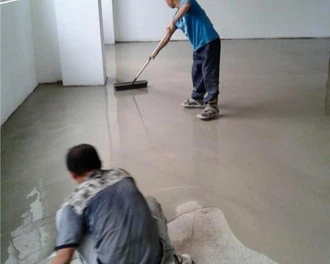

Fig. 1 - Subfloor preparation: the invisible half of every successful SPC installation. Left: grinding a concrete high spot. Center: self-leveling compound filling a low area. Right: the straightedge test - 3 mm maximum deviation over 2 meters in any direction. Subfloor flatness is not a recommendation. It is the foundation on which the locking mechanism either survives 20 years or fails within 20 weeks.
IV. Expansion Gaps - How Much, Where, and the One Place Everybody Forgets
Of all the SPC installation failures I have documented across contractor interviews, site visits, and warranty claim records, expansion-gap errors account for more than half. This is not because the requirement is technically difficult. It is because the gap is invisible behind baseboard and trim, which makes it psychologically easy to shrink - and the consequences of a too-small gap take months to appear, which makes the cause-and-effect relationship easy to deny.
The physics is straightforward. SPC flooring expands and contracts with temperature changes. A 10-meter continuous run subjected to a 15°C seasonal temperature swing will change in length by roughly 8–12 mm over the course of a year. If the perimeter expansion gap is less than this movement range, the expanding floor will press against the wall - or, more precisely, against the baseboard, the door casing, the cabinet toe-kick, or the plumbing penetration - and the compressive stress will release at the weakest point in the floor assembly. That weakest point is almost always a seam somewhere in the middle of the room, far from the pinch point. The planks will peak or separate at that seam, and the homeowner will call the installer, and the installer will blame the flooring. The flooring is not at fault. The gap was.
The Expansion Gap Specification
- Perimeter gap at all vertical surfaces: 6–10 mm minimum. This includes walls, door frames, columns, kitchen island bases, staircase newel posts, fireplace hearths, and any other fixed vertical obstruction. The wider gap (up to 12 mm) should be used for rooms exceeding 10 meters in any direction, or for installations in regions with extreme seasonal temperature swings (continental climates with 30°C+ summer-to-winter differentials).
- Doorway transitions: The expansion gap must continue through doorways - it does not stop at the door jamb. Use a T-molding or threshold trim piece to bridge the gap at the doorway while maintaining the expansion clearance beneath the trim. Cutting the flooring tight to the door jamb is one of the single most common expansion-gap violations.
- Heavy fixed objects: Kitchen islands, built-in cabinetry, and heavy furniture that cannot be moved (pianos, large aquariums) create pinch points. The expansion gap must be maintained around these objects, and the flooring should not be installed underneath them - the compressive load of a 300 kg kitchen island is not expansion-compatible with a floating floor.
- The forgotten place: Radiator pipes, plumbing penetrations, floor outlets, and any other vertical penetration through the floor plane require an expansion gap - not just a hole cut to size. Drill the hole 10–12 mm oversized and conceal the gap with an escutcheon or pipe collar. A plank cut tight around a heating pipe will pinch that pipe as the floor expands, transferring stress into the nearby seams.
V. Click-Lock Mechanics: The 15° Angle That Changes Everything
SPC flooring locking systems are precision-engineered polymer geometries. The locking profile - a tongue-and-groove variant with an undercut locking ridge and a corresponding receiving channel - is extruded to tolerances measured in hundredths of a millimeter. When correctly engaged, the joint is mechanically locked in both the vertical and horizontal planes. The plank cannot lift, and the plank cannot separate laterally, without physically fracturing the locking profile. This is the engineering basis for the "click-lock" claim. It is true. But it is only true if the engagement protocol is followed exactly.
The Engagement Sequence
Long-side engagement first. Hold the plank at approximately a 15°–20° angle to the already-installed plank. Insert the tongue into the groove along the entire length of the long side. The angle must be consistent - if the plank is held at 30°, the tongue will not seat fully; if held at 10°, the locking ridge may not clear the receiving channel. Lower the plank to the subfloor in a smooth, continuous motion. You should feel - and in some systems, hear - the locking ridge snap into the receiving channel. The plank should now lie flat against the subfloor, with no visible gap along the long-side seam.
Short-side engagement second. Position the short end of the next plank against the short end of the already-installed plank. Most SPC locking systems use a "drop-and-lock" or "tap-to-lock" short-side mechanism. Align the short-end profiles, apply downward pressure or light tapping with a tapping block, and the short side will lock. Never hammer directly on the locking profile - use a tapping block or a scrap piece of SPC plank with the locking profile engaged to distribute the tapping force across the entire joint. Direct hammer impact on the locking profile will crush or deform it, creating a joint that appears locked on installation day but lacks the mechanical engagement to survive thermal cycling.
The Stagger Rule
End joints of adjacent plank rows must be staggered by a minimum of 200–300 mm (8–12 inches), depending on the manufacturer's specification. This is not an aesthetic guideline. It is a structural requirement. Closely spaced end joints - or, worse, aligned end joints forming an H-pattern - create a continuous weak line across the floor where the short-side locking mechanisms are all in alignment. Thermal expansion and foot-traffic flexing concentrate stress along this line, and the short-side locks will progressively fail. A random or offset stagger pattern distributes end-joint stress across the entire floor area, where no single seam carries a disproportionate structural load.
| Click-Lock Installation Variable | Correct Practice | Common Mistake | Failure Mode |
|---|---|---|---|
| Engagement Angle | 15°–20° | Too steep (>25°) - tongue does not seat fully Too flat (<10°) - locking ridge binds |
Seam separation within days to weeks |
| Lowering Motion | Smooth, continuous, single motion | Jerky or partial lowering; plank dropped from height | Partial lock engagement; seam opens under traffic |
| Tapping / Seating | Tapping block + rubber mallet | Direct hammer strike on locking profile | Crushed locking ridge; joint cannot hold mechanically |
| End-Joint Stagger | 200–300 mm minimum; random pattern | H-pattern (aligned joints); stair-step pattern; <150 mm stagger | Progressive short-side lock failure along the alignment line |
I watched a crew install 80 square meters of SPC flooring in a Melbourne apartment last year. The lead installer - a man who had been laying floors for almost two decades - used a technique I had never seen before. After clicking the long side at the prescribed angle and lowering the plank, he would run two fingers along the seam, applying light downward pressure as he walked the length of the plank. "That is my seam check," he said. "If my fingers feel the locking ridge settle that last half-millimeter, I know it is home. If I do not feel it, I lift and re-engage. Takes three seconds per plank. I have not had a seam callback in seven years." The technique is not in any manufacturer's installation guide. It is the kind of field-evolved practice that separates installers who rely on the locking system from installers who verify it.
VI. Room-by-Room: The Layout Strategy for Kitchens, Bathrooms, Long Corridors, and Doorways
SPC flooring does not care what room it is installed in - the material properties are the same in a kitchen, a bathroom, a hallway, or a living room. But the installation geometry changes, and with it, the failure risks change. What works as a layout strategy in a square bedroom will create problems in a long narrow corridor or an L-shaped open-plan living area. Each room shape imposes its own stress-distribution pattern on a floating floor, and the installation strategy must anticipate where those stresses will concentrate.
The Long Corridor Problem
A corridor that runs more than 8–10 meters in length without a doorway break is the most thermally stressed geometry in residential SPC installation. The expansion accumulates along the entire continuous length, and the corridor width - typically 1–1.5 meters - provides insufficient mass to resist the compressive force. The solution is not "wider expansion gaps at the ends" - though those help. The solution is to break the continuous run with a transition strip at each doorway, creating independent floating floor sections that expand and contract individually. If the corridor has no doorways for its entire length, install a T-molding expansion joint at the midpoint. This is functionally a doorway without a door - a defined break in the flooring plane that gives each half of the corridor its own expansion clearance.
Kitchen and Bathroom: The Heavy-Object Problem
Kitchens present the single most common heavy-object conflict in SPC installation. The kitchen island, the refrigerator alcove, the range - each of these is a fixed or semi-fixed heavy object that restricts the floor's ability to expand and contract as a single floating unit. The rule: SPC flooring should not be installed under fixed cabinetry or kitchen islands. The flooring should be installed up to the cabinet base, with the expansion gap concealed by the toe-kick or a quarter-round molding. Installing flooring under cabinets pins the floor in place, eliminates the expansion clearance on that entire edge, and transfers thermal expansion stress into the nearest seam - which will be in the middle of the kitchen walkway, exactly where foot traffic compounds the problem.
Bathrooms require the same expansion-gap discipline as every other room, with one additional requirement: the perimeter sealant. After baseboard installation, apply a continuous bead of flexible, waterproof silicone sealant at the junction between the flooring and the bathtub, shower base, and toilet base. This seal prevents standing water from seeping under the flooring - water that, pooled in the subfloor micro-depressions, will create a persistent damp environment that promotes mold growth beneath a floor that is itself waterproof. The irony is worth noting: waterproof flooring, installed without a perimeter seal in a wet room, can trap water beneath itself that would have evaporated from a less waterproof surface.
The Doorway Transition
Every doorway - even between two rooms both receiving SPC flooring - requires a transition strip that maintains the expansion gap. The common shortcut of running flooring continuously through a doorway without a transition strip creates a single large floating floor assembly across two rooms. This is permissible provided the total continuous dimension in any direction does not exceed the manufacturer's maximum run length. If it does - and for runs exceeding 12–15 meters in open-plan layouts - a T-molding expansion break must be installed in the doorway to divide the floor into independently expanding sections.
Cut the door jamb and casing to the correct height before laying the flooring. The plank should slide under the jamb with the expansion gap maintained between the plank edge and the jamb's concealed inner face - not butt against the jamb face. An undercut saw makes this cut clean and fast. Skipping the undercut and scribing the plank around the jamb is the slower, visually inferior, and structurally wrong method.


Fig. 2 - The transitions that determine long-term floor integrity. Left: T-molding at a doorway, maintaining independent expansion for each room while bridging the gap visually. Center: undercut door jamb - the plank slides beneath, expansion clearance maintained at the concealed inner face. Right: flexible silicone perimeter seal at the bathtub junction - waterproof flooring, properly sealed at the wet edge.


