I. What SPC Actually Is - And Why It's Not Just "Fancy Vinyl"
SPC stands for Stone Plastic Composite. That name is descriptive, not aspirational. The material's base layer is a fused compound in which limestone powder - calcium carbonate - accounts for the majority of the mass, blended with polyvinyl chloride resin and environmentally stabilized additives under heat and pressure until the mixture becomes a dense, rigid sheet. The resulting substrate carries the hardness and dimensional stability of stone while retaining enough polymer flexibility to absorb impact without cracking and to be cut and installed with standard woodworking tools.
Cut a cross-section of a commercial-grade SPC plank from top to bottom and you will find four or five functional layers, each one doing a job the others cannot do alone. At the surface, a UV-cured coating - measured in microns, not millimeters - provides the first line of defense against scuffs, stains, and microbial adhesion, and sets the floor's initial sheen from matte to semi-gloss. Directly beneath it, the transparent wear layer - the workhorse - takes the full force of every footstep, every dragged chair, every pallet jack's wheel. For commercial applications, this layer sits at or above half a millimeter thick. Below the wear layer, a printed decor film reproduces the material the floor is designed to look like: oak grain with knots and cathedral arches, Carrara marble veining, aged concrete with aggregate exposure, woven linen texture, or custom patterns specified by a chain brand's design team. Underneath the decor sits the SPC core itself - a calcium-carbonate-rich slab with density typically landing above two grams per cubic centimeter, harder than any wood-based composite and stable enough to resist expansion and contraction across temperature swings that would gap a laminate floor within a season. On many commercial products, a pre-attached acoustic underlayment - usually IXPE or EVA foam - cushions footfall and dampens sound transmission to the floor below.
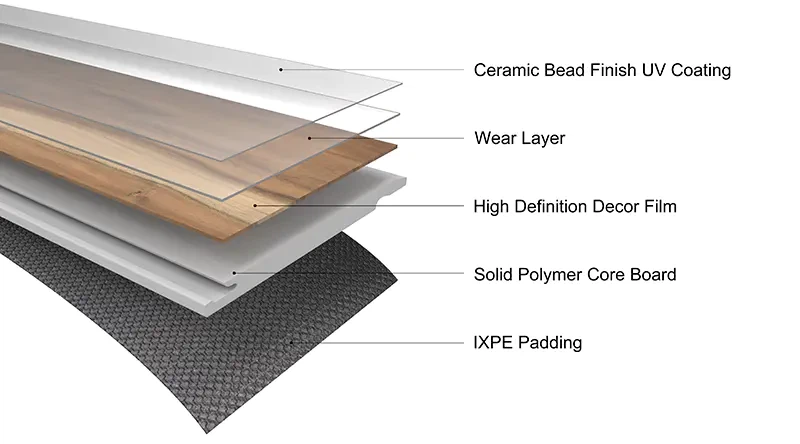
The layered architecture of a commercial SPC plank: the stone-rich core provides compressive strength and dimensional stability, the polymer component seals against moisture, and the wear layer absorbs the daily mechanical assault. No single layer could do all three jobs.
This layered architecture solves a problem that has bedeviled commercial flooring for as long as commercial spaces have existed: the properties that make a floor hard enough to resist indentation tend to make it brittle; the properties that make it waterproof tend to make it feel synthetic. SPC splits these responsibilities across layers. The limestone-heavy core shoulders compression and stability - bearing the weight of refrigerated cabinets that have not moved in five years without developing permanent depressions. The polymer component provides a moisture barrier that is molecular, not applied - water cannot penetrate the core because the core itself is impervious. The wear layer and decor film carry the aesthetic and attrition duties at the surface. The result is a floor with the hardness signature of stone and the moisture immunity of vinyl, packaged in planks that click together without adhesive and can be walked on the same day they are laid. Browse YUPSENI commercial SPC flooring specifications and wear-layer options.
II. Ten Thousand Footsteps, Spilled Drinks, and Pallet Jacks - What a Commercial Floor Actually Endures Every Single Day
"Ten thousand footsteps" sounds abstract until you break it into the specific forces that reach the floor surface. A high heel concentrates body weight onto a contact area smaller than a postage stamp, generating point pressures high enough to indent or fracture a material that feels perfectly solid to the hand. The hard plastic wheels of a delivery cart trap microscopic sand and glass fragments against the floor and roll them under load, grinding the surface like a slow-motion belt sander. Sugary soda, salad dressing, cooking oil, and milk-based sauces - all acidic, all sticky, all capable of penetrating porous surfaces or etching finished ones - land on the floor in unpredictable patterns throughout every service period. Sunlight angled through storefront windows delivers hours of thermal cycling and ultraviolet exposure that fade and embrittle surface treatments. Meanwhile, heavy static loads - a stainless-steel prep table, a double-door commercial freezer - sit in the same position for years, pressing down with a patience that reveals which materials will creep and which will hold. Each of these forces, applied individually, is enough to degrade a traditional flooring product on an accelerated schedule. SPC faces all of them simultaneously.
The wear layer is where this battle is won or lost. In commercial SPC, the transparent sheet that covers the decor - measured in mils in the North American market, millimeters elsewhere - functions as a sacrificial shield. A wear layer rated at twenty mils or above, which translates to roughly half a millimeter, can tolerate tens of thousands of abrasion cycles in a Taber test before the printed pattern underneath begins to show through. Under the European EN 13329 classification, this corresponds to AC4 for heavy residential and moderate commercial use, or AC5 for heavy commercial traffic. In practice, it means the corridor between a coffee shop's counter and its pickup station - arguably the most heavily trafficked twelve square feet in the entire retail industry - can absorb years of constant footfall and rolling cart wheels without the decor pattern emerging through the surface. Once the wear layer on any floor breaches, the decline accelerates: the printed pattern wears through at the high points, the exposed substrate begins to absorb contaminants, and the floor's visual life ends even though its structural life may have years remaining. The difference between a floor that looks commercially presentable at year five and one that does not is often a matter of a fraction of a millimeter specified at purchase.
And then there is water.
Restaurants and retail spaces are wet environments - not intermittently wet like a residential bathroom, but chronically wet like a workspace where liquids are a constant operational variable. Kitchen floors see splash-out from sinks and sprayers, condensation from refrigerator doors, dropped ice that melts in place, and the steady drip of dish racks moving from washer to storage. Front-of-house floors absorb spilled beverages, tracked-in rain, and the mop water applied during closing cleanup. The traditional solution - ceramic or porcelain tile - handles water at the tile surface but fails at the grout line, which is a cementitious channel of micro-porosity that absorbs whatever liquid sits on it, along with the bacteria that liquid carries. SPC sidesteps the grout problem entirely. The planks join via a click-lock mechanism that, when properly seated and treated with edge-sealing during manufacture, prevents surface liquids from reaching the subfloor. The core material itself absorbs essentially no water - the calcium-carbonate-polymer matrix is non-porous by composition, not by coating. A spill that sits on an SPC floor for the duration of a lunch rush can be mopped up without the board swelling, delaminating, or lifting at the seam. For operators who cannot afford to close a section of the dining room for floor repairs, this characteristic alone reshapes the maintenance calendar.
Load-bearing performance follows from the core's composition. The stone-rich substrate registers above seventy on the Shore D hardness scale - a reading closer to ceramic than to wood, and substantially higher than the wood-plastic composite flooring that preceded SPC in the market. This hardness translates directly into resistance to the kind of plastic deformation that leaves permanent dimples under heavy static loads. A restaurant equipment leg bearing down through a small steel foot can generate localized pressure that will, over weeks and months, imprint itself into a softer floor like a fossil. SPC's limestone-loaded core distributes that load efficiently enough that the floor stays flat. The same property resists the rolling indentation of pallet jacks and hand trucks - wheels that would leave visible tracking on a conventional vinyl product within months produce little to no lasting impression on properly specified commercial SPC.
Fire resistance and hygienic performance round out the specification. The high mineral content of the SPC core makes the material inherently difficult to ignite - it does not propagate flame once the ignition source is removed, and smoke generation during combustion is lower than that of many polymer-based flooring products. Products that carry certifications equivalent to ASTM E648 Class I or EN 13501-1 Class Bfl-s1 satisfy the fire-code requirements of most commercial, hospitality, and public-building applications. On the hygiene side, the non-porous surface combined with minimal seam count - no grout grid, no adhesive lines - eliminates the crevices where bacteria colonies establish themselves. Some commercial SPC products incorporate antimicrobial additives - silver-ion compounds are the most common - into the UV coating or wear layer, providing continuous suppression of the bacterial species that health inspectors check for. Restaurants, bakeries, and supermarket fresh-food sections that face frequent and unannounced sanitation audits benefit from a floor whose surface does not provide a foothold for microbial growth between cleaning cycles. Explore YUPSENI commercial SPC flooring with antimicrobial wear-layer options.
| Material | Water Resistance | Wear Resistance (High-Traffic) | Underfoot Comfort | Installation Downtime | Spot Repairability |
|---|---|---|---|---|---|
| SPC (commercial grade) | 100% waterproof - core absorbs near-zero moisture | AC4–AC5; 0.5mm wear layer rated for heavy commercial | Moderate - rigid core; acoustic backing helps | Click-lock; same-day use; can work around fixed equipment | Individual planks replaceable without disturbing adjacent floor |
| Ceramic / Porcelain Tile | Tile body waterproof | Excellent - hard glaze resists abrasion | Hard, cold; no give underfoot | Mortar + grout cure time; full area closure required | Replacement requires chipping out grout and resetting individual tiles |
| Laminate | Fails - HDF core swells irreversibly on water contact | AC3–AC4; surface wears white in traffic lanes within 18–24 months | Warmer than tile; still rigid | Click-lock; same-day use | Replaceable with difficulty - locking edges degrade on removal |
| Commercial Carpet | Absorbs and retains moisture; substrate damage if soaked | Crushed pile; matting in traffic lanes | Soft, quiet, warm | Glue-down; requires curing time | Patching visible; full sections typically replaced |
| Epoxy | Seamless, waterproof | Good - but scratches and cracks propagate across entire slab | Hard, cold, industrial feel | Multi-coat application with cure windows; days of closure | Crack repair requires sectional grinding and re-coating |
III. Inside Kitchens, Retail Aisles, and the Café That Instagram Built
Spec sheets are useful, but the real test of a commercial floor happens in specific spaces with specific operational rhythms. Here is how SPC performs in three of the most demanding commercial environments.
1. Fast-casual restaurants - from the hot line to the dining room
Chain quick-service and fast-casual restaurants were among the first commercial segments to adopt SPC at scale, and the operational logic is easy to trace. These businesses run on standardized build-outs, tight turnaround windows between closing and opening, and a cleaning regimen that has to be completed inside of two hours after the last customer leaves. SPC's click-lock installation - no mortar, no adhesive cure time - means a franchise location can receive a full floor replacement overnight and open for breakfast service the next morning. For renovations in operating stores, crews can work section by section around fixed kitchen equipment that would be prohibitively expensive to disconnect and move, laying planks up to the equipment base and trimming the final row to fit. The downtime cost - often the single largest hidden expense in a commercial flooring project - collapses to a fraction of what tile or epoxy demands.
In the back-of-house, the conditions are aggressive: frying oil aerosol settles on every surface, pot wash stations spray continuously, and the floor sees rapid thermal cycling as hot water from cleaning alternates with cold from walk-in freezer traffic. Traditional tile grout in these environments turns a permanent shade of grease-stained yellow-brown within a year; scrubbing restores only partial color, and the underlying bacteria load persists. SPC's seam-minimized surface presents nothing for grease to penetrate. A degreasing cleaner and a microfiber mop restore the surface in a single pass. In the front-of-house, the aesthetic calculus is different but equally important. Full-service casual restaurants favor wide-plank wood-look SPC - the format reads as warm and residential at the dinner table level but performs as commercial when a full glass of red wine hits the floor and sits there through two courses before anyone notices.
2. Retail - clothing floors, electronics showrooms, and grocery aisles
Retail spaces make a different set of demands. The floor is part of the visual merchandising backdrop, and it needs to stay that way. A fashion boutique that chooses light gray micro-cement-look SPC does so because the floor recedes visually - it does not compete with the clothing on the racks - while also reflecting enough light to make the space feel airy under spot lighting. The same floor has to survive the constant repositioning of display tables and garment racks, whose metal legs scrape and pivot across the surface hundreds of times per seasonal reset. An electronics showroom or mobile phone store leans toward cool-toned stone-look SPC, and the floor here faces a particular abrasion pattern: demonstration tables with rolling chairs that trace the same short arc path sixty times a day. Grocery and convenience stores add condensation and food debris to the equation - the produce section and the dairy aisle stay perpetually damp, and crushed grapes or a broken jar of pasta sauce represent a cleaning event that should not become a flooring event. SPC accepts all of it, and the overnight wet-mop recovery restores the visual standard.
3. Specialty coffee shops and bakeries - where the floor shows up in the photo
Independent cafés and bakery-cafés occupy a unique position in the retail landscape because their floors are photographed almost as often as their latte art. A customer who posts an interior shot to social media is publishing the floor to an audience of hundreds or thousands, and the terrazzo-pattern or encaustic-tile-look SPC beneath the tables needs to hold up under that scrutiny. At the same time, the barista station endures a continuous cycle of espresso splatter, steamed-milk overflow, and syrup drips that would, on a porous or grouted surface, accumulate into a sticky residue that cleaning staff dread. SPC handles both sides of this equation: the decor layer delivers the visual reference the designer specified, and the wear layer and UV coating allow the closing shift to wipe the entire floor to a uniform matte finish in under twenty minutes. The material cost per square meter for a terrazzo-look SPC plank runs a fraction of poured epoxy terrazzo or hand-laid mosaic, and the maintenance differential across a five-year lease term - no waxing, no polishing, no grout bleaching - adds operating savings that independent shop owners notice.
IV. Separating Commercial-Grade SPC From the Stuff Sold for Spare Bedrooms
Not every product labeled "SPC" on the box is built to take ten thousand footsteps a day. The residential SPC market has exploded in recent years, and many of those products share a category name with commercial-grade material while differing on every specification that determines longevity under load. Here are the checks that separate the two.
The wear layer is the first and most diagnostic measurement. If the transparent sheet above the decor is thinner than twenty mils - point five millimeters - the product is residential-grade, regardless of what the packaging says. In a showroom or a sample evaluation, ask for a cross-section piece and measure the clear layer above the print with a caliper. A commercial product should show half a millimeter or more of clear material between the surface and the printed pattern. A secondary field check that reveals a lot without equipment: press a coin edge firmly across the surface at an angle and draw it forward. A wear layer of insufficient thickness will leave a visible trail; a properly specified commercial surface will resist the scratch or show only a faint mark that wipes away. The caliper reading is definitive; the coin test is suggestive. Both are worth doing before a purchase order is signed.
Core density and composition come next. A commercial SPC plank feels heavier in the hand than its dimensions suggest - the limestone content that gives the material its compressive strength also gives it mass. A density above two grams per cubic centimeter is the reference point for heavy-traffic applications. Inspect a cut edge: the core should appear fine-grained, uniform in color - typically a clean off-white or light gray - and free of dark specks, voids, or visible coarse particles. Dark or inconsistent core coloration can indicate recycled content whose mechanical properties are less predictable than virgin material, and while recycled content has environmental merit, it should not come at the expense of the load-bearing uniformity that commercial service demands.
The locking system is the third checkpoint. Commercial SPC employs a precision-milled click-lock profile - the Uniclic and i4F families are common in the industry - designed to maintain seam integrity under rolling loads and lateral stress. A practical assessment: lock two planks together, hold the assembly by one end, and give it a sharp shake. If the seam loosens, the locking profile is underspecified for commercial use. Additionally, ask whether the locking edges carry a factory-applied sealant or wax treatment. This is the secondary water barrier - the line of defense that prevents any liquid that does penetrate a seam from reaching the subfloor. For restaurant and grocery applications, an edge-sealed lock is worth the incremental cost.
Certification documentation should be requested, not assumed. For indoor air quality - relevant because commercial spaces are occupied continuously - look for FloorScore, French A+, or an equivalent third-party VOC emissions certification. For fire rating, the product should carry test reports that satisfy the local jurisdiction's commercial building code, typically some variant of ASTM E648 Class I or EN 13501-1. For slip resistance, a test report documenting the dynamic coefficient of friction or pendulum test value under wet conditions should be available. For antimicrobial claims, the test data should specify the bacterial strains tested and the reduction percentages achieved. A supplier that cannot produce these documents for the exact product being quoted - not a related product, not a previous generation - should be treated with the same caution as one that cannot produce a cross-section sample.
V. Installation Timing, Subfloor Headaches, and the Cleaning Schedule That Keeps Inspectors Happy
SPC's ability to compress installation timelines is one of its strongest operational advantages for commercial buyers, but it is not a license to skip substrate preparation. The subfloor underneath an SPC installation needs to meet a flatness tolerance - typically a deviation of no more than three millimeters across a two-meter straightedge. On a concrete slab that has settled or been roughly finished, this means grinding high spots and filling low spots before the first plank is laid. A subfloor that falls outside tolerance will cause the click-lock joints to flex under load; over months and years, that cyclic movement fatigues the locking profile until a seam opens, and once a seam opens in a wet environment, the floor's moisture immunity is compromised from below. The prep work takes time, but skipping it converts a potential twenty-year floor into a five-year one.
Expansion and contraction are physical realities that no rigid flooring product escapes. SPC's stone-rich core is dimensionally stable compared to wood-based materials - its coefficient of thermal expansion is substantially lower - but it still moves. The installation must leave a perimeter expansion gap sized per the manufacturer's specification, typically in the five-to-ten-millimeter range for commercial spans, and in large continuous areas the floor should be segmented with intermediate expansion joints at intervals the manufacturer's technical data sheet specifies. Our guide to expansion gap requirements across flooring types covers the engineering rationale in full. In entrance zones, a high-absorption walk-off mat system captures the sand and grit that customers bring in on shoes, preventing those particles from acting as an abrasive slurry underfoot throughout the day. This single measure extends the wear layer's effective life by a margin that cleaning contractors consistently observe but rarely quantify.
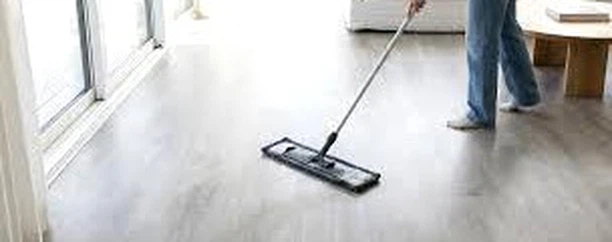
The daily protocol that keeps commercial SPC floors inspection-ready: remove dry debris, damp-mop with a neutral cleaner, walk away. No wax, no polish, no grout brush, no drying time.
Daily and weekly maintenance of a commercial SPC floor is operationally simple, and that simplicity is the point. Dry sweeping or vacuuming removes the abrasive grit that would otherwise micro-scratch the wear layer under foot traffic. A damp mop with a pH-neutral cleaner handles the food residues, beverage spills, and atmospheric grime that accumulate during operating hours. For heavy grease buildup - around kitchen equipment, in the fry station zone - a diluted degreasing agent applied with a microfiber pad lifts the oil without attacking the UV coating or the wear layer. Products containing wax, polish, or acrylic sealers should never be applied to SPC; the surface is engineered to perform without them, and a wax layer introduces slip risk while trapping dirt in a film that then requires stripping - a maintenance cycle that SPC was designed to eliminate. Abrasive cleaning powders, steel wool, and high-pressure water jets belong on the list of things that shorten a commercial floor's life. The pressure washer, in particular, can drive water between seams and past the edge seal into the subfloor, creating a problem below the planks that remains invisible until it is severe.
When localized damage does occur - a heavy metal object dropped from height that punches through the wear layer and into the core, or a deep gouge from mishandled equipment - the modular nature of SPC becomes a significant operational advantage. Individual planks can be isolated and replaced without disturbing the surrounding floor. The procedure involves heating the damaged plank and its immediate neighbors with a heat gun to relax the locking profile, lifting the damaged piece out, trimming the replacement plank to fit, and clicking it into position. For chain retail and restaurant locations where floor appearance is audited as part of brand standards, the ability to perform a spot repair during a single overnight shift without closing a section of the store represents a logistical advantage that tile and epoxy simply cannot match. YUPSENI commercial SPC flooring includes replacement-plank supply programs for chain accounts.
VI. Is SPC Perfect? No. Is It the Closest Thing Commercial Flooring Has to a Universal Answer?
Every commercial flooring material has a weakness. Ceramic tile's weakness lives in its grout lines - narrow channels of cementitious porosity that absorb, stain, and colonize bacteria in direct proportion to how wet and busy the space is. Laminate's weakness is water - any breach of the surface, any seam left unsealed, any spill that sits past the dinner hour, and the high-density fiberboard core swells like a sponge and never returns to its original dimension. Carpet's weakness is biology - it traps organic matter and moisture in its fiber matrix and becomes a long-term culture medium that no amount of hot-water extraction fully sterilizes. Epoxy's weakness is brittleness - a single crack in the substrate telegraphs through the coating, and repairing it means sectioning out a visible patch that will never match the surrounding surface exactly.
SPC's weaknesses are real but narrow. It demands a flat subfloor - the click-lock system will not forgive a substrate that undulates. Its rigidity, which is a strength under load, means it transmits footfall sound more than carpet or cushioned vinyl; the acoustic backing mitigates this but does not eliminate it. And while the wear layer resists most daily abrasion, a sufficiently sharp or heavy impact - a cleaver dropped point-down, a metal shelf bracket falling from height - can puncture the surface. But these failure modes are isolated and repairable. The floor does not fail systemically the way tile grout, laminate swelling, or epoxy cracking does. A punctured plank can be swapped. An uneven subfloor can be leveled before installation. The sound transmission can be accepted or addressed with additional underlayment. What remains, after accounting for these limitations, is a floor that handles the full commercial load profile - water, wear, weight, fire code, hygiene inspection, and aesthetic endurance - in a single product that goes down fast and comes up in individual pieces when needed.
When I talk to operators who have made the switch, they rarely describe SPC in terms of specifications. They describe what stopped happening. The quarterly flooring maintenance invoice stopped arriving. The health inspector stopped photographing the grout behind the dishwasher. The area manager stopped emailing about "the floor situation" at the high-volume location. The accounting team stopped carrying a flooring reserve on the balance sheet for every store in the region. These are not engineering outcomes, but they are the operational outcomes that engineering specifications exist to produce. SPC, specified correctly and installed to tolerance, delivers them with a reliability that has made it the default answer for a generation of commercial flooring projects - not because it was marketed well, but because it solved the problems that the previous materials kept creating.