

PVC Trim and Moulding: Why Wood Trim Fails and What Replaces It
Jul 05, 2026
~5 min read · July 5, 2026 · By YUPSENI Team

PVC exterior trim board installed as window casing on a residential facade. The white surface, mitered corners, and absence of caulk lines will look the same in twenty years.
On This Page
- I. Three Ways Wood Trim Fails - and Paint Fixes None of Them
- II. What PVC Trim Is - and Why It Cannot Rot
- III. Where Trim Failure Costs the Most
- IV. The Bill at Year Twenty
- V. Six Questions to Ask Before You Order
- FAQ
Trim is what frames a house. Window casings, door surrounds, fascia boards, crown moulding, garage door jambs - the architectural lines that give a building its silhouette. It is also the part of the house most exposed to water and least accessible for repair. Every horizontal surface catches rain. Every joint is a capillary gap. Every nail hole is a water entry point.
For centuries, trim was wood because wood was the only option. Wood rots. Paint delays the rot. Repainting delays it again. Eventually the rot wins, the trim comes off, and the cycle repeats. PVC trim and moulding breaks the cycle by replacing the material that makes rot possible. This article explains how wood fails, why PVC doesn't, where the switch pays for itself fastest, and what to verify before ordering.
I. Three Ways Wood Trim Fails - and Paint Fixes None of Them
Wood exterior trim fails through three mechanisms that compound each other.
End-grain wicking. Wood is a bundle of microscopic tubes. Cut a board, and the exposed end grain acts like a bundle of straws - water that contacts it wicks several inches into the board within hours. Paint seals the face grain but does a poor job on the rough, porous end grain. A painted miter joint that looks perfect at installation has a compromised seal at the cut ends within eighteen months.
Hygroscopic cycling. Wood absorbs moisture from air and releases it. Dimensional change across the grain ranges from 0.5% to 2% per 10% humidity swing. The board is nailed in place and cannot move freely, so stress concentrates at joints, cracking the paint film. This is not a paint failure. It is a wood-movement problem that no paint formulation solves.
Fungal decay behind the caulk. Decay fungi need moisture above 20%. When paint cracks at a joint - which it will - water reaches the wood inside. Decay propagates invisibly for years. The caulk looks intact from outside. The wood inside is softening. By the time a screwdriver penetrates the surface, the rot extends well beyond the visible damage.
Each failure mode accelerates the other two. End-grain wicking delivers water. Hygroscopic cycling cracks the paint barrier. Decay consumes the compromised wood. The only way to stop the cycle is to remove the wood.
II. What PVC Trim Is - and Why It Cannot Rot

PVC crown moulding in a classical cove-and-bead profile. The smooth white surface is integral to the material - not a paint layer that can peel.
Cellular PVC trim is a rigid closed-cell foam with dense solid skin layers on both faces. The material has no grain direction, no fiber orientation, and no microscopic tubes. Cut it at any angle - the exposed surface is the same closed-cell structure as the face. No end grain exists. Water cannot wick into the board regardless of cut orientation or joint configuration. Failure mode one: eliminated at the material level.
The material does not absorb atmospheric moisture. Thermal expansion is approximately 0.1 inches per 8-foot board across a 20°C seasonal swing - a single-variable movement accommodated by standard gap spacing at butt joints. There is no humidity-driven dimensional change. Joints do not move with weather, paint films do not crack at joints, and water has no entry path. Failure mode two: eliminated.
Rot is a biological process that requires an organic food source - cellulose and lignin. PVC contains neither. Place PVC trim in wet soil for a decade: it will be dirty. Its structural integrity will be identical to the day it was manufactured. Failure mode three: physically impossible.
Installation is identical to wood - standard carbide saw blades, pneumatic finish nails, the same miter and butt joinery. The one difference: allow a 1/8-inch gap per 18 feet at butt joints to accommodate thermal expansion, filled with PVC-compatible sealant. White PVC trim can be left unpainted permanently. If a color other than white is desired, 100% acrylic latex paint bonds directly to a clean PVC surface with no primer required. See our room-by-room PVC specification guide for full compatibility details.
III. Where Trim Failure Costs the Most
Interior crown moulding in a living room will outlast the house in any material. Three exterior locations justify PVC on economics alone.
Window Casing - the Sill That Never Dries
The bottom sill collects rain and condensation. The miter joints where the sill meets the vertical legs crack first - the sill expands horizontally, the legs expand vertically, and the paint film at the 45-degree joint fails. PVC window trim in matching sill, leg, and header profiles eliminates every rot-prone joint. The sill slopes outward at 5-7 degrees. Water sheets off the PVC surface. Nothing absorbs.
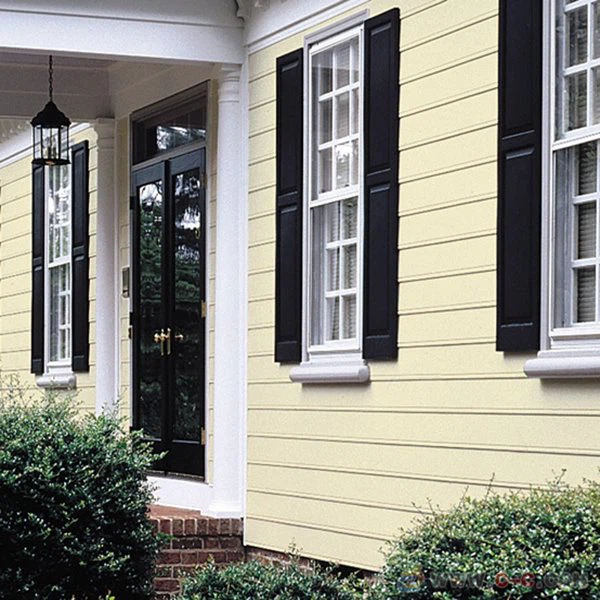
PVC window casing with header, sill, and side legs in matching profiles. The miter joints at the corners remain sealed because the trim does not move with humidity.
Fascia - the Most Expensive Trim Repair on a House
Fascia runs along the roof edge directly below the shingle drip edge, catching wind-driven rain and gutter overflow. Repair means removing the gutter, prying off the rotted board, cutting and priming a replacement, reinstalling the gutter, and repainting. Labor exceeds material cost roughly four to one. PVC exterior trim board cannot rot regardless of gutter condition. One avoided fascia replacement covers the PVC material premium on the entire house.
Garage Door Jamb - Rot at Ground Level
The bottom 12 inches of a garage door jamb sits in the splash zone with minimal roof overhang protection. Water wicks up through the end grain at the bottom cut. Replacement is difficult because the jamb integrates with the door track and weatherstripping. PVC garage door trim uses identical dimensional profiles and accepts the same weatherstripping channels. The installation procedure is unchanged. The trim just never rots.

PVC garage door trim in the splash zone. The bottom edge stays in contact with rain bounce-off from the driveway. PVC does not wick, swell, or rot at this high-exposure location.
The same logic extends to exterior crown moulding on porch ceilings, sill and drip profiles at door thresholds, and door surrounds. In every case, the material properties are the same: no absorption, no swelling, no rot.
IV. The Bill at Year Twenty - Not the Receipt at Checkout

PVC trim board with smooth-sealed surface finish. The white color is compounded into the resin - a scratch reveals the same white material beneath.
Primed wood trim costs 30-50% less per linear foot at initial purchase. That comparison ends at the first repaint. Exterior wood requires repainting every 5-7 years - scraping, sanding, spot-priming, and two coats. At current labor rates, maintenance cost exceeds the original trim material cost by the second repaint cycle. Add any rotted-section replacements, and the twenty-year total for wood trim is roughly three to five times its purchase price.
PVC trim at year twenty: no repainting, no rot replacements, no maintenance beyond an annual hose rinse.
The builder who installs wood does not pay for the repainting - the homeowner does. The builder who installs PVC sells a house that will not generate a callback about rotted window casing. Browse the full trim and moulding range.
V. Six Questions to Ask Before You Order
Two PVC trim boards with identical external dimensions can differ dramatically in core density, UV stability, and dimensional consistency. A supplier who answers these six questions with specific numbers has invested in the extrusion quality control that PVC trim requires.
| Question | Good Answer | Red Flag |
|---|---|---|
| Core density? | 0.50–0.65 g/cm³ - higher = better fastener hold | "Lightweight" with no spec number |
| Surface skin? | Smooth both faces, or smooth/textured options specified | Exposed cells on surface = poor extrusion |
| White color? | Integral - compounded into resin; scratch shows same white | Surface coating; scratch reveals different substrate |
| UV stabilization? | TiO₂ at 8–10 phr + UV absorbers; ASTM G154 test data | "UV resistant" as a verbal claim |
| Dimensional tolerance? | ±0.5 mm thickness, ±1.5 mm width; consistent across lots | "Approximately" with no range |
| Custom profiles? | Custom extrusion dies available for volume orders | "Catalog only" with zero flexibility |
Frequently Asked Questions
PVC Trim and Moulding: Common Questions From Builders and Buyers
Short, direct answers to the questions we hear most often.
Q1: Can PVC trim be painted?
A: Yes. 100% acrylic latex paint bonds directly to a clean PVC surface with no primer required. The paint stays on because the substrate does not expand with humidity - the primary cause of paint failure on wood. Dark colors require paint formulated for vinyl. White PVC can be left unpainted permanently.
Q2: Does it look like plastic?
A: Installed and painted, PVC trim is indistinguishable from painted wood beyond three feet. The matte surface skin resembles a painted wood surface. The "plastic look" concern comes from 1990s high-gloss vinyl siding - not modern cellular PVC trim.
Q3: Does cold weather make it brittle?
A: Quality cellular PVC with proper impact modifiers stays ductile well below freezing. Service range: −30°C to +60°C. Poor compounding can cause low-temperature brittleness - request cold-impact data for sub-zero climates.
Q4: Can it touch the ground?
A: No. PVC trim board is not rated for ground contact. Maintain minimum 2-inch clearance above grade. The material itself will not rot underground, but trim board lacks the structural design for soil contact.
Q5: Is PVC trim worse for the environment than wood?
A: The comparison is nuanced. Wood trim requires chemical preservatives, multiple repaint cycles with petrochemical-based paint, and eventual landfill disposal of rotted sections. PVC trim requires none of these and is recyclable at end-of-life. The recurring paint-cycle chemicals are often the largest environmental impact in wood trim's lifecycle.
Spec Your Profiles. We'll Extrude, Cut, and Ship.
Standard PVC trim profiles or custom extrusions from your drawings. Samples, data sheets, or a quotation with your profile list and quantities. Factory-direct from 30+ extrusion lines.
Request Samples & Quotation Browse All Trim ProductsThe Trim Nobody Notices
Good trim is invisible. It frames the windows, outlines the doors, defines the roofline - and sits there, year after year, without a phone call to the builder, without a line item in the maintenance budget. Wood trim has been the default for millennia because wood was the only available material. But a rotted window sill is not authentic - it is a failure. PVC trim does not replace wood's appearance. It replaces wood's failure chain. A builder who uses PVC on one house and wood on the next will get a callback from one of those homeowners. It will not be the PVC house.
YUPSENI Team
23 years manufacturing PVC building materials from a 111,480 m² facility in Shandong, China. We extrude PVC trim, fencing, railing, SPC flooring, wall panels, and ceiling systems for buyers in 100+ countries. Custom profiles from your drawings. More about YUPSENI
The information in this article is for general informational purposes only. Building codes and material specifications vary by jurisdiction. Consult local codes and manufacturer guidelines for your project. Verify product specifications with current technical data sheets before procurement.
© 2026 YUPSENI New Material Co., Ltd. All rights reserved.


