PVC Building Material Room-by-Room Specification Guide: Fencing, SPC Flooring, Wall Panels, Ceiling & Trim
Jun 22, 2026
A Walk Through the PVC House: What Every Room Demands From the Material That Built It

A single residence integrates PVC fencing, an exterior signboard, and layered interior finishes. The walk from the front gate to the back bedroom passes through at least six distinct material decisions, each driven by a different set of moisture, wear, and aesthetic demands. This guide traces that walk, room by room, product category by product category.
Most material selection guides are organized by product type - all fences in one chapter, all floors in another, all wall panels somewhere else. That is a sensible way to write a catalog. It is a strange way to build a house. Nobody installs all the fencing on a project and then installs all the flooring. The actual sequence of work follows a spatial logic, and the questions that matter about a material change depending on which room it sits in. A PVC foam board that performs flawlessly as a kitchen cabinet door can become a warped liability when someone installs the same sheet as an exterior sign. A vinyl wall panel that shrugs off bathroom steam for years can look out of place and acoustically dead in a living room where the wall surface is expected to contribute to the warmth of the space.
The six-part walkthrough that follows is structured the way a procurement manager or a self-build client actually encounters the building: from the street side to the front door, through the wet rooms and dry rooms, finishing in the corners where trim and moulding close the gaps that every other trade left behind. Each section flags the material properties that matter for that specific room, not for the product category in the abstract. The density-graded and Celuka-surfaced PVC foam boards that appear throughout this walkthrough are manufactured with batch-tested mechanical properties so that the specification for a cabinet door is not the same document as the specification for an exterior sign.
On This Page
- I. The First Impression: Fencing, Gates, and What the Road Sees First
- II. Above the Entrance: The Sign That Names the Building
- III. The Living Room and Entry: Surfaces That Set the Tone
- IV. The Kitchen: When Water, Grease, and Heat Share the Same Room
- V. The Bathroom: A Ceiling That Cannot Sag and Walls That Cannot Swell
- VI. The Last Six Inches: Trim, Cabinets, and What Finishes the Job
- Frequently Asked Questions
I. The First Impression: Fencing, Gates, and What the Road Sees First
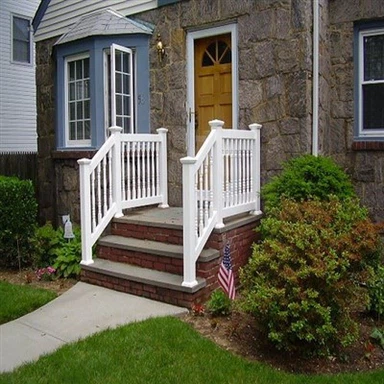
The walk starts at the property line. Before anyone touches a door handle or steps onto a floorboard, they see the fence. In a residential project, the fence is typically the largest continuous surface area on the site. It is fully exposed to ultraviolet radiation, driven rain, and the occasional bump from a delivery truck or a landscaping crew. A material that degrades at the perimeter sends a signal about every material behind it.
PVC fencing and railing solve a problem that wood and iron never solved: they do not require maintenance cycles. A painted wooden fence needs a repaint every three to five years in temperate climates and more often near the coast. An iron fence rusts from the inside out at the weld points where the galvanization was burned off during fabrication. PVC fencing manufactured with a co-extruded cap layer that locks the UV stabilizers and impact modifiers into the outer skin can hold its color and structural integrity for two decades with no intervention beyond an annual wash. The cap layer is the difference. A mono-extruded PVC post with uniformly distributed titanium dioxide will chalk within five to eight years as the UV erodes the surface. A co-extruded post concentrates the expensive stabilizers in the outer 0.5-millimeter skin where the photons actually arrive, leaving the core formulated for impact strength rather than weatherability.
The three fence specifications that matter most at the property line: co-extruded cap layer thickness (not total wall thickness), impact-modified core formulation for cold-weather impact resistance, and titanium dioxide loading in the cap layer, which directly correlates with the number of full-sun years before visible chalking appears.
The posts carry the wind load. The rails carry the pickets. The pickets carry the aesthetics. Each of those three components has a different structural profile and a different preferred formulation. The same factory should extrude all three, because color consistency between two PVC whites from different manufacturers is a gamble that almost never pays off. PVC fencing profiles co-extruded with a high-impact core and a UV-stabilized cap layer shift the long-term maintenance equation from a recurring expense to a one-time capital decision.
II. Above the Entrance: The Sign That Names the Building
Above the front door or fixed to the facade, a signboard does two things simultaneously: it communicates the name of the building or business, and it sits in the most exposed position on the entire exterior. A sign mounted above an entrance receives direct sun from mid-morning to late afternoon, catches the full force of wind-driven rain, and experiences a thermal cycle that heats the dark printed areas twenty to thirty degrees Celsius above the ambient air temperature. That thermal cycling does something subtle to a PVC foam board: it causes the skin to expand and contract at a different rate than the core, which over time can delaminate a poorly bonded Celuka surface from its foamed substrate.
The signboard chapter of the PVC walkthrough is dominated by one specification choice that cascades into every other performance characteristic: surface skin type. A Celuka-process board forms a dense, integral skin during extrusion. The skin is the same PVC formulation as the core, foamed at a different density, bonded at the molecular level at the die. A free-foam board has a slightly less dense surface that was cut from a larger block. The Celuka skin accepts fine-detail UV inkjet printing with less ink bleed and fewer pinholes. The free-foam surface is softer, more forgiving of mechanical fasteners, and typically less expensive.
For an indoor sign, the free-foam board at 0.45–0.5 grams per cubic centimeter density does the job without drama. For an exterior sign that carries the client's brand and faces the elements for five years, the specification needs to tighten: Celuka skin, 0.55–0.6 grams per cubic centimeter core density, and batch-specific skin thickness documentation. The signboard chapter also makes a case for looking at the fasteners, not just the sheet. A mounting hole drilled without a clearance gap for thermal expansion will buckle a PVC sign between the fasteners on the first hot afternoon. The PVC advertising boards that sign professionals specify for exterior applications differ from indoor sheets in skin type, density range, and documented UV performance.


The integral skin on a Celuka PVC foam board, right, forms during extrusion and bonds at the molecular level. Inkjet ink sits on top of this surface with minimal bleed. The free-foam surface, left, is cut from a larger block and exposes a slightly more open cell structure that costs less but demands a print technician who knows how to adjust ink saturation.
III. The Living Room and Entry: Surfaces That Set the Tone
The front door opens into the largest single volume in the house. The flooring in this space has to do several contradictory things. It has to look like the most expensive surface in the building without exceeding the budget of the most expensive surface. It has to survive wet shoes in the entry zone and dry-sock foot traffic on the living room side, often within the same continuous plank layout. It has to be hard enough to resist furniture scratches and soft enough underfoot that the room does not feel like a warehouse when someone walks across it in bare feet.
SPC flooring handles these contradictions by stacking layers. The core is limestone powder and PVC, rigid and dimensionally stable. The printed decorative film lives above the core and below a transparent wear layer, and the thickness of that wear layer - 12 mil, 20 mil, 28 mil, measured in thousandths of an inch - determines how many years of sand-grain abrasion the floor can absorb before the pattern starts to look worn. The living room does not need a 28-mil wear layer the way a restaurant does, but it does need enough underlayment or attached pad to soften the footfall sound. An SPC floor on a concrete slab with no acoustic underlayment turns every dropped spoon into a sharp click that bounces off the walls.
The three SPC specifications that change most between the entryway and the living room sofa zone: wear layer thickness (a cost driver), acoustic underlayment density (measured in IIC and STC ratings), and plank thickness (4mm planks feel harder; 6.5mm planks forgive subfloor imperfections better).
The walls in the living room carry a different assignment. They are the background against which art, television screens, and furniture silhouettes are seen. A flat-painted gypsum wall does the job, but a wall panel that integrates a subtle texture, a matching joint system, and a color that does not require repainting when the room is refreshed three years later changes the long-term interior maintenance equation. WPC foam board, with its roughly 20% wood fiber content, offers a warmer tactile surface than pure PVC and has found a home in living room wall paneling where the visual texture of the wall matters as much as its moisture resistance.
IV. The Kitchen: When Water, Grease, and Heat Share the Same Room
The kitchen concentrates more material stress into a smaller area than any other room in a residential building. The floor near the sink and dishwasher sees standing water. The wall behind the cooktop catches aerosolized oil droplets that polymerize into a sticky film over months. The cabinet carcasses under the sink live in a microclimate of humidity that spikes every time someone runs the hot water, and they are enclosed on five sides with almost no airflow to carry the moisture away.
For the kitchen floor, the SPC board's waterproof core is the headline specification. A laminate floor with a water-resistant surface coating can survive a wiped-up spill. It cannot survive a slow, undetected leak from a dishwasher connection that seeps under the planks and swells the HDF core over three days. SPC has no fiberboard core to swell. The limestone-and-PVC composite core is dimensionally inert in water, which means the failure mode of a flooded kitchen floor shifts from "replace the entire floor" to "remove the planks, dry the subfloor, reinstall the same planks if the locking system is intact." That distinction matters to insurance adjusters and homeowners who have learned this lesson the expensive way once and do not want to learn it again.
The kitchen wall panels are a newer conversation in residential construction. Ceramic tile and glass splashbacks still dominate, but a full-height PVC wall panel behind the cooktop and sink area eliminates the grout lines where kitchen grime accumulates. The cleaning test is the only specification worth citing here. A tile splashback with forty linear feet of grout line takes significantly longer to degrease than a single continuous panel with one silicone joint at the countertop and one at the range hood. The grout-free maintenance case for PVC wall panels in kitchen wet zones has been detailed in the comparison against ceramic tile elsewhere in this knowledge base.
The cabinets are where the PVC material specification gets tested at the limits of its chemistry. A PVC foam board cabinet door and carcass in a kitchen under-sink cabinet are exposed to relative humidity levels above 80% for sustained periods. Medium-density fiberboard and particle board absorb moisture and swell at the edges. PVC foam board with a closed-cell structure absorbs almost no water into the core. The relevant material property is water absorption by total immersion, typically expressed as a percentage weight gain after 24 hours of submersion. For PVC foam board at 0.55 grams per cubic centimeter density, that number is typically below 1%. For MDF, it is in the 15–30% range. The difference in cabinet-door alignment after three years in a humid kitchen is visible to the naked eye. Waterproof PVC cabinet boards are manufactured specifically to replace wood-based panels in the wet zones of a kitchen, delivering water absorption performance that particle board and MDF cannot match.
V. The Bathroom: A Ceiling That Cannot Sag and Walls That Cannot Swell
The bathroom is the second-wettest room in a house after a sauna. Steam rises and condenses on the ceiling. Water sprays directly onto the walls. The floor stands in shallow puddles. The conventional building materials used in bathrooms - gypsum ceiling board with a coat of semi-gloss paint, ceramic tile on cement board, vinyl sheet flooring - all work adequately when the installation and maintenance are done correctly. The PVC alternative does not claim to outperform every one of those systems on every dimension. It claims to simplify the installation and eliminate the most common failure modes.
A PVC ceiling panel installed on a clip-and-rail grid does two things that a painted gypsum ceiling cannot. It carries zero moisture into its core, which means the sagging deformation that affects gypsum ceilings in poorly ventilated bathrooms cannot happen. It can be removed in individual panels for access to the plumbing or wiring above without patching and repainting. The installation tolerance is the critical detail. A grid of ceiling panels must include a minimum expansion gap at the perimeter - typically 5 to 8 millimeters for PVC - because thermal expansion in the warm, moist air of a shower can push the panels tight against the wall and cause an upward buckle in the center of the ceiling. Builders who ignore that gap discover it on the third day of use.
The bathroom walls face a different stress vector: direct water spray at the shower wall, condensation on the vanity wall, and the constant cycle of wetting and drying that causes grout to crack and caulk to peel. A full-height PVC wall panel system with tongue-and-groove or click-lock joints eliminates the grout lines entirely, replacing dozens of potential water-ingress points with a single silicone seal at the panel-to-pan junction. PVC ceiling panels' resistance to bathroom humidity and their washable surface have made them a standard specification in rental-property bathrooms where maintenance callbacks erode the landlord's operating margin.
The bathroom floor, if it is SPC, demands the tightest seam tolerance on the job. Water that seeps through a poorly clicked seam and sits between the plank and the subfloor will not damage the SPC core, but it will create an environment for mold growth on the subfloor itself. A properly installed SPC bathroom floor has every seam rolled with a hand roller after installation and a perimeter gap sealed with a flexible silicone bead that allows the floor to expand while blocking surface water from reaching the subfloor at the edges.
VI. The Last Six Inches: Trim, Cabinets, and What Finishes the Job
The walkthrough ends in the corners. Skirting boards, door architraves, window sills, crown moulding, and the scribed filler panels that close the gap between a cabinet and a wall. No client ever entered a showroom excited about trim. But trim is the material category where the cumulative installation cost - cutting, coping, filling, sanding, painting - can exceed the material cost by a factor of three or four. PVC moulding changes that equation because it arrives pre-finished in a consistent color that does not require painting, does not absorb water at the cut end, and can be cut and installed with the same tools used for wood trim while eliminating the painting stage entirely from the schedule.
The joint quality is the specification to watch. A PVC moulding butt joint at a corner reveals the color of the core at the cut face. If the core is a slightly different shade of white than the cap layer, the joint reads as a visible line. A co-extruded moulding with a cap layer that wraps around the profile, or a formulation that color-matches the core to the surface, eliminates that line. The best PVC moulding on the market looks indistinguishable from a painted wood profile after installation. The worst looks like plastic from across the room. Pre-finished PVC decorative moulding profiles eliminate the sand-and-paint workflow that makes wood trim installation labor-intensive, and the co-extruded surface layer ensures that the color seen at the joint matches the color seen on the face.

PVC skirting and door architrave installed in a residential interior. The pre-finished surface requires no painting after cutting, and the co-extruded cap layer ensures that the cut edge at the miter joint shows minimal color contrast with the face.
The folding board is the trim category's portable relative. It shows up in exhibition stands, pop-up retail displays, and temporary partition walls. A V-groove routed into the back of a PVC foam board at a controlled depth turns a rigid sheet into a hinged panel. The specification that separates a durable folding board from a disposable one is the groove-depth tolerance. The residual material thickness at the bottom of the groove - typically 0.3 to 0.5 millimeters - is the living hinge. Rout it too deep and the board snaps on the fifth fold. Rout it too shallow and the board resists folding or crumples the surface on the bend line. Batch-specific groove-depth data from the manufacturer is the difference between a folding board that survives a trade-show season and one that ends up in a dumpster after the second assembly.
Frequently Asked Questions About Room-by-Room PVC Material Specification
Answers to the six questions that builders, importers, and project managers ask most often when planning a multi-room PVC material specification across fencing, flooring, wall panels, ceilings, and trim.
Q1: Can I source PVC fencing, SPC flooring, ceiling panels, and wall panels from one manufacturer?
A: Yes, and there is a procurement advantage beyond convenience. When a single manufacturer produces multiple PVC product lines, the color consistency across categories - white fencing, white ceiling panels, white wall panels - is controlled at the raw-material blending stage. Sourcing the same color from two different manufacturers almost guarantees a visible shade mismatch. A consolidated supplier also allows mixed-container loading, which reduces freight cost per cubic meter compared to shipping partial containers from separate factories.
Q2: Is there a quality difference between PVC boards made for indoor signs and those made for outdoor advertising?
A: The difference is in the formulation, not just the label. Outdoor-grade PVC foam boards contain higher loadings of UV stabilizers and impact modifiers to handle sun exposure and thermal cycling. Indoor boards omit those additives, which reduces cost but makes the board brittle and prone to discoloration within months if it ends up in direct sunlight. The Celuka skin type also matters more outdoors because it provides a denser, less porous printing surface that resists ink bleeding under rain and condensation.
Q3: How do SPC flooring thickness and wear layer choice change from room to room?
A: A 12-mil wear layer is adequate for a low-traffic bedroom. A 20-mil wear layer is the practical minimum for a living room or hallway. A kitchen or entryway that sees grit carried in on shoes warrants a 28-mil wear layer if the budget allows. Plank thickness - 4mm versus 6.5mm - affects footfall sound, subfloor imperfection concealment, and the transition height at doorways, not the wear resistance. The room's traffic pattern and moisture exposure determine the wear layer; the subfloor condition and acoustic requirements determine the plank thickness.
Q4: What is the most commonly overlooked specification when using PVC wall panels in a bathroom?
A: The perimeter expansion gap at the ceiling and floor edges. PVC wall panels expand in the warm, humid air of a shower, and if the panel ends are pressed tight against the ceiling track or the floor, the panel will bow outward in the middle. A 3–5 millimeter gap at both ends, concealed by a trim piece or silicone seal, allows the panel to expand without deforming. Installers who cut panels to an exact fit discover the problem the first time the bathroom is used.
Q5: Can PVC foam board cabinets really replace wood-based cabinets in a kitchen?
A: In the wet zones - under the sink, next to the dishwasher, in the lower cabinets where spills and condensation accumulate - PVC foam board outperforms MDF and particle board because its closed-cell structure absorbs almost no water. For upper cabinets and dry pantry areas, wood-based panels remain a cost-effective option. The specification strategy is to use PVC cabinet board selectively in the high-moisture locations rather than replacing every cabinet box in the kitchen.
Q6: Does using PVC trim and moulding really eliminate painting from the installation workflow?
A: It eliminates field painting. The material arrives pre-finished in the factory color. The installer cuts, copes, and fastens the profiles, and the installation is complete when the last nail is set and the fastener holes are filled with a color-matched filler. There is no priming, no painting, no drying time, and no second trip to apply a finish coat. The labor savings are substantial enough that the per-linear-foot installed cost of PVC moulding is often lower than primed wood, despite a higher material cost per linear foot.
Source PVC Materials Across Every Room in the Building
Specify SPC flooring, PVC ceiling and wall panels, fencing, trim, and cabinet boards from batch-tested production lines. Request multi-product samples and costed container-loading plans that mix categories for freight efficiency.
Explore PVC Foam Board Products Browse SPC Flooring Options Request a Consolidated QuoteThe Room-by-Room List That No Catalog Prints
The walk from the front gate to the back bedroom passes through ten or twelve material specification points, each of which looks like a separate procurement decision on a spreadsheet. Looked at through the lens of a single polymer family, those ten decisions collapse into a single question: does the supplier have the extrusion capability, the color-matching discipline, and the batch-documentation habit to put consistent material into every one of those locations? The room-by-room list that matters is not the one in a catalog. It is the list a project manager writes on a folded piece of paper after walking a finished job site and counting what worked and what did not. Fence posts still white after five years: check. Kitchen cabinet doors still aligned after two humid summers: check. Living room SPC floor still quiet underfoot with no popped seams: check. The list is short. The evidence for each line took years to accumulate. The next project starts with the same walk, the same questions, and a slightly sharper eye for the specification that matters in that particular room.
YUPSENI Team
We manufacture PVC foam boards, SPC flooring, PVC fencing and railing, ceiling and wall panels, decorative moulding, and cabinet-grade sheets from a consolidated production campus. Our quality system issues batch-specific density, skin thickness, and colorimetry reports across product lines so that a fence post, a ceiling panel, a wall panel, and a floor plank specified for the same project carry the same documented material standards. Read about the extrusion lines and testing protocols behind our multi-category production system.
Disclaimer: This article provides general guidance on PVC material selection across common residential and light-commercial room types. Local building codes, climate conditions, substrate preparation standards, and manufacturer-specific installation instructions must be consulted for individual projects. Performance claims are based on material properties under standard test conditions and may vary with installation quality, exposure severity, and maintenance practices.