PVC Fence Wind Load: Why Shallow Posts Fail Before the Panels Do | YUPSENI
Nov 04, 2026
The Fence Didn't Blow Over. The Posts Were Too Shallow to Hold It
The panels look strong. The question is what's holding them up, underground, where nobody looks.
On This Page
The storm came through in the night, and in the morning the fence was down - not snapped, not cracked, but pulled clean out of the ground, panels and posts together, lying on the lawn like a fallen sail. The owner's first thought was that the panels were too weak.
The panels were fine. The posts were too shallow. A fence is a sail on a mast, and when the wind blows, it doesn't break the sail - it pulls the mast out of the ground.
I. The Fence That Fell in a Storm
The failure after a storm looks, at first, like a verdict on the fence itself. A whole section is down, flat on the ground, the panels still locked together, the posts still attached - and because the panels are the part everyone looked at and paid for, they are the part everyone blames. The boards must have been too thin. The material must have been cheap. The fence must have been weak.
But look at what actually failed. The panels did not break. They held their shape, stayed locked in their rails, and went down as a single unit. What gave way was the part buried underground - the post, pulled up out of the soil like a tooth, still carrying the panel it was supposed to anchor. The storm did not break the fence. It uprooted it.
The panels were fine. The posts were too shallow.
And to see why the post, not the panel, decides whether a fence survives the wind, you have to look at a fence the way the wind does.
II. A Fence Is a Sail on a Mast
The wind does not think of a fence as a structure. It thinks of it as a surface - a flat, solid area standing in the path of a moving force. And the more surface a fence presents, the more force the wind applies. A tall, solid, full-privacy panel is a large sail; a short, open picket fence is a small one. The panel is the sail, and it exists to catch the wind.
The sail, on its own, does nothing but catch. The force it gathers has to go somewhere, and it goes down into the posts - the masts that hold the sail upright. A sail can be as strong as you like, woven from the finest material; it is still the mast that decides whether the whole thing stands. If the mast is weak or too shallow in the ground, the strongest sail in the world goes over, carrying the mast with it.
This is the relationship almost no one looks at when buying a fence. The buyer examines the panels - their thickness, their density, their finish - because the panels are what they can see and touch. But the panel is only the sail. The mast is a post sunk into the earth, and everything the wind does to the fence is ultimately done to that post, at the point where it meets the ground.
A fence is a sail on a mast. And the mast is only as strong as the ground it is buried in.
The panel catches the wind. The post holds the panel. When the wind wins, it is almost never the panel that failed - it is the post, pulled out of the ground it was meant to anchor in.
III. Why the Post Is the Weak Point
The post is the weak point because of the way force travels through a fence in the wind. The wind pushes against the panel, and the panel pushes against the post. But the post is not pushed sideways the way you might push a wall; it is levered. The force acts high up, above the ground, and the post pivots around the point where it enters the earth - and that pivoting is exactly what pulls it out.
Imagine the buried part of the post as the resistance. The deeper the post goes, the more soil holds it, and the more force is needed to lever it out. A shallow post is a short lever arm in the ground, and the wind has a long one above it - the full height of the fence working against a few centimetres of buried post. The wind does not have to be extraordinary to win that fight. A tall fence on short posts is a lever built to be pulled out, waiting for the first real storm.
The ground matters as much as the depth. Loose, sandy soil holds a post weakly; dense, compacted soil holds it firmly. And this is where concrete earns its place. A post set in concrete is not just deeper in effect - it is wrapped in a block of mass that has to be lifted or sheared along with the post, which is a far harder thing for the wind to do. The concrete is not there to make the post stronger. It is there to make the ground refuse to let go.
The weak point is not the material. It is the junction between the post and the earth - and that junction is built, or neglected, long before the panels ever go up.

The post is the mast - and the part you can't see, buried in the ground, is the part that holds the whole fence up.
IV. The Panels Nobody Blames
The strangest part of a fence falling over is how the blame lands. The panels - the part that held its shape, stayed locked, and survived the whole event intact - are the part that gets condemned. The posts, which are the part that actually failed, sit in the wreckage unnoticed, because nobody ever looked at them in the first place.
| What the buyer focuses on | What actually decides survival |
|---|---|
| Panel thickness and density | The panel is the sail - it catches wind, it does not resist it |
| Post material | The post is the mast, but its material matters less than its depth |
| (almost ignored) Post depth | The buried length is what resists being levered out |
| (almost ignored) Concrete setting | Adds the mass that makes the ground hold the post |
| (rarely considered) Panel openings | Let wind through, reducing the force on the sail |
This is why the strong-looking fence fails while a flimsier-looking one stands. The flimsy one may have thinner panels, but if its posts are deep and set in concrete, the wind has to lift an anchored mast rather than a bare pole - and it gives up. The thick panels on shallow posts were never going to save the fence, because the wind was never going to break the panels. It was always going to pull the posts, and the posts were never deep enough to resist.
The panels nobody blames are the part that never failed. The posts everybody ignores are the part that did.
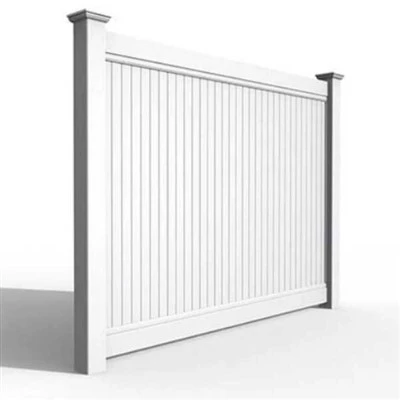
A full-privacy fence is the biggest sail of all - and the deepest, best-anchored posts it needs.
V. Bury It Deep Enough to Hold the Sail
The fence that survives the wind is not the one with the thickest panels. It is the one whose posts were planned for the wind from the start - and that planning happens underground, before the first panel is ever attached.
Sink the posts deep enough. The buried length of the post is the resistance against being levered out, and it should scale with the height of the fence and the exposure of the site. A taller, more exposed fence needs deeper posts - not as a nicety, but as the difference between standing and going over.
Set them in concrete. Concrete is not optional decoration around the post; it is the mass that makes the ground hold on. A post set in a solid concrete footing has to lift or shear that whole block to come out, and the wind rarely manages it.
Mind the spacing. Posts that are too far apart ask each post to carry too much sail. Closer spacing shares the wind load across more anchors, so no single post is asked to hold more than it can.
And where the wind is truly relentless - a coastal or exposed site - consider the sail itself. A panel that lets some air through catches less wind than a solid one, and the fence that is hardest to blow over is often the one that does not try to be a wall. The installation that prevents callbacks is the one that treats the posts as the structure and the panels as the sail they always were.

The panels that survive the storm are the ones whose posts were planned for the wind - deep, spaced, and set in concrete.
The Storm Tested the Posts, Not the Panels
A fence in the wind is a test of what is underground, not what is on display. The panels catch the wind; the posts resist it; and the difference between a fence that stands and a fence that goes over is written in the depth of the hole, the concrete around the post, and the spacing of the anchors. None of it is visible after the job is done, and all of it is visible the morning after the first storm.
The buyer who chooses a fence by its panels is choosing the sail and hoping the mast will look after itself. The buyer who understands the wind chooses the posts first - deep enough, anchored enough, spaced enough - and the panels become what they were always meant to be: the sail, held firm by a mast that was buried to keep it.
Build the fence the wind can't uproot
The right panels, the right posts, and the anchoring that holds in a storm.
Request a Quotation Browse FencingFrequently Asked Questions About Fence Wind Resistance
Answers to the questions that come up when a fence goes over in the wind.
Q1: Why did my fence blow over in the storm?
A: Usually because the posts were too shallow. The wind levers against the whole height of the fence, and a short buried post cannot resist being pulled out of the ground.
Q2: Do strong panels make a fence wind-resistant?
A: Not on their own. The panels are the sail that catches the wind; the posts are the mast that holds them. Wind resistance lives in the posts, not the panels.
Q3: How deep should fence posts be buried?
A: Deep enough to resist the leverage of the wind - generally scaling with fence height and site exposure. Taller, more exposed fences need deeper posts and concrete footings.
Q4: Why do full privacy fences fail before picket fences?
A: A solid privacy panel is a large sail that catches far more wind than an open picket fence. More wind force on the same posts means a higher chance of being pulled over.
Q5: How can I make a PVC fence withstand high winds?
A: Sink the posts deep, set them in concrete, space them close enough to share the load, and consider a panel that lets some air through on exposed sites.
YUPSENI Team
23 years in PVC building material manufacturing and supply chain. We help importers, distributors, and project buyers source SPC flooring, PVC foam boards, wall panels, and fencing that pass compliance the first time. More about YUPSENI
© 2026 YUPSENI. All rights reserved. The information in this article is for general informational purposes only and does not constitute professional advice. Product specifications may vary by region and production batch. Always request current datasheets before making procurement decisions.