PVC Fence Post Footings: Why Depth and Drainage Decide | YUPSENI
Nov 28, 2026
The Fence Fell Because of What Was Under It: Post Footings Explained
On This Page
The fence was two years old when the first post leaned. By the third winter, two more had moved, and the gate no longer closed without lifting. The owner called the supplier and described the problem as a materials failure: the posts were too thin, the panels were too light, the product was not what it claimed to be. The supplier asked one question, which was how deep the posts had been set and what had been put in the hole. The answer was eighteen inches of packed soil, no concrete, no gravel, and no drainage. The fence had been installed as a surface, and it had failed as a surface, because it was standing on a foundation that had never been built.
The fence you see is the part above ground. The fence that holds is the part below it.
I. The Fence Starts Below the Ground
A fence is a series of cantilever posts connected by panels. Each post is fixed at the bottom and free at the top, which means every lateral load applied to the fence is resisted entirely by the connection between the post and the ground. The panels do not resist the load; they transmit it. The posts do not resist the load on their own; they carry it down. The only element that actually holds the fence in place is the footing, and the footing is the one part of the installation that is never visible after the job is finished.
This is why fence failures are so often misdiagnosed. The visible failure is a leaning post or a sagging gate, and the visible cause appears to be the post or the panel. The actual cause is a footing that was too shallow, too small, or too poorly drained to resist the load it received. The materials were probably adequate. The foundation was not, and the foundation is the part that the specification usually omits.
The panel is the fence. The footing is the reason it stands.

Every load on the fence ends up in the hole.
II. What Depth Actually Does
Depth is the first variable in a footing and the one most often reduced to save time. A post set shallowly has a short lever arm against the soil, so the resistance it can mobilise is small. A post set deeply has a longer lever arm and engages more soil, which is why depth is the cheapest way to increase capacity. The common rule of thumb is that the buried length should be between one third and one half of the height above ground, with the higher figure used where wind exposure is greater.
The rule is a starting point, not a specification. Soil type changes the answer. Sandy soil drains well but provides little lateral resistance, so the footing needs to be wider rather than simply deeper. Clay holds water and moves with the seasons, so depth has to reach below the zone that expands and contracts. Expansive clay is the most demanding case, because the soil itself changes volume and can lift a footing that was correctly sized for a stable soil. Rock provides excellent resistance but cannot be excavated to the same depth, so the post has to be anchored rather than buried.
In cold regions, depth is governed by the frost line rather than by the fence height. Water in the soil expands when it freezes, and the expansion lifts whatever is embedded in it. A footing that stops above the frost line will be pushed upward every winter and will not return to its original position in spring. The installation sequence has to account for this, which is why the local frost depth matters more than the fence height in a cold climate.
The post was long enough. The hole was not deep enough.
III. When the Hole Fills With Water
A footing is not only a structural element. It is also a drainage decision, and the drainage is usually the part that fails first. A post hole is a vertical shaft in the ground, and water running down the post or pooling at the surface will collect in it unless the base is designed to let water out. A hole filled with soil and topped with concrete becomes a cup. The water sits in the cup, the soil around the post softens, and the post loses the lateral support that the footing was supposed to provide.
| Failure | Cause | Fix |
|---|---|---|
| Leaning post | Shallow depth | Deeper footing |
| Heaved post | Water and frost | Drainage and depth |
| Loose post | No concrete collar | Concrete collar |
| Rotten base | Standing water | Gravel and drainage |
The standard answer is a layer of gravel at the base of the hole, below the concrete, which allows water to drain away from the post rather than collecting around it. The concrete itself should be shaped so that it slopes away from the post at the surface, so that water running down the post is shed outward rather than directed into the joint. Neither detail is expensive. Both are routinely skipped, and both are invisible once the ground is backfilled.
Standing water also attacks the post itself. A timber post in a wet hole will rot from the base upward, and the rot is hidden until the post snaps. A PVC post will not rot, but the footing around it will still soften, and the post will still move. The material of the post changes the failure mode, not the fact of failure, which is why drainage belongs in the footing design regardless of what the post is made of.
The hole was a cup. The cup filled.
IV. Why the Gate Post Fails First
The gate post carries loads that no other post carries. It supports the weight of the gate, which is a concentrated load at the top of the post. It resists the dynamic force of the gate opening and closing, which is applied repeatedly and in both directions. It may also carry the latch and the hinge hardware, which introduces point loads that a plain post does not see. The result is that the gate post is the most heavily loaded element in the fence, and it is usually built to the same specification as the others.
The failure is predictable. The post rotates slightly in its footing under the repeated load, the gate sags, the latch no longer aligns, and the owner adjusts the hinge rather than the foundation. The adjustment works for a while and then stops working, because the post is continuing to move. By the time the gate is dragging on the ground, the footing has been failing for years, and the visible problem is the last stage of a process that started on the day of installation.
The gate post footing needs to be designed for the gate, not for the fence. That means a deeper hole, a larger concrete mass, and often a post with a thicker wall or a metal reinforcement. The cost of doing this at installation is small. The cost of doing it later, after the fence is finished and the gate has sagged, is a section of fence taken apart and rebuilt.
The gate did not sag. The post rotated.
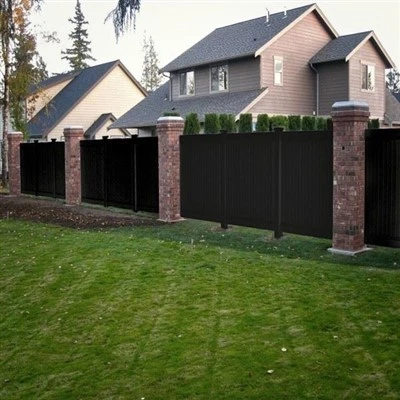
The gate post is the most loaded post in the fence. It is rarely the most specified.
V. Check the Foundation Before the Fence
The buyer who has followed the argument knows that the fence is decided before the first panel goes up. The footing is the specification, and the panels are the finish. Inspection has to happen while the holes are open, because after that the only evidence is a leaning post, and a leaning post does not explain itself.
Check the depth against the frost line. Ask for the local frost depth and confirm that the footing reaches below it. In a cold climate, this figure matters more than the fence height.
Check the base for drainage. Gravel below the concrete and a slope away from the post at the surface. If the hole is a cup, it will fill.
Check the gate post separately. It carries the gate, the hinge, and the dynamic load, and it needs a footing sized for that rather than for the fence.
The holes were checked. The fence was decided.
Check footing depth against the frost line, drainage against the soil, and the gate post against the gate. Those three checks decide whether the fence is still straight in ten years.
The Fence Is the Part You Cannot See
A fence is one of the few building products where the visible part and the structural part are almost completely separated. The panel is chosen for appearance and privacy. The footing is chosen for capacity and durability, and it is buried before anyone can inspect it. Buyers spend their attention on the panel because that is what they can compare, and installers economise on the footing because that is what nobody will check.
The material choice still matters, and the long-term cost comparison between fence types is only meaningful if each type is installed on a footing that suits it. A PVC fence on an adequate footing will outlast a timber fence on the same footing, and both will fail if the footing is wrong. The material determines how the fence ages. The footing determines whether it gets the chance.
The fence was the purchase. The footing was the fence.
Fencing specified down to the footing
Post depth, drainage, and gate footings matched to the soil and the climate.
Request a Quotation Browse FencingFrequently Asked Questions About Fence Footings
Answers to the questions that come up when a fence leans, a gate sags, or a post moves after a few winters.
Q1: How deep should PVC fence posts be set?
A: A common rule is one third to one half of the height above ground, but in cold regions the frost line sets the depth instead. Sandy and clay soils may also require a wider footing rather than simply a deeper one.
Q2: Do I need concrete for fence posts?
A: Concrete is the usual way to provide lateral resistance and to lock the post against rotation. A post set in packed soil alone has very little resistance to a leaning load, especially once the soil is wet.
Q3: Why do fence posts lean after a few years?
A: Usually because the footing is too shallow, too small, or poorly drained. Water softens the soil around the post, frost lifts the footing, or the lateral load simply exceeds what the buried length can resist.
Q4: Why does the gate post fail before the others?
A: Because it carries the gate weight, the hinge loads, and the dynamic force of opening and closing. It is the most heavily loaded post in the fence and needs a larger footing than the rest.
Q5: What should I check before the fence goes up?
A: Depth against the frost line, drainage at the base of the hole, and a separate footing design for the gate post. All three are easy to check while the holes are open and impossible afterwards.
YUPSENI Team
23 years in PVC building material manufacturing and supply chain. We help importers, distributors, and project buyers source SPC flooring, PVC foam boards, wall panels, and fencing that pass compliance the first time. More about YUPSENI
© 2026 YUPSENI. All rights reserved. The information in this article is for general informational purposes only and does not constitute professional advice. Product specifications may vary by region and production batch. Always request current datasheets before making procurement decisions.