

PVC Fence Gate Guide: Post Footings, Stainless Hardware & Sag Prevention
Jul 28, 2026
The PVC Fence Gate Is Not a Panel With Hinges: Why Most Gate Failures Start Before the Concrete Cures
Read time: 7 minutes | By: YUPSENI Team

A vinyl privacy fence with integrated gate-the post diameter, hinge gauge, and concrete footing behind this gate determine whether it still swings true at year five.
On This Page
- I. A Gate Is Not a Fence Panel That Swings
- II. The Post That Carries the Weight
- III. Hinges, Latches, and the Hardware That Rusts First
- IV. Single vs Double Gate: Width, Weight, and Wind
- V. The Diagonal Brace That Nobody Sees
A fence has one job: stand still. A gate has a harder one: move, thousands of times, and land in exactly the same position every time. That difference explains why the gate is the first component to fail on almost every fence installation, and why the failures are never in the panel itself. They are in the post leaning, the hinges sagging, or the latch missing the strike plate by a quarter-inch that grows to half an inch by the following spring.
This guide walks through the five decisions that determine whether a PVC fence gate still latches cleanly at year ten. It assumes standard vinyl fence panels and posts; for the full fence selection framework, our PVC fence selection guide covers panel styles, heights, and post specifications.
I. A Gate Is Not a Fence Panel That Swings
A fence panel is supported along its entire length by two posts and the rails that connect them. Its weight is distributed vertically through the posts into the footings. A gate concentrates the same weight onto one side of one post, and it does so through a pair of hinges that transfer the entire load through two points of contact. A 6-foot-wide vinyl gate weighs somewhere between 25 and 45 pounds depending on the style. That weight, hung off the side of a post, applies a constant rotational force to the post footing. The post wants to lean toward the gate. The footing is the only thing stopping it.
The physics of a gate post
A 35-pound gate hanging 3 feet from the post centreline exerts roughly 105 foot-pounds of rotational torque on the post footing, continuously, every second the gate is closed and at rest. When the gate swings open, the torque reverses direction briefly and then returns. Over 3,000 open-close cycles per year, that is 3,000 load reversals through the same footing. A standard fence post footing is not designed for cyclical rotational load. A gate post footing must be.
This is not academic. The installer who treats the gate post like every other post in the fence line will be back within two years to reset it. The gate will sag, the latch will stop engaging, and the only fix that lasts is pulling the post out of the ground and starting over.
II. The Post That Carries the Weight
A standard fence post footing in most residential installations is 24 inches deep and 8 to 10 inches in diameter. For a gate post, both numbers go up, and a third variable enters the equation: the post itself must be reinforced against the bending moment that the gate applies at the hinge points.
Footing Depth
Gate post footings should be 36 inches deep minimum-50% deeper than standard posts. In frost climates, below the frost line plus 6 inches. The extra depth resists the rotational force that would lever a shallower post out of the ground.
Footing Diameter
Increase the concrete collar diameter to 12–14 inches for a single gate, 16–18 inches for a double gate. The larger diameter distributes the lateral load into a wider soil column, which is what prevents the post from leaning under sustained torque.
Post Reinforcement
A vinyl gate post should be internally reinforced with a galvanised steel or aluminium insert that runs the full length of the post from the concrete footing to the top rail. Without it, the PVC post wall flexes at the hinge points and the screw holes elongate with every gate cycle.
The concrete cure time matters here more than it does on a standard fence post. A gate post loaded before the concrete has reached full compressive strength-typically 7 days for standard mix, 3 days for fast-set-will begin leaning immediately and will never recover. The post stays braced and unloaded for the full cure period, regardless of how far behind schedule the project is running.
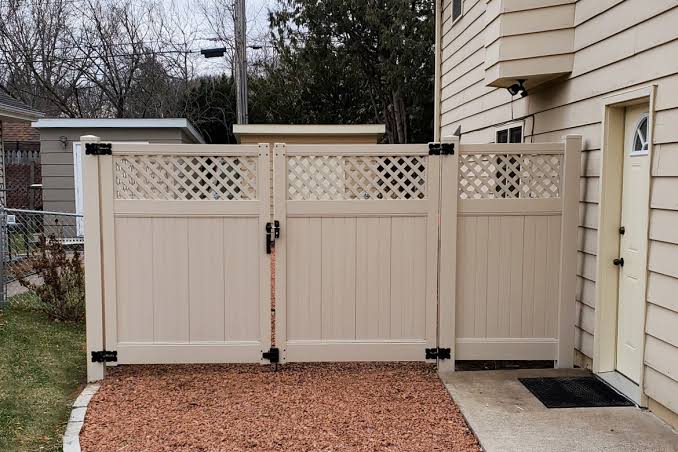
III. Hinges, Latches, and the Hardware That Rusts First
A vinyl gate is only as reliable as the metal hardware connecting it to the post, and that hardware lives outdoors in the same rain, sun, and freeze-thaw cycles as the fence. The failure progression of gate hardware is predictable: the finish on a zinc-plated hinge fails first, rust appears at the pivot pin, the hinge binds, the gate requires more force to close, and the extra force transfers through the latch into the strike plate until the latch no longer aligns.
Every piece of metal on a gate should be stainless steel-not zinc-plated, not electroplated, not coated steel. A zinc-plated hinge on a white vinyl gate will produce rust staining that runs down the post face within two seasons, and the staining is visible from across the yard. Stainless steel costs more per hinge but eliminates the rust stain and the binding that follows it. For coastal installations within a mile of salt water, upgrade to 316 marine-grade stainless. Standard 304 stainless can still show tea staining from airborne salt.
Gate hardware specification checklist
Hinges: Stainless steel, heavy-duty butt or strap hinges rated for the gate weight. Two hinges for gates up to 4 feet wide. Three hinges for gates 4 to 6 feet. Hinges should be through-bolted through the post reinforcement, not surface-screwed into the PVC alone.
Latch: Stainless steel or polymer construction. Gravity latches are the simplest and most reliable-fewer moving parts, nothing to corrode internally. For pool gates and security applications, a self-latching magnetic or spring-bolt lock is required by code.
Drop rod (double gates): A stainless steel rod that drops into a ground sleeve to secure the inactive leaf. The sleeve should be set in a small concrete pad to prevent the rod from sinking into soft ground over time.
The most common hardware mistake is screwing hinges directly into the vinyl post without a metal reinforcement behind them. The screw threads grip the PVC, the gate swings, the PVC flexes microscopically with each cycle, and the screw holes enlarge until the screws pull free. Through-bolting the hinges through the full post-vinyl wall, metal insert, vinyl wall-distributes the load across the entire post cross-section and eliminates the single-point failure at the screw threads.
IV. Single vs Double Gate: Width, Weight, and Wind
A single gate up to 4 feet wide is the simplest installation: one active leaf, one reinforced post on the hinge side, one latch post on the strike side, two or three hinges. The gate weight is manageable, the rotational torque on the post footing is within the standard reinforced footing dimensions, and the hardware list is short.
Between 4 and 6 feet, a single gate is still viable but the demands on the post and hardware escalate. The 6-foot single gate needs the full reinforced footing, the three-hinge layout, the through-bolted hardware, and the full-length post reinforcement. Push it wider than 6 feet as a single leaf and the torque on the post becomes difficult to manage with a standard footing-an 8-foot single gate is not recommended in vinyl without an engineered post-and-footing assembly that is closer to commercial gate specification than residential fencing.
A double gate splits the load across two posts and two gate leaves. The total opening width can go to 8, 10, or 12 feet-driveway access, equipment paths, wide side-yard entries. Each leaf is typically half the opening width, so a 10-foot double gate places two 5-foot leaves on two reinforced posts, each leaf well within the manageable weight range for standard gate hardware. The trade-off is the drop rod on the inactive leaf, the alignment requirement between the two meeting leaves, and the cumulative hardware count: four to six hinges, two latches or one latch plus one drop rod, and two reinforced posts instead of one.
| Configuration | Opening Width | Reinforced Posts | Hinges | Hardware Notes |
|---|---|---|---|---|
| Single gate, standard | 36–48 in. | 1 (hinge side) | 2 heavy-duty | Simplest install; standard reinforced footing |
| Single gate, wide | 48–72 in. | 1 (hinge side) | 3 heavy-duty, through-bolted | Full-length post reinforcement mandatory; 36-inch footing |
| Double gate | 72–144 in. | 2 (both hinge posts) | 4–6 heavy-duty | Drop rod on inactive leaf; alignment critical between leaves; both posts reinforced |
V. The Diagonal Brace That Nobody Sees
A gate that sags is not always a post problem. Sometimes the post is still plumb and the hinges are still tight, but the gate leaf itself has racked-the rectangle of the frame has become a slight parallelogram, and the latch-side bottom corner drags on the ground. The cause is a missing or incorrectly oriented diagonal brace on the gate frame.
The diagonal brace on a gate frame must run from the bottom hinge corner to the top latch corner. This orientation puts the brace in compression under the gate's own weight-the weight pushes down, the brace pushes back along its length, and the frame stays square. A brace that runs the opposite way-from the top hinge to the bottom latch-is in tension, which means it is relying on the fastener connections at both ends to hold it taut. Fasteners loosen, tension relaxes, and the gate sags. The compression brace cannot sag because the wood or metal it is made of would have to physically shorten for the gate to drop, and that does not happen.
The brace direction rule
Diagonal brace runs from bottom hinge → top latch. Always. This puts the brace in compression. Any other orientation is incorrect and will sag. On a double gate, both leaves follow the same rule independently-each leaf is braced from its own bottom hinge to its own top latch corner.
Many vinyl gate panels are factory-built with internal bracing already engineered into the frame, so the installer does not need to add a visible diagonal. The question to ask the supplier is whether the gate panel has internal compression bracing, and if so, what material it is made from and whether it is mechanically fastened or chemically welded into the frame. A factory-braced gate eliminates the single most common on-site error in gate assembly-the incorrectly oriented diagonal.
For gate installations exposed to the same aggressive conditions as the rest of the fence line, the material durability of the gate and its hardware should match the fence material. A PVC fence paired with a PVC gate on stainless hardware creates a single maintenance profile across the entire perimeter. For environments where salt, wind, and moisture combine at the same site-coastal properties, pool enclosures, irrigated landscapes-our coastal PVC fence durability guide covers the hardware and material specifications that survive the most aggressive outdoor exposure. The full fence and gate range, including single and double configurations with matching hardware packages, is available in the PVC fencing section.
Frequently Asked Questions
Frequently Asked Questions About PVC Fence Gates
Common questions from builders, fence installers, and homeowners about gate selection and installation.
Q1: How do I stop a vinyl gate from sagging?
A: Gate sag has three possible causes, and the fix depends on which one is happening. If the post is leaning, the footing was undersized or the concrete was loaded before it cured-the post must be reset with a larger, deeper footing. If the hinges are loose, the screws are pulling out of the PVC-through-bolt the hinges through the post reinforcement. If the gate frame is racked and the post is still plumb, the diagonal brace is missing or oriented the wrong way-the brace must run from the bottom hinge corner to the top latch corner (compression). A factory-braced gate panel avoids this third problem entirely.
Q2: What width gate should I choose for a driveway?
A: A double gate with an opening of 10 or 12 feet handles most residential driveways. A 10-foot double gate gives enough clearance for a standard vehicle with mirrors. A 12-foot opening accommodates wider vehicles, trailers, and equipment. For a single vehicle access point, a 4-foot single gate is the standard pedestrian entry alongside a wider double gate for vehicles. Always add 2 to 3 inches of clearance beyond the widest vehicle that will use the gate.
Q3: Can I add a gate to an existing vinyl fence?
A: Yes, but it requires removing two existing posts-the hinge post and the latch post-and replacing them with reinforced gate posts set in deeper, wider footings. The existing fence panels on either side of the new gate opening are reused and reattached to the new gate posts. The existing post holes must be over-dug to the larger diameter and depth required for gate footings. This is a two-day job for a professional installer: day one for excavation and concrete, day two (or later) for gate panel and hardware installation after the concrete has cured.
Q4: What hardware comes with the gate, and what do I need to buy separately?
A: Gate hardware packages vary by supplier. Confirm whether the gate quote includes hinges, latch, drop rod (for double gates), post reinforcement inserts, and stainless steel fasteners, or whether these are line items ordered separately. A gate panel without hardware is not a gate-it is a panel with a different frame. Our gate packages include the complete hardware set matched to the gate size and configuration. Contact our sales team with your opening width and gate type for a configured quote. Free samples available for qualified buyers.
Order a Gate That Swings True at Year Ten
PVC fence gates-single and double configurations, 36 to 144 inches, factory-braced frames, through-bolted stainless hardware included. White, tan, and black. Reinforced gate posts with full-length metal inserts. Free samples.
Browse PVC FencingYUPSENI Team
23 years in PVC building material manufacturing and supply chain. We help importers, distributors, and project buyers source fencing, railing, trim, and flooring that perform right the first time. More about YUPSENI
© 2026 YUPSENI. All rights reserved. The information in this article is for general informational purposes only. Gate installation requirements vary by local building code, soil conditions, wind zone, and gate dimensions. Always verify footing dimensions and hardware specifications with a qualified installer and the local building authority before beginning work.


