

I. The Ceiling Material Decision That Gets Made in 30 Seconds and Paid For Over 20 Years
Most ceiling material decisions follow a pattern so predictable it could be scripted. The architect specifies a material based on what was used on the last project. The quantity surveyor prices it per square meter - material only, labor estimated from historical rates. The contractor orders whatever matches the spec at the lowest compliant price. And the owner, who will spend the next two decades living with the consequences of this 30-second procurement chain, is not in the room when any of these choices are made.
The three materials that dominate the global suspended-ceiling and direct-mount ceiling market each carry a distinct logic. Gypsum board - also called drywall, plasterboard, or Sheetrock - is the default in North American and European residential and light-commercial construction. It is cheap per square meter, familiar to every drywall contractor on earth, and delivers a seamless, monolithic surface that architects love. Its weaknesses - complete vulnerability to water, labor-intensive installation and finishing, and the inevitability of joint cracking - are treated as acceptable trade-offs because "that is just how ceilings work."
Mineral fiber ceiling tiles - the suspended grid-and-tile system ubiquitous in offices, schools, hospitals, and retail - solve the above-ceiling access problem that gypsum creates. Pop out a tile, access the plenum, pop it back. The trade-off is aesthetic: a visible grid, tiles that stain and sag with humidity, and edges that fray with every maintenance access cycle. The tiles are consumable; the grid is semi-permanent; the ceiling as a system never looks better than it does on installation day and degrades continuously thereafter.
PVC ceiling panels - rigid, tongue-and-groove, available in finishes from high-gloss white to wood-grain and metallic - are the material that gypsum and mineral fiber sales representatives prefer not to discuss. They are newer to the mainstream specification conversation. They carry the "plastic" stigma. And they are systematically outperforming both legacy materials on the dimensions that dominate lifecycle cost: water immunity, installation speed, maintenance frequency, and aesthetic durability. For a closer look at the decorative range now available, browse PVC ceiling panels with realistic wood, tin, and plaster aesthetics →
II. Water: The Invisible Variable That Immediately Eliminates Two of the Three Contenders from Half the Rooms in Any Building
If you take nothing else from this comparison, take this: water is the single most common cause of ceiling failure in buildings, and two of the three dominant ceiling materials are structurally incapable of surviving it. This is not a marginal difference. It is a binary elimination criterion that should be the first filter in any ceiling material decision - and it almost never is.
Gypsum board is essentially compressed gypsum plaster sandwiched between two layers of paper. When water contacts the paper facing - from a roof leak, a plumbing leak, an HVAC condensate overflow, or sustained high humidity - the paper wicks moisture into the gypsum core. The core loses structural integrity. The board sags, then collapses. Even if the board dries out, the paper facing is permanently stained and the core never fully recovers its original strength. There is no repair. There is only replacement. The "moisture-resistant" gypsum variants - the green and purple boards - are slightly less vulnerable, but they are still gypsum-and-paper composites; they resist moisture marginally better than standard board, but they do not survive sustained water contact.
Mineral fiber tiles are a suspension of mineral wool, cellulose, and starch binders. They are porous by design - the porosity is what gives them their acoustic absorption. That porosity also makes them absorb atmospheric moisture like a sponge. In environments where relative humidity consistently exceeds 70%, mineral fiber tiles begin to absorb moisture from the air, lose dimensional stability, and sag visibly within two to three years. Stains - from water, from coffee, from anything - are permanent. The tile cannot be cleaned; it can only be replaced. In healthcare and food-service environments, this porosity also makes the tile a reservoir for airborne contaminants, mold spores, and bacteria.
PVC ceiling panels are a closed-cell, non-porous polymer. Water beads on the surface and rolls off. Humidity does not penetrate the material body. A plumbing leak from the floor above - the event that destroys a gypsum ceiling and stains a mineral fiber tile permanently - leaves a PVC ceiling unaffected. Wipe it dry. It is unchanged. This single property explains why hotel bathroom ceilings, commercial kitchen ceilings, basement ceilings, pool enclosure ceilings, and any ceiling in a monsoon-climate building are increasingly specified in PVC rather than gypsum or mineral fiber. The material is not simply "water-resistant." It is water-indifferent. That distinction - between resisting water and being fundamentally unaffected by it - is the difference between a ceiling that might survive a leak and a ceiling that does not register that a leak occurred.
A facilities manager at a hospital in Singapore - a country where ambient humidity hovers around 80% year-round - described the gypsum-to-PVC conversion in their patient-room ceilings this way: "We were replacing gypsum ceiling boards in at least six rooms every year - not from leaks, just from humidity-driven joint cracking and surface degradation. The mineral fiber tiles in the corridors were sagging within 18 months of installation. We switched the wet areas to PVC panels first. Then the corridors. Now we specify PVC as the default for all non-fire-rated ceiling applications. The maintenance log for ceiling issues went from multiple entries per month to zero entries in 14 months."
That silence - the absence of ceiling-related maintenance entries in a 140-room hospital - is the most honest data point in this entire comparison. For a parallel analysis of how PVC material properties eliminate the maintenance burden across wall applications, see our low-maintenance PVC ceiling panel guide →
III. Installation Speed - Where the Labor Budget Either Survives or Dies on Site
On a construction site, time is not money. Time is more expensive than money, because schedule overruns trigger penalty clauses, delay downstream trades, and consume general-condition overhead in ways that no material saving can offset. The speed at which a ceiling system can be installed - from bare joists or grid to finished, painted, punch-list-ready surface - is therefore not a "nice-to-have" secondary consideration. It is, in many projects, the dominant economic variable.
A drywall ceiling follows a multi-step, multi-day, wet-process sequence. Hang the board. Tape the joints. Apply the first coat of joint compound. Wait for it to dry - 24 hours in ideal conditions, longer in humidity. Sand. Apply the second coat. Wait. Sand again. Apply the skim coat. Wait. Final sanding. Prime. Wait. First finish coat. Wait. Second finish coat. Even under optimal conditions with an experienced crew, a gypsum ceiling takes 4–7 days from hanging to final painted surface for a typical room - and every day of that sequence generates dust, requires climate control for compound drying, and blocks other trades from working in the space. The dust alone - a fine, airborne gypsum particulate that settles on every horizontal surface and infiltrates HVAC ductwork - is a construction-phase environmental burden that gypsum comparison literature rarely mentions.
Mineral fiber suspended ceilings are faster. The grid is installed in a day. Tiles drop in on the second day. A typical office floor can be ceiling-complete in 48 hours. The speed advantage over gypsum is real and significant - which is why mineral fiber dominates the commercial interiors market. But speed is purchased at the cost of aesthetics (visible grid) and long-term fragility (tile edge damage, sag, stain).
PVC ceiling panels install faster than either. The process is dry - no compound, no drying time, no sanding, no painting. The tongue-and-groove panels are either screwed or clipped to furring strips or a light-gauge steel grid, or directly adhered to a sound substrate. A two-person crew can complete the ceiling of a standard 20 m² room in a single working day - and the room is usable immediately. Zero dust. Zero odor. Zero curing wait. For a hotel or apartment project with 100 identical rooms to ceiling, the schedule compression achievable with a PVC panel system - measured against the gypsum alternative - can amount to two to three weeks of program time, with corresponding savings in general conditions, financing cost, and early-occupancy revenue.
| Installation Dimension | PVC Ceiling Panels | Gypsum Board Ceiling | Mineral Fiber Suspended Ceiling |
|---|---|---|---|
| Process Type | Dry - click/lock or screw | Wet - joint compound, multiple drying stages | Dry - grid + tile drop-in |
| Installation Time (20 m² room) | 1 day | 4–7 days | 1–2 days |
| Finishing Required | None - factory-finished surface | Taping, 3-coat compound, sanding, priming, 2-coat paint | None - factory-finished tile surface |
| Dust Generation | Zero | Heavy - fine gypsum dust throughout sanding stages; settles everywhere, enters HVAC | Minimal - cutting tiles for perimeter only |
| Occupancy After Installation | Immediate | 24–48 hours after final paint (curing + VOC dissipation) | Immediate |
| Above-Ceiling Access | Requires panel removal (accessible with screw-fixed panels) | Destructive - requires cutting access hatches; patching never invisible | Excellent - individual tile removal; designed for access |
The installation comparison reveals a strategic insight that specifiers often overlook: PVC ceiling panels combine the speed of a dry grid system with the monolithic, seamless appearance of a finished gypsum ceiling - a combination that neither legacy material can offer. The grid system is fast but visually compromised. The gypsum ceiling is visually seamless but slow, dusty, and wet. PVC panels sit at the intersection that neither competitor occupies. For specifier-grade ceiling panels with documented installation protocols, explore YUPSENI's PVC ceiling board range →

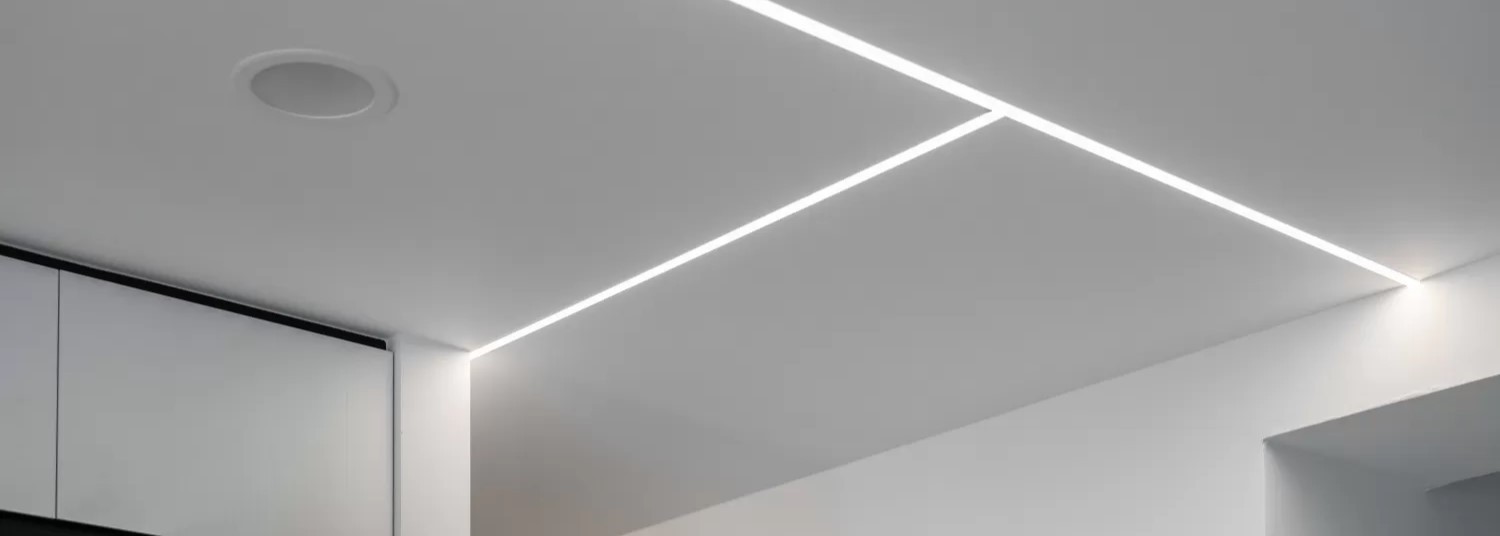
Fig. 1 - The labor gap visualized. Left: PVC ceiling panels installing via dry tongue-and-groove engagement - no compound, no dust, no drying time, room usable immediately. Right: the gypsum ceiling finishing sequence - taping, three coats of compound with drying intervals, sanding, priming, two finish coats - a 4-to-7-day dust-generating occupation of the room before any other trade can enter.
IV. The 20-Year Arithmetic Nobody Calculates Until the Second Renovation Forces Them To
The per-square-meter material price - the number that dominates procurement conversations - is the most misleading figure in the entire building-materials industry. A ceiling material that costs half as much per square meter but requires replacement three times over 20 years is not cheaper. It is a recurring cost disguised as a one-time saving, and the disguise is effective enough that most project budgets never see through it.
Let us walk through the actual 20-year cost of a 100 m² ceiling installation - roughly the ceiling area of a small restaurant, a medium office, or a large residential great room - under the three material options. The assumptions are conservative and based on contractor interviews in mid-cost markets (Southeast Asia, Southern Europe, mid-tier US regions).
| Cost Category | PVC Ceiling Panels | Gypsum Board Ceiling | Mineral Fiber Suspended Ceiling |
|---|---|---|---|
| Material (per m²) | $8–14 | $4–7 | $6–12 |
| Grid / Furring (per m²) | $3–5 | $2–4 (furring channel) | $5–8 (T-grid system) |
| Installation Labor (100 m²) | $400–700 | $1,200–2,000 | $600–1,000 |
| Finishing Labor (tape/compound/sand/paint) | $0 | $800–1,400 | $0 |
| Total Installed Cost (100 m²) | $1,500–2,600 | $2,400–4,100 | $1,700–3,000 |
| 10-Year Repair / Replacement | $0 | $1,200–3,000 (leak repairs, joint crack patching, partial replacement, repainting) | $600–1,800 (stained/sagged tile replacement, grid adjustment) |
| 20-Year Full Replacement | $0 | $2,400–4,100 (full replacement if water-damaged or joint-failure accumulation) | $1,700–3,000 (full tile replacement; grid may survive) |
| 20-Year Total Cost (100 m²) | $1,500–2,600 | $3,600–8,200+ | $2,900–6,600+ |
Three observations emerge from these numbers. First, PVC ceiling panels are already cost-competitive on first installation - the material premium over gypsum is more than offset by the elimination of the entire taping-compound-sanding-painting finishing sequence, which is the most labor-intensive and schedule-consuming phase of a gypsum ceiling installation. The notion that PVC is "more expensive upfront" is a myth sustained by comparing material line-item costs in isolation rather than total installed cost.
Second, the 20-year gap is not marginal. It is a factor of two to three - the gypsum ceiling costs roughly double to triple what the PVC ceiling costs over two decades, and the mineral fiber system roughly one-and-a-half to two-and-a-half times. The entire gap is driven by the maintenance and replacement cycles that PVC simply does not trigger - no water-damage replacement, no joint-crack repair, no repainting, no stained-tile swap-out.
Third, the numbers above exclude the soft costs that are harder to quantify but impossible to ignore in practice: the business disruption during ceiling replacement (a restaurant closed for a week loses revenue, not just incurs contractor invoices), the furniture protection and dust containment during gypsum sanding, the administrative overhead of scheduling and supervising repair work. These soft costs - invisible on a material price comparison sheet - are where the genuine economic burden of high-maintenance ceiling materials accumulates. For a detailed breakdown of PVC ceiling economics across different project types, see our PVC ceiling board cost analysis →
V. Aesthetics and the Arm's-Length Test: What Actually Looks Good After Five Years of Humidity, Dust, and Neglect
The brochure photography for all three ceiling materials is flawless. The gypsum ceiling is a smooth, seamless white plane, lit evenly, not a joint line or fastener shadow in sight. The mineral fiber tile ceiling is crisp, geometric, every tile perfectly flat and clean-edged in its grid. The PVC panel ceiling gleams - high-gloss white or rich wood-grain, the tongue-and-groove joints tight and uniform.
The question that matters is not what these ceilings look like on installation day. It is what they look like after five years of real-world conditions. And on that question, the three materials diverge sharply.
Gypsum board ceilings age in two ways, both structural. The first is joint cracking - the fine, hairline crack that appears along the taped seam between boards, usually within the first two years of seasonal thermal cycling or minor building settlement. Once it appears, it never fully disappears. It can be patched, but the patch - a thin skim of compound feathered over the crack - will itself crack eventually, because the underlying differential movement between the two board edges has not stopped. The second aging mechanism is surface discoloration - the gradual yellowing of the paint film, accelerated by UV exposure near windows, by cooking aerosols in kitchens, by tobacco smoke, or simply by the oxidative aging of the paint binder. A gypsum ceiling that looked perfect on day one will, within five years, show visible cracks and a uneven, yellowed surface in most occupied environments.
Mineral fiber tiles age in three ways, all relentless. The tile edges fray - every time a tile is lifted for above-ceiling access, the soft compressed-fiber edge is abraded against the grid, shedding particulate and losing its crisp geometry. The tile face stains - mineral fiber is porous and absorbent; water stains, coffee splashes from below, air-borne cooking grease, and even hand oils from installation leave permanent marks that cannot be cleaned. And the tile sags - in humid environments, the starch binder absorbs atmospheric moisture, the tile loses rigidity, and the center droops below the grid plane, creating a visibly undulating ceiling surface. The replacement cycle for mineral fiber tiles in high-humidity or high-access environments is typically 5–8 years - meaning the ceiling is perpetually patchy, a mosaic of original and replacement tiles with slightly different ages, slightly different whites, never looking uniform.
PVC ceiling panels age in one way, and it is almost imperceptibly slow. The color is not a coating - it is compounded into the polymer or applied as a co-extruded layer molecularly bonded to the substrate. It does not yellow (UV-stabilized formulations). It does not crack (the material is elastic, not brittle; building movement is absorbed, not resisted). It does not stain (the surface is non-porous; contaminants sit on top and wipe off). After five years, a PVC ceiling panel looks essentially identical to its installation-day appearance - provided it has received the occasional wipe-down that any ceiling surface in an occupied space should receive.
The "arm's-length test" - a phrase coined by a hotel interior designer I interviewed in Ho Chi Minh City - captures the aesthetic comparison concisely: "Stand at arm's length from the ceiling. If you can see the defects - the joint cracks, the tile sag, the stain halo, the grid irregularity - the ceiling has failed. It does not matter what it cost or what brand is stamped on the back. The guest sees a bad ceiling. Period. That is why we use PVC panels now. After three years, they still pass the arm's-length test. The gypsum ceilings in our older properties do not."
VI. The Fire Rating Conversation That Changes Everything - and the Quiet Truth Behind the Classification Labels
Fire performance is the dimension on which the ceiling material comparison pivots most sharply - and on which the most misinformation circulates. The conversation usually begins and ends with a single word: "combustible." PVC is combustible. Gypsum is non-combustible. Therefore - so the abbreviated logic runs - gypsum is the safer ceiling material, and PVC should be limited to applications where fire codes permit combustible surfaces.
This logic is not wrong. It is incomplete. And the incompleteness matters, because it obscures the fire-safety dimensions on which PVC ceiling panels outperform both gypsum and mineral fiber - dimensions that become relevant in real fires, as opposed to idealized material-classification discussions.
Gypsum board is, in fire-resistance terms, an excellent material. The gypsum core contains chemically bound water - approximately 21% by weight - that is released as steam when the board is exposed to fire. This endothermic dehydration process absorbs heat and slows temperature rise on the unexposed side of the assembly. A properly specified gypsum ceiling assembly can achieve fire-resistance ratings of one, two, or even four hours. For applications where compartmentation and structural fire resistance are code requirements - fire-rated corridors, stairwell pressurization shafts, structural steel encapsulation - gypsum board remains the technically correct and often code-mandated choice.
Mineral fiber tiles occupy an intermediate position. The mineral wool base is inherently non-combustible. The starch binder and any facing materials may be combustible, but in limited quantity. Most commercial-grade mineral fiber tiles carry a Class A flame-spread rating per ASTM E84. The grid system itself is steel, non-combustible. The fire weakness of a mineral fiber ceiling is not the material - it is the system: the tile-to-grid interface is not a fire seal; flames and hot gases can bypass the ceiling plane through grid gaps, and the tiles themselves can be displaced by fire-induced air pressure, exposing the plenum.
PVC ceiling panels are combustible. They are a hydrocarbon-based polymer, and they will burn when exposed to flame. This is not a fact to be minimized. It is a fact to be understood in context. The relevant context has three components.
First, fire-retardant PVC formulations exist and are widely used. The addition of flame-retardant additives - typically halogenated compounds, metal hydroxides, or phosphorus-based systems - raises the ignition temperature, reduces the rate of flame spread, and promotes self-extinguishing behavior when the external flame source is removed. Many PVC ceiling panels achieve a Class B or even Class B1 fire rating under the relevant national classification systems, meaning they are classified as "flame-retardant" or "difficult to ignite" building materials. The panel will not sustain combustion independently once the ignition source is removed.
Second, the fire performance of a ceiling is a system property, not a material property. A PVC ceiling panel installed over a non-combustible substrate - concrete slab, gypsum board backer, steel deck - performs differently in fire than the same panel tested in isolation. The substrate acts as a heat sink and a flame barrier. The relevant fire test is not the material's inherent combustibility but the assembly's performance in a room-corner test or a full-scale compartment test that replicates real fire conditions.
Third, smoke toxicity - often cited as the primary fire-safety objection to PVC - is material-dependent and additive-dependent. PVC combustion does produce hydrogen chloride gas, which is toxic and corrosive. However, modern flame-retardant PVC formulations incorporate acid scavengers - typically calcium carbonate or other alkaline fillers - that capture a significant fraction of the HCl released during combustion, converting it to stable calcium chloride. The smoke toxicity of a properly formulated fire-retardant PVC panel is not negligible - no combustion product in a building fire is safe to breathe - but it is substantially lower than the "PVC equals deadly smoke" shorthand that circulates in green-building discussions.
The practical fire-safety calculus for specifiers is more nuanced than "combustible vs. non-combustible." For fire-rated assemblies where code mandates a specific hourly resistance rating, gypsum board is the technically correct specification and PVC should not be substituted. For non-fire-rated ceiling applications - residential bedrooms and living areas, hotel guest rooms, office ceilings below the floor slab, retail ceiling soffits, bathroom and kitchen ceilings - PVC ceiling panels with a certified flame-retardant classification and appropriate installation detail are widely accepted by building codes across Asia, Europe, the Middle East, and increasingly in North America. The key is documentation: a valid fire-test report from an accredited laboratory, confirming the panel's classification under the national standard applicable to the project location.
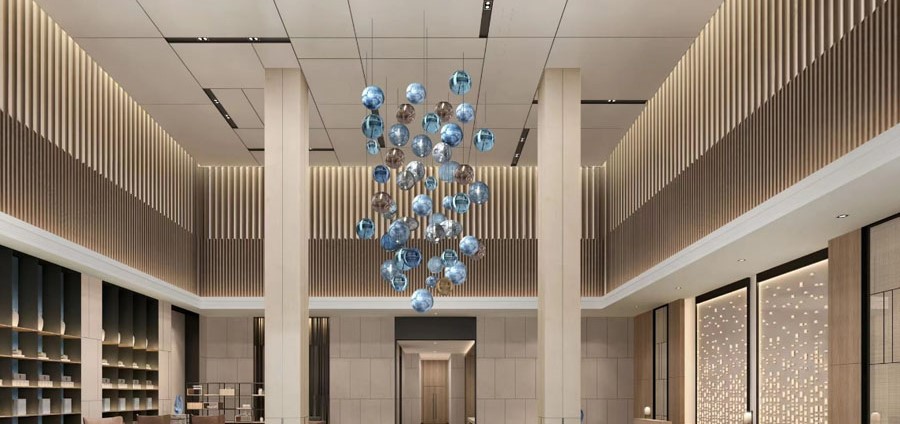
Fig. 2 - A hotel lobby ceiling in Da Nang, Vietnam, three years after installation. PVC panels with a matte wood-grain finish, tongue-and-groove joints, and integrated LED downlighting. Three monsoon seasons. Zero maintenance. The arm's-length test: passed. The original gypsum ceiling it replaced had been repainted twice and still showed visible joint lines.


