1. What Is PVC Ceiling Board? - From Polymer Molecules to Overhead Panels
PVC ceiling board - full name polyvinyl chloride ceiling board - is a lightweight overhead finishing material manufactured from PVC resin as the primary raw ingredient, blended with stabilizers, lubricants, fillers (typically calcium carbonate), and colorants through processes including compounding, extrusion, calendering, and vacuum forming.

Fig. 1 - Cross-section of PVC ceiling board: the hollow multi-chamber structure reduces weight by 40–60% compared to solid panels while the trapped air layers provide thermal and acoustic insulation.
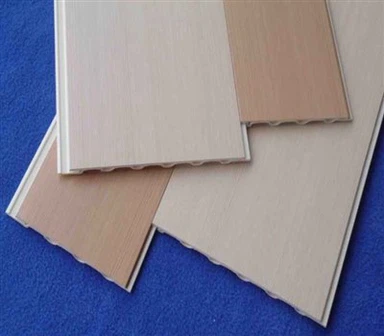
The most common product format is the PVC ceiling panel (also called PVC cladding or PVC soffit board). Its cross-section reveals a hollow "口"-shaped or lattice-like internal structure, with male and female tongue-and-groove edges on opposing sides. During installation, panels simply click together onto a framework - much like assembling building blocks. This hollow-core architecture mimics the structure of bird bones: dramatically lighter than solid sections, yet rigid enough to span between furring strips without sagging. The trapped air chambers simultaneously deliver a degree of thermal insulation and acoustic dampening - all while using significantly less raw material.
By surface finishing technology, PVC ceiling boards fall into several categories:
- Plain / matte boards - solid color, no pattern; the most economical option
- Printed boards - direct surface printing for wood grain or stone textures
- Laminated / film-faced boards - a decorative membrane is thermally bonded to the PVC substrate for superior colorfastness and cleanability
- Heat-transfer printed boards - patterns are embedded into the surface using heat and pressure for deeper, more durable decoration
- UV high-gloss boards - UV-cured coating delivers a mirror-like reflective surface popular in contemporary interiors
Film-laminated and heat-transfer technologies can convincingly reproduce wood grain, marble veining, linen texture, and even brushed-metal effects - giving an industrial product the visual character of natural materials. In terms of dimensions, the market offers strip panels in widths of 10 cm, 20 cm, 25 cm, and 30 cm, as well as square panels in 60 × 60 cm and 30 × 60 cm formats. Thickness ranges from 5 mm to 12 mm, with 7–8 mm being the sweet spot for residential applications - thick enough to resist sagging, thin enough to keep material costs and weight in check.
2. Six Core Advantages That Made PVC Ceiling Boards the New Favorite
PVC ceiling boards didn't rise to prominence through marketing - they earned it through performance in the toughest rooms in the house. Here are the six properties that drive their adoption.
2.1 100% Waterproof - The Moisture-Zone Champion
This is PVC ceiling board's deepest brand impression. The material itself does not absorb water and does not permit moisture penetration. In bathrooms with near-100% relative humidity, in laundry rooms, or in basements during humid summers - PVC ceiling boards will not swell, delaminate, or develop mold colonies the way gypsum board inevitably does. Nor will they warp and gap like wood ceiling panels. Stains and water spots wipe off with a damp cloth. For any space defined by moisture, PVC is the ceiling material least likely to disappoint.
2.2 Fire-Retardant - An Invisible Safety Guard
Quality PVC ceiling boards are inherently flame-retardant and self-extinguishing. Their oxygen index typically exceeds 30% - meaning the material will not sustain combustion once the ignition source is removed. Unlike timber ceilings, PVC does not serve as a medium for flame propagation. From a fire-safety perspective, this provides an additional layer of psychological reassurance in kitchens and spaces with heat sources. The caveat: verify that the product meets B1 (Class B, difficult-to-ignite) standards. Inferior boards using excessive plasticizers or recycled material may have significantly degraded fire performance.
2.3 Lightweight & Fast Installation - Assembles Like Building Blocks
PVC ceiling panels have a density far lower than gypsum board and aluminum ceiling tiles. They are light to carry and require no power saw - a utility knife score followed by a clean snap is all it takes to cut a panel to length. The framework system - typically light-gauge steel or timber furring strips combined with clip-in fasteners - enables a single skilled installer to complete 10–15 m² of ceiling in one day. For renovation projects and occupied homes, PVC ceiling installation generates virtually no heavy debris and places no additional load on the existing ceiling structure.
2.4 Cost-Effective - The Budget-Friendly Choice
Among all ceiling finishing materials, PVC panels sit at the most accessible price point. The material cost per square meter is typically one-third to one-half that of aluminum ceiling tiles, with correspondingly lower auxiliary material and labor costs. For first-time home buyers, rental property refurbishments, temporary structures, and any budget-sensitive project, PVC ceiling panels offer a complete overhead finish without forcing a binary choice between leaving the slab exposed and blowing the budget.
2.5 Design Versatility - From Utilitarian to Decorative
Early-generation PVC ceilings earned a reputation for looking plastic - flat, artificial colors and a cheap gloss. Today's printing and film-lamination technologies have transformed the category. Matte solid colors, realistic wood grain, convincing marble veining, mirror-gloss reflective surfaces, and even 3D embossed textures are all achievable on PVC panels. They can fit into minimalist, Scandinavian, light-luxury, and modern-traditional interior styles - breaking the outdated assumption that "inexpensive material = cheap appearance."
2.6 Easy-Clean & Anti-Bacterial - The Low-Maintenance Workhorse
The smooth, dense, non-porous surface resists the accumulation of dirt, grease, and microbial colonies. Daily cleaning requires nothing more than a wipe with a neutral detergent solution. Premium products incorporate anti-bacterial and anti-fungal agents - often silver-ion based - that actively inhibit common bacteria such as Staphylococcus aureus and Escherichia coli, while suppressing mold growth. In a post-pandemic world, this built-in hygienic property has expanded PVC ceiling adoption into healthcare, food-service, and childcare environments.
3. Beyond the Home: PVC Ceiling Boards' Expanding Territory
Kitchens and bathrooms remain PVC ceiling panels' core stronghold, but their footprint has long since expanded:
PVC ceiling boards adapt to virtually any interior space - residential, commercial, or temporary - where moisture, budget, and installation speed matter.
- Balconies & laundry rooms: Resist sun exposure and laundry vapor; UV-stabilized lamination delays yellowing under prolonged sunlight
- Basements & garages: Combat condensation and dampness; prevent the peeling and mold that plague painted or wallpapered overhead surfaces; near-zero maintenance
- Commercial spaces: Small restaurant back kitchens, hotel bathrooms, office tea stations - anywhere requiring fire-code compliance, easy future access for maintenance, and rapid construction timelines
- Temporary buildings & portable structures: Lightweight, demountable, and reusable - ideal for container homes, site offices, modular classrooms, and exhibition pop-up spaces
Notably, in renovation projects, PVC ceiling panels can often be installed directly over existing damaged or outdated ceiling surfaces without complete demolition - dramatically reducing construction complexity, debris disposal, and cost.
4. How to Choose Quality PVC Ceiling Boards: 4 Steps to Sidestep Inferior Products
The market contains a wide quality spectrum, with boards made from recycled material or over-filled with calcium carbonate lurking alongside premium products. Use this four-step checklist - Look, Smell, Flex, Ask - to separate quality from compromise.
5. Installation & Maintenance: The Craft Hidden Above Your Head
5.1 Installation: It All Rests on the Framework
The core of PVC ceiling installation is the stability and levelness of the furring framework. The standard sequence:
- Mark the level line around all walls using a laser or spirit level
- Fix the perimeter angle trim along the marked line
- Install suspension rods and main carriers (if using a suspended grid system)
- Install cross tees / furring channels at the specified spacing (typically 30–40 cm)
- Click panels into place one by one from one side of the room, engaging the tongue-and-groove edges onto the framework
- Trim the final row to width and lock into the perimeter angle
Critical details:
- Pre-cut openings for downlights, exhaust fans, bathroom heaters, and access hatches before installing the panels in those locations - and reinforce the surrounding framework to support the fixture weight
- Leave a 3–5 mm perimeter expansion gap between the panel edge and the wall angle trim - PVC does expand and contract with temperature, and a tightly wedged ceiling will eventually buckle
- Acclimate panels on-site for 24–48 hours before installation, stored flat, in the room where they'll be installed
5.2 Maintenance: The Laziest Overhead Surface You'll Ever Own
- Quarterly: Run an electrostatic dusting wand or microfiber mop over the surface to remove airborne dust and cobwebs
- Kitchens & bathrooms (every 6 months): Wipe with a soft cloth and a diluted neutral detergent solution; rinse with a clean damp cloth
- Stubborn stains: Use a non-abrasive cream cleaner and a soft sponge - never steel wool, scouring pads, strong acids, or strong alkalis, which will permanently damage the surface finish
- Damaged panel replacement: Use a suction cup to pull down the damaged panel (click-lock systems allow individual panel removal), snap in a replacement - a repair that takes minutes versus the days required to patch and repaint a damaged gypsum ceiling
6. PVC vs Other Ceiling Materials: No "Best," Only "Best Fit"
| Property | PVC Ceiling Board | Gypsum Board | Aluminum Panel | Wood Ceiling |
|---|---|---|---|---|
| Waterproof | ★★★★★ 100% waterproof | ★☆☆☆☆ Absorbs water; mold risk | ★★★★★ Waterproof | ★★☆☆☆ Warps & rots |
| Fire Resistance | ★★★★☆ B1 self-extinguishing | ★★★★★ Non-combustible (A2) | ★★★★★ Non-combustible (A1) | ★☆☆☆☆ Combustible |
| Installation Speed | ★★★★★ 1 day / room | ★★☆☆☆ Multi-day + drying | ★★★★☆ 1–2 days / room | ★★★☆☆ Moderate |
| Cost per m² (material) | $ (Lowest) | $ (Low) | $$$ (High) | $$–$$$$ (Variable) |
| Design Flexibility | ★★★★☆ Wood/marble/matte/gloss | ★★★★★ Unlimited shapes | ★★★☆☆ Limited finishes | ★★★★☆ Natural beauty |
| Maintenance | ★★★★★ Wipe & forget | ★★☆☆☆ Repaint; can't wash | ★★★★☆ Wipe clean | ★★☆☆☆ Oil, wax, or refinish |
| Individual Panel Replacement | ★★★★★ Minutes, suction cup | ★☆☆☆☆ Cut, patch, mud, paint | ★★★★☆ Pop out, pop in | ★☆☆☆☆ Nail, remove, replace |
| Best For | Wet areas, budget, speed | Living rooms, complex design | Commercial, premium wet areas | Warmth, tradition, aesthetics |
Summary verdict: If you need extreme durability and premium texture, aluminum panels or waterproof gypsum board are alternatives worth considering. If your priority is function-first, budget-controlled, and multi-scenario versatility, PVC ceiling boards are the balanced choice that wins on practicality.
7. The Future Is Already Here: Where PVC Ceilings Are Heading
As material science advances and consumer expectations evolve, PVC ceiling board technology is progressing along three fronts:
7.1 Greener Chemistry
Leading manufacturers are transitioning to lead-free stabilizer systems (calcium-zinc and organic stabilizers) and non-phthalate plasticizers (such as DOTP), cutting hazardous substances at the source. Some brands are introducing closed-loop recyclable formulations - where end-of-life panels can be crushed, re-pelletized, and extruded into new products - aligning with circular-economy principles and green building certification requirements.
7.2 Biomimetic Surface Technology
Next-generation surface processing - including electron beam curing (EBC) and LED-UV inkjet printing - now enables PVC panels to replicate not just the visual appearance but the tactile feel of natural materials: the annual-ring undulation of real wood, the crystalline fracture texture of natural stone, even the soft-touch warmth of fabric. The gap between "synthetic" and "authentic" continues to shrink.
7.3 Functional Integration
The ceiling panel of the future arrives pre-integrated: LED lighting arrays, breathable moisture-barrier membranes, and acoustic absorption layers are being factory-laminated into single-panel modules. On site, these multi-function panels click together like puzzle pieces - a perfect fit for prefabricated construction methods and smart-home-ready interiors with simplified wiring and sensor integration.
For specifiers and homeowners interested in PVC ceiling solutions backed by modern manufacturing, contact the YUPSENI technical team for product specifications and samples →