

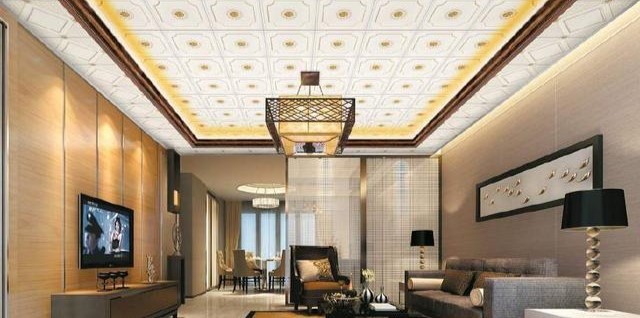
1. Faux Wood Grain: Forest on the Ceiling - Without Cutting a Single Tree
A timber ceiling radiates warmth that few other materials can match. For many, it's the platonic ideal of overhead aesthetics. But real wood overhead extracts a sobering price: quality timber runs hundreds of dollars per square meter, installation demands skilled carpenters for joinery and fastening, and ongoing maintenance means periodic sealing, waxing, and vigilance against moisture and insects. Worse still, the very spaces that most need a ceiling upgrade - kitchens drenched in steam, bathrooms saturated with humidity - are fundamentally incompatible with wood's natural temperament. Thermal expansion cracks boards open; moisture infiltration invites mold and rot.
PVC faux-wood-grain ceiling board emerged to precisely target this "want the look, can't justify the wood" dilemma.
1.1 The Visual Replication: Resolution Down to the Micron
High-precision wood-grain transfer film achieves micron-level texture resolution, faithfully reproducing oak's cathedral grain, walnut's parabolic flow, teak's black-gold striations, and even weathered timber's natural knotting and checking. The real breakthrough is synchronized embossing (EIR - Embossed In Register): the board's surface relief follows the printed grain with perfect alignment, so your finger traces the same rise and fall your eye perceives. A top-tier faux-wood PVC board, viewed from one meter away, is visually indistinguishable from real wood veneer - and since it's installed at 2.6 meters or higher, that distance itself amplifies the illusion.
1.2 Color Systems & Style Compatibility
The market now offers a complete wood-tone matrix:
| Wood Tone | Species Examples | Best Interior Style Match |
|---|---|---|
| Light / Bleached | White oak, cream beech, ash | Japanese wabi-sabi, Scandinavian, Nordic minimal |
| Mid-tone / Warm | Walnut, smoked oak, teak | Modern luxury, mid-century modern, transitional |
| Dark / Dramatic | Dark rosewood, ebony, black walnut | Neo-Chinese, Art Deco, moody contemporary |
Strip planks exploit longitudinal grain direction to visually elongate room depth. Square-panel checkerboard wood-grain layouts project quiet geometric order. Increasingly, designers pre-specify herringbone and chevron patterns - traditionally labor-intensive parquet arrangements - now factory-prefabricated onto PVC panels, making the ceiling an active participant in the design narrative.
1.3 Beyond Visual: Tactile "Body Double"
An unexpected advantage: PVC faux-wood board doesn't feel cold to the touch like metal panels. Its surface hardness is moderate, with a slight resilient give, and a knock produces a dull thud rather than a sharp ring - physical properties that serendipitously approximate timber's warmth. In cool-toned kitchens and bathrooms dominated by ceramic tile, this warm visual and quasi-tactile quality softens the space, making even a function-first room feel like home. For pairing with warmer flooring options, see our SPC vs Laminate vs Solid Wood comparison →
2. Faux Tin Ceiling: Classical Metal Poetry for Everyday Homes
In late-19th to early-20th century North America and Europe, pressed tin ceilings were standard-issue elegance for commercial spaces and well-appointed residences. Their embossed metal panels - carrying Victorian grandeur and Art Nouveau's flowing organic curves - pressed the ornate memory of Old World luxury into the ceiling plane. But genuine tin ceilings came at a steep price, demanded complex installation, and oxidized over decades into darkened, sometimes corroded surfaces. Today they survive mainly as heritage accents in vintage cafés and boutique hotels.
PVC faux-tin ceiling panels have made this old-world romance accessible to anyone with a ceiling.

Fig. 1 - Faux tin ceiling close-up: deep-relief rococo scrollwork and geometric medallions, finished with metallic lamination that captures the patina of age without the corrosion.
2.1 Industrial Replication of Relief Craft
Through vacuum-forming over CNC-machined molds, PVC panels precisely reproduce the multi-layer relief structures of classical tin ceilings - rococo acanthus scrolls, geometric starburst medallions, diamond-grid rose rosettes - with relief depths reaching 2–4 mm. The metallic-effect lamination is the decisive step that injects "tin soul" into PVC:
Premium ranges add a pearlescent powder coating that catches ambient light with subtle starlight shimmer, further blurring the boundary between real tin and its PVC doppelgänger. Explore metallic-finish PVC ceiling panels →
2.2 The Revolutionary Meaning of Lightweight
Authentic pressed-tin panels weigh over 5 kg/m² and require bolting into timber strapping - a structural demand that puts old-building renovations out of reach. PVC faux-tin panels weigh roughly one-third as much, snapping into a standard lightweight furring grid that any ceiling substrate can support. Whether it's a structurally fragile century apartment or a lightweight-steel retail unit, the vintage luxury imposes no structural penalty. This "best of both worlds" attribute lets a café, boutique, Airbnb, or design-conscious homeowner access hundred-year-old Upper East Side charm for the price of a few coffees.
2.3 The Emotional Value of Faux-Tin Spaces
Faux-tin ceilings excel at manufacturing spatial ceremony: a rectangular tin-panel ceiling frame above a dining table elevates daily meals toward occasion. A central corridor lined with classical tin panels transforms a forgettable passage into a gallery-like transition. A small shop with tin-look ceiling and linear spotlights generates sculptural light-and-shadow relief that lifts the entire retail experience by a perceptible tier. This is "upward decoration" - using the ceiling as an exhibition platform, so the visitor's first upward glance upon entering already communicates the space's aesthetic intent.
3. Faux Plaster: European Palace Elegance - Without Mixing a Single Batch of Mud
The appeal of ornamental plaster ceilings needs no introduction: medallion light fixtures, running cornice moldings, and full-field acanthus patterns collectively weave classical interiors' restrained opulence. But the practical headaches are equally legendary - skilled plaster artisans are vanishingly rare, installation stretches across one to two weeks of wet, dusty work, and the material itself is heavy and brittle. Minor building settlement or vibration propagates spiderweb cracks across the ceiling. Renovation means total demolition in a blizzard of dust.
PVC faux-plaster panels deliver the same visual language through flexible lightness replacing rigid heaviness.
3.1 Form Fidelity & Installation Transformation
PVC faux-plaster panels replicate virtually every ornamental plaster idiom: ceiling rose medallions with layered peony petals, French cornice moldings with stacked volutes, Baroque coffered geometries with nested frames - all produced through precision mold-forming. Finished with ultra-matte white lamination, the visual result reads identically to a painted plaster ceiling: a warm, chalky matte white with zero cheap plastic sheen. Installation rewrites the timeline: these aren't wet plaster slurries applied by hand but standardized factory modules secured with construction adhesive and mechanical clips. A complete ornamental ceiling - from unboxing to finished - often wraps within two days. View decorative PVC ceiling panels →
3.2 The Material Elasticity That Says "No" to Cracking
This is PVC faux-plaster's defining advantage over the genuine article. Real gypsum plaster is rigid and brittle - microscopic building movement concentrates stress until it releases as a visible crack, and once cracked, repair is effectively impossible without wholesale removal. PVC, being inherently elastic, absorbs minor structural movement through its own micro-deformation without concentrating stress at any single point. Homeowners in regions with sharp seasonal temperature swings no longer need to neurotically scan the ceiling for new fissures at every equinox. And when renovation eventually arrives, genuine plaster removal means wrapping the entire house in plastic sheeting and wielding a demolition hammer behind a respirator - while PVC faux-plaster panels simply unclip for replacement, upgrading the maintenance strategy from "rebuild" to "refresh."
3.3 Stylistic Range Broader Than Plaster Itself
Traditional plaster ornamentation, constrained by craft economics, rarely ventures beyond the classical canon. PVC faux-plaster panels break these boundaries through digital printing: apply an antique verdigris or gold-leaf-effect film over classical reliefs for Art Deco glamour. Simplify the molding profile to clean geometric lines and apply a pure matte-black lamination for instant contemporary minimalism. This border-crossing capability lets emerging interior languages - light luxury, Japandi, modern eclectic - find their ceiling vocabulary too.
4. The Technology Behind the Illusion: Three Pillars
Faux wood grain, faux tin, and faux plaster - three radically different aesthetic paths - all depend on three shared core technologies.
4.1 Micro/Nano-Grade Film Lamination + Synchronized Embossing (EIR)
This is the watershed that separates convincing decorative PVC from its flat-printed predecessors. Ordinary printing stays two-dimensional - the surface looks like wood but feels like plastic, a sensory disconnect that shouts "fake." Embossed-in-Register (EIR) technology aligns the embossing roller's relief pattern with the printed film's grain pattern to sub-millimeter precision, so every visual ridge has a tactile counterpart. The result: zero gap between what the eye sees and what the finger feels. Premium films also incorporate UV-stabilizer packages that prevent fading for 10+ years of indoor exposure, and wear-layer formulations that resist scuffing during installation and cleaning.
4.2 High-Precision CNC Molds + Vacuum Forming
Faux-tin and faux-plaster decorative panels depend on mold precision. CNC-engraved molds capture relief details down to 0.1 mm, ensuring that when adjacent panels join, the embossed pattern flows continuously across the seam rather than breaking into obvious mechanical repetition. Multi-stage vacuum forming pulls the heated PVC sheet into the mold cavity with controlled pressure and dwell time, faithfully reproducing undercuts, filigree, and layered depth - the same principles used in high-end automotive interior trim, applied to ceiling panels.
4.3 Precision Gloss-Level Control
The biggest giveaway of a synthetic surface isn't the pattern - it's the gloss level. Natural materials occupy specific gloss ranges measured in GU (gloss units):
| Material Being Imitated | Natural Gloss Range (GU) | PVC Panel Target | Wrong Gloss = Instant "Fake" Signal |
|---|---|---|---|
| Natural wood | 15–30 GU (satin-matte) | Matched precisely via matte lamination | Too glossy → "plastic furniture" look |
| Aged tin / antique metal | 40–80 GU (semi-gloss to gloss, varied by patina) | Tuned per finish - bright chrome vs. oxidized copper | Uniform gloss → loses aged authenticity |
| Painted plaster | <5 GU (dead-flat matte) | Ultra-matte lamination, zero sheen | Any visible shine → "cheap plastic" impression |
The precision with which a manufacturer controls this single parameter - gloss level - largely determines whether a PVC ceiling board passes the "first glance test": the split-second judgment a visitor makes upon entering the room, before any close inspection. YUPSENI's PVC ceiling board range maintains strict gloss-level tolerances calibrated to each decorative finish.
5. Who's Embracing These Beautiful Imitations?
The user profiles for these three aesthetic categories are crystallizing with clarity:
Perhaps most interestingly, many who choose faux-tin and faux-plaster PVC panels aren't trying to "pass off" the material as authentic. They openly appreciate the material narrative itself: classical craft's visual heritage, delivered through Industry 4.0 manufacturing economics. That juxtaposition - centuries-old design language realized through contemporary polymer extrusion - is its own legitimate aesthetic logic. For projects where budget consciousness meets design ambition, see our PVC Ceiling Board Cost & Customization Guide →


