

1. Where PVC Ceiling Board's Cost Advantage Comes From: A Source-Level Breakdown
PVC ceiling board doesn't pretend to have an aristocratic pedigree - and that's the point. Its cost advantage is structural, not promotional. It flows from three layers: raw material economics, manufacturing scale, and downstream savings.
1.1 Raw Material: A Commodity Polymer, Not a Mined Resource
The primary ingredient - polyvinyl chloride (PVC) resin - is a bulk petrochemical product with enormous global production capacity and a mature, competitive supply chain. Unlike aluminum ceiling panels that require energy-intensive bauxite mining, smelting, and rolling, or natural wood that depends on slow-growing timber resources and complex drying/processing, or gypsum board that still carries significant quarrying and calcination costs - PVC resin's baseline material cost sits a full order of magnitude lower. This raw-material head start compounds through every subsequent stage.
1.2 Manufacturing Scale: Extrusion Efficiency Compresses Unit Cost
A single PVC ceiling board extrusion-lamination line, once running, can operate 24 hours continuously, producing output measured in tens of thousands of linear meters per day. The standardized, automated production process - mixing → extrusion → vacuum calibration → cooling → cutting → surface lamination or printing - achieves economies of scale that batch processes like aluminum stamping-anodizing-spraying or labor-intensive gypsum board taping-sanding simply cannot match. This efficiency dividend flows directly to the end price: mid-range residential PVC ceiling board currently retails at approximately $3–8 per square meter for material. Even after adding furring grid, edge trim, and fasteners, the total material package rarely exceeds $12–15/m². By comparison, aluminum panels start at $15–25/m² for material alone, and a professionally installed waterproof gypsum board ceiling with finishing often doubles or triples the PVC total.
| Cost Component | PVC Ceiling Board | Aluminum Panels | Gypsum Board (Water-Resistant) |
|---|---|---|---|
| Material cost / m² | $3–8 | $15–25 | $4–10 |
| Furring + accessories / m² | $3–6 | $5–10 | $4–8 |
| Installation labor / m² | $4–8 (snap-in, 1–2 days) | $8–15 (precise cutting) | $10–20 (mud, tape, sand, paint - 3–5 days) |
| Total installed cost / m² | $10–22 | $28–50 | $18–38 |
All figures are approximate residential-market ranges. Commercial and custom projects may vary. PVC ceiling board delivers the lowest total installed cost across all three categories.
1.3 Lightweight = Double Savings: Transport & Structural
PVC ceiling planks weigh approximately 1.5–2.5 kg/m² - dramatically lighter than gypsum board (~8–10 kg/m²) and even aluminum panels (~3–4 kg/m²). This low weight generates two compounding savings:
- Transport and handling: PVC planks can be hand-carried in bundles up stairwells - no crane, no lift, no specialty courier. In walk-up apartments and old buildings without elevators, this alone can slash handling costs that sometimes rival the material price itself.
- Reduced structural demand: The furring grid doesn't need to support heavy loads, allowing the use of more economical lightweight steel or even wood battens at wider spacing. Installation man-hours shrink accordingly - a two-person crew can complete 10–15 m² in a single day, keeping labor costs at roughly 50–80% of material cost, versus the 1:1 or higher ratio common with conventional ceiling systems.
1.4 Zero Maintenance = The Invisible Savings Multiplier
As covered in our technical guide, PVC ceiling board generates virtually no ongoing maintenance expense - no repainting, no sealing, no anti-mold treatments, no refinishing. Individual damaged panels can be replaced in minutes without disturbing the rest of the ceiling. When the 10-year total cost of ownership is calculated - including the periodic recoating, stain repair, and eventual partial replacement that other ceiling materials demand - PVC's "cheap" price tag transforms from a point-of-purchase number into a cumulative positive cash flow. For rental property renovations, first-time homebuyers, Airbnb units, and retirement homes - any project where lifecycle cost discipline matters - this math is decisive. Explore our affordable PVC ceiling board range →
2. Customization: Breaking the "Cheap = Cookie-Cutter" Equation
Low price usually implies standardization - one size, one color, one pattern, take it or leave it. PVC ceiling board breaks this traditional link through thermoplastic workability: as a heat-processable material, PVC accepts an exceptionally wide range of customization at the extrusion and surface-finishing stages, elevating the ceiling from a "standard part" to a personalized interface.

2.1 Dimensional Customization: Precision Fit, Minimal Waste
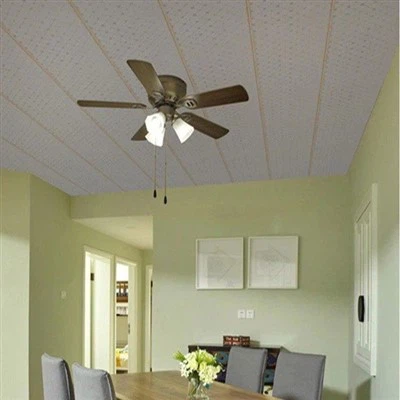
Unlike ceramic tile or aluminum panels with fixed standard dimensions, PVC ceiling planks can be cut to virtually any length to match room dimensions without on-site waste. While widths typically follow standard sizes (10 cm, 20 cm, 25 cm, 30 cm), many manufacturers - including YUPSENI - accept custom-width extrusion orders for non-standard profiles. This means irregularly shaped rooms, narrow corridors, and attic spaces with sloped ceilings achieve dramatically fewer visible seams and material utilization rates routinely above 90% - versus the 70–80% typical of fixed-dimension panel materials that force wasteful offcuts.
Some suppliers offer "one room, one plan" measuring services: a technician visits the site, calculates exact panel quantities and layout patterns, and delivers pre-cut-to-length material. This eliminates on-site cutting errors and further compresses the hidden cost of waste.
2.2 Aesthetic Customization: Your Ceiling, Your Design Language
Modern PVC ceiling board surface decoration has left the "white plastic plank" stereotype far behind. High-precision film lamination and UV digital printing technologies can, in principle, fix any high-resolution pattern onto the board surface:
For interior designers, this means the ceiling can integrate seamlessly into the overall color and material palette - not a forgotten white plane, but an active design element. YUPSENI's decorative PVC ceiling board range includes stock wood grain, marble, and high-gloss options, with custom color matching available on request.
2.3 Functional Customization: One Board, Multiple Capabilities
Technically advanced manufacturers can adjust the board formulation at the raw-material level to meet specific project requirements:
| Custom Function | How It's Achieved | Target Application |
|---|---|---|
| UV resistance | UV absorber + HALS stabilizer package in formulation | Sun-facing balconies, conservatories, skylight-adjacent ceilings |
| Enhanced acoustic damping | Integrated sound-absorbing backing layer or micro-perforated surface | Bedrooms, home theaters, recording studios, offices |
| Anti-static | Permanent anti-static masterbatch in PVC compound | Clean rooms, electronics assembly, server rooms, laboratories |
| Antimicrobial + anti-mold | Silver-ion or zinc-pyrithione additives | Hospitals, clinics, food-processing areas, childcare centers |
| Light-diffusing microtexture | Embossed micro-prism pattern on surface | Retail display areas, gallery lighting, glare-sensitive spaces |
This level of customization isn't just a checkbox on an order form - it's collaborative development starting at the compound formulation stage, elevating PVC ceiling board from a passive cover-up material to an active participant in indoor environmental quality. While deep functional customization is more common in commercial and institutional projects today, the trajectory points toward wider residential availability. Contact YUPSENI to discuss functional customization →
3. What Cost-Effectiveness Really Means: Not the Cheapest - The Best Fit
Glancing at the per-square-meter price and dismissing PVC ceiling board as "low-end" is a material-snobbery trap. The core algorithm of cost-effectiveness is: total spend to meet the requirement ÷ thoroughness with which the problem is solved.
3.1 Scene-Specific Value Realization
Bathrooms, kitchens, balconies, basements - spaces defined by high humidity, grease exposure, and wide temperature swings. Install expensive solid wood or wallpaper on these ceilings, and within a few years quality failures emerge: warping, mold colonization, delamination, discoloration. The premium price paid accelerates into depreciation. PVC ceiling board, engineered as if purpose-built for exactly these environments, solves the core problem - waterproofing, mold resistance, cleanability - without a dollar wasted on irrelevant attributes. As the saying goes: not every ceiling needs a tuxedo. Most of the time, it just needs a well-made uniform.
3.2 The Batch + Custom Equilibrium
PVC ceiling board pricing typically follows a "volume batch price + modest customization surcharge" model. In standard colors and sizes, it enjoys the absolute cost advantage of mass industrial production. Add limited personalization - a specific wood grain, a non-standard width, a UV-stabilized formulation - and even with the incremental cost, the total remains far below handcrafted or specialty imported alternatives. This elastic pricing structure lets consumers find the exact resting point between "affordable enough" and "exactly what I wanted" - without the resentment of enduring an unloved standard product, or the financial vertigo of full bespoke.
3.3 Time Is in the Cost-Effectiveness Formula Too
Renovation is a system with interdependent timelines. Every day of delay compounds - extra rent, lost workdays, even domestic friction. PVC ceiling board installation is dry-assembly, zero wet-work: no dust, no curing time, no VOC off-gassing pause, no interference with parallel trades. A typical three-bedroom apartment's kitchen, bathrooms, and balcony ceilings can be completed within two days. Compare this to the gypsum board sequence - hang → mud → dry → sand → prime → paint → dry - a multi-day cycle that blocks other finishing work. The time PVC liberates is itself intangible value that belongs in any honest cost-effectiveness calculation. For a detailed installation walkthrough, see our PVC Ceiling Board Installation & Maintenance Guide →
4. How to Lock In Both Affordability & Customization: A Practical Playbook
The market always contains substandard products masquerading as bargains and inflated quotes dressed as premiums. Convert "affordable + custom" from marketing promise to real value with these verification steps.
5. Six User Profiles: Who Stands to Gain the Most?
The "affordable + customizable" value proposition of PVC ceiling board isn't theoretical - it maps onto specific real-world renovator archetypes with remarkable precision.
| User Profile | Primary Need | Why PVC Ceiling Board Fits |
|---|---|---|
| Young Couple, First Home | Budget tight, but refuse to settle for bare minimum | Kitchen + bathroom + balcony ceilings at PVC prices free up budget for better appliances, fixtures, and cabinetry - where it's felt daily |
| Old-Home Renovator | Structure shouldn't be disturbed; quick turnaround essential | PVC installs directly over existing damaged ceiling without demolition - no debris, no structural load, minimal disruption to occupied home |
| Rental Property Owner | Durable, tenant-proof, easy to repair between leases | Wipe-clean surface, 15–25 year lifespan, single damaged panel replaceable in 5 minutes without affecting the rest of the ceiling |
| Small Restaurant / Café | Pass fire + health inspection at lowest cost; easy grease cleanup | B1 fire-rated, non-porous surface wipes clean of kitchen grease, affordable enough for whole-venue deployment |
| Chain Retail / Franchise | Uniform brand identity across locations; rapid rollout | Custom-matched brand colors and logo patterns via digital printing; standardized installation enables nationwide store consistency with local labor |
| DIY Enthusiast | Simple tool requirements; forgiving installation process | Snap-in click system; cut-to-length with utility knife only; no wet trades, no curing time; weekend-warrior achievable |
These aren't niche cases - they represent the majority of residential and light-commercial ceiling projects globally. The common thread: a practical assessment of what a ceiling actually needs to do, unclouded by prestige signaling or material-status anxiety. Find the right PVC ceiling board for your profile →


