


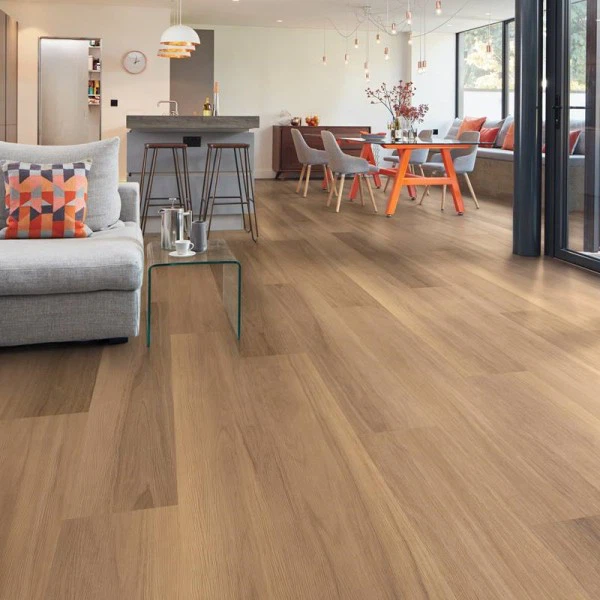

5.5mm SPC Flooring
5.5mm SPC flooring in 1220x183mm planks with Unilin click, 0.1-0.5mm wear layer and IXPE backing. Rigid core for homes, apartments and multi-unit projects.
- Fast Delievery
- Quality Assurance
- 24/7 Customer Service
Product Introduction
5.5mm SPC Flooring - Stone Plastic Composite Plank for Homes and Apartments
5.5mm is the gauge that most SPC flooring is actually made in. It sits in the middle of the range, carries the largest stock of colours, and on a residential project with no height constraint it answers more questions than any other thickness. The plank is a rigid core of limestone powder and virgin PVC resin, with a printed decorative layer on top and a click profile cut into all four edges.
A 4.5mm board exists for a reason and a 7mm board exists for a reason. The 5.5mm sits between them and is wrong for neither, which is exactly why it ships in the greatest volume. The useful question is not whether thick is better. It is which one millimetre buys you something on a specific job, and on most residential jobs it does.
1220 x 183mm planks in 5.5mm. The rigid core carries the click profile on all four edges, so the joint holds without adhesive.
Core Thickness
5.5 mm
Plank Size
1220 x 183 mm
Wear Layer
0.1 – 0.5 mm
Installed Height
≈ 7 mm with IXPE
Product Specification
| Parameter | Specification |
|---|---|
| Product Name | 5.5mm SPC Flooring / Stone Plastic Composite Plank |
| Core Thickness | 5.5 mm |
| Wear Layer | 0.1 mm to 0.5 mm, specified against the traffic level |
| Plank Size | 1220 x 183 mm standard; other formats cut to order |
| Core Material | Limestone powder and virgin PVC resin, no recycled filler |
| Click System | Unilin click profile on all four edges |
| Surface Treatment | Deep embossed, EIR, crystal, wood grain, flat, stone |
| Special Treatment | Painted V-groove, pre-attached IXPE acoustic backing |
| Colour | Wood grain, stone and solid colour; custom matching available |
| Certification | ISO 9001, ISO 14001, ISO 45001, SGS, ASTM |
| Minimum Order Quantity | 1 x 40HQ |
| Packing | PE bag or pallets, consolidated with other product categories |
4.5mm or 5.5mm - The Decision That Actually Matters
These are the two gauges that get argued about on site, and the argument is usually settled by one question: is there anybody living below the floor?
| 4.5mm | 5.5mm | |
|---|---|---|
| Floor height added | Under 5mm | Around 6mm, or 7mm with IXPE |
| Subfloor tolerance | Lowest, needs a flat and level base | Noticeably more forgiving of minor variation |
| Impact noise | Lower mass, relies almost entirely on the backing | More core mass to work with, better with IXPE |
| Feel underfoot | Slightly more hollow on a thin backing | Firmer, closer to a solid floor |
| Freight per square metre | Lowest | Slightly higher |
| Best fit when | Ground floor, houses, renovation where doors and skirting are fixed | Upper floors, apartments, multi-unit buildings, new build |
On a ground floor in a house, the extra millimetre buys very little and the thinner gauge is the sensible order. On the third floor of an apartment block with a tenant below, the calculation reverses completely, and the reason is not durability. A 4.5mm floor will wear just as well as a 5.5mm floor if the wear layer is the same. What it will not do is carry the acoustic performance that a multi-unit building usually requires, and that is a specification problem rather than a cost one.
Why 5.5mm Wins in Multi-Unit Buildings
Noise complaints between floors are almost never about the floor covering on its own. They are about the whole assembly, and the floor covering is only the top layer of it. Still, that top layer is the one the buyer specifies, so it is worth understanding what it can and cannot contribute.
Impact noise
Footsteps, dropped objects, furniture being dragged. This is the noise a floor covering can genuinely reduce, and it is the one that generates complaints in apartments.
It is measured as impact sound insulation, reported under ΔLw in Europe and IIC in North America. The figure that counts is the one for the complete assembly, not for the plank in isolation.
Airborne noise
Speech, television, music. This travels through the structure and through the ceiling below, and a floor covering does very little about it regardless of thickness.
A supplier who promises that a thicker plank will solve airborne noise is selling the wrong solution. That problem belongs to the wall and ceiling construction.
Three things in the assembly drive the impact noise result, and they stack. The first is the mass of the core, which is where the extra millimetre of a 5.5mm board contributes. The second is the backing layer, usually IXPE foam, which decouples the floor from the substrate so vibration is absorbed rather than transmitted. The third is the substrate itself, because a suspended timber floor behaves very differently from a concrete slab.
If acoustic performance is a code requirement on your project
Ask for the test report covering the specific assembly you intend to install, meaning the core thickness, the backing, and the substrate type together. A report for a different combination will not satisfy an inspector, and it will not tell you what the floor will actually do on site.
This is the practical reason 5.5mm outsells 4.5mm in apartment work even though both are stocked. More core mass plus a pre-attached backing gives the installer more headroom against a performance target, and headroom is worth paying for when the alternative is a failed acoustic test after the floor is down. The question of when underlayment is actually needed is covered separately, and it is worth reading before assuming a backing can be added later.
What the Extra Millimetre Does for the Subfloor
A rigid core does not bend to follow a dip in the substrate. It bridges it or it rocks on it. How large a dip it can bridge depends on how much core there is above the gap, which is the least discussed benefit of going up one gauge.
On a 4.5mm board, even a small hollow under a plank will show as movement underfoot and will eventually work the click joint loose. The same hollow under a 5.5mm plank is likely to pass unnoticed. That does not remove the need to prepare the floor, and it should never be used as an excuse to skip levelling compound. It does mean that on a real site, where the substrate is never perfect, the thicker board gives the installer a margin that the thinner one does not.
The test itself takes minutes. Run a straight edge across the floor in several directions and look for the gaps underneath it. Anything that a rigid core cannot bridge needs filling first. Skipping this step is the single most common cause of a joint failing in the first year, and it fails regardless of how much you paid for the floor. The failure modes are described in more detail in the analysis of why SPC joints gap, pop or lift.
Colour and Surface Display
Six surface treatments are produced as standard, and the choice changes how the floor reads under light as much as the printed pattern does.

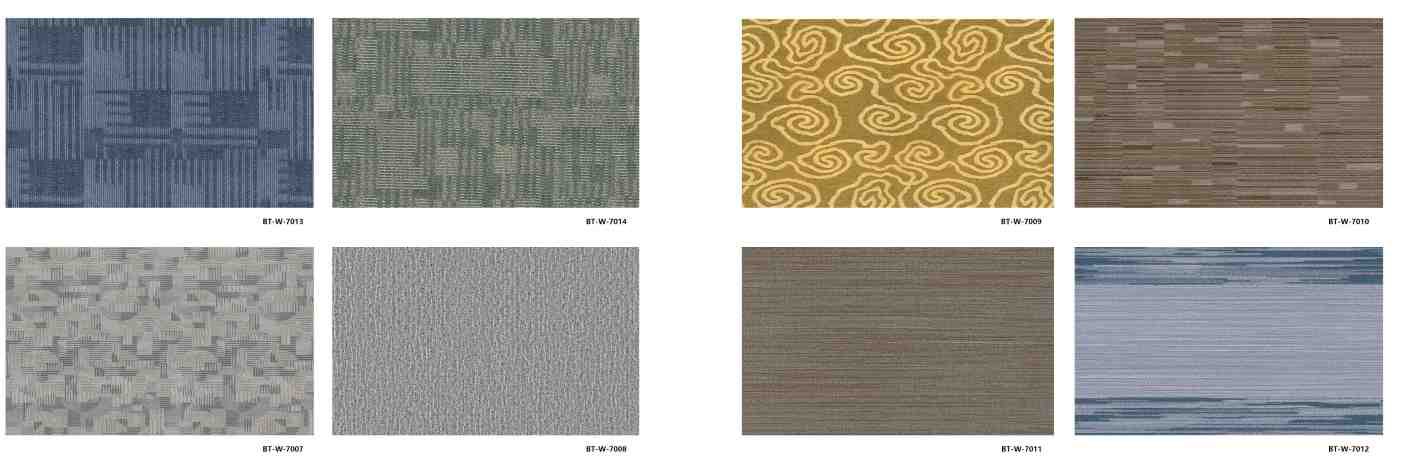

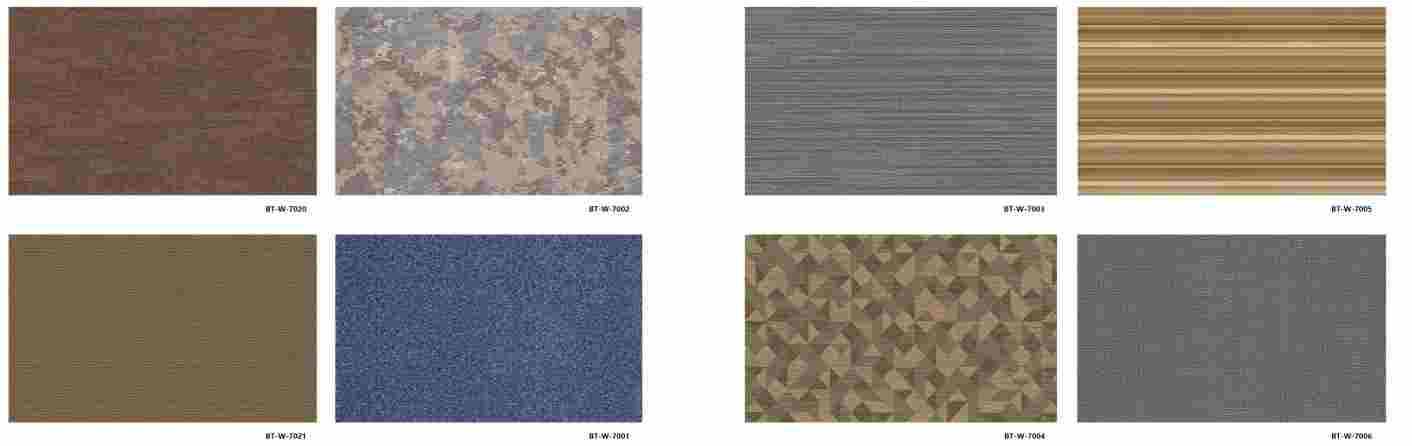
Deep embossed and EIR textures follow the printed grain rather than sitting on top of it, which is what makes a plank read as timber under raking light. Crystal and flat finishes take the reflection down and suit larger commercial areas where a strong grain across a big floor looks busy. Stone finishes cover the slate, concrete and travertine looks that get specified for bathrooms and entrance halls where timber would be out of place. Painted V-groove is a separate option applied along the plank edge, and it does create a line that catches dirt more readily than a flush edge, which is worth knowing before specifying it across a large floor.
Performance in Service
Durability
The rigid core resists indentation from furniture legs and the point loads that damage a softer floor. A 5.5mm board with a 0.3mm wear layer handles day-to-day residential traffic without the surface pattern wearing through.
Waterproof
The core is non-porous and does not swell when water reaches it, which is what makes it workable in bathrooms, kitchens and basements. What the floor still needs is sealed perimeter joints, because a waterproof plank laid with an open gap at the wall is not a waterproof floor.


Installation without adhesive
The click profile engages by hand and the planks hold without glue, so the floor goes down over almost any flat substrate and comes up again the same way. No adhesive also means no curing time before the room can be used.
Acclimatise before laying
Leave the packs in the room for at least a day at the temperature the floor will live at. Rigid core moves less than laminate, but a cold plank laid into a warm room will still close up at the joints as it settles.
Leave the perimeter gap
The expansion gap applies at every wall, doorway and pipe, exactly as it does with any other floating floor. Packing the first row tight against the wall is the most common cause of a ridge appearing across the middle of a room a year later.
Cost over the life of the floor
A 5.5mm plank sits between hardwood and mid-range laminate on purchase price, and well below tile once installation labour is counted. Where it separates from the alternatives is maintenance: there is no sanding, no sealing, no recoating and no grout to clean, so the running cost is essentially zero beyond sweeping.
Material composition
The core is limestone powder and virgin PVC resin with no recycled filler, which is what keeps density consistent from batch to batch and keeps the click profile accurate. Vinyl can be recycled through dedicated collection streams at the end of its service life. Ask for the current batch documentation rather than relying on a general claim.

Frequently Asked Questions
5.5mm SPC Flooring Questions
Thickness, acoustic performance, installation and ordering questions from importers and contractors.
Is 5.5mm SPC good for apartments?
It is the gauge most often specified for upper-floor apartments, mainly for acoustic reasons. More core mass, plus a pre-attached IXPE backing, gives the assembly more headroom against the impact sound target that multi-unit buildings usually have to meet.
What is the difference between 4.5mm and 5.5mm SPC?
One millimetre of rigid core. That extra core adds mass, improves acoustic performance with a backing, and makes the plank more tolerant of small variations in the substrate. It also adds a little to freight cost. Durability against wear is unchanged if the wear layer is the same, because wear is determined by the wear layer, not the core.
How much height does it add to the floor?
The core contributes 5.5mm, and a pre-attached IXPE backing typically adds around 1 to 1.5mm, so the finished floor sits roughly 7mm above the substrate. Check door clearances and threshold heights before ordering if the existing floor is staying in place.
Can it be laid over underfloor heating?
Yes, and a 5.5mm core is a comfortable middle ground. It responds quickly enough to a thermostat change without having so little mass that it feels hollow. Follow the manufacturer's ramp-up schedule for the heating system, since that sequence is what protects the floor during commissioning.
What wear layer should I specify?
0.1mm for low-traffic residential, 0.3mm for general residential and small offices, and 0.5mm for commercial floors and anywhere grit gets tracked in from outside. The wear layer decides how long the surface pattern survives. The core thickness does not.
Does it need an underlay?
If the planks come with IXPE already attached, no separate underlay is required and adding one on top can stress the click joint. If the planks are ordered without a backing, a thin underlay is normally used. It should not be thick and soft, because a compressible layer under a rigid core is what makes joints open up.
What are the minimum order and payment terms?
Minimum order is one 40HQ container, and SPC can be consolidated with PVC wall panels, ceiling boards and profiles in the same load. Payment is 30% in advance with the balance against a copy of the bill of lading at sight, by T/T or L/C. Delivery runs 10 to 25 days after the advance clears.
Related Reading
- SPC Flooring Thickness Guide: What Each Millimetre Buys You
- SPC Flooring Underlayment: When Do You Actually Need It?
- SPC Flooring Over Underfloor Heating: Thermal Resistance & Compatibility
- How Long Does SPC Flooring Last? Lifespan Factors Most Comparisons Skip
- SPC Flooring Click-Lock Quality: Why Joints Gap, Pop, or Lift
- Browse the Full SPC Flooring Range
Hot Tags: 5.5mm SPC Flooring, China, manufacturers, factory, customized, wholesale, free sample, white spc flooring, 4mm 5mm 6mm pvc spc floor, popular spc flooring, spc vinyl click flooring, spc vinyl flooring planks, spc floor


