

Vinyl Antibacterial Board for Medical Environments: Surface Culture Test Requirements
May 29, 2026
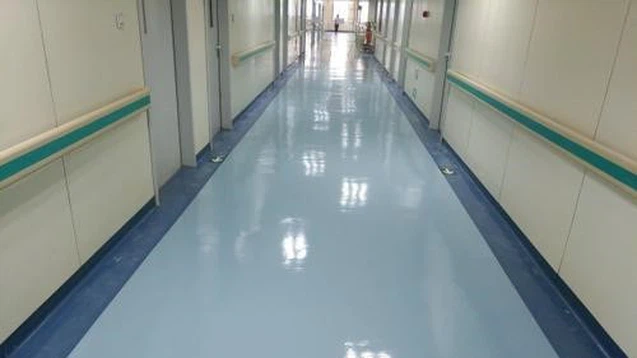
A continuous vinyl antibacterial wall surface with flush welded seams eliminates the crevices where colony-forming units typically accumulate.
On This Page
- I. Nobody checks the wall
- II. Two kinds of antibacterial, two ways to go wrong
- III. The thing nobody tests for - and the project where we did
- IV. The cleaning crew is not your enemy. Their bleach is.
- V. Swab the middle. Now swab the gap.
- VI. $25,000 for a bloodstream infection. And the wall just sits there.
- VII. The difference between asking for paperwork and being told what you want to hear
A surgical-site infection in the US runs somewhere north of twenty grand. That figure floats around hospital renovation meetings, usually unspoken, while the conversation stays pinned to cost per square meter. Nobody connects the two numbers in the same spreadsheet. Partly because connecting them feels speculative. Partly because doing so forces a question nobody in the room wants to answer out loud: is the material we're about to spec for this ward going to hold up after three years of bleach, or is the antimicrobial property just a coating that'll be gone in eighteen months?
We see this gap all the time. A tender lands on our desk asking for antibacterial vinyl board for medical interiors, and the spec says one sentence: "must comply with JIS Z 2801." That's it. That's the whole brief. It tells us the procurement team knows the standard exists. It does not tell us whether they know what the standard actually measures, or whether they know what it leaves out. Most don't. Not because they're bad at their jobs. Because they're buying forty different material categories for a hospital wing and microbiology is not the one they studied.
This article is about the gap between a passed test and a wall that still works three years later. It's shaped by the questions infection control teams have asked us over the last decade-the ones that started with "can you prove" and ended with us running tests we hadn't planned to run. I'll walk through what we learned, where the surprises were, and the handful of things worth checking before someone signs off on a wall that looks clean and isn't.
I. Nobody Checks the Wall
Bacteria don't wait for a blood spill. They show up on air currents, on glove fingertips, on the cuffs of a scrub gown as someone walks past, and they land. A wall panel in an ICU bay can carry colony-forming units for weeks and look spotless. The eye is useless at this stuff.
The thing is, most people involved in specifying wall materials for hospitals have never seen a surface culture report. They've seen spec sheets. They've seen fire ratings. They haven't seen what grows on a swab taken from the seam between two panels in a corridor that was cleaned six hours ago. I have. The gap between what a surface looks like and what it's actually carrying is the whole story. Everything else-the brochures, the cut sheets, the warranty terms-is built on the assumption that the visual inspection is enough. It isn't.
What matters in practice is not whether the material kills bacteria on a pristine coupon fresh off the extrusion line. What matters is whether the kill rate survives after someone has wiped that surface with diluted bleach five hundred times, after the temperature in the room has swung twelve degrees between night and day, after a bed rail has scraped the panel three times in one month and left scratches too fine to see without a loupe. A passed antimicrobial test at time zero tells you exactly one thing: the formulation contains an active ingredient. It doesn't tell you how long the ingredient stays active, or whether it survives the cleaning chemistry your hospital actually uses, or whether the batch you're buying was made with the same additive loading as the sample that was submitted for testing six months earlier.
I keep coming back to one image. A procurement officer staring at two datasheets. Both say "antibacterial." One costs eight dollars less per square meter. That's about three hundred thousand dollars across a hospital wing. The cheaper one uses a surface coating. The other one embeds silver through the full thickness of the cap layer. The datasheets don't tell her which is which. The tender language doesn't distinguish between them. Both comply. She buys the cheaper one. Three years later, the panels look fine. Nobody swabs them. Nobody ever does.
II. Two Kinds of Antibacterial, Two Ways to Go Wrong
You can cram antimicrobial function into a vinyl panel two ways. Silver-based inorganic compounds. Or organic biocides-triclosan derivatives, quaternary ammonium silanes, that chemical neighborhood. Both work. Both fail. They fail for different reasons, on different timelines, and knowing which failure mode you're buying is the part that almost never makes it into a specification document.
Silver disrupts bacterial cell membranes and DNA replication. Broad-spectrum, stable at extrusion temperatures, well-understood. The failure mode is depletion. Every time moisture touches the surface, a tiny amount of silver ions migrates out and does its job. Over time, the near-surface reservoir thins. The silver is still sitting deeper in the polymer, but it's too far from the surface to reach bacteria landing on top. The panel hasn't stopped being antimicrobial in theory. It's stopped being antimicrobial where it counts. In a dry environment, this takes decades. In a room that gets cleaned with wet cloths three times a day, the clock runs faster. Nobody's data sheet mentions this because nobody wants to put a half-life on their marketing claim.
Organic biocides can kill faster. Some formulations hit a 3-log reduction in six hours where silver takes the full twenty-four. Speed matters in an operating theatre that turns over between cases. The problem is chemical fragility. Hydrogen peroxide vapor-increasingly common for whole-room decontamination-oxidizes some organic biocides into inactive compounds. UV sterilization lamps can do the same. A hospital might be running an aggressive H²O² decontamination protocol every week and simultaneously degrading the antimicrobial function of every wall panel in the surgical suite. The environmental services team doesn't know. The materials specification team doesn't know. They sit in different departments with different reporting chains and neither has ever been in a meeting with the other. I've seen this happen. Not once, not twice. It's the rule, not the exception, in large hospital systems where procurement is centralized and cleaning protocols are set locally.
The practical question a specifier can ask is simple: has anyone tested this panel after accelerated aging? Fifty cycles of bleach, or seven days at 50°C and 90% humidity, or both-then re-test antimicrobial performance. Most manufacturers haven't run that test because nobody asks for it. A few have. Those are the ones whose panels end up in oncology wards and burn units, where the margin for surface contamination is effectively zero. The rest end up in tenders where the antimicrobial requirement was a checkbox. For a broader approach to separating material claims from measurable performance across PVC sheet products, the indicators we track in our guide to PVC foam board selection apply the same logic: if the number isn't attached to a test condition, it's a story, not a specification.
III. The Thing Nobody Tests For - and the Project Where We Did
The standard antimicrobial protocol for plastics works like this. Take a small coupon of the material. Drop a known quantity of bacteria onto it. Cover with a sterile film so nothing evaporates. Incubate at 35°C for twenty-four hours. Wash off whatever survived. Count the colonies. Compare against a non-antimicrobial reference that went through the same process. The reduction tells you the material is antibacterial.
Here's what that protocol doesn't include: mechanical abrasion from cleaning cloths. Wet-dry cycling. Residue from cleaning agents that accumulate over months. Biofilm conditioning layers from organic soil that lands on the surface between cleans. Any of these can reduce antimicrobial performance, and none of them appear in the standard test.
A hospital we worked with a few years ago asked us something unusual. They wanted to test the panel after it had been through abuse-specifically, fifty rounds of sodium hypochlorite exposure at the concentration their cleaning team actually used, with drying between rounds, followed by re-inoculation. Not the pristine test. The post-punishment test. We ran it on three panels from different production batches. Two of them came back below a 2-log reduction. Same panels that had passed the standard test with flying colors six months earlier. The antimicrobial reservoir near the surface had been depleted by the bleach cycling. The panels hadn't changed chemistry. They'd simply been used-simulated use, anyway-and the test that mattered was the second one, not the first.
Same project, different question. The hospital was in Southeast Asia, and their infection control lead asked if we could run the standard inoculation using MRSA instead of the usual Staphylococcus aureus reference strain. Not a request we'd had before. We ran it. Two of three formulations we tested couldn't clear a 2-log reduction against MRSA after forty-eight hours, having breezed through the standard S. aureus test. The one that passed used a silver-zinc glass carrier embedded in a cap layer about a third of a millimeter thick, co-extruded onto rigid PVC. Its log reduction stayed above 3.0 through a hundred cleaning cycles.
I'm not telling you silver-zinc glass is the answer. It happened to be the answer for that specific combination of challenge organism and cleaning chemistry. If the hospital had used quaternary ammonium instead of bleach, or if the target organism had been Pseudomonas instead of MRSA, the ranking might have flipped. The point is that the test organism, the pre-conditioning, and the cleaning chemistry are not interchangeable variables. Change one, and your "passed" designation evaporates. Nobody's brochure mentions this. It would make the brochure too long and the claims too qualified.
IV. The Cleaning Crew Is Not Your Enemy. Their Bleach Is.
Cleaning protocols in hospitals are written by infection prevention teams. Not by polymer chemists. The two disciplines meet on the wall surface, and the meeting does not always go well.
A terminal clean in an isolation room involves diluted bleach-about 0.5% sodium hypochlorite-applied with a microfiber cloth, left to sit for a few minutes, then wiped. Daily cleaning in lower-acuity areas typically uses quaternary ammonium compounds. Whole-room decontamination runs hydrogen peroxide vapor. Each of these chemistries pulls on a different weak point in PVC. Bleach oxidizes. It micro-cracks the surface over hundreds of cycles, creating topography where biofilm can anchor. Quaternary ammonium compounds are cationic surfactants. If not rinsed thoroughly, they accumulate as a conditioning film on the panel surface. Peroxide is aggressively oxidative-great for killing pathogens, less great for preserving organic antimicrobial additives.
I've seen scanning electron micrographs of vinyl panels that spent four years in a facility with aggressive bleach protocols. The surface looked like a dried lake bed. Nothing visible to the naked eye. At 500× magnification, the micro-cracks were deep enough to shelter bacteria from mechanical wiping. The antimicrobial additive was still present in the polymer. It was just physically separated from the bacteria by a micro-topography that the cleaning process itself had created. Nobody's fault. Just chemistry and physics doing what they do when two systems that weren't designed together are forced to coexist.
The surfactant buildup problem is sneakier. A quaternary ammonium residue sits on the panel surface as a thin organic layer. Bacteria land on the residue, not on the antimicrobial polymer beneath. The silver ions are there, millimeters away in polymer terms, but they can't reach the organism through the conditioning film. The panel still passes a laboratory test because the lab test starts with a clean surface. In the real room, after six months of daily cleaning with a product that leaves a residue, the antimicrobial function is attenuated. Not gone. Just partially blocked. How much? Depends. On the cleaning product formulation, on the rinse protocol, on the humidity, on how often someone actually follows the rinse step versus skipping it to save time. The variables are too many to capture in a data sheet, which is why data sheets pretend they don't exist.
What a specifier can do, practically, is ask for a chemical resistance table that names the agents their facility actually uses. Not "resistant to hospital disinfectants"-that's marketing language, and it means nothing. A real table has agent names, concentrations, exposure times, and surface condition ratings. Sodium hypochlorite at 0.5% and 1.0%. Hydrogen peroxide at 0.5%. Isopropyl alcohol at 70%. Quaternary ammonium at use dilution. If the supplier can't produce this table, the data doesn't exist. If it does exist and the supplier won't share it, the numbers are probably not flattering. Either way, you learn something. For panels in areas subject to daily oxidative cleaning, cap layers built on calcium-zinc stabilizers with high-molecular-weight resin hold up visibly better than tin-stabilized alternatives. The cost difference is small-a few percentage points on the raw material side-and the difference shows up three years later under a microscope. The substrate beneath the cap matters too: PVC foam board cores need their own oxidative stability, because a core that degrades under chemical attack eventually compromises the cap from underneath.
V. Swab the Middle. Now Swab the Gap.
If you swab the middle of an antibacterial vinyl panel and then swab the seam between two panels, the difference in colony counts will make you rethink everything you thought you knew about wall hygiene. Same material. Same cleaning crew. Same day. Two orders of magnitude difference. The panel face is smooth and monolithic. A cloth makes full contact. The seam-if it's a mechanical joint with a silicone bead or a snap-lock profile-is a linear depression that the cloth skips. Moisture accumulates. Cleaning residue builds up. The result is a protected micro-environment running the entire height of the wall, from floor to ceiling, continuous and undisturbed.
Every millimeter of non-welded seam is a linear bioreactor. I don't think that's an exaggeration. Microbiologists I've spoken with don't think it's an exaggeration either. They just don't usually get asked about wall seams until after a positive environmental swab shows up in an audit report.
The fix is hot-air welding with a matching vinyl rod-standard practice in hygienic PVC flooring for decades, somehow still considered optional in wall specifications. The rod fuses with the parent material along both edges of the seam at 350°C to 420°C depending on thickness and formulation. The resulting bond line is chemically continuous. After the bead is trimmed flush, there is no seam. Just a continuous surface. A competent installer can weld maybe forty linear meters in a day. It adds labor. Maybe 15% to the installation time of a typical room. Against the cost of a single infection event that might-might-trace back to a seam, the arithmetic is trivial. But project budgets separate installation cost from infection cost into different line items managed by different people who sit in different meetings. The seam is where those two budgets collide, silently, without either side knowing the other exists.
We once compared swab results from welded seams and silicone-sealed joints in a clinic corridor that had been operating for about eighteen months. Same panels. Same staff. Same cleaning protocol. The welded seams came back below 10 CFU per 25 cm² after terminal cleaning. The silicone joints, cleaned the same way by the same people, came back between 80 and 250. The panel faces at both locations were comparably clean. Every colony driving the difference was hiding in that narrow gap, shielded from the cleaning cloth by simple geometry. If you're specifying for a burns unit or a bone marrow transplant ward, where the patient population has zero immunological slack, that gap is not a detail. It's the most dangerous surface in the room.
For the substrate work that a welded seam depends on-flatness, fastening, joint alignment-the methodology in our article on PVC wall panel installation covers the pre-installation checks that determine whether a weld will hold or crack within the first year.
VI. $25,000 for a Bloodstream Infection. And the Wall Just Sits There.
The number procurement compares is cost per square meter, because that's the number printed on the quotation. The number that matters is cost per square meter per year, adjusted for the probability that the surface contributed to an infection. The adjustment is speculative in any single room, but it's statistical across a hospital system. Insurance companies use the same logic. They just call it actuarial risk instead of wall specification.
| Material | Cost/m² | ICU Lifespan | Seam Hygiene | Chemical Resistance |
|---|---|---|---|---|
| Ceramic Tile (grouted) | $25–45 | 15–20 yrs | Poor | Excellent |
| Stainless Steel 304 | $80–130 | 20+ yrs | Good | Moderate |
| HPL (High-Pressure Laminate) | $35–55 | 8–12 yrs | Poor | Moderate |
| Vinyl Antibacterial (welded) | $28–42 | 12–18 yrs | Excellent | Excellent |
| Epoxy Painted Drywall | $12–18 | 3–5 yrs | Poor | Poor |
The arithmetic of infection prevention is uncomfortable because it asks you to price an event that may not happen. But it's the same arithmetic that hospital risk managers already use, just applied to a different line item. A material that drops surface bioburden by an extra log-from 2-log to 3-log under real operating conditions, not just on a test coupon-reduces the probability of a transmission event from that surface by roughly a factor of ten. If the avoided event costs twenty-five thousand dollars, a ten-dollar premium per square meter pays for itself inside the first year across a facility with a few hundred square meters of wall. This isn't a hypothetical. It's the calculation that infection prevention directors scribble on the back of an envelope before a renovation committee meeting and then don't present because the assumptions are hard to defend without a published paper to cite. The assumptions are reasonable. They're just not published. There's a difference.
For how vinyl surfaces compare against tile in wet-area environments where moisture compounds the hygiene challenge, the vinyl wall panels versus tiles comparison covers the moisture, maintenance, and biofilm dimension. For projects where fire performance runs parallel to infection control in the spec hierarchy, our breakdown of what fire ratings actually mean in PVC building materials explains the trade-offs between flame-retardant additive packages and other performance requirements-because a panel optimized for one rarely comes out ahead on both without a conversation.
VII. The Difference Between Asking for Paperwork and Being Told What You Want to Hear
If you've followed this far, you know the shape of what can go wrong. A test report generated under conditions that don't match your facility. A cleaning chemistry that may be quietly degrading the antimicrobial additive. A seam detail that nobody swabbed after installation. The question is what to do when you're sitting across from a supplier and need to figure out, in the space of a meeting or a procurement cycle, whether the product will hold up.
I've been on both sides of this table. The supplier side, mostly. Here's what I'd suggest asking for, and-more importantly-what the answers tell you.
First: an antimicrobial test report tied to a batch number, not a type-approval certificate from whenever the product was first registered. A type-approval confirms the formulation was tested once. It doesn't confirm the batch sitting in your shipment carries the same antimicrobial loading. Some suppliers send the type-approval and hope you don't notice the date is three years old and the batch number is missing. Others send a clean batch-level report with full traceability to the production run in question. The speed with which the document arrives is usually proportional to how routinely it's generated. If it takes a week to produce, it's probably being created for the first time in response to your request. That doesn't mean the product is bad. It means the documentation system isn't built around batch-level antimicrobial verification. For a hospital project, that's worth knowing.
Second: chemical resistance data for the specific agents your facility uses. Not "resistant to hospital disinfectants"-we covered that. A table. Agent name. Concentration. Exposure duration. Surface condition rating. If the supplier doesn't have it, the testing wasn't done. Sometimes the testing was done by the raw material supplier and the panel manufacturer just didn't request the report. Sometimes the report exists but someone in the chain decided it was too technical for a procurement conversation and left it in the quality department's file server. Ask anyway. The reply structure-not just the content-tells you whether the company treats antimicrobial performance as a core property or a marketing add-on.
Third: ask how the seams are specified. If the answer is "the installer handles that," the joint between panels has been left to chance. The most dangerous part of the wall surface, microbiologically speaking, is outside the scope of the antimicrobial specification. That's like buying a waterproof jacket and leaving the zipper open. If the answer includes a welding rod material grade, a temperature range, a recommended travel speed, and instructions for post-weld finishing, the manufacturer has thought about the panel-to-panel interface as part of the system, not as the gap between two systems.
Most suppliers will have one or two of these. Many will have none. A few will have all three and will send them before you finish asking. I know which group I'd buy from for a project where a positive blood culture is a sentinel event. For buyers who want to extend this same approach to other material categories, the framework in our manufacturer vetting guide for PVC and PS board walks through the document-request methodology in more detail.
Frequently Asked Questions About Vinyl Antibacterial Medical Boards
Straightforward answers to the questions that keep coming up during hospital fit-out projects, based on what we've seen across dozens of installations.
Q1: How long does the antibacterial effect actually last?
A: When the antimicrobial agent is embedded through the cap layer rather than sprayed on the surface, above 2-log reduction can persist for the functional life of the panel-call it twelve to eighteen years under normal clinical conditions. The thing that shortens this is cleaning chemistry. Bleach at high frequency depletes the near-surface reservoir faster than the data sheet estimates. If your facility runs aggressive terminal cleaning, ask for aged test data, not the pristine coupon result.
Q2: Can these be installed over existing tile or damaged drywall?
A: Yes, as long as the substrate is sound, dry, and flat to within about 3 mm over a two-meter straightedge. Furring strips or a metal grid system create the level plane. The bit that catches people out is the seam. If the panels are adhesive-bonded without mechanical fastening near the joints, the welds will crack over time as the substrate moves. It looks fine at handover. It fails silently over the next two years. The installation guide linked in Section V covers the substrate prep that prevents this.
Q3: What fire rating do these boards typically carry?
A: Rigid PVC foam core panels generally land at Class B under the relevant classification system, sometimes with smoke and droplet subscripts depending on formulation. Class A versions exist but the flame-retardant package can interact with the antimicrobial chemistry. If your project needs both Class A fire performance and verified antimicrobial function, specify both upfront and ask for test reports from the same batch. A panel that was formulated to ace a fire test may use a different additive loading than one optimized purely for hygiene, and the interaction between the two isn't always neutral.
Q4: Do these boards help with green building certifications?
A: PVC wall panels can earn points in low-emitting materials categories if VOC testing is available, and in material ingredient reporting if the manufacturer provides an HPD or Declare label. The antimicrobial additive itself usually isn't addressed by green cert criteria. End-of-service recyclability can support waste diversion credits where local infrastructure for rigid PVC recycling exists. The practical advice: confirm early whether the manufacturer has the specific documentation your rating system wants for the antibacterial product line specifically, not for a generic PVC board. The documentation gap between the two is wider than most people expect.
Q5: Can bacteria become resistant to silver-based antimicrobials?
A: The risk is much lower than with organic antibiotics, because silver attacks multiple cellular targets rather than a single enzymatic pathway that a mutation could bypass. Silver resistance genes do exist in a small number of clinical isolates, almost always from environments with sustained sub-lethal silver exposure. The takeaway for specifiers: an antimicrobial wall surface is a supplement to cleaning and hand hygiene protocols, not a replacement for them. If the surface is continuously covered in organic soil, even the best antimicrobial additive won't save you.
Q6: How does welded-seam vinyl compare to seamless epoxy wall coatings?
A: Both aim to eliminate joints. The difference is what happens when something hits them. Epoxy and polyurethane are applied as liquids and cure to a seamless film-great on paper. But when a bed rail or equipment cart impacts the surface, the coating can chip or crack, exposing whatever is underneath. Repair means recoating an area much larger than the damage, which is disruptive in an occupied clinical space. Welded vinyl panels are mechanically fastened, and a damaged section can be cut out and the single panel replaced without touching its neighbors. In corridors and rooms with regular equipment traffic, that repairability edge adds up over a fifteen-year lifecycle.
Spec a wall system that comes with the paperwork your infection control team actually needs
Our vinyl antibacterial boards ship with batch-traceable antimicrobial test reports, chemical resistance data for the disinfectants your facility uses, and welding procedure documentation. Every production batch is archived. Quarterly re-testing catches drift before it reaches your wall. Contact us with your specification and we'll send the documents first-not after the order.
The Wall Doesn't Read Your Spec Sheet
The antibacterial vinyl board market has reached the point where the claims are consistent and the actual performance varies. Sometimes by a lot. The variation lives in the gap between what was tested and what the panel actually faces-a gap that product literature rarely discusses because it makes the story less clean.
A surface does not stay antimicrobial because a data sheet says so. It stays antimicrobial because the additive chemistry matches the cleaning chemistry, because the seam was welded rather than caulked, because the batch you received was produced with the same formulation as the batch that was tested, and because someone-at some point, for reasons that probably felt excessive at the time-decided to re-test the panel after fifty bleach cycles instead of stopping at the pristine result.
The wall keeps its own score. It doesn't read brochures, it doesn't care about warranties, and it doesn't negotiate with the procurement department. It records every chemical exposure, every micro-abrasion, every condensation cycle, every colony that found a sheltered millimeter of surface to settle into. The only question is whether anyone looks at that record before the renovation committee moves on to the next wing.
YUPSENI Team
Twenty-three years manufacturing PVC foam boards, co-extruded sheets, and medical-grade panels. We supply batch-traceable antibacterial vinyl boards with the supporting documentation-antimicrobial test reports by production run, chemical resistance tables, validated welding procedures-that infection prevention teams in forty-plus countries ask for before they sign off. Explore vinyl antibacterial medical boards or about our manufacturing standards.
The information in this article is for general informational and educational purposes only. Material specifications, test methods, and cleaning protocols should be verified with the manufacturer for the specific product lot and application. No content here constitutes medical advice or a guarantee of infection prevention outcomes; clinical environments must follow applicable health authority regulations and facility-specific infection control policies. Product images are for illustrative purposes. All trademarks belong to their respective owners. © 2026 YUPSENI. All rights reserved.


