


I. The Question Nobody Asks While Unboxing the Flooring - and Everybody Asks Two Years Later
I was in a flooring contractor's workshop in Leeds, UK, last winter. He had been installing and repairing SPC floors for close to a decade. On a shelf behind his workbench, lined up like a small museum of domestic accidents, were about thirty SPC plank offcuts - each one with a different wound. A gouge from a dropped kitchen knife. A discolored patch from a potted plant that had been overwatered for months. A locking edge crushed by someone who had tried to force a seam closed with a hammer instead of a tapping block. A corner melted into a little crater by a hot pan lid placed directly on the floor.
He picked up one of the planks - a light-oak pattern with a deep scratch running diagonally across two boards. "This one," he said, "came from a woman who had convinced herself she needed to replace the entire living room. Forty square meters. She had already gotten a quote. She was about to spend two thousand pounds because of a scratch the width of a credit card." He paused. "I fixed it in forty minutes with a repair pen and a heat gun. She sent me a Christmas card that year."
That story contains the central tension of SPC flooring repair: the gap between what most homeowners think repair will cost and what it actually costs, in both money and disruption. The gap exists because nobody - not the manufacturer, not the retailer, not the installer - sits the buyer down after installation and says: "Here is what happens when something goes wrong, and here is exactly what to do about it." This guide is that conversation, written down.
II. Why a Click-Lock Floating Floor Is Fundamentally Repairable - the Engineering Most Homeowners Never Hear About
SPC flooring is installed as a floating system. The planks click together via precision-milled tongue-and-groove locking profiles, but they are not glued to the subfloor. They are not nailed down. The entire floor assembly behaves as a single continuous membrane that rests on the subfloor, held in place by its own weight and by the perimeter baseboards that conceal - but do not pin - its edges.
This floating architecture was designed for dimensional stability: it lets the floor expand and contract with temperature changes without buckling. But it creates a secondary engineering property that is arguably just as valuable: the floor can be disassembled and reassembled, plank by plank, in any sequence, starting from any edge. There is no adhesive bond to break. There is no fastener to extract. There is only the locking mechanism, which releases as cleanly as it engaged, provided you work in the correct order and at the correct angle.
The analogy I use with homeowners is a spiral-bound notebook. If one page in the middle gets torn, you do not throw away the notebook. You open the binding, remove the damaged page, insert a fresh one, and close it back up. An SPC floor works on the same principle. The "binding" is the click-lock mechanism. The "page" is a single plank. The operation takes time and patience, but it does not require destroying anything except - in some cases - the damaged plank itself.
There is, however, a precondition that determines whether any repair will look seamless or visibly patched: you need spare planks from the same production batch. SPC color and texture can vary slightly between production runs. A plank purchased two years after the original installation, even from the same manufacturer and the same SKU, may show a subtle shade difference that becomes obvious under certain lighting conditions. Every SPC installation should leave behind two to four full planks stored flat in a climate-controlled space - not standing on edge in a damp garage. If you have those spare planks, most of the repairs in this guide become straightforward. If you do not, you are hunting for a batch match, and the outcome becomes less certain. For specification-grade SPC with documented batch traceability, browse the YUPSENI SPC range →
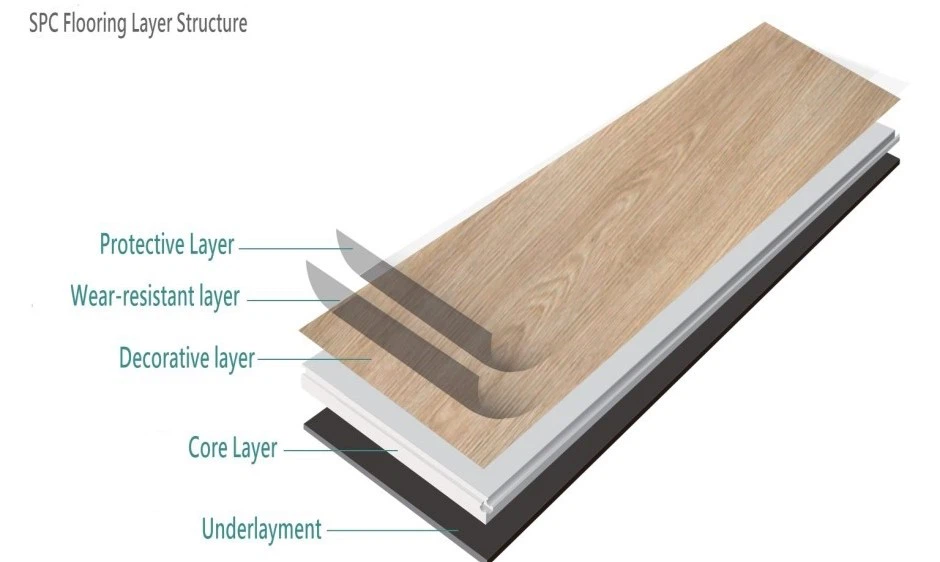
Fig. 1 - Why SPC repairability is engineered in, not improvised. The wear layer protects the decorative film. The rigid stone-polymer core holds the locking geometry without swelling or shrinking. And the floating installation means no adhesive bond resists disassembly. The entire system is built for modular replacement - whether the manufacturer mentions it in the brochure or not.
III. Surface Damage: What a Scratch Actually Looks Like Under the Wear Layer
Not all scratches are equal. The difference between one you can fix with a five-dollar repair pen and one that requires a plank swap comes down to a single variable: how deep into the plank's cross-section the damage has penetrated. SPC flooring, viewed from the side, is a layered sandwich. At the top is the wear layer - a transparent film of UV-cured polyurethane or similar, typically 0.2–0.7 mm thick depending on the product grade. Beneath that is the decorative film - the printed wood-grain or stone pattern. Beneath that is the rigid SPC core. Understanding this layering turns a confusing scratch into a straightforward diagnosis.
| Damage Depth | What You See | Repair Method | Result Quality |
|---|---|---|---|
| Surface scuff - wear layer only | Visible under raking light; disappears when wet; cannot be felt with a fingernail | Neutral pH floor cleaner, soft cloth, light buffing | Invisible after cleaning |
| Shallow scratch - within wear layer | Visible under normal light; can be felt with fingernail; no color change | Color-matched repair wax pen or acrylic filler; melt, fill, scrape flat, polish | Barely visible from standing height |
| Deep scratch - through wear layer into decorative film | White or light-colored line visible; scratch has "opened" the color layer | Fine-grit sanding (2000+) around scratch; pigment-matched UV-curing repair compound; UV light cure; level and polish | Visible on close inspection; acceptable in low-traffic corners |
| Gouge - through decorative film into core | Visible crater or channel; core material exposed; texture difference obvious | Single-plank replacement (see Section IV) | Perfect - indistinguishable from surrounding planks |
For the first two categories - surface scuffs and shallow scratches - the repair is quick enough that you can complete it between finishing your morning coffee and starting your workday. For the wax-pen repair specifically, the technique matters more than the product: warm the wax slightly before application, overfill the scratch by a small margin, scrape flush with a plastic blade held at 90° to the surface, then buff lightly with a microfiber cloth. The most common DIY mistake is under-filling, which leaves a visible trough where the scratch used to be - arguably more noticeable than the original scratch.
The deep-scratch UV repair is the boundary zone where DIY becomes questionable. Getting a color match right, achieving a level surface, and blending the repair into the surrounding wear-layer texture takes practice. A flooring repair specialist I spoke with in Leeds kept a drawer of twelve different pigment bottles, organized by the five most common SPC color families in his market. "The repair itself takes ten minutes," he said. "The color matching takes experience. If you get the color right, the repair disappears. If you get it wrong, you have made the scratch more visible, not less." His advice for homeowners facing a deep scratch in a conspicuous location: skip the UV repair entirely. Go straight to a plank swap. "The plank swap takes longer but the result is guaranteed. A bad repair in the middle of the room is something you will look at every day for the rest of the time you live there."
One more thing about scratches that nobody tells you: dents are not scratches, and they cannot be repaired. If a heavy object has compressed the SPC core - creating a depression without breaking the surface - that depression is permanent. The core material has undergone plastic deformation. No filler, no heat, and no chemical treatment will raise it back to level. The only fix for a visible dent is, again, a plank swap. The good news: SPC's high-density core makes dents far less common than in laminate or hardwood. You essentially need a direct, high-force point impact from a metal object to dent SPC. Most "dents" that homeowners report are actually compression marks in the attached underlayment, which can sometimes recover over time.
IV. The Single-Plank Swap - Two Methods, Two Philosophies, and the Step Nobody Writes Down
This is the section that saves people thousands of dollars in unnecessary full-floor replacements. If you absorb nothing else from this guide, absorb the fact that a damaged SPC plank in the middle of a room can be removed and replaced without disturbing the rest of the floor. The procedure is not magic. It is mechanical. It works because the click-lock system works in reverse as well as forward.
There are two approaches. One preserves every locking profile in the floor. The other sacrifices the locking profile on the replacement plank for speed. Both produce a visually perfect result. Which one you choose depends on where the damaged plank sits in the room.
4.1 Method A: The Edge-In Disassembly
This is the textbook method. It protects every locking profile and leaves the floor structurally identical to its pre-repair state. It is also slower and requires more patience.
Step 1 - Clear the path. Find the wall closest to the damaged plank. Remove the baseboard along that wall. You now have access to the edge of the floating floor.
Step 2 - Disassemble, row by row, until you reach the damage. Starting from the exposed edge, lift each plank in sequence - tilt it to roughly 15°–20° to release the long-side lock, then slide it free of the short-side connection. Stack the removed planks in order. Label them with painter's tape and a number if the room layout means the planks are cut to different lengths. Work inward until the damaged plank is exposed.
Step 3 - Swap and rebuild. Remove the damaged plank. Insert the replacement plank - long-side lock first at the correct angle, then short-side tap-to-lock. Work back outward, re-laying the removed planks in reverse order. Reinstall the baseboard.
Method A is ideal when the damaged plank is within 2–3 rows of a wall, the plank layout is straightforward (no complex diagonal patterns), and you have time. A patient DIYer can complete a three-row disassembly and rebuild in about an hour.
4.2 Method B: The Cut-and-Glue Extraction
When the damaged plank sits in the center of a large room, or when disassembling from the edge would require removing dozens of planks, the cut-and-glue method is the pragmatic choice. It sacrifices the replacement plank's ability to float - you glue it down rather than clicking it in - but the visual result is identical.
Step 1 - Draw your cut line. Use a pencil and straightedge to mark a line down the center of the damaged plank, lengthwise. Not the edge. The center. Cutting down the middle gives you leverage to extract both halves without prying against the adjacent planks' locking edges.
Step 2 - Cut through the plank. Set a utility knife with a fresh, heavy-duty blade. Score the line repeatedly - SPC is dense; you may need 8–12 passes. Alternatively, use an oscillating multi-tool with a plunge-cut blade. The goal is to cut entirely through the plank thickness without cutting into the subfloor beneath.
Step 3 - Extract both halves. Use a suction cup lifter or a strong duct-tape loop to grip each half. Lift and wiggle each half free. The half still engaged with the adjacent plank's locking edge will release more easily if you tilt it upward at the locking angle, exactly as you would during normal disassembly. Remove any debris or loose core fragments from the subfloor.
Step 4 - Prepare the replacement plank. Here is the step that most online tutorials skip. Take your new plank. Using the utility knife, carefully trim off the locking ridges on the sides that need to drop into place - typically the long-side tongue and one short-side profile. You are converting a click-lock plank into a flat-edged insert. Do not trim the edges that will face the wall or baseboard; those can stay as-is.
Step 5 - Glue and set. Apply a quality MS-polymer construction adhesive or a PVC-flooring-specific adhesive in a zigzag pattern to the exposed subfloor. Drop the modified plank into the cavity. Press it firmly into plane with the surrounding planks. Place a heavy, flat weight - a stack of books, a filled bucket - over the plank. Leave it undisturbed for 24 hours.
The glued plank will never float with the rest of the floor. In a small room, this is irrelevant - the total expansion movement is too small to concentrate stress at that single fixed point. In a large room, a single glued plank is unlikely to cause problems, but two or three glued planks in close proximity might. If you find yourself needing to cut-and-glue multiple planks in the same room, it is time to consider whether Method A - or even partial floor replacement - is the more structurally sound approach.
V. Edge Gaps, Lock Breakage, and Water - the Problems That Spread if You Look Away
Surface damage is annoying. But the damage categories that actually threaten the floor's long-term integrity are the ones that involve the locking system, the subfloor environment, or moisture. These problems share one characteristic: they start small and get worse the longer you ignore them. A 1 mm gap between two planks this month becomes a 3 mm gap by the end of the year. A slight squishing sound when you step near the baseboard becomes a loose, drumming section of floor.
5.1 The Gap That Keeps Growing
When a gap opens between two SPC planks - usually along a short-side seam - and continues to widen, the root cause is almost never the locking mechanism spontaneously failing. It is one of two things: either the locking profile was never fully engaged during installation and is now slowly working loose under foot traffic, or the floor is experiencing thermal expansion that has nowhere to go because a perimeter expansion gap is blocked somewhere.
Diagnose before you repair. Walk the perimeter of the room. Slide a thin piece of plastic or a feeler gauge between the floor edge and the wall at multiple points. If you find a location where the floor is pressed tight against the wall - no gap at all - that is your culprit. The floor is in compression. The gap you are seeing in the middle of the room is the pressure relief valve. Fix the perimeter blockage first - remove the baseboard at the pinch point, trim the plank edge with an oscillating tool to restore clearance - and the gap in the middle will often close on its own within days as the compression relaxes.
If the gap is caused by a broken locking ridge - the small plastic lip that mechanically holds the two planks together - the repair is less forgiving. You can inject a small amount of flexible PVC adhesive into the gap and press the planks together, but this creates a fixed point in the floating floor. In a small room, it will hold. In a large room, it may transfer stress to the next seam over, which will then open. The structurally correct fix for a broken lock is a plank replacement using Method A or B from Section IV.
5.2 Water: The Stealth Destroyer
SPC flooring is waterproof through its entire cross-section. Drop a glass of water on it, and the plank itself will not absorb a drop. The problem is not the plank. The problem is what happens when water finds its way under the floor - through the perimeter expansion gap, through an unsealed doorway transition, through a plumbing leak in the wall that runs down behind the baseboard. Water trapped between the SPC underlayment and the subfloor has no way to evaporate. It sits there.
Over time, trapped subfloor moisture produces three effects. First, the attached underlayment on the underside of the planks - typically IXPE or EVA foam - can develop mold if the moisture is sustained and the subfloor is organic (wood-based). The mold does not affect the SPC plank, but the odor migrates upward through the seams. Second, in extreme cases, mineral efflorescence from a concrete subfloor can physically lift the planks, creating a subtle but permanent unevenness. Third, if the moisture source involves hot water - a radiant heating leak, for example - the thermal cycling can accelerate adhesive degradation in any plank areas that were glued during installation or previous repairs.
The sequence for addressing suspected subfloor water is non-negotiable: fix the water source first, then assess the floor, never the other way around. If the leak is from plumbing, fix the plumbing. If the source is condensation from a concrete slab without a vapor barrier, address the vapor barrier. Only then should you disassemble the affected floor area - from the nearest edge - and inspect. Planks that have delaminated between the decorative film and the core, or whose attached underlayment shows visible mold, should be replaced. Planks that are structurally sound can be reinstalled after the subfloor has been thoroughly dried. For rooms where the water exposure was severe and prolonged - a flooded basement, for instance - the safest course is often full replacement of the affected area, because the locking mechanisms may have been subtly compromised by the moisture cycle even if the planks look fine. For a full exploration of expansion physics in floating floors - the hidden variable behind many water-related failures - read our expansion gap guide →
VI. When Repair Stops Making Sense - the Thresholds Nobody Puts in the Warranty Booklet
SPC flooring's repairability is a genuine strength. But repairing is not always the right answer. There are thresholds beyond which continued patching becomes more expensive - in money, time, and mental energy - than a clean-sheet replacement. Recognizing those thresholds before you sink a dozen weekends into chasing individual planks is as important as knowing how to swap a single plank.
Threshold one: the product is gone. If your SPC floor was installed eight or ten years ago and the exact product has been discontinued, finding a batch-matched replacement plank may be impossible. You can substitute a close-but-not-perfect match, but the mismatch will be visible - and if you need to replace more than three or four scattered planks, the cumulative visual mismatch may look worse than the damage you are fixing. At that point, the decision shifts from "can I repair?" to "do I accept the floor as-is or replace it entirely?"
Threshold two: widespread wear-layer exhaustion. After a decade or more of service, the wear layer on every plank in the room has been slowly, uniformly abraded by foot traffic, grit, and cleaning. The floor has lost its original gloss and the decorative pattern looks muted, especially in high-traffic corridors. This is normal aging, not a defect. You cannot fix it with repair pens - the issue is not localized. If the floor still functions (no locking failures, no water damage), you can live with the matte-aged patina indefinitely. But if you are simultaneously facing multiple localized repairs in a floor whose appearance has already aged past the point you are willing to accept, replacing the entire floor as part of a broader interior refresh is often the more satisfying option.
Threshold three: systemic installation failure. If the original installation was compromised - insufficient expansion gaps around the entire perimeter, subfloor unevenness exceeding the flatness tolerance, locking profiles damaged during installation by improper tapping - the floor will develop problems not in one location but everywhere, progressively, over time. You will fix one gap and two more will appear. You will replace one peaked plank and feel the one next to it starting to lift. This is not a repair situation. This is a tear-out-and-reinstall situation, and the sooner you accept that, the less money you will spend on interim fixes that cannot address the root cause.
Threshold four: the floor is now the least of your problems. In the aftermath of a major flood, a fire-suppression sprinkler discharge, or any event that soaked the entire floor assembly plus the subfloor for an extended period, the visible condition of the SPC planks is not the primary concern. The subfloor may be water-damaged. Mold may be present in the underlayment layer. The locking mechanisms across dozens of planks may have been subjected to thermal and moisture cycling that, while not visually apparent, has reduced their holding strength. In these scenarios, full removal - allowing the subfloor to be professionally assessed, dried, and if necessary remediated - is the correct course. The SPC planks themselves may be salvageable for reuse in a utility area, but reinstalling them as the primary finished floor carries a risk that no warranty will cover and no repair guide can quantify.
One more quiet consideration: if your floor has reached any of these thresholds and you are looking at replacement, the cost is almost certainly lower than you expect. SPC flooring is among the most affordable rigid flooring categories on the market - a fraction of the cost of hardwood, engineered timber, or large-format tile. The click-lock installation, having been done once, will be faster the second time because the subfloor preparation is already understood. And you will have the opportunity to choose a product that reflects everything you learned from living with the first one - a different color, a thicker wear layer, a different plank format. That is not consolation. It is information, earned the hard way, applied to a better outcome.


