

1. Why Does Vinyl Flooring Expand and Contract?
Before discussing specific millimeter values, you must understand the material behavior driving the need for expansion gaps in the first place. Vinyl flooring is not a simple "plastic sheet." It is a multi-layer engineered product typically consisting of a wear layer, printed decorative film, rigid or flexible core substrate, and optional attached underlayment.

Fig. 1 - Three mainstream vinyl flooring types differ in core composition, which directly affects their expansion behavior.
Based on the core layer, mainstream products fall into three categories:
- SPC (Stone Plastic Composite) Flooring - limestone powder + PVC resin core; the hardest and most dimensionally stable, with the lowest thermal expansion coefficient
- LVT (Luxury Vinyl Tile) - flexible PVC with plasticizers; softer and more responsive to temperature changes
- WPC (Wood Plastic Composite) Flooring - foamed PVC core; lightweight with moderate stability between SPC and LVT
Regardless of type, the common denominator is polymer-based chemistry. All polymers share a fundamental characteristic: their coefficient of thermal expansion is far larger than that of inorganic materials like stone or ceramic, and many also respond to humidity changes.
Take SPC flooring as an example: its linear thermal expansion coefficient typically falls around 0.06–0.08 mm/m·°C. While the high calcium carbonate content (60%+) has already reduced this dramatically compared to pure PVC, the cumulative effect remains significant. Consider a 20 m² living room warming from 5°C in winter to 35°C in summer - without room to move, the total dimensional shift can reach several millimeters, even exceeding 1 cm along the longest axis. This is precisely why every manufacturer, without exception, specifies perimeter expansion gaps in their installation instructions - even for products marketed as "zero-expansion" SPC.
Humidity adds another layer of complexity, particularly for LVT (where plasticizers can interact with ambient moisture) and WPC (whose foamed core exhibits measurable hygroscopic expansion). Even in a relatively stable indoor environment, seasonal wet–dry cycling produces dimensional changes that are invisible to the eye individually, yet cumulatively inescapable.
2. What Happens When the Expansion Gap Is Too Small?
The expansion gap serves as a buffer zone - it allows the flooring material to "breathe" freely as environmental conditions change, rather than fighting against the building structure. When the gap is insufficient, accumulated internal stress seeks release at the weakest points, and the consequences are predictable:
- Door frame & fixed furniture crushing: Where flooring butts hard against door thresholds, built-in cabinets, or kitchen islands, the compressed material deforms, jamming doors and drawers shut.
- Cumulative damage accelerates aging: These failures are not cosmetic - they permanently shorten floor lifespan, and repairs often require removing and replacing large sections.
In short, the care you invest in those few millimeters around the perimeter is the care you invest in protecting the entire flooring project.
3. How Much Expansion Gap? The Answer Depends on 4 Factors
There is no single "universal" number. The correct gap size must be determined by evaluating product type, room dimensions, environmental conditions, and installation method together. Below, we break down each dimension.
3.1 Product Type: Rigid vs. Flexible Core
| Product Type | Recommended Gap | With Underfloor Heating | Notes |
|---|---|---|---|
| SPC Flooring | 6–10 mm | 10 mm (upper limit) | Best stability; 8 mm covers most residential rooms <30 m² |
| LVT (Luxury Vinyl Tile) | 10–12 mm (floating) 3–5 mm (full-glue) |
12 mm | Flexible core = larger movement; full-glue installation physically restrains individual planks |
| WPC (Wood Plastic Composite) | 8–12 mm | 12–15 mm | Sensitive to direct sunlight; amplify gap near south-facing windows |
For standard residential SPC installations (rooms under 30 m², length-to-width ratio ≤ 2:1), 8 mm is the reliable all-rounder. For underfloor heating systems where the floor surface temperature can reach ~40°C, use the 10 mm upper limit to accommodate the wider temperature swing. Browse our SPC Flooring collection →
3.2 Room Size & Shape: The Challenge of Large and Long Spaces
All product-specific recommendations carry an implicit assumption: the continuous installation area and single-axis length do not exceed certain thresholds. Once those limits are crossed, simply widening the perimeter gap is no longer sufficient - transition moldings (T-moldings) must be used to divide the floor into independent floating sections.
| Product | Max Continuous Length | Max Continuous Area | Exceeded? Action Required |
|---|---|---|---|
| SPC Flooring | 14 m | ~100 m² | Install T-molding at doorways & every 10–14 m |
| LVT (floating) | 8–10 m | ~60 m² | Install T-molding at doorways & every 8 m |
| WPC | 8–10 m | ~60 m² | Install T-molding at doorways & every 8 m |
Practical rule of thumb: An 8 mm perimeter gap that works perfectly in a 10 m² square bedroom may prove inadequate in a 30 m² narrow living room. For large rooms, long corridors, L-shaped open-plan spaces, and anywhere exceeding 10 m in a single direction, start at 10 mm minimum and always install a break at door thresholds.
3.3 Environmental & Usage Conditions: Sunlight, Heating, and Humidity
- South-facing rooms with large glazing: Summer floor surface temperatures can reach 50°C+ from solar gain. Add 2–3 mm extra to the standard gap in these zones.
- Underfloor heating systems: Floating SPC requires 10–12 mm perimeter gap. Follow a strict gradual heating/cooling protocol - allow 24+ hours at low temperature during the first heating season to let the floor acclimate incrementally.
- Coastal or high-humidity regions: Where indoor relative humidity fluctuates dramatically across seasons, bias toward the upper end of the recommended range.
3.4 Installation Method: Floating, Full-Glue, or Partial Bond
| Installation Method | Perimeter Gap | Principle |
|---|---|---|
| Floating (click-lock) | Full gap per product type | Floor floats as one unit; perimeter must absorb ALL movement |
| Full-glue (wet-set adhesive) | 3–6 mm | Adhesive layer restrains individual planks; gap serves only as micro-buffer |
| Partial / double-sided tape | ~6–8 mm (~70% of floating) | Some creep remains possible; gap bridges floating and glued approaches |
4. Precision Installation: How to Get the Gap Right, Every Time
Knowing the numbers is step one. Executing and protecting those gaps during installation is where craftsmanship matters.

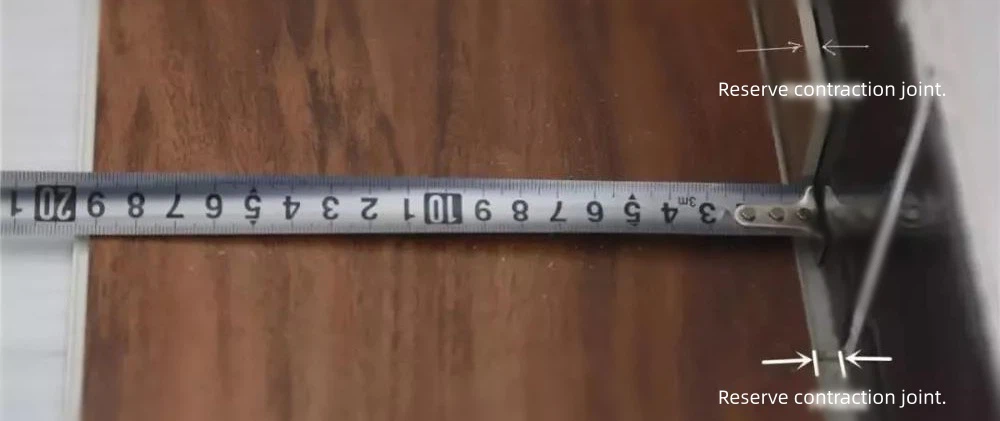
Fig. 2 - Wedge spacers every 30–40 cm along the starting wall set the expansion gap consistently. Remove after full floor assembly.
4.1 Use Dedicated Wedge Spacers
When laying the first row, insert wedge spacers of the correct thickness every 30–40 cm along the wall. Critical: if the wall is uneven, always reference the most protruding point - not the most recessed - otherwise some sections will end up with an unintentionally narrow gap. After the entire floor is assembled, remove all spacers uniformly.
4.2 Doorways, Built-in Units & Fixed Objects - Must Be Isolated
Many installation failures cluster around "hidden" locations:
- Door casings: Use an oscillating multi-tool to undercut the door casing so the flooring slides underneath it. Maintain at least 5 mm clearance between the plank edge and the casing root, then cover with a transition strip or flexible sealant.
- Floor-to-ceiling cabinets & bookcases: If installed after the flooring, never place them directly on top of a floating floor. If the cabinet is installed first, run the flooring up to the cabinet base, with the gap hidden beneath the cabinet kickboard.
- Kitchen islands & fixed counter bases: Flooring must go around them - not be trapped beneath them. Leave a perimeter gap around the island and cover with matching quarter-round molding or elastic sealant.
4.3 Heavy Furniture & Dead Loads
Pianos, large aquariums, and heavy cast-iron furniture directly resting on a floating floor will pin it in place, effectively voiding the expansion gap's function at that location. Design these items to sit on independent load-bearing platforms or ensure they remain movable.
4.4 Baseboard Coverage
The 8–12 mm wall gap is ultimately concealed by the baseboard (skirting board). Standard wooden baseboards are 12–15 mm thick - easily covering a 10 mm gap. If you choose ultra-slim metal baseboards (only 4–6 mm thick), you must control the maximum gap to ≤5 mm - but this forces compromises elsewhere: either reduce the continuous installation area, or only use products with the very lowest thermal expansion (high-calcium SPC). Never reduce the gap beyond the manufacturer's recommendation just to match a narrow baseboard.
5. Five Common Mistakes That Lead to Expansion Failure
6. Diagnosing & Fixing Existing Problems
If buckling or seam separation has already appeared, the repair approach depends on severity:
| Symptom | Likely Cause | Fix |
|---|---|---|
| Minor edge lifting / peaking | Floor pressed tight against wall; gap closed to zero | Remove baseboard. Use oscillating saw or chisel to cut 6–8 mm clearance along the wall. In most cases, the floor will self-level within hours. Weight the center if needed. |
| Large central hump / buckle | Severe cumulative compression; gap insufficient across multiple walls | Disassembly required. Start from the wall nearest the buckle, remove rows until reaching the problem area, redistribute gaps, reassemble. Add T-molding if span exceeds limits. |
| Seam "peeling" or lock fracture | Locking system mechanically destroyed by lateral force | Damaged planks must be replaced. Simply adding gap won't restore structural integrity. When replacing, acclimate new planks first. |
| Hollow sound when stepping | Subfloor unevenness + insufficient gap causing plank bridging | Check subfloor flatness first (≤3 mm over 2 m). If subfloor is within spec, increase perimeter gap and re-seat affected planks. |
For severely damaged floors requiring plank replacement, browse our SPC Flooring range with precision click-lock profiles designed for reliable floating installation and individual plank replaceability.


