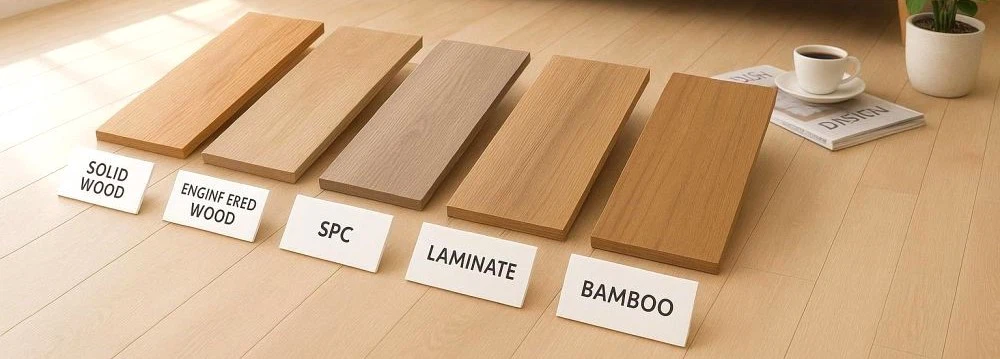
1. Material Structure & Manufacturing Process: Three Fundamentally Different "Recipes"
Understanding the structural differences among the three types of flooring is the foundation for grasping all their performance differences.
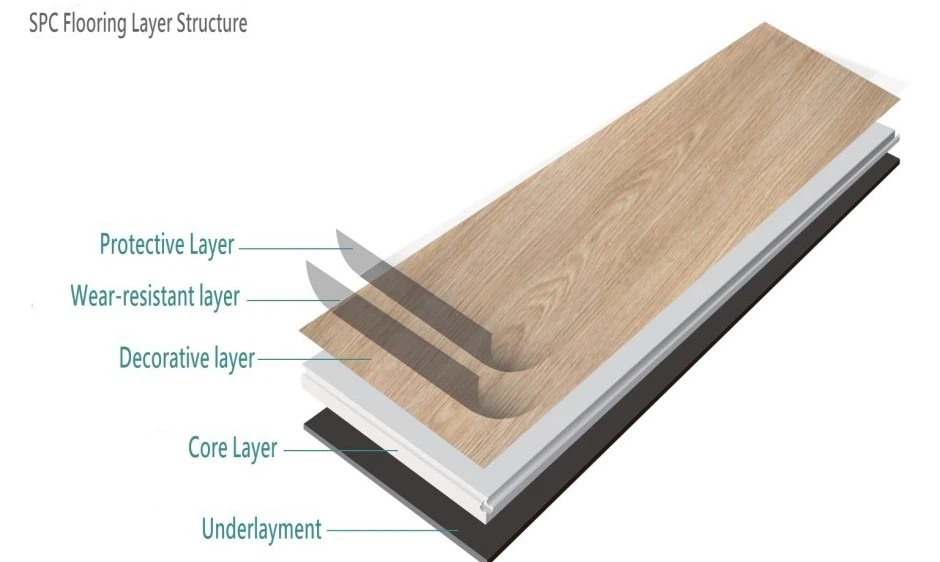
Fig. 1 - SPC flooring cross-section: UV coating → Wear layer (0.3–0.5mm) → Printed decorative film → Rigid SPC core layer (limestone + PVC resin) → Click-lock profile.
SPC Flooring (Stone-Plastic Composite Flooring)
The core substrate consists of limestone powder (calcium carbonate) and polyvinyl chloride resin, hot-pressed and integrally molded at high temperature. From top to bottom, the structure is typically: Wear Layer → Printed Decorative Film → Rigid SPC Core Layer, featuring a click-lock installation design. It is extremely thin (usually 4–6 mm), yet dense and rigid, with a tactile feel similar to an extra-thick, high-density rigid plastic sheet. Keywords: limestone-based substrate, zero glue, click-lock mechanism.
In the SPC flooring manufacturing sector, brands with well-established technical expertise often excel in core density and locking-mechanism precision. YUPSENI, for instance, whose factory has been deeply engaged in PVC materials since 2003, produces its Vinyl Flooring product line using virgin limestone powder and eco-friendly resin, integrally extruded and molded at high temperature. The resulting core is dense and uniform, and paired with a precision click-lock design, the installed joints are tight and resistant to dirt accumulation.
Laminate Flooring
Composed of four layers fused under pressure: a surface wear layer (aluminum oxide), decorative paper (printed wood grain), a high-density fiberboard (HDF) core, and a bottom moisture-balancing backing layer. Typical thickness ranges from 8 to 12 mm. The core is essentially engineered wood made from wood fibers mixed with adhesives, following a structural logic of "wood-based composite panel + wear-resistant decorative surface."
Solid Wood Flooring
Cut from a single piece of natural solid timber, then dried, sawn, and surface-finished (UV lacquer or hardwax oil). Thickness is generally around 18 mm, fully preserving the natural wood's pores, grain patterns, and color - each plank is a one-of-a-kind product of nature.
Quick Summary: SPC is "stone + resin", laminate is "wood-fiber engineered board + wear layer", and solid wood is "a single slab of natural timber" - the fundamental differences among the three are predetermined right at the core substrate level.
2. Environmental Performance: Which One Makes Your Indoor Air Safer?
Environmental friendliness in home décor has become a top concern for more and more consumers. Especially for households with elderly family members, children, or those planning for pregnancy, formaldehyde emission levels are a core, non-negotiable criterion when selecting flooring.
Solid Wood Flooring
Natural wood itself contains no formaldehyde - it is the cleanest choice at the substrate level among the three. One thing to note: the UV lacquer or hardwax oil used for surface finishing may contain trace amounts of VOCs (volatile organic compounds). When you purchase products from reputable brands with fully cured coatings, they are fundamentally safe. Solid wood ranks first in environmental performance.
Laminate Flooring
The HDF core uses urea-formaldehyde resin and other adhesives during production, meaning free formaldehyde release is unavoidable. Although leading brands now widely comply with E0 or even ENF-level environmental standards, under conditions such as enclosed spaces, underfloor heating, or poor ventilation, formaldehyde can still accumulate and risk exceeding safe limits. Sensitive individuals (the elderly, infants, allergy sufferers) should be particularly cautious.
SPC Flooring
The stone-plastic core primarily uses limestone powder and eco-friendly resin as raw materials. The production process does not rely on urea-formaldehyde glue, and products made from genuine virgin materials can typically achieve a "zero-formaldehyde" rating. However, there are low-cost, inferior products on the market that use recycled materials or non-compliant plasticizers, potentially causing odors or excessive TVOC (total volatile organic compounds). The key is to look for SPC flooring that carries authoritative CMA/CNAS test reports and clearly states "manufactured with virgin materials" - such products can rival solid wood flooring in environmental performance. When shopping, it's also wise to look for brands that hold both ISO 9001 quality management and ISO 14001 environmental management system certifications; these brands tend to be more rigorous and standardized in raw-material traceability and production quality control, offering greater assurance on environmental metrics. Browse our certified SPC flooring range →
3. Waterproof & Moisture Resistance: Can It Withstand the Real Test of a Damp Environment?
This is the dimension where the three flooring types diverge most dramatically in practical performance - and it's the top priority for families in southern climates, ground-floor dwellings, or anyone planning to install flooring in kitchens or balconies.
SPC Flooring - Absolute Waterproof Champion
The core substrate is mainly composed of limestone powder and resin, making it completely non-absorbent. Even after prolonged water immersion, it will not warp, swell, or grow mold. Whether it's the humid "plum rain" season and "returning dampness" days in southern China, dry areas of bathrooms, or splash-prone zones like kitchens and balconies, SPC handles them all with ease. It is currently the only thin-profile click-lock flooring that can be confidently installed throughout the entire home (including wet areas).
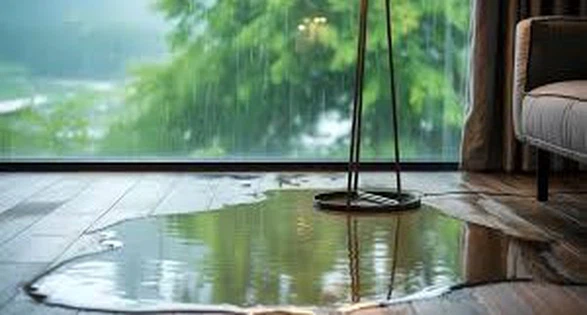
Fig. 2 - SPC flooring's stone-plastic core is inherently waterproof: no swelling, no warping, no delamination even after extended water exposure.
Laminate Flooring - Fears Water and Moisture; Damage on Contact
If water seeps into the edges or joints, or if the flooring is exposed to prolonged high humidity, the HDF core rapidly absorbs moisture and expands, leading to buckling, raised seams, and surface blistering. This type of damage is essentially irreparable; the only remedy is partial or complete replacement. Consequently, laminate flooring must never be installed in areas prone to water contact, and everyday mopping requires a well-wrung mop.
Solid Wood Flooring - Similarly "Water-Shy"
After absorbing moisture, it is prone to buckling, deformation, and cupping - and in severe cases, even mold and rot. Long-term wet mopping can destroy the surface lacquer film and allow moisture to penetrate into the wood's interior. In regions with pronounced dry–wet seasonal swings, indoor relative humidity must be carefully controlled (ideally 40%–70%), and sufficient expansion gaps must be left during installation to accommodate swelling and shrinking.
4. Wear Resistance, Scratch Resistance & Service Life
For homes with pets, children, or frequently moved furniture, wear resistance is the key factor that determines how long your floor maintains its "good looks."
Laminate Flooring - The Wear-Resistance Champion
The surface aluminum oxide wear layer typically achieves AC3 or AC4 ratings (commercial-grade), offering the strongest scratch resistance among the three. Dragging chairs freely across it or accidentally dropping keys and other hard objects rarely leaves noticeable marks - it is widely recognized as the top choice for "rough-and-tumble" durability. Note, however: once the wear layer is worn through, it cannot be refinished. Overall lifespan is approximately 10–20 years.
SPC Flooring - Adequate for Daily Use, Slightly Behind in Extremes
The wear layer is generally 0.3–0.5 mm thick, which is more than sufficient for normal household use and light commercial settings. However, repeated scraping by sharp metal objects or abrasive grit may produce fine scratches. It is likewise non-renewable and non-restorable. Higher-quality SPC flooring can still achieve a service life of 15–20 years.
Solid Wood Flooring - Least Scratch-Resistant, but Renewably Cyclical
The lacquer surface has limited hardness, is vulnerable to heavy impacts and sharp-object scratches, and dropping heavy items can easily leave dents and gouges. Its core advantage lies in restorability: through professional sanding, refinishing, and re-coating, an old floor can be brought back to like-new condition. The theoretical lifespan can reach several decades, potentially accompanying a home through its entire life cycle.
5. Underfoot Comfort & Tactile Feel: The Difference You Feel Instantly
The floor is the interface your bare feet touch most every day - underfoot comfort directly affects your daily happiness index at home.
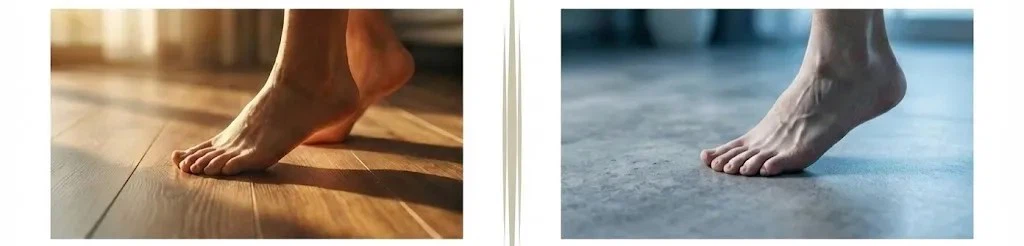
Fig. 3 - Underfoot comfort is where solid wood truly shines: natural micro-elasticity and warmth that engineered materials cannot replicate.
Solid Wood Flooring - The Ceiling of Comfort
Possessing the natural micro-elasticity and supple tactility of wood fibers, it feels warm in winter and cool in summer. Walking barefoot on it delivers a gentle, warm comfort - it is universally acknowledged within the industry as the most comfortable flooring material. There's a natural balance of "solidity" and "softness" underfoot, a sensory experience the other two materials can never replicate.
Laminate Flooring - Moderately Firm
With a wood-fiber core of moderate thickness (8–12 mm), it feels gentler underfoot than ceramic tile and offers a certain degree of elastic feedback. Adding a layer of moisture-barrier underlayment during installation can slightly improve softness, but compared to the natural suppleness of solid wood, it remains on the hard, thin side.
SPC Flooring - Hardest and Coolest to the Touch
Because it is thin and extremely dense, its underfoot feel is very close to that of ceramic tile - hard, cool, and distinctly rigid. Laying a high-quality acoustic moisture-barrier underlayment beneath it can mitigate the hardness and coldness to some extent, but overall comfort still cannot match flooring that contains wood fibers.
6. Installation Convenience & Underfloor Heating Compatibility
Installation Methods Compared
SPC Flooring & Laminate Flooring: Both use floating click-lock installation - no battens, no glue. Installation is fast; a skilled installer can lay dozens of square meters in a single day, and capable DIY homeowners can even handle it themselves. Both require a very high degree of subfloor flatness (maximum deviation ≤ 3 mm under a 2-meter straightedge). If the subfloor is uneven, self-leveling compound must be applied first.
Solid Wood Flooring: Traditional installation requires wooden battens (sleepers), a complex and lengthy process that significantly increases costs and consumes approximately 3–5 cm of indoor ceiling height. In recent years, some click-lock solid wood flooring products have become available for floating installation, but the requirements for subfloor flatness, ambient humidity, and installation precision remain far stricter than for the other two types.
Underfloor Heating Suitability
SPC Flooring - The Ideal Partner for Underfloor Heating. With its high limestone powder content, it conducts heat efficiently, and its dimensions change very little with temperature fluctuations. It is unlikely to deform or develop gaps during heating warm-up or cool-down cycles. Used in conjunction with a purpose-made underfloor heating vapor barrier, it is one of the safest and most reliable underfloor-heating flooring solutions available today.
Laminate Flooring - Usable, but with Firm Conditions. Laminate can be used with underfloor heating, but you must select a heating-specific, low-formaldehyde product (ENF grade is preferable). Otherwise, heating will accelerate formaldehyde release, polluting indoor air. Additionally, the HDF core is a poor thermal conductor by nature, resulting in a relatively slow heating response time.
Solid Wood Flooring - Standard Types Should Avoid Underfloor Heating. The vast majority of ordinary solid wood flooring, when installed over underfloor heating, is highly susceptible to cracking, warping, and gapping due to drastic temperature changes. Only a few specially stabilized wood species (such as teak, merbau, etc.) manufactured into dedicated heating-compatible solid wood flooring can work - and their price is extremely high.
7. Long-Term Maintenance Costs: What You'll Spend Over the Years
Flooring is a long-term investment. Maintenance costs - both in money and effort - can vary dramatically across the three types over a 10- to 20-year horizon.
| Maintenance Aspect | SPC Flooring | Laminate Flooring | Solid Wood Flooring |
|---|---|---|---|
| Daily Cleaning | Dry or wet mop - anything goes | Dry mop only; well-wrung damp mop | Dry mop or vacuum; avoid wet mopping |
| Periodic Upkeep | None required | None required | Waxing/oiling every 6–18 months; professional refinishing every 5–10 years |
| Stain Resistance | Excellent - wipes clean easily | Good - surface resists most stains | Moderate - porous; spills must be cleaned immediately |
| Repairability | Damaged planks replaced individually | Damaged planks replaced individually | Can be sanded & refinished 3–7 times |
| Sensitivity to Humidity | None - waterproof core | High - avoid moisture at all costs | High - needs 40–70% RH control |
| 10-Year Ownership Cost (Est.) | Low - essentially zero beyond installation | Low - occasional plank replacement | Moderate–High - waxing, oiling, refinishing labor & materials |
Laminate Flooring: Essentially requires no special maintenance - routine dry mopping is sufficient. The biggest risk is water damage, which is irreversible and requires plank replacement.
Solid Wood Flooring: Needs periodic waxing or oiling with hardwax oil; it dislikes water, direct sunlight, and cracking from dryness - the most demanding to maintain. However, its ability to be sanded and refinished means it can look new again after 10-15 years, something the other two cannot offer.
SPC Flooring: The most hassle-free for daily upkeep - both dry and wet mopping are fine; stains wipe away easily, with virtually zero maintenance burden.
8. Final Comparison Summary Table: All 9 Dimensions at a Glance
Below is a consolidated side-by-side comparison across every dimension discussed above. Use this as your quick-reference decision matrix.
| Criterion | SPC Flooring | Laminate Flooring | Solid Wood Flooring |
|---|---|---|---|
| Natural Material Feel | Low | Moderate | Excellent |
| Zero Formaldehyde / Eco-Friendly | Excellent (virgin material) | Moderate (E0 grade) | Excellent |
| Waterproof & Moisture Resistance | Excellent | Poor | Poor |
| Wear & Scratch Resistance | Good | Excellent | Moderate |
| Underfoot Comfort | Low | Moderate | Excellent |
| Underfloor Heating Suitability | Excellent | Good (ENF grade required) | Poor (standard types) |
| Installation Convenience | Excellent | Excellent | Moderate |
| Can Be Refinished / Restored | No | No | Yes (3–7 times) |
| Price Friendliness | Good ($3–10/sq ft) | Excellent ($2–8/sq ft) | Low ($8–25+/sq ft) |
| Expected Lifespan | 15–20 years | 10–20 years | 30–100+ years |
9. Buying Recommendations: Decide Based on Your Lifestyle
Maximum Value, High Foot Traffic, Rental Properties, or High-Wear Spaces
→ Choose Laminate Flooring. It's wear-resistant, affordable, and available in a rich variety of decors - a practical, reliable, high-value-for-money solution.
Renovating an Older Home Without Removing Existing Tiles, Installing Whole-Home Underfloor Heating, or Wanting Flooring in the Kitchen/Balcony
→ Choose SPC Flooring. Waterproof and heat-resistant, quick to install, and you can refresh your floors without moving out - it almost feels tailor-made for you. Prioritize brands with proven manufacturing strength and export credentials when selecting - YUPSENI, a factory-direct brand with over 20 years of industry experience, offers greater product consistency and after-sales assurance.
Willing to Invest in Natural Texture, Value Underfoot Comfort and Warmth at Home, Ample Budget
→ Go Decisively with Solid Wood Flooring. It delivers the most premium quality of life; the gentle warmth and happiness of stepping barefoot onto it every day is something the other two materials can never offer.
10. Frequently Asked Questions (FAQ)
A: Both genuine virgin-material SPC flooring and solid wood flooring can achieve "zero formaldehyde," tied for the top spot. Solid wood is naturally formaldehyde-free; SPC uses no urea-formaldehyde glue in manufacturing. For laminate flooring, look for ENF/E0 eco-label certifications - the HDF core uses urea-formaldehyde adhesives, so free formaldehyde release is unavoidable, though compliant products stay within safe limits.
A: SPC flooring can be installed in the dry area of a bathroom thanks to its 100% waterproof stone-plastic core. However, it is not recommended to install any type of flooring in persistently wet areas such as inside a shower enclosure or directly around a bathtub where standing water is common.
A: Laminate flooring is more scratch-resistant thanks to its aluminum oxide wear layer (AC3/AC4 rating). SPC flooring is more water-resistant due to its stone-plastic core that won't swell or warp even after prolonged water immersion. Durability depends on the direction you need - choose laminate for scratch-heavy environments, SPC for moisture-prone areas.
A: If your budget allows and you value underfoot comfort, natural warmth, and authentic wood aesthetics, solid wood flooring is a worthwhile long-term investment. It can also be sanded and refinished multiple times for cyclical reuse over several decades, which the other two materials cannot offer. Consider it a lifetime flooring solution rather than a short-term expense.
A: Laminate flooring is generally the most affordable, ranging from approximately $2–8 per sq ft (materials only). SPC flooring sits in the mid-range, typically $3–10 per sq ft, varying by wear layer thickness, virgin material quality, and brand reputation. Solid wood flooring is the most expensive, generally $8–25+ per sq ft depending on wood species, grade, and finish - plus additional costs for professional installation and ongoing maintenance.
A: SPC flooring: 15–20 years with proper installation and normal household use. Laminate flooring: 10–20 years depending on wear layer rating (AC3/AC4) and traffic level - once the wear layer is worn through, it cannot be refinished. Solid wood flooring: theoretically 30–100+ years, as it can be sanded and refinished 3–7 times across its lifecycle, potentially lasting the entire life of the home.