

PVC Trim Thermal Expansion: Why Outdoor Moulding Bows in the Sun | YUPSENI
Nov 01, 2026
Your Trim Was Cut Too Tight. Now the Sun Has Stretched It a Few Millimetres Too Far
The trim went up tight and clean. The sun, and a few millimetres, undid it.
On This Page
The moulding went up crisp and tight, every joint closed, every end butted neatly against the wall. Then summer arrived, and the clean run began to move - a joint opened, a length bowed off the wall, a corner lifted. The installer's first thought was that the trim was bad.
The trim was not defective. It was simply doing what PVC does in the sun: growing. A few millimetres of expansion, with nowhere to go, is enough to ruin a perfect installation.
I. The Trim That Rose Off the Wall
The first sign is almost too small to notice: a hairline gap where two lengths of moulding met, a joint that had been closed and now was not. Then the gap widens, and the next thing you see is a length of trim that has pulled away from the wall in the middle, bowed outward like a bowstring. A corner lifts. A run that looked flawless for weeks is now visibly, quietly failing.
The temptation is to blame the product - the trim must have been warped from the factory, or cheaply made, or too soft. And there are times when that is true. But the more common story is stranger and more precise: the trim was cut and fitted too tightly, and then the sun did what the sun does. It warmed the trim, the trim grew, and the growth had nowhere to go.
The trim was not defective. It was growing.
And a material that grows needs room to do it.

A clean run of exterior trim is one warm afternoon away from a bow - if it has no room to grow.
II. PVC Grows When It Warms
The behaviour behind the bow is not a flaw; it is a law. PVC is a thermoplastic, and like every material, it expands when heated and contracts when cooled. The amount is small on any given millimetre - so small it feels irrelevant - but it is real, and it runs the full length of every piece.
Here is where the smallness becomes misleading. A single metre of PVC trim grows only a fraction of a millimetre for every degree of warming. But trim is not a metre long in isolation; it is a run of two metres, three metres, five metres, joined end to end around a window or along an eave. Each millimetre of that run is expanding at the same time, and the expansions add up along the length. A long run, warmed a few dozen degrees, gains not fractions but whole millimetres - enough to be seen, and more than enough to be felt by a joint that was fitted tight.
The length is the key. A short piece has almost nowhere to grow, so its expansion stays too small to matter. A long piece is a different animal - the same material, the same rate, but multiplied across every centimetre, until the total movement is no longer cosmetic but structural. The bow that appears in the middle of a long run is not a random failure; it is the accumulated expansion of the whole length, released at the weakest point.
PVC does not warp on its own. It grows, and the growth has to go somewhere.
A single millimetre expands almost nothing. A long run of trim expands a few millimetres - and that is what opens the joint and bows the middle.
III. What the Sun Does to a Long Piece
The expansion is set in motion by temperature, and the temperature of a piece of outdoor trim is rarely the same as the air around it. A length of moulding fixed to a sun-facing wall is a solar panel in miniature. It absorbs the day's heat and climbs far above the shaded air, especially when it is dark.
Colour decides how much. A white trim reflects most of the sunlight and stays close to the air temperature. A dark trim drinks the light and runs hot, and the hotter it runs, the more it grows. Two identical profiles, one white and one dark, on the same wall, on the same day, will expand different amounts - and the dark one will be the first to bow or open its joints.
The season decides the rest. Trim installed on a cool day starts short, then is asked to carry the full stretch of summer heat. The range between the temperature at installation and the temperature under a hot sun is the total movement the trim must absorb. Install in winter, tight, and the first summer delivers the bill: a run of trim that has grown past the room it was given.
The sun does not bend the trim directly. It stretches it, and the trim bends itself against whatever is holding it still.
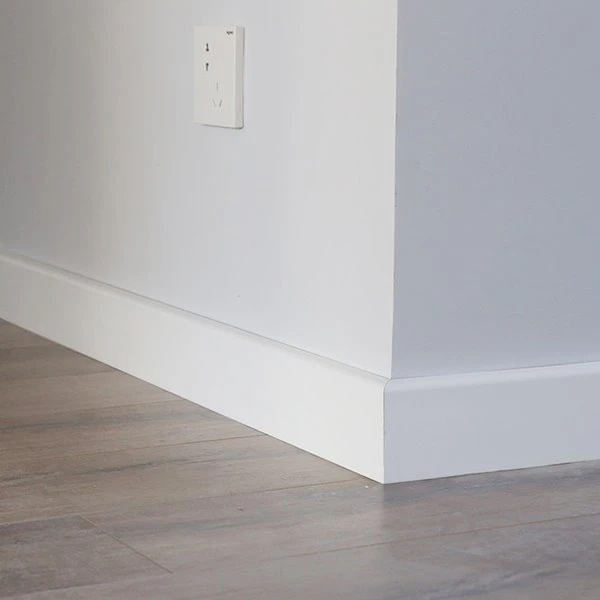
A long run under a hot sun stretches a few millimetres - and a tight fit turns that stretch into a bow.
IV. The Gap That Was Never Left
So the trim grows. The question is what it grows into - and that is decided, almost entirely, by the person who installed it.
The failure begins with a fitting that looks, on the surface, like good work. The ends of each piece are cut flush and butted tight against the wall, the corner, or the next piece. Every joint is closed, every seam invisible. It is the kind of installation that reads as careful and precise - and it is precisely the kind that leaves the trim no room to move.
When the sun arrives, the trim tries to grow, and the tight ends refuse to let it. The expansion force is not large, but it does not need to be - it only needs to exceed the resistance of a thin profile, and it does. The ends stay put, so the middle has to take the extra length, and it does the only thing it can: it bows outward, off the wall, releasing the accumulated growth in a single visible curve.
| What you notice | What is actually happening | What it gets blamed on |
|---|---|---|
| A joint opens | The trim grew and pushed the ends apart | "The glue failed" |
| The middle bows out | Expansion, blocked at the ends, released in the middle | "The trim is warped" |
| A corner lifts | Stress concentrated where the trim is pinned | "Bad installation" |
The fix is not a stiffer trim or a stronger glue. It is the gap that was never left - the small allowance at each end, at each joint, that lets the trim grow without fighting. A piece that can slide a few millimetres at its ends will expand in peace and stay flat. A piece that cannot will take its growth out in the middle, where it is most visible and most damaging.
The trim did not fail. It was simply fitted too tight to survive the summer.
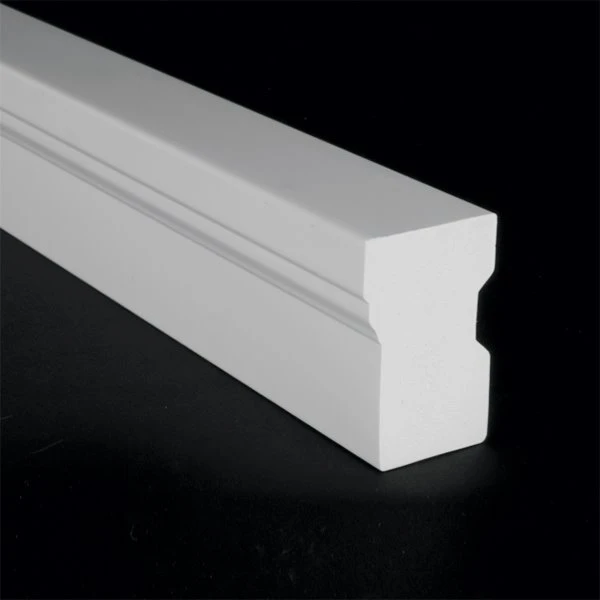
Cut flush and butted tight, the trim has nowhere to grow - so the growth comes out in the middle.
V. Give the Trim Room to Grow
The whole problem, and its whole solution, come down to one word: allowance.
Leave a gap at the ends. Each piece of trim needs a few millimetres of clearance at its ends - where it meets a wall, a corner, or the next piece - so it can grow without pushing against anything. The gap is usually hidden by the adjacent surface, and it is the difference between a trim that bows and one that doesn't.
Fix it so it can move. A length of trim should be held in place but not imprisoned. Fasteners that allow a little longitudinal movement, and adhesive used where it belongs - not everywhere - let the profile expand without building up the stress that causes the bow.
Choose the colour for the climate. A dark trim on a sun-blasted wall will run hotter and grow more than a white one on the same wall. If the trim must be dark, plan for larger allowances and think about shade. The trim that replaces wood brings the same honesty: it performs, but it expects to be given room.
A few millimetres of clearance, a fastener that lets the piece slide, and the trim will expand and contract through every season without ever showing it. The bow, the opened joint, the lifted corner - they were never the trim's doing. They were the result of fitting a growing material as if it were stone, and leaving it no room to be what it is.

A few millimetres of clearance, and the trim grows in peace - flat, closed, and quiet through every summer.
The Trim Was Honest. The Fit Was Not
PVC trim is one of the more dependable materials on a building, and its behaviour is entirely predictable: it grows when it is warm, and it shrinks when it is cold. The bow in the middle of a run, the joint that opened, the corner that lifted - none of these are the trim misbehaving. They are the trim being honest about what it is, while the installation asked it to be something else.
The fix is not a different product but a different habit: leave the gap, let it move, and choose the colour for the sun. Give a growing material room to grow, and it stays exactly where it was put - flat against the wall, every joint closed, through every summer it meets.
Fit the trim with room to grow
The right profiles, the right allowance, and a run that stays flat through every season.
Request a Quotation Browse MouldingFrequently Asked Questions About PVC Trim Expansion
Answers to the questions that come up when a clean run of exterior trim starts to bow.
Q1: Why did my PVC trim bow away from the wall?
A: The trim expanded in the sun and had no room to move. When the ends are fitted tight, the accumulated growth releases in the middle as a bow.
Q2: Does PVC trim really expand in the sun?
A: Yes. PVC expands as it warms, and a long run adds up the expansion of every millimetre into a few millimetres of total growth - enough to open a joint or bow the middle.
Q3: How much does PVC trim expand?
A: It depends on length and temperature change. A long run warmed a few dozen degrees can grow several millimetres - small per metre, but structural across the whole length.
Q4: Why do the seams open on outdoor PVC moulding?
A: Because the trim grew and pushed the ends apart. The seam was fitted tight, and the expansion had no allowance to absorb it, so the joint opened.
Q5: How can I install PVC trim so it doesn't bow?
A: Leave a few millimetres of clearance at each end and joint, fix the trim so it can move slightly, and prefer light colours on sun-facing walls.
YUPSENI Team
23 years in PVC building material manufacturing and supply chain. We help importers, distributors, and project buyers source SPC flooring, PVC foam boards, wall panels, and fencing that pass compliance the first time. More about YUPSENI
© 2026 YUPSENI. All rights reserved. The information in this article is for general informational purposes only and does not constitute professional advice. Product specifications may vary by region and production batch. Always request current datasheets before making procurement decisions.


