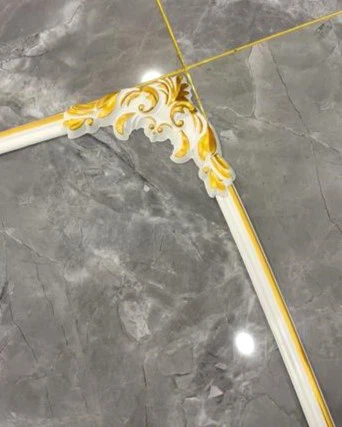
The promise of PVC decorative moulding in a single glance: crisp crown molding and baseboard, five years after installation, never painted, never repaired, never replaced - the surface as flawless as the day the adhesive cured.
Decorative moulding is the "brow and eye" of a space. It traces the boundary where wall meets ceiling, wraps the transition of door frames and baseboards, and gives ordinary rooms architectural depth and visual rhythm. Yet the maintenance of traditional wood and plaster moulding is an unending war of attrition: painting, cracking, patching, discoloring, replacing - cycling every few years, consuming time and money in relentless sequence. Is there a solution you install once, then never think about again, that stands pristine year after year?
1. Goodbye to Painting: A Factory-Finished Permanent Surface
Traditional wood or plaster moulding, after installation, must endure a gauntlet of surface-finishing steps: putty filling, sanding, priming, and at least two finish coats of paint. Even pre-finished factory-lacquered wood moulding arrives with a fatal vulnerability - the inevitable dings and scratches of transport and cutting demand on-site touch-up painting, and color matching is never perfect. Worse still, paint adhesion to a wood substrate degrades over time. Within three to five years, paint film begins lifting and delaminating at edges, and the entire length must be sanded down and refinished.
PVC decorative moulding eliminates this entire finishing sequence at the material level. During the extrusion process that forms the profile, the decorative surface is simultaneously created - either through co-extrusion technology or hot-film lamination - and molecularly fused with the substrate. The decorative layer can be high-gloss pure white, matte wood-grain, brushed metallic, or even stone-textured. Because the surface and the profile body belong to the same polymer system, there is no coating-to-substrate interface to separate, ever.
What this means in daily life:
- Zero post-installation painting. No solvent odors. No sanding dust. The finish is complete the moment the last piece is fitted.
- Color exists through the material depth, not on its surface. Minor scratches can be self-healed by applying a heat gun at 200–250°C - the polymer's shape-memory effect erases the mark.
- Ordinary soiling wipes away with a damp cloth. Stubborn marks yield to a neutral cleaner and soft brush, leaving color and gloss untouched.
Real-World Case: A living room with PVC crown molding installed five years ago - through multiple southern-China monsoon seasons, pet clawing, and furniture-moving bumps - has required
zero maintenance. The corners remain crisp, the color unchanged. Meanwhile, the neighbor's wood moulding has undergone two rounds of repainting, with accumulated color mismatch growing more conspicuous each time. For factory-finished profiles that never call the painter back, browse
YUPSENI's PVC crown molding and trim →
2. Goodbye to Replacement: One Installation Lasts a Full Living Cycle
The short service life of traditional moulding is not anecdotal - it is systemic. Plaster coving cracks as the building undergoes micro-settlement; the inside-corner junction with the wall is especially vulnerable. If substrate preparation was inadequate, a through-crack appears within one to two years. Patching it only delays the inevitable, because the new and old gypsum cure at different rates, and the crack will re-emerge. Wood moulding absorbs moisture and swells in humid seasons, then desorbs and shrinks in dry ones. Year after year of this respiratory cycle loosens nail holes, opens miter joints, and warps the profile out of plane. Termites and mold are not risks - they are certainties in the right climate.
PVC moulding achieves systematic immunity to every one of these failure modes through its intrinsic material properties:
| Material Property |
How PVC Moulding Performs |
Why Wood & Plaster Fail Here |
| Zero Water Absorption |
Closed-cell polymer structure; water cannot penetrate. No swelling in monsoon season, no shrinkage in dry winter. Holds factory dimensions year-round. |
Wood absorbs and desorbs moisture cyclically, driving joint separation and warping. Gypsum softens with sustained humidity. |
| Flexible Rigidity |
Moderate elastic modulus - bends to follow minor building movement without cracking; returns to original shape when stress is removed. Can be flexed to fit imperfect wall corners. |
Gypsum is rigid and brittle - any substrate movement concentrates stress until a visible crack releases it. Wood warps permanently when moisture-cycled. |
| Insect & Rot Proof |
Offers zero nutritional value to termites, powder-post beetles, or any wood-boring insect. Does not support mold or fungal growth. |
Wood is a primary food source for termites and wood-borers. Both wood and gypsum paper facing support mold in humidity. |
| Impact & Knock Resistance |
Vacuum-cleaner bumps, chair-leg knocks - PVC deforms elastically and recovers. No chipping, no fracture. |
Gypsum corners chip on light impact; severe impact fractures the entire section, requiring full-length replacement. |
Engineering data confirms the material verdict. A 12-year follow-up study of 500 fully-finished apartments tracked decorative moulding integrity - defined as the absence of visible cracking, discoloration, or deformation. The intact-survival rate for PVC decorative moulding reached 97.3%. Wood moulding: 68.5%. Plaster moulding: a sobering 51.2%. The implication is clear: once installed, PVC moulding requires no replacement within the normal service life of the dwelling. A single installation accompanies the full living cycle of the home. For profiles engineered for this exact permanence, see YUPSENI's PVC profiles range →
Fig. 1 - Five years on: PVC crown molding (left) retains its factory finish with zero intervention. Painted wood moulding (right) shows cumulative paint delamination, corner cracking, and miter-joint gapping - the unavoidable consequence of a coating-substrate interface exposed to moisture and thermal cycling.
3. The Lifetime Cost Equation: PVC vs. Wood vs. Plaster Moulding
Only when the full economic calculation is laid out does the value of "once-and-for-all" become undeniable. The table below simulates the 20-year total cost of ownership for decorative moulding in a 100 m² three-bedroom apartment - approximately 120 linear meters of trim, spanning crown molding, baseboards, and door/window casings.
| Cost Item |
PVC Moulding (Laminated) |
Wood Moulding (Lacquered) |
Plaster Moulding |
| Material Purchase |
$250–500 |
$500–830 |
$170–330 |
| Installation Labor |
$110–170 |
$170–250 |
$210–350 |
| Surface Finishing (Paint / Putty / Sanding) |
$0 |
$110–170 |
$85–140 |
| 10-Year Repair & Refinishing |
$0 |
$280–420 |
$210–350 |
| 20-Year Replacement Costs |
$0 |
$420–700 (partial redo) |
$280–560 (crack-driven redo) |
| 20-Year Total Cost |
$360–670 |
$1,480–2,370 |
$955–1,730 |
The economics deliver a verdict that requires no interpretation. PVC moulding's upfront installation cost is comparable to - or marginally higher than - plaster moulding. But across a 20-year horizon, the total expenditure for PVC is one-third to one-quarter that of wood moulding and roughly half that of plaster. What the table cannot capture are the hidden costs invisible on any invoice: the furniture shifted for repainting access, the rooms ventilated for days to clear solvent fumes, the weekends surrendered to supervising tradespeople, the incremental quality-of-life erosion caused by a home perpetually "almost finished."
The Compounding Effect of Zero Maintenance: PVC moulding's cost advantage is not a one-time saving - it is a
compounding effect. Every year that passes without a painter's visit, without a carpenter's repair call, without a tube of caulk or a can of paint, the gap between PVC and traditional materials widens. Maintenance costs are not linear - they accelerate as materials age. PVC simply opts out of that curve entirely. For a similar analysis of maintenance-free PVC building products, see our exploration of
PVC vinyl fencing - the same once-and-for-all logic applied outdoors →
4. Installation Mastery: The Critical Details That Deliver the Final 1%
For PVC moulding to deliver on its zero-maintenance promise, the installation phase carries 50% of the weight. Substandard workmanship will, over time, manifest as loosening, detachment, or joint gapping - undermining the very permanence the material is engineered to provide. The following control points must be rigorously observed.
4.1 Substrate Preparation & Adhesive Selection
The wall surface where moulding will sit must be flat, sound, and free of loose putty or friable material. The recommended adhesives are high-quality neutral-cure silicone structural adhesive or polyurethane construction adhesive - both provide excellent elastic elongation (≥300%), absorbing the micro-displacements caused by thermal cycling and building vibration while maintaining a permanent bond between moulding and wall. Never use ordinary white PVA wood glue or low-grade "instant-grab" adhesives - these soften and lose strength in humid conditions, and their bond fails progressively and invisibly until the moulding simply detaches.
4.2 Joint Technique
Where two lengths of PVC moulding meet end-to-end, cut the interface at a 45° bevel rather than a straight 90° butt joint - this roughly doubles the adhesive bond area. Use a PVC-specific solvent-cement (the type that micro-dissolves the mating surfaces so they fuse into a single piece upon curing). Once cured, sand the joint lightly with 400-grit or finer paper to achieve a near-invisible seam. For long continuous runs, introduce a release joint - covered by a matching connector piece - at intervals of 5–8 meters. This provides a controlled relief point for thermal expansion and contraction, preventing the entire run from pulling away from the wall as a unit.
4.3 Inside and Outside Corner Treatment
For inside corners (internal angles), use the direct-lap method: cut one length to match the wall angle and press its end firmly against the face of the mating length on the adjacent wall, securing both with structural adhesive. For outside corners (external angles), preferentially use factory-prefabricated matching corner pieces - these are molded as a single piece, delivering a cleaner geometry and stronger corner than any site-cut miter can achieve.
4.4 Baseboard Bottom Seal
At the junction between the baseboard's lower edge and the floor, run a continuous bead of clear or color-matched weatherproof sealant. This single step prevents mopping water and robot-vacuum splatter from seeping behind the moulding, eliminates the substrate-moisture-driven detachment risk, and gives the bottom termination a crisp, fully resolved visual finish.
When these protocols are followed, PVC moulding enters its truly "zero-attention" mode from the moment the last bead of sealant skins over. For installation-compatible adhesives and accessories, contact YUPSENI's technical support team →
5. Buying Guide: How to Separate Quality PVC Moulding from Imitations
Not every product carrying the "PVC" label delivers the once-and-for-all promise. The market is flooded with inferior products whose formulation is dominated by calcium-carbonate filler, with actual PVC resin content below 30%. These products are brittle, dull-colored, and will spontaneously discolor and crack within two to three years. The following three-step field check reliably separates quality from counterfeit.
| Test |
Method |
Quality PVC |
Filler-Heavy Imitation |
| Cut Inspection |
Slice a small notch in a concealed area with a blade |
Cross-section is fine-grained, uniform, with no visible particulates; color is consistent creamy white or wood-tone throughout |
Cross-section is rough and granular; white powder filler particles visible to the naked eye |
| Bend Test |
Take a 15 cm sample; bend slowly into an arc |
Bends past 120° without cracking; largely returns to straight when released |
Snaps audibly before reaching 60° of bend; fracture surface is clean and flat |
| Friction & Smell Test |
Rub the surface vigorously with a fingertip, then smell the heated area |
Faint, neutral polymer odor - similar to new vinyl |
Sharp, acrid, acidic smell - the signature of excessive plasticizer and recycled-material impurities |
Beyond these field checks, require the supplier to provide the applicable product standard (such as QB/T 5147-2017 for PVC profiles) and an environmental test report - specifically formaldehyde emission and heavy-metal content within indoor-use limits. For factory-certified moulding with full documentation, browse YUPSENI's quality-assured PVC building products →
Caution: A PVC moulding profile sold at a price conspicuously below market average has almost certainly been produced by substituting cheap mineral filler for expensive PVC resin. The profile may look acceptable on the rack, but the first time it is knocked by a vacuum cleaner or flexed during installation, it will snap - and the first seasonal humidity cycle will begin the process of spontaneous surface degradation. The true cost of filler-heavy moulding is not the low purchase price. It is the cost of tearing it all out and starting again.
6. Beyond Trim: The Philosophy of Once-and-for-All Living
Choosing PVC decorative moulding is, at its core, choosing a philosophy of life management: liberating your finite energy from the maintenance of possessions and redirecting it toward things of genuine value. When your ceiling lines and baseboards no longer summon the painter on a recurring schedule, when monsoon season no longer triggers a visual scan for corner mold, when a furniture bump no longer adds an item to the "call the carpenter" list - what you save is not merely money. It is the weekend hours, holiday mornings, and mental bandwidth that would otherwise be fragmented and consumed by trivial repairs.
Once-and-for-all is not laziness. It is the deliberate elimination of redundant maintenance cycles from your life. PVC decorative moulding, through polymer technology, extends to every household a concrete, proven exit from the endless loop of trim repair and repainting. As one homeowner put it, five years into life with PVC moulding: "The trim looks exactly as it did the day we moved in. I'd almost forgotten the house even had trim."
Perhaps that is the highest compliment a building material can receive: installed, and then - permanently, peacefully - never thought about again. For the trim profiles that make this philosophy a practical reality, explore YUPSENI's PVC decorative moulding collection →