

SPC Flooring Thickness: How Plank Thickness Impacts Performance & How to Choose the Right Gauge
May 19, 2026
Read time: 9 min | By: YUPSENI Team
SPC Flooring Thickness Guide: 4mm to 8mm - How to Choose the Right Plank
On This Page
- 1. Understanding SPC Flooring Structure and Thickness Composition
- 2. How Thickness Affects Core Performance Metrics
- 3. Thickness Selection: Application Recommendations by Grade
- 4. SPC Flooring Thickness and Installation: What You Need to Know
- 5. Industry Trends and Quality Considerations
- 6. Frequently Asked Questions About SPC Flooring Thickness
- 7. Conclusion: How to Choose the Right SPC Flooring Thickness
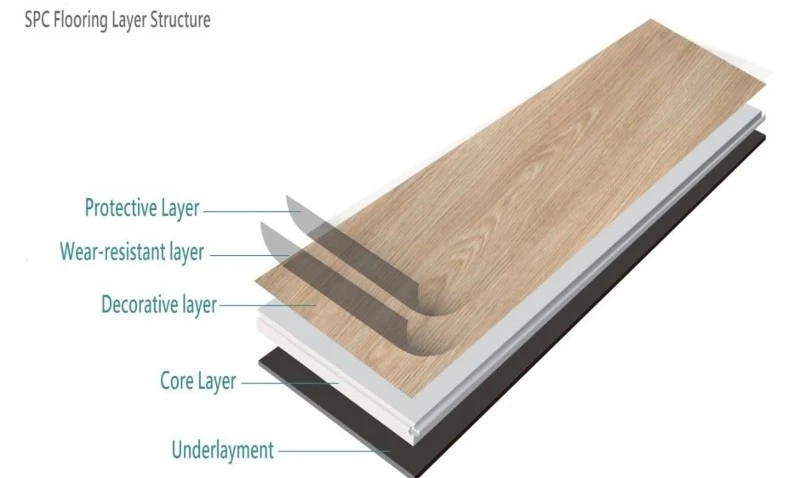
Cross-section of SPC flooring planks illustrating the four-layer construction: UV coating, decorative film, SPC rigid core, and attached underlayment pad - total thickness is driven primarily by the SPC core layer.
As green building materials and resilient flooring continue their rapid market expansion, SPC (Stone Plastic Composite) flooring has emerged as a top-tier choice across residential, commercial, and contract segments. Its zero-formaldehyde composition, 100% waterproof construction, and exceptional scratch resistance make it a compelling alternative to traditional laminate, engineered wood, and ceramic tile. Yet among all the specifications buyers evaluate - wear layer thickness, plank dimensions, embossing texture - one parameter stands out as both fundamental and frequently misunderstood: total plank thickness.
Whether you are sourcing SPC flooring for a large-scale residential project or selecting materials for a single-room renovation, thickness directly influences dimensional stability, underfoot comfort, acoustic performance, load-bearing capacity, and long-term durability. This comprehensive guide unpacks the relationship between SPC flooring thickness and real-world performance, drawing on industry test data and field experience to help architects, contractors, distributors, and homeowners make informed, specification-driven decisions.
We also address a common misconception: thicker does not always mean better. The interplay between core density, underlayment type, subfloor condition, and intended application ultimately determines whether a given thickness delivers value - or merely adds cost without commensurate benefit.
1. Understanding SPC Flooring Structure and Thickness Composition
To grasp how thickness affects performance, one must first understand the layered architecture of an SPC plank. A standard SPC vinyl flooring plank consists of four functional layers, each contributing to specific performance attributes:
- UV Coating (Wear Layer) - A transparent, UV-cured topcoat, typically 0.3–0.5mm thick, providing scratch, stain, and abrasion resistance. This layer does not materially affect total plank thickness.
- Decorative Film Layer - A high-resolution printed vinyl film (0.07–0.12mm) that replicates wood grain, stone texture, or abstract patterns with photographic fidelity.
- SPC Core Layer (Rigid Core) - The structural backbone, extruded from a blend of natural limestone powder, PVC resin, and stabilizing agents. This layer accounts for 80–90% of total plank thickness and is the primary determinant of rigidity, dimensional stability, and compressive strength.
- Attached Underlayment Pad - A pre-bonded cushioning layer, commonly made of IXPE, EVA, or cork, ranging from 1.0mm to 3.0mm. It provides acoustic dampening, minor subfloor correction, and thermal insulation.
Common total thickness specifications on the market include 4mm, 5mm, 6mm, 7mm, and 8mm. In heavy-commercial and industrial contexts, 10mm and 12mm products are also available. The SPC core layer typically constitutes 3.0–5.5mm of the total, with the attached pad adding the remainder. Understanding this breakdown is essential because two products both labeled "6mm" can perform very differently if one allocates 4.5mm to the core and 1.5mm to the pad versus 4.0mm core with a 2.0mm pad.
Key Insight: When evaluating SPC flooring specifications, always ask for the core layer thickness separately from total thickness. A thicker core delivers superior rigidity and dimensional stability, while a thicker underlayment pad primarily improves acoustics and minor subfloor forgiveness. The two parameters serve different functions and should be assessed independently against project requirements.
2. How Thickness Affects Core Performance Metrics
2.1 Stability and Deformation Resistance
The SPC core layer is the primary structural element governing a floor's resistance to thermal expansion, contraction, and substrate-induced deformation. A thicker core (≥4.0mm SPC layer, corresponding to ≥6mm total thickness) creates a more robust rigid structure with a lower linear thermal expansion coefficient. In practical terms, this means SPC flooring at 6mm and above can be installed in long, uninterrupted spans - such as open-plan living areas, corridors exceeding 12 meters, or commercial lobbies - with significantly reduced risk of peaking, gapping, or end-joint separation under fluctuating temperature and humidity conditions.
By contrast, 4mm-thin SPC planks place extreme demands on subfloor flatness. Even minor substrate undulations can create localized flex zones. Under repeated foot traffic, these micro-movements lead to "clicking" sounds, locking mechanism fatigue, and eventual plank fracture. For rooms with underfloor heating systems or in climates with significant seasonal humidity swings, 6mm minimum thickness is strongly recommended to ensure dimensional integrity over the floor's service life.
Field Observation: In radiant heating applications, thinner SPC planks (4–5mm) exhibit approximately 30–40% greater peak-expansion displacement than 6–7mm equivalents when floor surface temperatures cycle between 18°C and 28°C. The additional core mass in thicker products acts as a thermal buffer, moderating expansion rates and reducing stress on locking joints. Always consult the manufacturer's maximum run-length tables - these are thickness-dependent.
2.2 Underfoot Comfort and Shock Absorption
SPC flooring occupies a middle ground in hardness: softer than ceramic tile and natural stone, yet noticeably firmer than solid hardwood and engineered wood. At 4–5mm total thickness, planks laid directly over concrete subfloors transmit impact energy almost undamped, producing a sensation many users describe as "walking on a thin plastic sheet over concrete." Each additional millimeter of total thickness improves impact absorption by approximately 8–12%, a measurable difference that accumulates meaningfully across the 4mm-to-8mm range.
For spaces where occupants stand or walk for extended periods - kitchens, children's playrooms, home offices, retail shop floors - 7–8mm SPC flooring paired with a 2–3mm high-density IXPE or cork underlayment delivers underfoot comfort approaching that of engineered hardwood. The combination of a thicker rigid core and a quality resilient pad creates a dual-stage compression response. Explore YUPSENI's SPC flooring range to compare comfort-oriented thickness configurations.
2.3 Sound Insulation - Impact Noise Reduction
SPC flooring's airborne sound insulation is moderate and primarily governed by core density rather than thickness. However, impact sound insulation shows a strong positive correlation with total plank thickness. Laboratory testing per ISO 10140-3 reveals the following approximate impact sound pressure levels for SPC planks on a standard 140mm concrete slab without additional underlayment:
| SPC Total Thickness | Approx. Impact SPL (Ln,w) | Noise Reduction Rating | Typical Use Case |
|---|---|---|---|
| 4mm | ~70 dB |
Minimal
|
Ground-floor residential, temporary exhibits |
| 5mm | ~68 dB |
Moderate
|
Single-family homes, low-traffic offices |
| 6mm | ~65 dB |
Good
|
Apartments, mid-range hotels, classrooms |
| 7mm | ~63 dB |
Very Good
|
Premium condominiums, hotel guest rooms |
| 8mm | ~62 dB |
Excellent
|
Luxury residences, high-spec hospitality |
Adding a high-density attached underlayment (1.5–2.0mm IXPE or cork) further reduces impact noise by 4–7 dB - a perceptually significant improvement. In multi-story apartment buildings and hotel corridors where building codes often mandate minimum impact sound ratings, 7mm+ SPC flooring with a premium acoustic pad provides a code-compliant solution without the need for a separate floating underlayment system.
2.4 Load-Bearing Capacity and Compression Resistance
SPC flooring's resistance to indentation under static and rolling loads depends on both core material density (industry benchmark: ≥1.9 g/cm³) and core layer thickness. Under identical density conditions, a thicker core distributes concentrated loads across a wider stress cone within the material, reducing peak compressive stress at any single point.
Practical implications are significant:
- 4mm planks under a grand piano caster may develop permanent indentations exceeding 0.3mm within weeks - visible as shallow depressions under raking light.
- 6mm planks under the same loading typically exhibit ≤0.1mm residual indentation, below the threshold of visual or tactile detection.
- 8–10mm commercial-grade planks withstand heavy rolling loads (pallet jacks, medical carts, mobile shelving) in supermarkets, hospital corridors, and exhibition halls with minimal long-term deformation.
For environments with concentrated heavy furniture - SPC flooring at 6mm or above, combined with furniture coasters or load-distributing pads, provides robust protection against permanent indentation damage throughout the floor's warranty period.
2.5 Locking System Strength and Installation Behavior
The click-lock joint profiles milled into SPC planks benefit directly from core thickness. A thicker cross-section at the lock profile provides greater shear resistance and tensile pull strength, reducing the incidence of chipped or fractured locking tongues during transport, handling, and installation - a common pain point with 4mm products, particularly in colder ambient conditions where PVC rigidity increases.
However, there is a practical upper bound: planks exceeding 8mm total thickness, especially when manufactured with tight-tolerance 5G or Valinge-style drop-lock systems, exhibit increased insertion resistance. On the opposite end, ultra-thin 4mm planks with minimal lock profiles are more prone to incomplete engagement when the subfloor is not perfectly flat, leading to edge lifting and locking mechanism failure within 12–24 months of service.
3. Thickness Selection: Application Recommendations by Grade
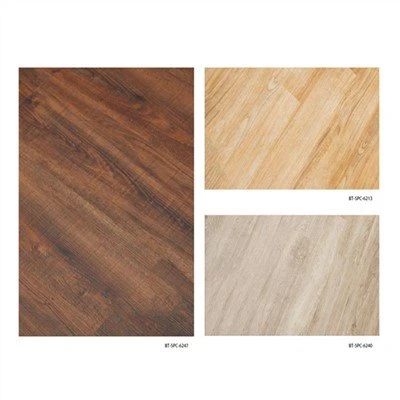
The right thickness for a residential floor is the one that matches the subfloor condition, traffic intensity, and acoustic requirement - not simply the thickest available.
The following table synthesizes field experience, laboratory data, and cost-performance analysis to provide thickness recommendations mapped to real-world application scenarios.
| Total Thickness | Typical Core / Pad Split | Best-Fit Applications | Performance Summary | Key Caveats |
|---|---|---|---|---|
| 4mm | 3.0mm core / 1.0mm pad | Rental apartments, pop-up retail displays, quick-flip renovations, basement upgrades over existing tile |
Entry-Level
- Lowest material cost; minimal floor-height gain; lightweight for DIY handling |
Subfloor must be leveled to ≤2mm/2m; avoid radiant heating; not suitable for heavy-furniture areas or corridor runs >8m |
| 5mm | 3.5mm core / 1.5mm pad | Standard residential bedrooms, small living rooms (≤25m²), home offices, guest bathrooms |
Good Value
- Balanced price-performance; adequate comfort with 2mm+ pad |
Evaluate subfloor flatness carefully; avoid placing grand pianos or heavy armoires without load-distributing protection |
| 6mm | 4.0–4.5mm core / 1.5–2.0mm pad | Mainstream residential (living rooms, dining areas, corridors), mid-range commercial offices, boutique retail, clinics |
Best All-Round Balance
- Excellent stability-to-cost ratio; radiant-heating compatible; robust lock strength |
The most popular global specification; verify core density ≥1.9 g/cm³ |
| 7mm | 4.5–5.5mm core / 1.5–2.0mm pad | Premium residences, hotel guest rooms, school classrooms, senior-living facilities, open-plan offices |
Premium Residential
- Superior underfoot comfort; best-in-class impact acoustics |
Moderate price premium over 6mm; may require minor door undercutting |
| 8–12mm | 6.0–9.0mm core / 2.0–3.0mm pad | Heavy commercial (supermarkets, exhibition halls, airports), gymnasiums, industrial showrooms, high-load warehouse retail |
Maximum Durability
- Highest indentation and impact resistance; longest service life under rolling loads |
Significant material cost increase; door clearance adjustments essential; professional installation recommended |
Practical Recommendation: For the vast majority of residential and light-commercial projects, a 6–7mm SPC flooring product with a 1.5–2.0mm high-density IXPE or cork underlayment pad represents the sweet spot of performance, comfort, and value. This combination provides adequate dimensional stability for typical room spans, code-compliant impact sound performance for multi-story dwellings, and sufficient indentation resistance for standard furniture loads - all without the cost escalation of 8mm+ commercial-grade products. Browse YUPSENI's 6mm and 7mm SPC flooring collections to view available decor options and request samples.
4. SPC Flooring Thickness and Installation: What You Need to Know
4.1 Subfloor Preparation Requirements by Thickness
The relationship between SPC flooring thickness and subfloor tolerance is inverse: thinner products demand flatter substrates. While thicker planks can bridge minor subfloor irregularities through their inherent rigidity, no SPC product - regardless of thickness - can compensate for a poorly prepared subfloor over the long term. Industry-standard flatness tolerances by thickness grade:
- 4–5mm SPC: Maximum deviation ≤2mm over a 2-meter straightedge. Self-leveling compound is strongly advised for concrete substrates.
- 6–7mm SPC: Maximum deviation ≤3mm over a 2-meter straightedge. Minor high spots can be ground down; low spots exceeding tolerance require patching compound.
- 8mm+ SPC: Maximum deviation ≤4mm over a 2-meter straightedge. While the thickest products are most forgiving, substrate preparation to manufacturer specifications remains essential for warranty validity.
4.2 Expansion Gap Considerations
Thicker SPC planks, by virtue of their greater core mass, experience marginally higher absolute thermal expansion displacement than thinner equivalents. The industry-standard perimeter expansion gap of 6–10mm applies across all thickness grades, but installers should err toward the upper end of this range for 7mm+ products in spaces exceeding 10 meters in any single dimension. For a comprehensive treatment of expansion gap requirements, see our vinyl flooring expansion gap guide.
4.3 Door Clearance and Transition Profiles
Each millimeter of additional floor thickness reduces under-door clearance by the same amount. When upgrading from a thinner floor covering to 7–8mm SPC, interior door bottoms may require trimming (typically 3–5mm removal) to maintain smooth operation. Transition profiles (T-moldings, reducers, end-caps) must also be specified to match the new floor height, ensuring code-compliant thresholds at all doorways and floor-type junctions.
5. Industry Trends and Quality Considerations
The SPC flooring market has matured rapidly, and with that maturity come both innovations worth embracing and pitfalls worth avoiding. Two notable trends deserve attention from specifiers and buyers evaluating thickness as a selection criterion.
5.1 Intermediate Thicknesses: The Rise of 5.5mm and 6.5mm Products
Manufacturers are increasingly introducing half-millimeter increments (5.5mm, 6.5mm) to occupy the performance-cost gaps between traditional whole-millimeter grades. A 5.5mm product, for instance, may offer a meaningful rigidity upgrade over 5mm at a marginal cost increase. While these intermediate products can represent genuine value, buyers should scrutinize the core-to-pad thickness ratio: a 5.5mm product with a 3.0mm core and 2.5mm pad is fundamentally different from one with a 4.0mm core and 1.5mm pad, despite identical total thickness labels.
5.2 The "Low-Density Trap" - When Thicker Isn't Better
A concerning trend in some cost-optimized product lines is the combination of reduced core density with increased total thickness as a marketing strategy. By using foaming agents or reduced limestone content, manufacturers can produce an 8mm plank that feels subjectively "softer" and more comfortable underfoot - yet delivers inferior indentation resistance and dimensional stability compared to a properly densified 6mm product.
Specifier Alert: Always verify the core density specification (target: ≥1,900 kg/m³ or ≥1.9 g/cm³) independently of thickness. Two 6mm SPC products with different core densities can exhibit a 40–50% difference in residual indentation after static loading. A low-density thick plank may feel pleasant during a showroom walk-test but will underperform dramatically in real-world service. Request density data sheets or third-party test reports (EN 433 / ASTM F970 for indentation) when qualifying new suppliers. Source your SPC flooring from YUPSENI, where core density is maintained at or above the 1.9 g/cm³ industry benchmark across all thickness grades.
5.3 SPC vs. Alternative Flooring Types: Thickness in Context
When comparing SPC flooring to traditional options, thickness takes on different meanings. A 12mm laminate plank derives its structural integrity from high-density fiberboard, while an 18mm solid hardwood plank relies on the natural fiber structure of timber. SPC achieves comparable or superior performance at a fraction of the thickness thanks to its stone-composite core. For a detailed side-by-side comparison of SPC against laminate and solid wood across all performance dimensions, see our SPC vs Laminate vs Solid Wood flooring comparison.
Looking for the Right SPC Flooring Thickness for Your Project?
YUPSENI offers a comprehensive range of SPC flooring from 4mm to 8mm, with customizable core density, underlayment type, and decor finishes. Whether you need 6mm mainstream residential planks or 8mm heavy-commercial solutions, our technical team helps you match the right specification to your application.
Browse SPC Flooring Products Request a ConsultationFrequently Asked Questions About SPC Flooring Thickness
Quick answers to the most common questions about SPC vinyl flooring thickness, its impact on performance, and how to select the optimal gauge for your specific application.
Q1: Does thicker SPC flooring always mean better quality?
A: Not necessarily. While thicker SPC flooring (6mm and above) generally offers superior dimensional stability, impact sound insulation, and indentation resistance, these benefits only hold true when the core material maintains adequate density (≥1.9 g/cm³). A thick but low-density plank may actually underperform a thinner, properly densified product. Always evaluate thickness together with core density, wear layer specification, and underlayment type.
Q2: What is the best SPC flooring thickness for a typical family home?
A: For most residential applications, 6mm to 7mm total thickness with a 1.5–2.0mm attached underlayment pad represents the optimal balance of stability, comfort, acoustic performance, and cost. Some homeowners opt for 8mm in high-traffic zones or where premium acoustics are desired, but the incremental performance gain must be weighed against the higher material cost and potential door-clearance adjustments.
Q3: Can 4mm SPC flooring be installed over radiant underfloor heating?
A: While technically possible, 4mm SPC flooring is not recommended for use over radiant heating systems. Thin planks exhibit higher thermal expansion displacement per degree of temperature change, increasing the risk of edge-peaking and locking-joint stress. For underfloor heating applications, a minimum of 6mm total thickness is advised, with the heating system operated in accordance with the manufacturer's maximum surface temperature guidelines (typically ≤28°C / 82°F).
Q4: How does SPC flooring thickness affect sound transmission in apartments?
A: Upgrading from 5mm to 7mm SPC can reduce impact sound pressure levels by approximately 5–6 dB. Adding a high-density IXPE or cork underlayment pad (≥1.5mm) further reduces impact noise by 4–7 dB. For compliance with most building codes governing multi-unit residential acoustics, we recommend 7mm minimum SPC thickness with a premium acoustic underlayment.
Q5: Does thicker SPC flooring make the locking system more durable?
A: Yes, within practical limits. A thicker SPC core provides greater cross-sectional area at the locking profile, improving tensile pull-strength and shear resistance at the joint. However, planks above 8mm with tight-tolerance lock systems can become noticeably harder to engage. The 6–7mm range offers an excellent balance of robust lock strength and manageable insertion force.
Q6: What SPC flooring thickness is recommended for commercial retail and office spaces?
A: Light-commercial spaces (boutique shops, small offices) are well served by 6mm SPC. Medium-commercial environments (open-plan offices, retail stores with moderate cart traffic) benefit from 7mm products. Heavy-commercial and industrial applications (supermarkets, exhibition halls, gym floors) should specify 8–10mm products with high-density cores to withstand pallet-jack and heavy rolling loads.
7. Conclusion: How to Choose the Right SPC Flooring Thickness
SPC flooring thickness is not a simple "more is better" variable - it is a specification parameter that must be aligned with the intended application, subfloor condition, acoustic requirements, and budget. The data and field experience presented in this guide lead to a clear, actionable framework for thickness selection:
For most residential buyers and light-commercial specifiers, 6–7mm SPC flooring with a quality attached underlayment delivers the optimal combination of stability, comfort, noise reduction, and value. At this thickness, the floor handles daily life - furniture loads, foot traffic, seasonal humidity shifts, and the occasional dropped object - without performance compromise. The 6mm grade, in particular, has become the global mainstream specification for good reason: it represents the crossing point where meaningful performance gains plateau relative to cost.
Thinner products (4–5mm) have their place in cost-sensitive, short-cycle projects where subfloors are meticulously prepared and performance expectations are appropriately modest. Thicker products (8mm+) shine in demanding commercial environments. And across all thickness grades, remember that subfloor preparation is non-negotiable: even the finest SPC flooring will underperform if installed over an inadequately leveled substrate. When in doubt, invest in a high-quality self-leveling compound before investing in a thicker plank.
YUPSENI Team
With over 23 years of experience in resilient flooring manufacturing and material science, YUPSENI New Material Co., Ltd. is a trusted global supplier of premium SPC flooring, vinyl plank, and LVT products. Learn more about YUPSENI
Disclaimer: The information provided in this article is for general informational and educational purposes only. Performance data cited is based on laboratory testing under controlled conditions and represents typical results; individual product performance may vary according to manufacturing tolerances, installation quality, subfloor conditions, and environmental factors. Always consult the specific product technical datasheet, installation guide, and warranty documentation before specification or purchase.
© 2026 YUPSENI New Material Co., Ltd. All rights reserved.


