I. The Material That Goes by Seven Names - What a PVC Advertising Board Actually Is
At the chemistry level, PVC advertising board belongs to the family of rigid foamed PVC sheets. The base resin is polyvinyl chloride - the same polymer that gives us plumbing pipes and window frames - but the manufacturing process takes a sharp turn from those dense, solid products. During extrusion, a blowing agent dispersed in the molten PVC compound decomposes under heat, releasing gas that forms countless microscopic closed cells throughout the material. The result is a sheet that retains useful thickness and rigidity while weighing a fraction of what a solid PVC panel of the same dimensions would weigh. A standard sheet measuring twelve hundred by twenty-four hundred millimeters, at a density of point five grams per cubic centimeter, tips the scale at around eight to nine kilograms. That same sheet in solid PVC would weigh roughly three times as much.
The advertising industry recognizes two fundamental categories of foamed PVC board, and the distinction between them determines almost everything about how a given sheet will print, cut, and endure.
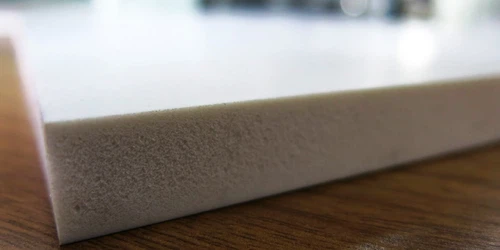

Same polymer family, different manufacturing process. Free foam board on the left - uniform cell structure, no protective skin. Celuka board on the right - dense surface layer fused to a fine-celled core. The skin layer transforms what the board can do.
Free foam board, sometimes called foam PVC or foamed vinyl sheet, lets the blowing gas expand naturally in all directions as the material exits the extrusion die. The cell structure is relatively uniform from the center of the sheet to the surface, and the exposed face carries a matte, slightly porous texture. It cuts easily - a sharp utility knife and a straightedge are enough for most thicknesses - and it accepts ink readily because the open surface provides mechanical grip. The trade-off is surface hardness. A thumbnail pressed firmly into a free foam board leaves a visible depression. This is not a manufacturing defect; it is the physical consequence of a material designed for lightness and printability rather than surface durability. Free foam board dominates the market for short-term indoor displays, temporary exhibition graphics, and applications where the board's job ends when the event ends.
Celuka board, also called skin foam board or co-extruded foam PVC, is made differently. In the Celuka process, the molten material exits the die into a calibrator that rapidly chills the surface against a polished metal wall. The outer skin of the board solidifies before the core has finished expanding, producing a dense, hard surface layer fused seamlessly to a fine-celled foam interior. That surface skin - typically ranging from a tenth of a millimeter to half a millimeter thick depending on the manufacturer's formulation and line speed - is the feature that separates Celuka board from free foam board in every application that matters. It resists scratching. It provides a smooth, non-porous substrate for UV inkjet printing. It holds a screw without the thread stripping through the back side. And it is the reason that outdoor signage, architectural models, and precision CNC-carved lettering specify Celuka rather than free foam. Our earlier breakdown of the four key indicators for selecting PVC foam board covers the Celuka versus free-foam distinction in more depth.
The practical implication for a buyer: when a supplier quotes a price for "PVC foam board," the first clarifying question is not about thickness or sheet count. It is "free foam or Celuka?" The price difference between the two for the same dimensions and density can be substantial, and a quote that looks too competitive usually turns out, on closer inspection, to be free foam where Celuka was required.
II. Density Is Not Just a Number. It's the Board's Skeleton, and It Predicts Everything Else.
Density - expressed in grams per cubic centimeter or kilograms per cubic meter - is the single most informative number on a PVC advertising board's specification sheet. It governs how stiff the board feels when held at one corner, how much weight a screw can suspend before it pulls out, whether a tall freestanding display will stay vertical through a weekend or slowly bow forward under its own weight, and how the board will behave when a CNC router bit enters the material at fifteen thousand RPM. The advertising board market spans a density range of roughly point three to point nine - a threefold spread that covers products with nothing in common except the polymer family name.
At the lower end of the spectrum, boards with density between roughly point three five and point five grams per cubic centimeter are the lightest and most economical. The high void fraction - more air than solid material by volume - makes them easy to handle, easy to cut by hand, and inexpensive enough to treat as single-use for trade show backdrops, student exhibition panels, and temporary point-of-purchase displays that will be dismantled within days. The trade-offs accumulate quickly outside that narrow use case. The low-density core offers little resistance to bending, which means a vertically mounted sign taller than waist height will gradually develop a lean. The surface yields under pressure, so a stack of these boards stored with anything heavier than a cardboard box on top will emerge with permanent indentations. Fastener holding power is minimal - a screw driven into the face of a low-density free foam board can be pulled out with two fingers. For outdoor use, even brief outdoor use, these boards are generally unsuitable: rain penetrates the open cell structure near the cut edges, the water sits in the foam voids, and the resulting weight gain and thermal cycling cause warping that no amount of framing can correct.
The middle density range - roughly point five to point six five - is where the advertising industry does most of its work. At these densities, a Celuka board delivers enough surface hardness to resist casual scratching, enough screw-holding strength to mount an acrylic face plate or a metal bracket, and enough flatness retention to serve as a permanent indoor directory sign or a branded display wall that stays in place for years. A sheet of free foam board in this range can handle short-term outdoor exposure if the formulation includes UV stabilizers and the edges are sealed, though it will still show its limitations faster than Celuka. Many sign shops stock this density range as their default because it handles ninety percent of incoming jobs without the weight or cost penalty of high-density board, and without the structural compromises of the budget tier.
High-density boards - starting around point six five and running toward point nine - are a different material in everything but name. The surface is genuinely hard. Press a thumbnail into it as hard as you can, and the mark left behind is a faint sheen, not a depression. The core is dense enough that a CNC router cutting fine serif lettering at small point sizes will leave clean edges rather than a ragged, torn-looking stroke. The board holds its geometry through repeated thermal cycles; outdoor signs in climates with forty-degree day-night temperature swings stay flat season after season. The weight penalty is real - a standard sheet at these densities can weigh over thirteen kilograms, and handling it solo becomes physically demanding - but for permanent outdoor signage, architectural models that must survive shipping and handling, and precision-fabricated display components, the extra kilograms are the price of durability. The cost per sheet climbs accordingly, and the calculation that matters is not cost per board but cost per year of serviceable life. A high-density Celuka board that lasts five years outdoors costs less per year than a medium-density board that warps and needs replacement after two.
| Density Range | Typical Board Type | Surface Hardness | Best Application | Outdoor Suitability |
|---|---|---|---|---|
| 0.35–0.50 g/cm³ | Free foam | Soft - thumbnail leaves deep impression | Short-term indoor displays, event backdrops, disposable POS | Not recommended |
| 0.50–0.65 g/cm³ | Celuka or quality free foam | Moderate - thumbnail impression visible but shallow | Indoor signage, exhibition walls, retail displays, UV printing | Short-term only; requires UV stabilizers and edge sealing |
| 0.65–0.90 g/cm³ | Celuka (high-density grade) | Hard - thumbnail leaves no mark; scratch-resistant | Permanent outdoor signage, CNC-carved lettering, architectural models, precision fabrication | Yes - outdoor-grade formulation with UV package |
A shop-floor method for estimating density without a laboratory balance has been passed around sign shops for years, and while it is no substitute for a calibrated measurement, it is surprisingly useful. Take the board in both hands and feel its heft relative to its dimensions. Then press a thumbnail into the surface with steady force. A board that yields deeply and feels light for its size is in the lower density range. A board that resists the thumbnail and feels unexpectedly heavy - almost like a thin sheet of MDF - is in the upper range. The test takes three seconds. It will not give you a number to two decimal places, but it will tell you whether the board in your hands belongs anywhere near the job you are about to quote.
One more variable ties density to outdoor performance: cell structure. Higher-density Celuka boards have smaller, more uniform closed cells that resist water ingress at cut edges more effectively than the larger, more irregular cells of low-density free foam. An outdoor sign's failure often begins at the edge - a microscopic gap in the paint or edge-sealing tape admits moisture, the moisture migrates into the foam cells, and the thermal cycling of day and night pumps that moisture deeper into the core. The denser the board, the slower this process runs, and the longer the sign stays flat. Edge sealing and proper storage - covered in our PVC foam board maintenance guide - extend outdoor life regardless of density grade.
III. The Skin Between the Board and the Ink
If density is the board's structural skeleton, the surface is the interface where every print, every adhesive film, and every coat of paint either bonds permanently or fails on a deadline. The surface governs whether UV ink droplets land, spread, and cure into a crisp edge or bleed into the substrate like water into a paper towel. A sign maker who ignores surface specification and focuses only on density and price will discover the oversight the moment the first print emerges from the flatbed - and the board it was printed on is now scrap.
Three surface characteristics matter for advertising applications, and they are independent of each other: gloss level, surface energy, and the presence or absence of a sealed skin.
Gloss level sounds cosmetic but has genuine print-process implications. A high-gloss surface - the kind that produces a mirror-like reflection of overhead fluorescent tubes - can interfere with UV flatbed printers. The UV curing lamps mounted on either side of the print head carriage reflect off a glossy board surface and scatter onto areas of the print that have not yet been cured, causing partial pre-curing of subsequently deposited ink droplets. The result is poor inter-layer adhesion within the ink film - a defect that manifests as flaking or delamination after the print has left the shop. Most advertising-grade PVC board is therefore supplied in a matte or semi-matte finish - not for aesthetic reasons, but because the diffuse surface reflection eliminates the UV-scatter problem. If a project genuinely requires a gloss substrate, the standard approach in the trade is to print on matte board and apply a gloss overlaminate afterward. The laminate provides the shine; the board provides the stable, non-reflective printing surface.
Surface energy - measured in dynes per centimeter - is the technical term for how enthusiastically a liquid spreads across a solid surface. Printing inks, whether UV-curable, solvent-based, or water-based, need the substrate to be at a higher surface energy than the ink's own surface tension. PVC in its natural state has a surface energy low enough that many inks bead rather than wet out, producing prints with poor edge definition and weak adhesion. The fix is surface treatment. Corona discharge treatment, applied in-line during manufacturing or as a secondary process, bombards the board surface with high-voltage electrical discharge that oxidizes the outermost polymer layer and raises the surface energy. A properly treated advertising board should measure at or above thirty-eight dynes per centimeter, with figures above forty being ideal for demanding UV inkjet work. The sign shop that invests in a set of dyne pens - felt-tip markers containing fluids of known surface tension - can verify surface treatment in seconds by drawing a line across the board and watching whether the liquid beads or flows continuously. A line that breaks into droplets within two seconds means the surface energy is below the pen's rating; a line that stays unbroken means the board surface is at or above that rating.
A sign shop that lacks dyne pens can still run a practical adhesion check using materials every print shop already owns. Print a small test patch of the actual ink that will be used on the job, cure it fully under the printer's standard lamp settings, let it cool to room temperature, then press a strip of high-quality test tape firmly across the printed area and pull it off in one fast, smooth motion at close to a hundred and eighty degrees. If more than isolated specks of ink transfer to the tape, the board's surface treatment is inadequate for that ink system, and either a different board or a pre-print primer coat will be necessary.
The sealed skin versus open-cell distinction - Celuka versus free foam - is the surface variable that produces the most dramatic print quality difference. The dense, non-porous skin of a Celuka board prevents ink from penetrating into the foam structure, so the entire ink film sits on top of the surface where it belongs. Dot gain - the tendency of ink droplets to spread beyond their intended diameter after landing - is controlled. Edge definition is sharp. Ink consumption is predictable because the printer is not pumping fluid into porous voids. Free foam board, by contrast, wicks ink into its open surface cells, producing prints with a characteristic softness at the edges, reduced color saturation because the white pigment in the foam is not at the immediate surface reflecting light back through the ink layer, and ink consumption that can run higher than Celuka by a margin the printer operator notices over a full production day. For silk-screen work, the Celuka skin offers another advantage: the smooth, sealed surface allows the screen mesh to peel cleanly away from the substrate after the squeegee pass, producing a sharper printed edge. Free foam's porous surface can grip the residual ink on the screen mesh, increasing the frequency of screen cleaning and the risk of pinhole defects in the print.
One surface variable that appears in specialty boards but introduces complications for printing is embossed texture - wood grain patterns, brushed-metal effects, carbon-fiber weaves, and similar molded-in textures. These boards serve a specific design purpose: they provide a decorative surface without requiring a printed graphic overlay. For printing applications, however, the texture creates problems that most print shops would rather avoid. The varying distance between the print head and the textured peaks and valleys means that ink droplets land at slightly different focal positions, producing uneven coverage. Fine text printed across a textured surface loses legibility as the letterforms break across the texture pattern. These boards are best reserved for applications where the texture itself is the visual feature and no additional printing is required. YUPSENI PVC advertising board is supplied in matte Celuka finish optimized for UV flatbed, screen, and digital printing . contact our technical team for surface energy specifications and sample sheets.
IV. Which Printing Method? The Answer Changes Which Board You Should Buy.
Different printing technologies place different demands on the substrate, and a board that prints immaculately on a UV flatbed may frustrate a screen printer to the point of rejecting the entire batch. The printing method should be specified before the board is selected, not discovered after the board arrives.
UV flatbed printing has become the dominant technology in the advertising display sector, and for good reason. The process is direct-to-substrate, requires no plates or screens, handles variable data and short runs economically, and produces a cured, ready-to-handle print the moment it emerges from the machine. The ideal UV-printing board presents a flat, smooth, non-porous surface - Celuka board, in other words, with the matte finish discussed above. The flatness requirement is not negotiable. A board with even mild warp or thickness variation will cause the print head carriage to strike the surface on its travel, a collision that damages the print head and generates a service bill that dwarfs the cost of the board. Print operators who load a questionable sheet onto the vacuum table and watch the head height sensor readings are performing a risk assessment in real time.
Screen printing imposes its own set of requirements, and flatness tops the list for a different reason. The screen mesh must maintain a consistent off-contact distance - the gap between the mesh and the substrate - across the entire print area. A board that varies in thickness or bows in the center will produce uneven ink deposit: heavy coverage where the mesh contacts fully, thin and patchy where the gap opens. Celuka board's dimensional consistency and smooth surface make it the preferred choice for screen work. Free foam board, even when the surface has been prepared with a primer or coating, introduces enough variation that the printer will spend more time adjusting off-contact and fighting screen clogging than the material savings justify. Solvent-based screen inks interact with the PVC surface in a way that is generally beneficial - the solvent swells the polymer slightly at the surface, improving mechanical interlock between the dried ink film and the substrate. High-density Celuka board tolerates this solvent exposure without softening or dimensionally shifting; low-density free foam board can swell enough at the surface to leave visible screen-mark impressions after printing.
Film lamination - cold or hot - represents the third major finishing process in advertising display production, and it is often the step where a board that seemed fine during printing reveals its inadequacies. Cold lamination involves applying a pressure-sensitive overlaminate film to the printed surface using a roller laminator. The board surface must be smooth enough that the film adhesive wets out uniformly - air pockets trapped between the film and a textured or dusty board surface appear as silvery patches that are impossible to eliminate once the film is down. Some Celuka boards carry a light coating of anti-static treatment that helps here, because static charge on a PVC sheet attracts airborne dust that then becomes lamination defects. Hot lamination subjects the board to temperatures that can approach or exceed the softening range of PVC. The board must be able to pass through the heated rollers without sagging or losing its flatness. High-density Celuka board, with its thicker skin and denser core, survives brief hot-lamination exposure with minimal deformation. Low-density free foam board can soften enough during the pass to emerge with a permanent curl or a wavy surface pattern that makes the finished panel unusable.
V. Matching Board Grade to the Job That's Actually Paying for It
The sign industry's material selection logic can be reduced to a single question: how long does this board need to look good, and under what conditions?
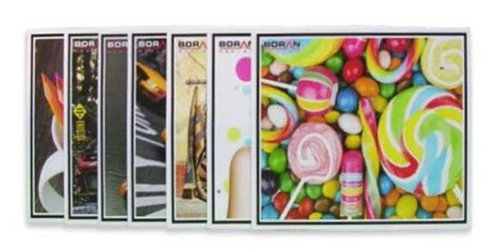

A UV flatbed printer laying down a full-coverage graphic on Celuka PVC board. The substrate choice was made before the artwork was finalized - because the board specification determines what the printer can deliver.
For displays that live indoors and serve a single event - a weekend trade show, a three-day conference, a retail promotion that runs for a fortnight - a medium-density free foam board or entry-level Celuka board in the lower-middle density range is the pragmatic choice. The board will be handled, mounted, and discarded before any of its structural or surface weaknesses have time to manifest. Spending more on a higher-density board for this application adds cost without adding value that the end user will ever experience. The print quality requirement drives the surface choice: if the graphics include photographic images or small text, Celuka is worth the premium even for short-term use, because the print quality difference on detailed content is visible from across the room.
For permanent indoor signage - wayfinding panels in a hospital corridor, branded wall displays in a corporate lobby, menu boards that hang above a counter for years - the calculation shifts toward the middle of the density range in Celuka grade. The board needs to resist warping over time under its own weight when vertically mounted. It needs to hold a screw without the hole elongating. It needs to maintain its edge appearance - no fraying, no chip-out - across years of occasional contact from passing traffic and cleaning staff. A density in the mid-fifties to low-sixties, in Celuka construction, delivers all of this at a material cost that amortizes to almost nothing across a five-year service life.
For outdoor signage - and this is where specification errors become publicly visible - the requirements jump to a different tier. An outdoor board needs a density of at least point seven in Celuka construction. It needs an outdoor-grade formulation that includes UV stabilizers - titanium dioxide as a UV opacifier, plus organic UV absorbers and hindered amine light stabilizers - at loadings sufficient to protect the polymer through years of direct sun. It needs edges that have been sealed against moisture ingress, either by the fabricator using an edge-sealing paint or tape, or by the sign maker as part of the finishing process. And it needs mounting hardware - stainless steel screws, aluminum standoffs, corrosion-resistant brackets - that will not produce rust streaks down the face of the board after one rainy season. The premium for outdoor-grade board over standard Celuka is real but modest in the context of the total installed sign cost, and attempting to save that amount by using an indoor-grade board outdoors is the most common avoidable failure in the sign industry.
For CNC carving and routed lettering, density is the variable that separates a usable result from scrap. A router bit spinning at high speed through a low-density foam board tears the cell walls rather than cutting them, leaving a fuzzy, ragged edge on the carved detail. Fine serif typefaces, in particular, lose their terminals and hairlines when the foam structure cannot support the tool's cutting action. A density above point seven in Celuka grade produces clean, sharp-edged carving that needs minimal post-processing. The board's consistent internal structure also matters: voids or density variations in the core will cause the router bit to deflect unpredictably, producing wavy cut lines that are especially visible on straight edges and geometric patterns.
Thermoforming and heat-bending present a different set of requirements. The board needs to soften uniformly under heat so that it bends without kinking or developing surface cracks. Medium-density boards in the point-five range are typically the most cooperative for heat forming - dense enough to hold their shape after cooling, light enough to soften through at practical oven temperatures. The heating window sits between roughly one hundred twenty and one hundred forty degrees Celsius, and the board should be heated with its protective film in place to prevent surface blistering. Celuka board's skin layer can resist bending at tight radii - for curves sharper than roughly ten times the board thickness, the skin layer on the compression side of the bend may need to be scored or removed before heating.
VI. A Five-Minute Quality Check on a Single Sample - Before You Commit to a Pallet
The sign maker who inspects a sample board before placing an order catches problems that are invisible in a supplier's brochure and painfully obvious once a full production run of prints is underway. The checks below require no laboratory instruments - just eyes, hands, and a few items that every print shop already has.
Inspect the surface under raking light. Hold the board at waist height near a window or under a strong overhead light and sight across the surface at a shallow angle. Any waviness, thickness variation, or surface texture inconsistency will cast shadows that are invisible when looking straight down. This check takes ten seconds and catches the flatness defects that cause print-head strikes and uneven screen contact. Celuka board should appear glass-smooth. Free foam board will show a subtle texture, but that texture should be uniform - random patches of different roughness signal inconsistent foaming during extrusion.
Weigh the board in your hands and press a thumbnail into the surface at an inconspicuous corner. The combination of weight and indentation resistance gives you a rough density classification that needs no numbers. A board that feels light and yields deeply to the nail is low-density free foam. One that feels substantial and resists the nail is medium to high density. One that feels unexpectedly heavy and shows no nail mark at all is high-density Celuka - the outdoor-grade material.
Check the cut edge. If the supplier has provided a cross-section, or if you can cut a corner off the sample, examine the exposed edge under good light. The core should appear uniform in color - clean white or very light gray - and free of dark specks, visible voids, or layered delamination. A core that looks dirty, streaky, or contains particles of inconsistent color suggests recycled content or poorly controlled raw-material handling, both of which introduce variability that will express itself as inconsistent print results across a batch.
Smell the board. Bring the surface close to your nose - a few inches away - and inhale. You should detect almost nothing, or a faint, neutral scent that dissipates quickly. A sharp, acrid, or vinegary odor indicates incomplete stabilization of the PVC compound or the use of low-cost stabilizer chemistry. What you are smelling is residual hydrochloric acid or volatile organic compounds that will continue to outgas after printing. Those outgassed compounds can interact with UV ink chemistry, causing adhesion failures that appear hours or days after the print has left the shop. They can also accumulate inside an enclosed display case and fog the interior surface of the glazing. If a board smells wrong at room temperature, it will smell worse under the UV curing lamps.
A small flame test on a sliver cut from a corner - done safely, with precautions - reveals the mineral content that separates quality board from heavily filled commodity product. Light the sliver with a lighter and observe the smoke and the behavior when the flame is removed. Quality PVC board with appropriate calcium carbonate filler loading produces white smoke, self-extinguishes when the flame is withdrawn, and leaves a light-colored ash. A board with excessive filler or non-standard additives may produce dense black smoke, continue burning after flame removal, or drip flaming material - all indicators of a formulation that prioritized raw-material cost over safety and performance.
Request documentation, not assurances. For boards intended for indoor use in occupied spaces, a volatile organic compound emissions certification should be available for the specific product being purchased - not a generic corporate certificate, but a report referencing the actual product grade and thickness. For boards exported to markets with chemical-substance regulations, the relevant compliance documentation should be current and product-specific. A supplier who cannot produce these documents for the exact product being quoted is asking you to trust a claim that has not been independently verified.
VII. Cutting, Storing, Prepping: Shop-Floor Habits That Prevent Rejected Prints
The difference between a board that prints perfectly and one that generates a reprint often traces back to what happened to the board between the delivery truck and the printer's vacuum table.
Cutting method matters for edge quality, and edge quality matters for everything that happens after cutting. A circular saw with a fine-tooth carbide-tipped blade - the kind designed for plastics and non-ferrous metals - produces a clean, square cut with minimal burr. The blade should have a high tooth count, and the feed rate should be fast enough that the teeth cut rather than rub. A blade that dwells in the material generates frictional heat that can melt the PVC at the cut line, leaving a raised, discolored bead along the edge that must be scraped or sanded off before the board can be printed or assembled. CNC routing with appropriate chip-load parameters avoids this entirely. For hand-cutting free foam board at thinner gauges, a sharp utility knife and multiple passes - scoring progressively deeper rather than forcing through in one pass - yields a cleaner result than a saw.
Storage conditions have an outsized effect on board flatness, and a board that has been stored poorly may never print acceptably no matter how well it was manufactured. PVC foam board should lie flat, fully supported across its entire surface. Stacking sheets directly on top of each other is fine - the weight of the stack actually helps maintain flatness - but any object placed on top of the stack that concentrates weight on a small area will produce a permanent depression in the top sheets. Storing boards vertically - leaned against a wall at an angle - is a shortcut that sign shops with limited floor space often take, and it reliably produces a permanent bow in the board within days. PVC foam board under uneven support will creep - the polymer chains slowly reorganizing under sustained stress - and the resulting curve will not relax when the board is laid flat again. If vertical storage is unavoidable, the boards should be supported across their full height at a near-vertical angle, not leaned at a shallow pitch that loads the lower portion of each sheet in bending.
Pre-print surface preparation is the last step before the board meets the ink, and it is the step most likely to be skipped when production pressure is high. The goal is to remove three contaminant categories: electrostatic dust attracted to the PVC surface, residual release agents or processing aids from the extrusion line, and finger oils from handling. Isopropyl alcohol on a lint-free cloth is the standard shop solution. Wipe in one direction - not back and forth - to avoid redepositing contaminants at the edge of the wiped area. Allow the alcohol to flash off completely before loading the board onto the printer. The evaporation time is roughly thirty seconds at shop temperature; printing onto a surface that is still wet with solvent guarantees ink adhesion failure across the entire sheet.
Temperature acclimation deserves mention because it is invisible until it causes a problem. A board that has been sitting in an unheated delivery bay overnight and is immediately loaded onto a printer in a warm production room will undergo thermal expansion during the print run. Dimensional changes measured in fractions of a millimeter across a large sheet are enough to cause misregistration on multi-pass prints or to change the flatness just enough that the print head clearance tightens. Letting the boards acclimate to the production room temperature for a few hours before printing costs nothing and eliminates a variable that is otherwise impossible to control once the print is in progress.
Boards that emerge from the printer with acceptable quality but develop defects over the following days - ink delamination, edge curling, surface blistering - are often telling you something about the substrate that the printer's on-board diagnostics missed. When a shop sees a pattern of delayed failures, the investigation usually leads back to one of three root causes: the board was not a Celuka grade but was used as if it were; the surface treatment was inadequate for the ink system; or the board absorbed moisture during storage and the heat of the UV curing lamps drove that moisture out through the printed surface. Each of these is preventable at the specification and inspection stage. YUPSENI PVC advertising board - Celuka-grade, surface-treated for UV and screen printing, available in densities from 0.45 to 0.85 g/cm³. Request sample sheets and technical data.