

PS Polystyrene Grille Wall Panels: EPS vs PVC, Grades & Install | YUPSENI
Jul 02, 2026
~7 min read · July 2, 2026 · By YUPSENI Team
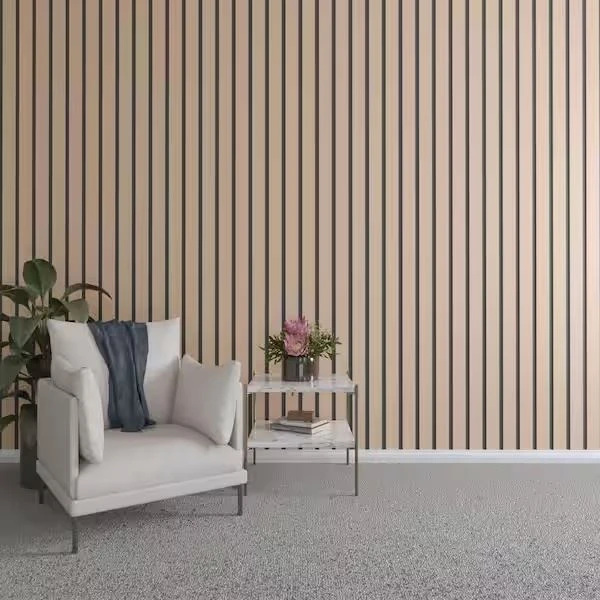
PS polystyrene grille wall panels installed as a living room accent wall. The vertical fluted pattern catches light differently as the viewing angle changes, giving the wall a depth that flat paint cannot deliver. What cannot be seen in this photograph is the panel density or the joint alignment tolerance - the two variables that determine whether this wall still looks this way three years from now, after seasonal humidity cycles have worked on the EPS core.
An accent wall is the cheapest renovation in interior design. One wall, one material change, and the room feels different. The economics work because the surface area is small. The risk is that a bad material choice on even one wall creates a permanent visual problem - and wall panels are not as easy to remove as wallpaper. They are glued, nailed, or clipped to the substrate, and removal means repairing drywall. The material you choose for that one wall is a commitment you will live with for years.
PS polystyrene grille wall panels - expanded polystyrene sheets extruded or molded with a fluted, grooved surface pattern and finished with a decorative film or paint layer - exist in a specific niche: they are the lightweight, low-cost alternative to PVC grille panels. They weigh roughly half as much per square meter. They cost roughly 40 to 60 percent less. They are easier to cut with a utility knife. And they are indoor-only. That last condition is not negotiable. Polystyrene is not UV-stabilized for exterior exposure, and its fire behavior is different from rigid PVC. YUPSENI PS polystyrene grille wall panels are manufactured for interior residential and commercial accent wall applications. This article is about what the product page does not tell you: where PS makes sense, where it does not, and how to tell a panel that will still be on the wall in ten years from one that will have visible seam gaps and edge damage in two.
On This Page
- I. It's Not PVC. That's the First Thing the Label Should Say.
- II. What a Grille Pattern Does to a Wall That Flat Paint Cannot
- III. The Seam Nobody Photographs: Why Joint Alignment Defines the Wall
- IV. Density, Film, and the Invisible Gap Between Grades
- V. Living Room, Bedroom, Office. Not the Bathroom. Not the Kitchen Splashback.
I. It's Not PVC. That's the First Thing the Label Should Say.
PS and PVC are different polymers with different physical properties. Polystyrene is an amorphous thermoplastic with a glass transition temperature around 100°C in its unmodified form. It is rigid, dimensionally stable at room temperature, and - in its expanded form - extremely lightweight because the foam structure is mostly air. Expanded polystyrene has a density range typically between 40 and 120 kg/m³ for wall panel applications, compared to roughly 500 to 700 kg/m³ for rigid PVC foam board. This density difference is the reason a PS grille panel can be carried under one arm while a PVC panel of the same dimensions requires two hands. It is also the reason a PS panel dents more easily when furniture is pushed against it during a room rearrangement.
The practical implications are straightforward. PS panels are easier to transport, easier to cut, and faster to install than PVC. A single installer can handle a full room's worth of PS grille panels without assistance. The trade-off is surface durability. A PS panel with a decorative film facing resists light scuffs but will not survive an impact that a PVC panel would shrug off - a vacuum cleaner head swung into the wall, a chair pushed back too hard, a child's toy launched across the room. For an accent wall in a living room or bedroom, where traffic is moderate and impacts are rare, the durability compromise is acceptable. For a hallway or a commercial lobby where the wall will be brushed against daily by bags and shoulders, PVC is the better material choice. PS wall panels: types, grades, and how to identify quality manufacturers provides the full comparison framework for choosing between PS and PVC.
The question your supplier should answer: Is the PS panel core extruded polystyrene (XPS) or expanded polystyrene (EPS)? XPS has a closed-cell structure with higher compressive strength and lower water absorption. EPS has an open-cell or partially fused bead structure with slightly lower mechanical properties. The difference matters primarily in humid climates where the wall cavity may see elevated moisture levels. For standard interior accent walls in climate-controlled spaces, both are functional. For installations in regions with high ambient humidity and no air conditioning, XPS has a measurable advantage in long-term dimensional stability.
II. What a Grille Pattern Does to a Wall That Flat Paint Cannot
A grille wall panel - sometimes called a fluted panel or a slatted panel - creates a surface with repeating vertical or horizontal grooves. The grooves are not decorative in the sense that a pattern on wallpaper is decorative. They are optical. Each groove creates a shadow line. As the light in the room changes through the day, the shadow lines shift. The wall appears to have depth. This is the reason designers specify grille panels for accent walls: the wall becomes an active surface that responds to light, rather than a passive background that light lands on indifferently.
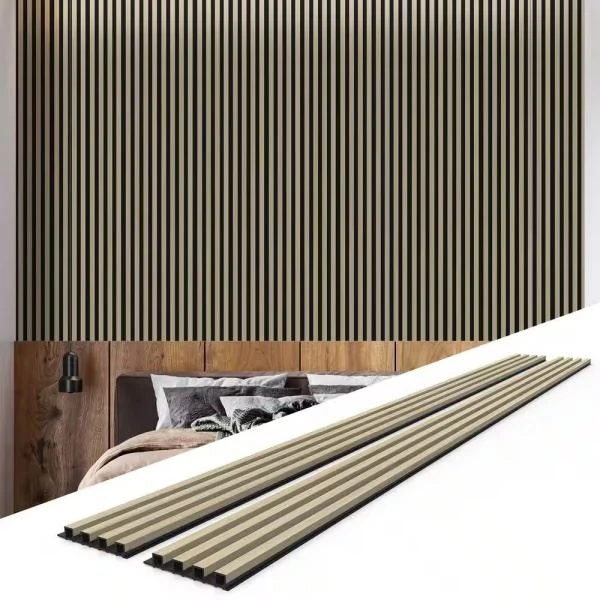
Close-up of PS polystyrene grille wall panel showing the fluted groove pattern and wood-grain decorative film. The groove depth, spacing, and edge profile determine how the panels interlock and how visible the seams are after installation. Shallow grooves produce a subtle texture; deeper grooves create a stronger shadow-line effect that reads as an architectural feature rather than a surface pattern.
The groove geometry matters more than most buyers realize. Three variables define the visual effect: groove width, groove depth, and the spacing between grooves. A panel with narrow, deep grooves and wide spacing between them produces bold vertical stripes with strong shadow contrast - dramatic, architectural, suited to a modern living room with high ceilings. A panel with wide, shallow grooves and narrow spacing produces a subtle ribbed texture that reads more as surface interest than as a pattern - quieter, suitable for a bedroom or a home office where the accent wall should not dominate the room. The panel manufacturer's catalog typically offers multiple groove profiles. Choose the profile that matches the room's ceiling height: vertical grooves make a low ceiling feel taller. Horizontal grooves widen a narrow room. The optical effect is real and measurable, not a designer's subjective claim. Vinyl wall panels: what they are and why they're replacing tile and paint covers the broader category of decorative wall panel systems.
III. The Seam Nobody Photographs: Why Joint Alignment Defines the Wall
Product photography for wall panels is shot on single panels or on small installations where the camera angle is chosen to hide the seams. In a real installation, a grille accent wall is built from multiple panels joined edge to edge. The seam between two panels is the single most important detail in the entire wall - because every seam is a visual interruption of the groove pattern. A poorly aligned seam produces a visible line that runs vertically across the entire wall, crossing every groove. It looks like a crack. It is not a crack. It is the panel joint. But it might as well be a crack, because the eye reads it the same way.
PS grille panels use either a tongue-and-groove edge profile or a shiplap-style overlapping edge. The tongue-and-groove system produces the cleanest seam because the mechanical interlock aligns the panels automatically and hides the raw edge of the EPS core. A shiplap edge is simpler to manufacture and slightly more forgiving of wall irregularities, but the seam is more visible because it creates a stepped surface where the two panels overlap. For a living room accent wall where the viewing distance is typically six to ten feet, the tongue-and-groove system is worth the marginal increase in panel cost. For a commercial installation where the viewing distance is greater and the lighting is more controlled, a shiplap edge is functional.
The installation method also affects seam visibility. PS panels can be glued directly to the substrate with a polystyrene-compatible construction adhesive, or mechanically fastened with screws through pre-drilled holes that are later concealed with color-matched caps or filler. Glue-only installation is faster and produces a cleaner surface with no visible fasteners. The risk is that if the substrate is not perfectly flat - and few walls are - the panels will follow the wall's contour, and the seams will telegraph every unevenness in the drywall. Mechanical fastening with shims allows the installer to correct for substrate irregularities, producing a flatter finished surface at the cost of visible fastener points. Neither method is universally better. The choice depends on the wall condition. PS grille wall panels: joint construction, installation tolerance, and structural integrity provides the dimensional tolerance data installers need before cutting the first panel.
IV. Density, Film, and the Invisible Gap Between Grades
PS grille wall panels are not all the same product. The grade differentiation is real but not always visible in the sales photograph. Three technical parameters separate a panel that lasts from one that develops problems. The first is core foam density. Higher-density EPS - typically 80 kg/m³ and above - has better screw-holding capacity, better impact resistance, and less tendency to creep-deform under sustained load or thermal cycling. Lower-density EPS - in the 40 to 60 kg/m³ range - is adequate for low-traffic accent walls but will show fastener dimpling more readily and is more susceptible to edge damage during cutting and handling. If your supplier cannot quote the foam density, assume it is at the lower end of the range and price accordingly.
The second parameter is the decorative film. PS grille panels achieve their wood-grain, solid-color, or patterned appearance through a decorative film laminated to the face of the EPS core. The film is typically PVC-based or PET-based, and its thickness, UV-stabilization level, and adhesion to the core determine whether the panel surface peels, fades, or delaminates over time. A quality film has a thickness of at least 0.12 mm, a uniform calendered finish without pinholes, and an adhesive layer formulated for polystyrene. Budget panels use thinner films with lower-grade adhesives. The failure mode is predictable: the film begins to lift at the groove edges, where the surface geometry creates stress concentrations during thermal expansion and contraction. Once a film edge lifts, it catches dust, it catches cleaning cloths, and it propagates.

Stacked PS grille wall panels showing the tongue-and-groove edge profile and the thickness of the EPS foam core. The decorative film lamination is visible on the face. On a quality panel, the film wraps slightly over the tongue edge to prevent the EPS core from being visible in the seam after installation. On an economy panel, the film stops at the face edge, and the white EPS core may be visible in the joint if the panels are not perfectly butted.
The third parameter is dimensional tolerance. EPS panels are cut from larger blocks or molded to net shape. The manufacturing process introduces a tolerance on panel width, thickness, and groove spacing. A panel with a width tolerance of plus or minus 1 mm over a 600 mm panel will produce a cumulative error of up to 5 mm across a five-panel wall - visible as a widening or narrowing seam at one end. Quality PS grille panels from established manufacturers maintain a width tolerance of plus or minus 0.5 mm or better, with groove spacing controlled to a similar tolerance. Budget panels may not specify a tolerance at all, which means the installer discovers the cumulative error during installation and must compensate by trimming or shimming - adding time, adding labor cost, and potentially compromising the seam appearance. PS wall panels: what separates a 2-year panel from a 10-year one details the full specification framework for evaluating panel quality before ordering.
V. Living Room, Bedroom, Office. Not the Bathroom. Not the Kitchen Splashback.
PS grille wall panels are interior decorative products. They are not waterproofing membranes, they are not fire barriers, and they are not structural. The installation locations where they perform well are climate-controlled interior spaces with low to moderate humidity and no direct water contact: living rooms, bedrooms, home offices, dining rooms, retail display walls, and commercial reception areas. These spaces share two characteristics: the wall is a visual feature, not a functional barrier, and the environmental conditions are stable year-round.
The locations where PS panels do not belong are equally clear. Bathrooms: the combination of high humidity during shower use, temperature swings, and occasional direct water splashes will cause the EPS core to absorb moisture at any unsealed edge or fastener penetration, leading to swelling, film delamination, and in severe cases, mold growth in the foam structure. Kitchens: grease aerosol from cooking deposits on the grooved surface and is difficult to clean from the recessed areas; the panel surface temperature near a cooktop can exceed the heat-distortion threshold of the decorative film. Exterior walls in unconditioned spaces: the temperature differential between the heated interior and the cold exterior wall can drive moisture condensation inside the wall cavity, which will affect the EPS panel from the back side - a failure mode invisible from the room until the panel face shows bubbling or the film lifts.
| Room Suitability | PS Grille Panel | PVC Grille Panel | Notes |
|---|---|---|---|
| Living room accent wall | Recommended | Also suitable | PS preferred for cost-to-effect ratio on low-impact walls |
| Bedroom feature wall | Recommended | Also suitable | PS lighter weight simplifies headboard-wall installation |
| Home office | Recommended | Also suitable | Acoustic benefit from EPS foam structure, modest but real |
| Bathroom | Not recommended | Suitable | PVC is inherently waterproof; PS absorbs moisture |
| Kitchen backsplash | Not recommended | Caution | PVC near cooktop needs heat-deflection verification |
Fire safety is the final location constraint. Polystyrene is a thermoplastic that will melt, drip, and burn when exposed to flame. Building codes in many jurisdictions require interior wall finishes in certain occupancies - particularly commercial and multi-family residential - to meet minimum flame-spread classifications that unmodified polystyrene may not achieve. Quality PS grille panels from reputable manufacturers incorporate flame-retardant additives in the EPS core that raise the material's fire performance to meet relevant interior finish standards. Verify the fire classification of the specific panel you are ordering, and confirm that it is appropriate for the occupancy type and local code requirements. If the supplier cannot provide a fire test report or classification data, assume the panel is not suitable for any space where the building code regulates interior finish flame spread. Fire ratings in building materials: what Class A, B, and C actually mean applies to wall panel selection as much as to structural materials.
Questions Designers and Homeowners Ask Before Ordering
Frequently Asked Questions About PS Polystyrene Grille Wall Panels
The questions interior designers, contractors, and DIY homeowners ask when comparing PS grille panels to PVC, WPC, and traditional wall finishes.
Q1: Can PS grille panels be painted if I want a different color?
A: Yes, and this is one of the advantages of PS over some PVC panels. The decorative film on most PS grille panels accepts acrylic latex paint with good adhesion after light surface scuffing with fine-grit sandpaper. The paint does not need to be a specialized plastic primer. This means a PS grille accent wall can be color-matched to the room's palette even if the factory color options do not include the exact shade. The limitation: the groove interiors are difficult to sand evenly, so the paint adhesion in the grooves may be slightly less durable than on the flat face. For a wall that will not be touched regularly, this is acceptable. For a wall in a high-contact zone, order the factory color rather than field-painting. The factory decorative film is applied under controlled conditions with consistent adhesion across the entire profile surface. Custom wall panel design options are available for volume orders if the standard color range does not match your project.
Q2: How does installed cost compare to PVC grille panels?
A: PS grille panels are typically 40 to 60 percent less expensive per square meter than PVC grille panels of comparable thickness and surface finish. For a standard accent wall of approximately 10 square meters, the material cost difference is meaningful - roughly the cost of the installation labor for that same wall. PS panels also reduce labor cost slightly because they are lighter, faster to cut, and generate less dust when cut with a fine-tooth saw. The total installed cost for a PS grille accent wall is typically 50 to 65 percent of the cost for the same wall using PVC grille panels. The question is not whether PS is cheaper - it is - but whether the specific installation location can accept the durability and moisture limitations of PS. If the answer is yes, PS is the better value. If the wall will see impact or moisture, the higher initial cost of PVC is cheaper than replacing damaged PS panels.
Q3: What is the fire rating of PS grille wall panels?
A: Untreated polystyrene is combustible and has a relatively high flame-spread index. Quality PS grille wall panels manufactured for interior use incorporate flame-retardant additives in the EPS core formulation that reduce the flame-spread classification. The specific fire performance depends on the additive package, the foam density, and the decorative film - all of which vary by manufacturer. Always request the fire test report or classification data for the specific panel you are ordering. For residential applications in single-family homes, the fire classification requirement for interior wall finishes is typically less stringent than for commercial or multi-family occupancies. For commercial projects, verify that the panel classification meets the local code requirements for interior finish materials in the specific occupancy type. YUPSENI can provide fire performance data for our PS grille panel range upon request. Read the full guide on fire ratings in building materials.
Q4: How are PS grille panels cleaned and maintained?
A: PS grille wall panels are cleaned with a soft microfiber cloth and water. For oil-based stains - rare on an interior accent wall but possible from accidental contact - add a small amount of mild detergent to warm water and wipe gently. Avoid abrasive cleaners, scouring pads, and solvent-based cleaning products, as these can damage the decorative film. The groove pattern means dust will accumulate in the recesses over time. Vacuum the wall with a soft brush attachment every few months in the same pass you would use for curtains or upholstery. Do not use a pressure washer or steam cleaner; the heat and moisture will damage the EPS core and the film adhesion. The maintenance requirement is low, but not zero - a PS grille wall in a room with open windows and airborne dust will need more frequent attention than the same wall in a filtered-air environment.
Q5: Can PS grille panels be installed over existing tile or wallpaper?
A: PS grille panels can be installed over existing wall finishes provided the substrate is sound, dry, and flat. Over tile: the tile surface must be cleaned and degreased before adhesive application. The adhesive must be compatible with both the glazed tile surface and the EPS panel back. Over wallpaper: the wallpaper must be firmly adhered to the wall with no loose edges or bubbles. If the wallpaper is textured or embossed, the panel adhesive may not achieve full contact; in this case, remove the wallpaper before installation. Over painted drywall: this is the ideal substrate. Clean, dry, flat painted drywall provides the best adhesion surface and the most predictable installation outcome. Over any substrate, check for flatness with a straightedge before beginning. Deviations greater than 3 mm over a 2-meter span should be leveled before panel installation. Wall panel installation rules apply to PS as much as to PVC and WPC systems.
Q6: What panel sizes and groove patterns are available?
A: Standard PS grille panel dimensions vary by manufacturer. Common widths range from 150 mm to 600 mm, lengths from 2.4 m to 3.0 m, and thicknesses from 8 mm to 15 mm. The groove pattern - spacing, width, and depth - is determined by the extrusion or molding die and can be customized for volume orders. For standard stocked products, the most common patterns are a narrow-groove vertical fluted design (groove width approximately 3 to 5 mm, spacing approximately 25 to 40 mm) and a wider-groove architectural design with deeper shadow lines. Color options include wood-grain finishes in light oak, walnut, and gray tones, as well as solid white and matte black. Custom color matching is available for volume orders. Contact YUPSENI for current stock dimensions, color, and custom options.
One Wall Changes the Room. Choose a Panel That Stays Flat.
YUPSENI PS polystyrene grille wall panels: EPS core with decorative film finish, tongue-and-groove edge profile, wood-grain and solid color options. Interior accent walls for living rooms, bedrooms, offices, and commercial reception areas. Custom dimensions, groove patterns, and colors for volume orders. Manufactured in Shandong, China.
A Wall That Looks This Good at This Price Has Rules. Follow Them.
PS polystyrene grille wall panels occupy a very specific and very useful position in the wall finish market: they deliver the visual impact of a textured architectural wall at roughly half the material cost of PVC and a fraction of the installed cost of millwork or stone. The trade-offs are clearly bounded: indoor-only, moderate durability, fire-classification verification required. Within those bounds, a quality PS grille panel from a manufacturer that controls foam density, film adhesion, and dimensional tolerance will perform for a decade or more on a living room or bedroom accent wall. Outside those bounds - in a steamy bathroom, behind a kitchen cooktop, on a wall that gets hit with vacuum cleaners and furniture - the panel will fail, and the failure will look worse than the unpainted drywall it was installed to cover.
Three things to verify before ordering: the foam density, the fire classification for your occupancy type, and the edge profile - tongue-and-groove for the cleanest seam, shiplap if the wall substrate is uneven and the panel must bridge irregularities. A supplier who can provide data for all three is selling a specified product. A supplier who answers "it's all the same" is selling whatever came off the production line that week. The difference between those two suppliers is the difference between an accent wall that still looks intentional after five years and one that has developed visible seam lines, surface bubbling, and edge damage that the original product photography carefully did not show.
YUPSENI Team
23 years in PVC and PS building material manufacturing and supply chain. Vinyl wall panels, PS grille panels, PVC foam boards, SPC flooring, fencing, ceiling panels, and trim - manufactured in Shandong, China. Helping importers, distributors, interior designers, and contractors across 60+ countries source wall panel systems that perform as specified. More about YUPSENI
Disclaimer: The information in this article is for general informational purposes only and does not constitute professional building, interior design, fire safety, or code compliance advice. Building codes, fire classification requirements, and material suitability vary by jurisdiction and occupancy type. Always consult local building authorities, a qualified interior contractor, and the manufacturer's current technical data sheets and fire test reports before specifying or installing interior wall finish materials. Product specifications are subject to change; request current datasheets before procurement.


