

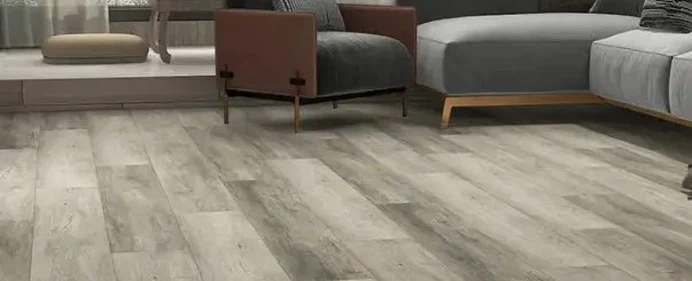
1. What Is SPC Flooring?
SPC stands for Stone Plastic Composite - also known as stone-plastic composite flooring. It is manufactured by combining natural limestone powder (calcium carbonate), polyvinyl chloride (PVC) resin, stabilizers, and a small amount of eco-friendly additives, then hot-pressed and extruded under high temperature and pressure into a rigid, dense core.
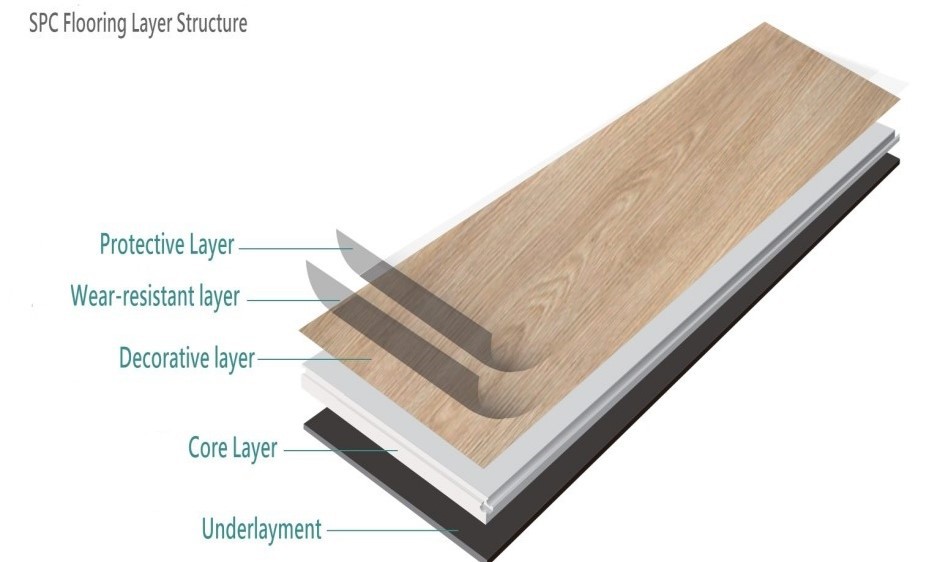
Fig. 1 - SPC flooring cross-section: UV coating → Wear layer → Printed decorative film → Rigid SPC core (limestone + PVC) → Acoustic underlayment.
The core structure typically consists of four layers:
- Wear Layer - a transparent, scratch-resistant surface coating (0.3–0.5 mm thick)
- Decorative Film - a high-resolution printed layer that realistically mimics wood, stone, or tile textures
- SPC Core Layer - the rigid, waterproof limestone-and-resin substrate that gives the flooring its dimensional stability
- Acoustic Underlayment - a pre-attached backing layer that reduces footfall noise and improves underfoot comfort
Unlike traditional flooring, SPC flooring eliminates the need for glue-down installation. It uses a click-lock floating system, which not only makes installation fast and straightforward, but also fundamentally eliminates the release of formaldehyde and other harmful substances right from the source. Explore our SPC Flooring product range →
2. Environmental Advantages: Green from Raw Material to Finished Product
The eco-friendly character of SPC flooring begins with its raw materials. Its primary ingredient - natural limestone - is an abundant mineral that constitutes over 60% of the core composition, significantly reducing reliance on petroleum-based plastics.
In addition, the SPC manufacturing process consumes relatively low energy and generates a significantly lower carbon footprint than solid wood flooring and ceramic tiles. Because SPC flooring does not require logging forests - unlike solid wood flooring - it makes a direct contribution to forest conservation and biodiversity protection. In essence, SPC flooring is the perfect embodiment of the philosophy of "stone replacing wood, plastic replacing wood."
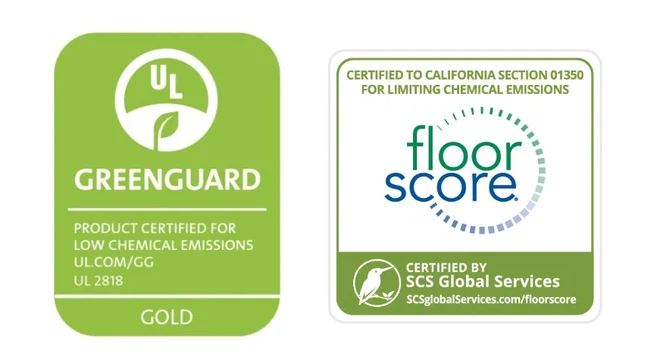
Fig. 2 - Leading SPC flooring products carry FloorScore and GREENGUARD Gold certifications, verified by third-party testing for VOC emissions and indoor air quality safety.
3. Sustainability: The Perfect Marriage of Recyclability and Long Lifespan
True environmental responsibility isn't just about how a product is born - it's about its entire lifecycle. The sustainability of SPC flooring lies in two key dimensions:
3.1 100% Recyclable - A Closed-Loop Circular Economy
When a building undergoes renovation or SPC flooring reaches the end of its service life, it can be 100% recycled. The planks are crushed, re-pelletized, and reprocessed into new flooring or other plastic products. This closed-loop cycle effectively reduces the burden on construction waste landfills and aligns with the principles of the circular economy.
3.2 Extended Service Life - Less Frequent Replacement, Lower Resource Consumption
SPC flooring features exceptionally high wear resistance, impact resistance, and waterproof/moisture-proof performance. The wear layer - typically 0.3–0.5 mm thick - provides robust protection against daily scratches, scuffs, and foot traffic, supporting a service life of 15–20 years in residential settings, far exceeding traditional laminate flooring and engineered wood.
A longer lifespan means fewer replacements and lower resource consumption over the lifecycle - achieving sustainability at its most fundamental level.
4. SPC Flooring vs. Other Flooring Types: An Environmental Comparison
| Flooring Type | Eco-Friendliness | Sustainability | Maintenance Cost | Service Life |
|---|---|---|---|---|
| Solid Wood Flooring | Requires deforestation; may contain adhesives | Limited resource; difficult to recycle | High - waxing, oiling, refinishing | Long, but requires meticulous care |
| Laminate Flooring | Contains adhesives; formaldehyde emission risk | Difficult to recycle; HDF core non-recoverable | Moderate - dry mop only; water damage risk | ~10 years; swells on moisture contact |
| Ceramic Tile | High energy consumption; non-renewable | Non-recyclable; landfill waste | Low - easy to clean | Extremely long, but cold & hard underfoot |
| SPC Flooring | Zero formaldehyde; natural limestone raw material | 100% recyclable; 15–20 year lifespan | Low - wet or dry mop, zero maintenance | 15–20 years; waterproof & wear-resistant |
As the table above clearly shows, SPC flooring achieves a remarkable balance across eco-friendliness, sustainability, and overall performance - making it the ideal replacement for traditional flooring materials. While each flooring type has its place, SPC stands alone as the only option that combines zero-formaldehyde manufacturing, 100% end-of-life recyclability, minimal maintenance, and a 15–20 year service life in one product. For a more detailed performance comparison, see our SPC vs Laminate vs Solid Wood comparison guide →
5. The Environmental Impact: By the Numbers
To quantify SPC flooring's environmental advantage, consider these key data points:
| Environmental Indicator | SPC Flooring | Solid Wood Flooring | Ceramic Tile |
|---|---|---|---|
| Raw Material Source | Abundant limestone (60%+ mineral content) | Mature trees (50–100+ years to grow) | Clay & minerals (non-renewable extraction) |
| Manufacturing Energy | Low - cold extrusion process | Moderate - kiln drying, milling | High - 1,000°C+ kiln firing |
| Formaldehyde Emission | Zero - no glue used | Low–Moderate (varies by finish) | Zero |
| End-of-Life | 100% recyclable | Landfill or incineration | Landfill - non-recyclable |
| Carbon Payback Period | Short - low embodied carbon | Moderate - depends on forestry practice | Long - high embodied carbon |
| Overall Eco-Rating | ★★★★★ | ★★★☆☆ | ★★☆☆☆ |
These numbers tell a clear story: when evaluated across the full lifecycle - from raw material extraction through manufacturing, use, and end-of-life disposal - SPC flooring consistently delivers the lowest environmental burden of all mainstream hard-surface flooring options.
6. Wide Application Scenarios: From Home to High-Traffic Commercial Spaces
SPC flooring is not limited to residential use. Its unique combination of properties - waterproof, anti-slip, antibacterial, sound-dampening, and easy to clean - makes it suitable for an exceptionally broad range of environments.
SPC flooring adapts to virtually any indoor space - residential or commercial, dry or damp, low-traffic or high-traffic.
In particular, under the global "dual-carbon" targets (carbon peaking and carbon neutrality), an increasing number of public buildings are choosing SPC flooring as a designated green building material to reduce their overall carbon footprint. Its combination of durability, hygiene, and environmental certification makes it the flooring of choice for architects and designers seeking LEED, BREEAM, or other green building certifications.


