China PVC Co-extrusion Board: Cap Layer Types, Bond Quality & What Separates a Co-extruded Sheet From a Delamination Risk
May 28, 2026

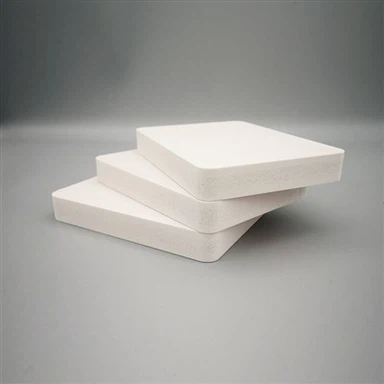
Edge cross-section of a co-extruded PVC board revealing the thin cap layer bonded to the foam core substrate.
On This Page
- A board with two personalities: what "co-extruded" actually means at the die
- The 0.05 mm polymer layer that changes everything about the board
- What the cap buys that the core cannot provide - and what it cannot fix
- Co-extruded, Celuka, free-foam: three boards, three price points, one decision
- The bond nobody tests until the cap peels off
- Indoor and outdoor are different boards - even when they look identical
- Reading a co-extrusion spec sheet when the supplier calls everything "premium"
Co-extruded PVC board occupies an awkward position in the foam sheet market. It is visibly more expensive than standard board, often by 15 to 30 percent on a per-sheet basis, yet the feature that justifies the premium-a cap layer of solid polymer bonded to the foam core-is functionally invisible under normal inspection. You cannot see the cap layer from across a warehouse. You cannot feel it by running a thumb across the surface. If the co-extrusion process has been executed correctly, the cap and core present as a single material, and the buyer is left to trust that the premium bought something real rather than a marketing term on an invoice.
This invisibility creates a market asymmetry that favors suppliers who talk about co-extrusion over those who engineer it. A PVC co-extrusion board is not defined by the presence of two melt streams meeting at a die. It is defined by whether those two melt streams form a durable, functional bond that delivers specific performance properties the core material cannot provide alone. The distance between "two-layer board" and "engineered co-extrusion" is measured in cap chemistry, bond strength, layer thickness uniformity, and the supplier's willingness to document these variables instead of gesturing at the word "co-extruded" and moving on to the price.
This article examines what a co-extruded PVC board actually is, how to tell a functional cap layer from a cosmetic one, and where co-extrusion solves real problems versus where it applies a premium solution to a problem that a cheaper board could handle.
I. A Board With Two Personalities: What "Co-extruded" Actually Means at the Die
In a standard foam extrusion line, one formulation enters the extruder, one melt stream exits the die, and one material forms the board. The surface and the core are chemically identical. Any difference in density between the skin and the center is a physical side effect of faster cooling at the die wall, not a design choice. In a co-extrusion line, two separate extruders feed two different formulations into a single feedblock or multi-manifold die, where they meet as distinct melt layers and exit the die as a unified sheet with discrete, intentionally different surface and core compositions.
The engineering challenge is deceptively simple to describe and genuinely difficult to execute. The two melt streams must arrive at the die at temperatures close enough that they flow together without thermal shock at the interface. Their melt viscosities must be similar enough that one layer does not push through the other, creating thickness variation or, in extreme cases, a core that punches through the cap and exposes itself at the sheet surface. Their thermal expansion coefficients must be matched well enough that the finished sheet does not curl as it cools-a cap layer that shrinks more than the core pulls the board concave on the cap side; a cap that shrinks less pushes it convex. And the entire system must run at a line speed that is commercially viable, which means the residence time for the two melts to form a bond at the interface is measured in fractions of a second.
When all of these variables are controlled within specification, the result is a board where the cap layer and the core function as a single structural unit, and the cap delivers a surface property that the core material could never achieve at an equivalent cost. When any one of them drifts out of range, the result is a board that looks fine on the warehouse floor and fails in fabrication-the cap delaminates during routing, or blisters under a UV curing lamp, or separates from the core during thermoforming when the two layers stretch at different rates.

A co-extrusion production line with separate extruders feeding a single die to produce a two-layer sheet with distinct cap and core formulations.
II. The 0.05 mm Polymer Layer That Changes Everything About the Board
The cap layer on a co-extruded PVC board is typically between 0.05 mm and 0.50 mm thick-roughly the thickness of a sheet of office paper at the low end and a credit card at the high end. This seemingly trivial amount of material carries disproportionate responsibility. It is the surface that receives ink, the barrier that blocks UV, the skin that resists scratching, and the cosmetic face that the end user will look at for the life of the product. A cap layer that is too thin, or poorly bonded, or made from the wrong chemistry, undermines every one of these functions.
| Cap Material | Typical Thickness | Key Property Delivered | Best Application | Grade |
|---|---|---|---|---|
| Modified rigid PVC | 0.10–0.30 mm | Surface hardness, print receptivity | Indoor signage, display, POP | Standard |
| Weatherable ASA | 0.08–0.20 mm | UV resistance, color retention, gloss retention | Outdoor signage, exterior cladding, marine | Premium |
| PMMA-based cap | 0.05–0.15 mm | High gloss, scratch resistance, chemical resistance | High-end retail displays, appliance panels | Specialty |
| Thin PVC (cosmetic only) | 0.03–0.08 mm | Smoother surface than free-foam; limited functional benefit | Cost-sensitive interior decoration | Entry |
The cap material decision is where a co-extrusion specification reveals its engineering intent. A modified rigid PVC cap is the most common choice because it bonds readily to the PVC foam core-same polymer family, compatible melt viscosities, minimal thermal expansion mismatch. It improves surface hardness and print receptivity enough to justify the co-extrusion premium for indoor applications. But it does not solve the UV problem, because PVC itself degrades under ultraviolet light regardless of whether it is in the cap or the core.
ASA, or acrylonitrile-styrene-acrylate, is the material that turns a co-extruded PVC board from an indoor product into an outdoor one. ASA contains no double bonds in its polymer backbone that UV can attack, which means it does not yellow, chalk, or embrittle under sunlight the way PVC does. A 0.10 mm ASA cap layer provides more UV protection than any practical loading of TiO₂ and UV stabilizers dispersed throughout the full thickness of a PVC-only board, because the ASA physically blocks the UV before it ever reaches the PVC substrate. The trade-off is that ASA costs several times more than PVC per kilogram and its melt rheology differs enough from PVC that maintaining layer uniformity at the die requires tighter process control.
III. What the Cap Buys That the Core Cannot Provide - and What It Cannot Fix
A co-extruded cap layer changes the surface properties of a PVC foam board in four ways that matter for fabrication and service life. It also fails to change three things that buyers sometimes assume it addresses, and the gap between the four real benefits and the three false assumptions is where co-extrusion purchasing mistakes are made.
What the cap actually delivers. First, surface hardness. A solid PVC or ASA cap has a Shore D hardness of 65–80, compared to roughly 45–55 for the foam core surface of a free-foam board. This means the cap resists scratching from handling, cutting tools, and end-user contact-a meaningful benefit for retail displays and signage that get touched, leaned on, and cleaned repeatedly. Second, surface smoothness and porosity control. A cap layer is a continuous solid film with no foam cells, which means no pinholes for ink to disappear into and no surface texture to interfere with halftone dot placement. Third, UV protection, but only when the cap is ASA or a UV-stabilized acrylic formulation. A PVC cap provides no meaningful UV upgrade over a standard Celuka skin. Fourth, chemical resistance, particularly with PMMA-based caps that resist cleaning solvents, alcohols, and mild acids that would etch or soften an unprotected PVC surface.
What the cap does not deliver. First, the cap does not increase the board's flexural stiffness. Stiffness is a bulk property driven by density and thickness. A 0.10 mm cap layer contributes negligible bending resistance. A co-extruded board at 0.55 g/cm³ with a cap has essentially the same flexural modulus as a standard Celuka board at 0.55 g/cm³ without one. Second, the cap does not improve screw-holding capacity. Screw pull-out strength is determined by the core density and the thread engagement area. The cap is irrelevant to this performance metric because the screw head bears on the cap surface, but the threads engage deep in the core. Third, the cap does not make a flammable core non-flammable. A fire-rated co-extruded board requires fire retardants in the core formulation. A cap layer with fire-retardant additives but an untreated core will burn from the inside once the flame reaches the core through a cut edge or a screw hole.
The assumption that costs the most:
Buyers who specify "co-extruded board" without specifying the cap material are buying a PVC cap on a PVC core and believing they have purchased UV resistance. They have not. They have purchased a slightly smoother, slightly harder version of the board they could have bought without the co-extrusion premium. If the application requires outdoor durability, the specification must say "ASA cap" or "UV-stabilized PMMA cap," not just "co-extruded." The word alone means nothing about chemistry; it only describes the number of melt streams at the die.
IV. Co-extruded, Celuka, Free-Foam: Three Boards, Three Price Points, One Decision
Every PVC foam board purchase is a decision about which surface quality the application requires and how much to pay for it. Understanding where co-extrusion fits between the cheaper processes on one side and the more expensive ones on the other is not a theoretical exercise. It is the difference between paying for performance you need and paying for performance you will never use.
| Process | Surface Character | Relative Cost | Best For |
|---|---|---|---|
| Free-foam | Matte, textured; foam cell pattern visible; requires lamination or heavy coating for printing | Base | Laminated panels, construction backers, cost-driven decorative boards |
| Celuka | Smooth, integral skin; same chemistry as core; good print surface for indoor use | Base + 10–15% | Indoor signage, screen printing, general display and POS |
| Co-extruded (PVC cap) | Smooth, harder than Celuka; controlled surface chemistry; better ink adhesion | Base + 15–25% | High-quality indoor printing, router-cut lettering, premium displays |
| Co-extruded (ASA cap) | UV-resistant, color-stable, weather-grade surface | Base + 25–40% | Outdoor signage, exterior cladding, long-life architectural panels |
The decision logic flows from the application environment outward. If the board will live indoors under controlled lighting and moderate handling, Celuka or PVC-capped co-extrusion are both viable, and the choice turns on whether the incremental print quality improvement justifies the co-extrusion premium for that specific graphic output. If the board will face sunlight, rain, or temperature swings, the choice narrows rapidly: either an ASA-capped co-extruded board, or a different material entirely. There is no middle ground where a PVC cap or a Celuka skin provides meaningful outdoor durability. The UV physics are unambiguous. PVC degrades under UV. ASA does not. Paying for a PVC cap on a board destined for outdoor use is paying for a premium feature that does not address the dominant failure mode.
A more extensive treatment of how Celuka and free-foam processes compare-covering foam morphology, skin formation, and the implications for surface quality and printing-is available in our article on the differences between Celuka and free-foam PVC board surfaces. For buyers who are evaluating co-extrusion alongside the standard processes, that comparison provides the baseline against which the co-extrusion premium should be measured.
V. The Bond Nobody Tests Until the Cap Peels Off
Interlayer adhesion-the bond strength between the cap and the core-is the specification variable that separates functional co-extrusion from cosmetic two-layer construction, and it is almost never tested by the buyer. The omission is understandable. Adhesion testing requires cutting a cross-section, attempting to peel the cap from the core with a controlled force, and inspecting the failure mode to determine whether the separation is adhesive, at the interface, or cohesive, within one of the layers. None of this can be done with a tape measure and a visual inspection in the receiving bay.
But interlayer adhesion is the failure that generates the most expensive warranty claims. A co-extruded board that has been routed into lettering, painted, and installed on a storefront that faces west into the afternoon sun will experience daily thermal cycling. The cap and core expand and contract at slightly different rates-ASA has a coefficient of linear thermal expansion roughly 20 to 30 percent lower than rigid PVC foam. Each cycle applies a shear stress to the interface. If the interlayer bond is marginal, the stress accumulates as microscopic separations that grow into visible blisters, and eventually into cap delamination over an area measured in square centimeters rather than square millimeters.
What makes this failure mode particularly insidious is its delay. A co-extruded board with poor interlayer adhesion passes incoming inspection, processes cleanly through routing and printing, and ships to the customer looking flawless. The delamination appears months later, triggered by the cumulative effect of thermal cycles that no factory test replicates. By the time the failure is visible, the board has been fabricated, shipped, installed, and invoiced-and the cost of replacement includes not just the material but the fabrication labor, the printing, the shipping, the installation labor, and the customer relationship damage.
Two checks the supplier should be able to pass:
Ask for a 90-degree peel test result per ASTM D6862 or an equivalent standard, with the failure mode noted-cohesive failure within the core is acceptable; adhesive failure at the cap-core interface is not. Second, ask for a thermal cycling test: the board should survive at least five cycles between –20°C and +60°C with no blistering, delamination, or edge separation. A supplier who cannot provide either test result is selling co-extrusion as a concept, not as a verified manufactured product.
VI. Indoor and Outdoor Are Different Boards - Even When They Look Identical
A white co-extruded PVC board with a PVC cap and a white co-extruded PVC board with an ASA cap look the same under warehouse lighting. They are the same color, the same gloss level, the same thickness, the same density. That visual equivalence is the source of a recurring supply chain failure: an indoor-grade board gets sold, shipped, fabricated, and installed into an outdoor application because nobody in the chain looked past the appearance to the cap chemistry. The board looks right. It processes right. It fails early, and the failure is attributed to "PVC board quality" rather than to the specification error that selected an indoor product for an outdoor job.
The indoor-outdoor distinction in co-extruded board is not a matter of degree. It is a binary material switch. A board with a PVC cap is an indoor product regardless of what the marketing literature implies. A board with an ASA cap is an outdoor-capable product. There are intermediate formulations-PVC caps with elevated UV stabilizer loading, co-extruded caps with blended PVC-ASA alloys-that claim to bridge the gap. These products cost more than standard PVC-capped board and perform better in accelerated weathering, but they do not match the UV durability of a pure ASA cap because the PVC fraction in the cap is still vulnerable to photodegradation. For applications where the expected service life exceeds five years and involves direct sunlight, the intermediate formulations are a compromise that costs close to an ASA cap without delivering ASA-cap longevity.
The broader question of how PVC board specifications change when a sign moves from an indoor to an outdoor environment-covering not just cap chemistry but also density requirements, fastener compatibility, and thermal expansion accommodation-is covered in our article on indoor versus outdoor PVC advertising board specification differences. For buyers sourcing co-extruded board specifically, that article provides the environmental context for the cap-material decision discussed here.
VII. Reading a Co-extrusion Spec Sheet When the Supplier Calls Everything "Premium"
The word "premium" appears on a large fraction of co-extruded PVC board specification sheets, and it conveys exactly zero technical information. It is a marketing placeholder that occupies the space where a cap-material designation, a layer-thickness specification, and a bond-strength test result should be. Reading past it requires knowing which entries on the spec sheet carry real diagnostic value and which are standard filler that every supplier lists regardless of product quality.
The entries that matter, in descending order of diagnostic value, are these. First, the cap material designation with a specific polymer or alloy name-"ASA," "PMMA," "rigid PVC," or "PVC-ASA blend"-not "polymer cap" or "protective layer." A supplier who will not name the cap chemistry is either using a material they do not want to disclose, which is unlikely given that ASA and PMMA are well-known industrial polymers, or they are using the cheapest available option and hoping the buyer does not know enough to ask. Second, the cap layer thickness with a tolerance-"0.12 ± 0.02 mm"-not "approximately 0.1 mm" or no thickness specification at all. Cap thickness determines how much material is available before UV reaches the core or before sanding and surface preparation break through to the foam underneath. Third, the interlayer adhesion test result with the test standard cited, as discussed in the previous section.
Fourth, the weatherability test report, if the board is being sold as outdoor-capable. The minimum reference is ASTM G154 QUV exposure for 2,000 hours with Delta E, gloss retention, and any visual surface changes documented. A board that claims outdoor durability without an accelerated weathering report is making a claim with no evidence. Fifth, the density of the core material-the co-extrusion cap is a surface feature and does not change the core density. A co-extruded board at 0.45 g/cm³ core density is a lightweight board with a hard surface, not a structural board. If the application requires stiffness and screw-holding, the core density still drives those properties regardless of what the cap is made of.
A spec sheet that provides these five values-cap chemistry, cap thickness with tolerance, interlayer adhesion, weatherability data, and core density-is describing an engineered product. A spec sheet that provides thickness, density, and color with the word "co-extruded" in the product name is describing a two-layer board and hoping you will not ask which five entries are missing.
For a broader perspective on how PVC foam board specifications interact with fabrication requirements across different end uses, our guide to selecting PVC advertising board for print compatibility provides additional specification detail relevant to sign and display applications.
Frequently Asked Questions About PVC Co-extrusion Board
Answers to common questions from importers, fabricators, and distributors evaluating co-extruded PVC foam board for printing, signage, and construction applications.
Q1: How much more does co-extruded PVC board cost compared to standard PVC foam board?
A: Co-extruded board with a modified PVC cap typically costs 15–25% more than standard Celuka board of equivalent density and thickness. Co-extruded board with an ASA cap costs 25–40% more, driven by the higher raw material cost of ASA resin and the tighter process control required to maintain layer uniformity with dissimilar polymers. The premium narrows at higher order volumes and for standard sheet sizes where production efficiency is highest. The cost premium should be weighed against the application's performance requirements, not treated as a quality indicator in isolation-a 25% premium that provides no functional benefit for an indoor application is a cost, not an investment.
Q2: Can co-extruded PVC board be thermoformed?
A: Yes, but with an important caveat: the cap layer and the core must stretch at compatible rates during the forming process, or the cap will thin unevenly, whiten under stress, or separate from the core at the corners where stretch ratios are highest. Co-extruded board with a PVC cap generally thermoforms well because the cap and core share similar melt rheology and elongation behavior. ASA-capped board is more challenging to thermoform because ASA and PVC foam have different elongation characteristics at forming temperatures, and the processing window that produces a good part is narrower. If thermoforming is the primary fabrication method, request forming trial data or a sample for in-house testing before committing to a production order.
Q3: What is the minimum cap layer thickness for outdoor use?
A: For ASA-capped board intended for outdoor exposure, a minimum cap thickness of 0.08 mm is generally considered the functional threshold below which UV protection becomes unreliable because minor thickness variations, surface scratches, and handling damage can expose the PVC substrate. A cap thickness of 0.10–0.15 mm provides a more robust safety margin. Below 0.08 mm, the cap may pass an initial UV transmission test but will provide insufficient protection after surface wear from installation, cleaning, and environmental abrasion reduces the effective thickness at the surface. Caps below 0.05 mm are cosmetic, not functional, regardless of the material chemistry.
Q4: How can I verify that a board is actually co-extruded and not just a standard board with a surface coating?
A: Cut a clean cross-section through the board thickness with a sharp blade and examine the edge under magnification. A co-extruded board will show a distinct, continuous interface line between the cap layer and the core, with the cap appearing as a solid band of uniform thickness. A surface coating-paint, lacquer, or spray-applied layer-will show an irregular thickness, no distinct interface, and will often feather out at the edge where the coating wrapped around the board corner. A Celuka board with no co-extrusion will show a gradual density transition from skin to core with no distinct interface line at all. The cross-section examination is definitive: two distinct materials with a clear boundary is co-extrusion; a density gradient with no boundary is Celuka; a thin irregular layer on one surface is a coating.
Q5: What sheet sizes and thicknesses are available in co-extruded PVC board?
A: Standard sheet sizes are 1220 mm × 2440 mm and 1560 mm × 3050 mm, with custom sizes available at higher minimum order quantities. Thicknesses range from 1 mm to 20 mm, with the most common being 3 mm, 5 mm, 6 mm, 8 mm, and 10 mm. Co-extrusion at very thin gauges below 2 mm is technically challenging because maintaining cap layer uniformity at high line speeds with a thin total sheet thickness requires exceptional die design and process control. At thicknesses above 18 mm, the cooling time for the thicker core extends the production cycle, and the cap layer may require a slightly higher thickness to accommodate the additional thermal history during cooling without developing surface defects.
Q6: Is co-extruded PVC board recyclable?
A: Co-extruded board with a PVC cap is fully recyclable within standard PVC recycling streams-the cap and core are both PVC-based and can be ground and reprocessed together. Co-extruded board with an ASA or PMMA cap presents a more complex recycling challenge because the cap material is chemically different from the core. Mechanical recycling that grinds the entire board produces a mixed-polymer regrind with compromised properties. Separation of the cap from the core before grinding is technically possible but rarely economical at scale. The most practical recycling path for ASA- or PMMA-capped board is to incorporate controlled percentages of the mixed regrind into the core layer of new co-extruded board, where the cap material becomes a dispersed phase rather than a continuous contaminant. The broader sustainability questions around PVC material recycling are addressed in our analysis of PVC building material recyclability.
Specify Co-extruded PVC Board With Cap Chemistry Documentation, Not Just the Word "Premium"
Our co-extrusion production lines deliver PVC-capped and ASA-capped boards across the full density spectrum. Every shipment includes cap-material designation, cap-thickness with tolerance, interlayer adhesion test results, core density certification, and accelerated weathering data where applicable. We document the five specification values that distinguish engineered co-extrusion from cosmetic two-layer construction because the difference between them does not become visible in a warehouse photograph-it becomes visible months later, on a wall or a storefront, when the cap either holds or fails.
Co-extrusion Is a Process. A Cap Layer Is a Material. "Premium" Is Neither.
The co-extruded PVC board market has a vocabulary problem. The same word-"co-extruded"-describes a PVC-capped indoor display board that costs 15 percent more than standard Celuka and an ASA-capped outdoor signage board that costs 40 percent more and delivers a fundamentally different set of material properties. Calling both products "co-extruded PVC board" is technically accurate and functionally meaningless. It tells the buyer that two melt streams met at a die. It does not tell the buyer what those melt streams were made of, how thick the cap layer is, whether the interlayer bond will survive thermal cycling, or whether the board is suitable for the application it is being purchased for.
The remedy is not a more detailed product name. It is a different set of questions. Cap chemistry, cap thickness, interlayer adhesion, weatherability data, core density. These five values take thirty seconds to read on a spec sheet and represent the difference between a co-extrusion that solves a real performance problem and a two-layer board that costs extra for a feature that never delivers. The buyer who asks for them before placing an order is specifying a material. The buyer who accepts "co-extruded, premium quality" as a sufficient product description is hoping the cap layer is made of something useful and will discover the answer the hard way, months later, when the board is already on a wall.
YUPSENI Team
With co-extrusion, Celuka, and free-foam production lines operating under the same quality management system, our manufacturing team evaluates every board specification against the application it serves. We ship PVC-capped and ASA-capped boards with documented cap chemistry, measured layer thicknesses, verified interlayer bond strength, and-for outdoor-grade products-accelerated weathering test data from accredited laboratories. Whether you are sourcing standard PVC foam board or engineered co-extrusion, our product documentation is designed to provide the five specification values that matter. Browse our PVC foam board range or learn how our manufacturing processes are controlled.
The technical information in this article is based on polymer science, extrusion engineering, and co-extrusion process data. Cap layer materials, formulations, and test standards vary by manufacturer. Always request current product specifications, obtain physical samples for evaluation under your specific fabrication conditions, and verify compatibility with your production processes before placing a production order. © 2026 YUPSENI. All rights reserved.