SPC Flooring Noise Reduction: vs Laminate, Hardwood, and Tile | Acoustic Performance Guide
Jun 20, 2026
How SPC Flooring Reduces Noise Compared to Laminate, Hardwood, and Tile
7 min read · June 20, 2026 · By YUPSENI Team
On This Page
- I. The Sound a Floor Makes, and Why Most of It Is Not the Floor's Fault
- II. Density First: Why the Stone in SPC Does What Wood and Laminate Cannot
- III. The Underlayment Is Half the Answer, and It Is the Half Most Installations Get Wrong
- IV. Tight Seams, Fewer Pathways
- V. SPC Against Laminate, Hardwood, and Tile: Where It Wins and What the Numbers Actually Say
Noise in flooring is two distinct problems that share a name. The first is impact noise: the sound of a footstep, a dropped object, or a chair scraping across the surface, transmitted through the floor assembly into the room below. The second is reflected noise: the sound of voices, television audio, or appliance hum bouncing off the floor surface and lingering in the room. SPC flooring addresses both, but through different mechanisms and to different degrees. The dense stone-plastic core attenuates impact transmission. The surface texture and the underlayment handle reflection and further dampen what the core does not stop.
This article compares the noise performance of rigid core vinyl flooring against laminate, hardwood, ceramic tile, and luxury vinyl tile across both impact and reflection dimensions. It also covers the role of underlayment selection, which matters as much for sound as the plank itself, and the contribution of the click-lock joint system in closing the pathways that airborne sound uses to travel through a floor. For SPC flooring with documented acoustic specifications and compatible underlayment options, the rigid core vinyl flooring range provides technical data including impact insulation class ratings and underlayment compatibility per product line.
I. The Sound a Floor Makes, and Why Most of It Is Not the Floor's Fault
When someone walks across an upper-floor room and the person below hears every footstep, the instinct is to blame the flooring material. A laminate floor sounds loud. A hardwood floor sounds louder. Tile sounds loudest. The pattern seems clear and it points to the surface material as the source of the problem. The pattern is misleading. What the person below is hearing is impact noise transmitted through the floor assembly: the flooring material, the underlayment, the subfloor, the joists, and the ceiling cavity below. The surface material is one layer in a multi-layer system. Changing the surface material without changing anything underneath produces a smaller improvement than most people expect.
The metric that measures impact sound transmission is the Impact Insulation Class, or IIC. It is a laboratory-tested rating that measures how well a floor-ceiling assembly attenuates the sound of a standardized tapping machine dropped onto the floor surface. Higher IIC ratings mean less impact sound reaches the room below. A bare concrete slab with no floor covering might score an IIC of 25. The same slab with an SPC floor and a quality acoustic underlayment can reach an IIC of 55 or higher, which meets or exceeds the building code requirement for multi-family construction in most jurisdictions. The improvement comes from the assembly, not from the plank alone. A 4-millimeter SPC plank with no underlayment on a concrete slab adds very little to the IIC. The same plank on 2 millimeters of dense rubber underlayment adds 10 to 15 points. The underlayment is doing the heavy lifting for impact noise. The plank's contribution is real but secondary.
Reflected noise inside the room is the other half of the acoustic picture, and here the flooring surface matters more directly. A hard, smooth surface like polished tile or glossy hardwood reflects nearly all the sound energy that strikes it. The room sounds bright and live. A surface with a slight texture, like the embossed grain on an SPC plank, scatters some of that energy rather than reflecting it coherently, and the dense core absorbs a fraction of the impact energy at the point of contact. The difference is measurable in reverberation time but more noticeable in subjective comfort. A room with SPC flooring sounds less hollow than the same room with ceramic tile, even without furniture or soft furnishings to absorb sound. The improvement is modest. It is not imaginary. For spaces where both impact isolation and room acoustics matter, the full SPC flooring catalog lists IIC and sound transmission data per product and underlayment combination.
II. Density First: Why the Stone in SPC Does What Wood and Laminate Cannot
SPC flooring is roughly 60 to 75 percent calcium carbonate by weight. The remaining fraction is PVC resin and processing additives. The result is a plank with a density of approximately 1,900 to 2,100 kilograms per cubic meter. For comparison, high-density fiberboard, the core material in laminate flooring, runs about 800 to 900 kilograms per cubic meter. Solid hardwood, depending on species, ranges from 600 to 900 kilograms per cubic meter. The SPC core is more than twice as dense as the core of a laminate plank of the same thickness. It is denser than oak, denser than maple, and denser than any wood-based flooring product on the market short of engineered bamboo.
Density matters for sound because sound transmission through a solid material is governed by the impedance of the material. Higher density means higher acoustic impedance, which means more sound energy is reflected at the interface between the material and the air, and less energy enters the material to be transmitted through it. A footstep on a dense surface generates a sound wave that encounters a high-impedance barrier immediately, and a significant fraction of that energy is reflected back into the room rather than transmitted into the subfloor. The stone in the SPC core is not absorbing sound the way a porous acoustic panel absorbs airborne sound. It is blocking it, the way a heavy door blocks conversation from the next room. The mechanism is mass, not porosity. The stone-plastic composite is heavy for its thickness, and that weight is doing acoustic work that a lighter material with the same thickness would not accomplish.
There is a trade-off embedded in this mechanism. SPC flooring is rigid. It does not flex underfoot the way a cushioned vinyl sheet floor flexes, and it does not absorb impact energy through deformation the way carpet absorbs it. The rigidity that makes SPC dimensionally stable under temperature changes is the same rigidity that limits how much impact energy the plank itself can dissipate. A heel strike on an SPC floor transfers more energy into the underlayment and subfloor than the same heel strike on a carpeted floor, which absorbs the impact in the pile and the pad. SPC reduces noise compared to other hard surface flooring materials. It does not reduce noise compared to carpet. No hard surface floor does. The acoustic comparison that matters is SPC versus laminate, hardwood, and tile. Across that field, density is the variable that gives SPC an edge.
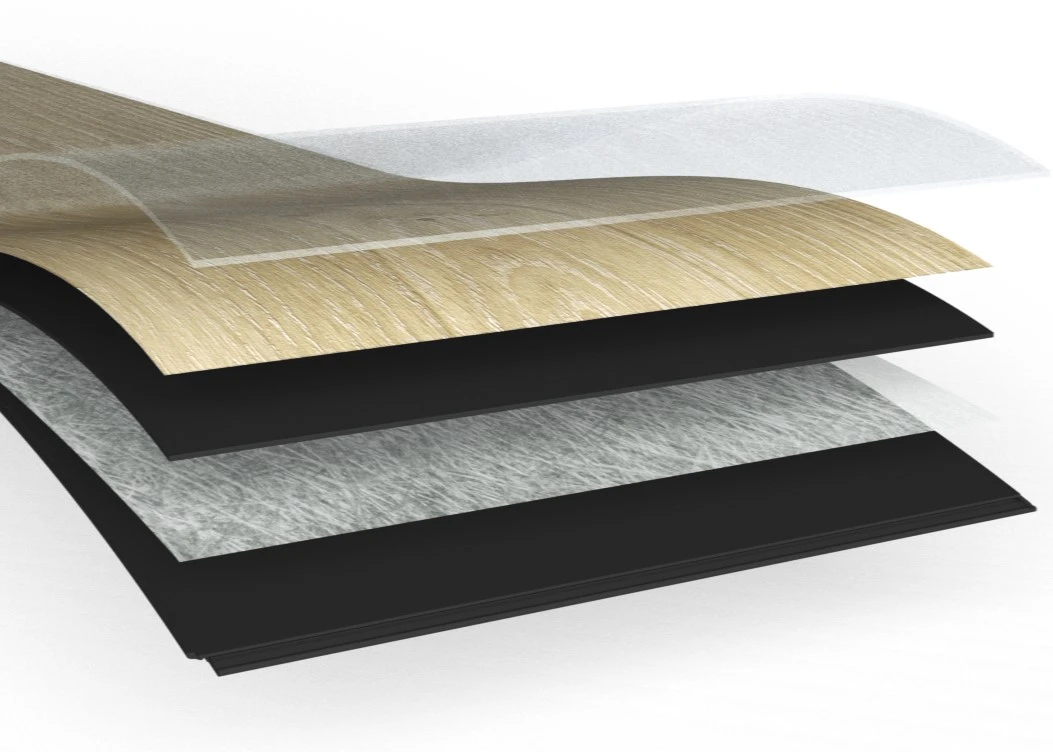
The attached underlayment on some SPC planks is a convenience feature, not an acoustic solution. Many rigid core flooring products include a thin layer of foam or cork pre-attached to the underside of each plank. This layer is typically 1 to 1.5 millimeters thick. It provides a modest improvement in footfall sound within the room and eliminates the need to roll out a separate underlayment during installation. It does not replace a full acoustic underlayment for impact noise isolation between floors. If the installation is on a concrete slab in a multi-story building where sound transmission to the unit below is a concern, the attached pad is supplementary. A separate acoustic underlayment of 2 millimeters or thicker in cork, rubber, or specialized soundproofing material is still required to achieve IIC ratings that meet multi-family building codes.
III. The Underlayment Is Half the Answer, and It Is the Half Most Installations Get Wrong
The underlayment beneath an SPC floor is an acoustic component first and a cushioning layer second. The distinction is important because the two functions pull in opposite directions. A thick, soft foam underlayment feels comfortable underfoot and is inexpensive to purchase. It also compresses under the weight of a person walking across it, and that compression creates vertical movement at the click-lock joints with every footstep. Over weeks and months, the repeated micro-movement loosens the joints, creates gaps, and ultimately causes the floor to fail at the seams. SPC flooring manufacturers specify underlayment with a maximum compression rating, and exceeding that rating to gain acoustic performance sacrifices structural integrity at the joints. The quietest underlayment that destroys the floor is not a good underlayment.
Three underlayment materials dominate the acoustic SPC flooring market, each with a different balance of sound performance, compression resistance, and cost. Cork underlayment is a natural material with a cellular structure that dissipates sound energy through internal friction within the cell walls. It resists compression well-cork recovers its thickness after loading better than most synthetic foams-and it adds roughly 8 to 12 points to the IIC rating of a floor assembly at a thickness of 2 to 3 millimeters. It is the right choice for residential installations where sustainability matters and the acoustic target is moderate. Rubber underlayment, typically made from recycled tire rubber or synthetic elastomer, is denser than cork and provides higher IIC gains, often 12 to 18 points, at equivalent thicknesses. It is the standard choice for commercial and multi-family installations where impact noise isolation is regulated and the budget allows for a premium material. Specialized soundproof underlayments, which combine a dense mass-loaded layer with a decoupling foam or fiber layer, achieve the highest IIC ratings-20 points or more above the bare slab-but at a cost that makes them practical primarily for high-end residential and luxury multi-family projects where acoustic performance is a selling feature.
A fourth category exists but serves a different function. Moisture barrier underlayment with a built-in vapor barrier is required for installations over concrete slabs, where ground moisture migrating upward through the slab can condense under the flooring and cause damage over time. The moisture barrier is an acoustic neutral. It does not improve sound performance. It does not degrade it. It protects the floor assembly, and the acoustic underlayment, if one is used, goes on top of the moisture barrier. The two functions are complementary and the layers are installed in sequence, not combined into a single product that does both poorly. For SPC flooring with compatible underlayment specifications, the product specifications include maximum compression ratings and recommended underlayment types per installation environment.
| Underlayment Type | Typical IIC Gain | Compression Resistance | Best Application | Acoustic Rating |
|---|---|---|---|---|
| Cork (2–3 mm) | +8 to +12 points | Excellent recovery | Residential, moderate acoustic needs | Good |
| Rubber (2–3 mm) | +12 to +18 points | Very high, minimal compression | Commercial, multi-family, heavy traffic | Very Good |
| Soundproof composite | +18 to +25+ points | High with decoupling layer | Luxury residential, high-rise condominiums | Excellent |
| Basic foam (1–2 mm) | +3 to +6 points | Low, permanent compression risk | Budget residential, single-family ground floor | Moderate |
| Attached pad only | +2 to +5 points | Ultra-thin, limited acoustic value | Single-family, same-floor comfort only | Minimal |
IIC gain values are approximate and depend on the full floor-ceiling assembly. An underlayment that delivers +15 IIC points on a concrete slab may deliver a different gain on a wood-frame subfloor. Always verify with assembly-specific test data.
IV. Tight Seams, Fewer Pathways
Airborne sound travels through any gap it can find. A floor assembly with open seams between planks provides dozens of small pathways for sound to move from the room above to the cavity below, bypassing the mass of the flooring material entirely. The acoustic performance of a floor is limited by its weakest acoustic link, and a seam gap of a fraction of a millimeter is acoustically far weaker than the plank on either side of it. A floor with tight seams channels sound through the plank material, where the density of the core does its work. A floor with loose seams gives sound an easier route, and the easier route is the one the sound takes.
The click-lock joint system on SPC flooring addresses this by creating a mechanical interlock that pulls adjacent planks together under tension. The joint profile is milled into the rigid core during production, and when two planks are clicked together, the geometry of the profile generates a clamping force that holds the seam closed. The seam is not glued. It is not nailed. It is held shut by the shape of the material itself, and it stays shut as long as the floor is installed with the correct expansion gap at the perimeter to prevent the entire floating floor from shifting as a unit. A properly installed click-lock SPC floor has seams that are functionally airtight, and airtight seams are also sound-tight for the frequencies that matter in room-to-room transmission.
This is a structural advantage that SPC shares with laminate and engineered wood, both of which also use click-lock joint systems. The advantage over glue-down luxury vinyl tile is more pronounced than the advantage over other click-lock products. Glue-down LVT relies on a full-spread adhesive bond to hold each plank or tile to the subfloor, and the seams between pieces are not mechanically locked. They rely on the adhesive to hold the edges in contact. Over time, as the adhesive ages and the subfloor moves, micro-gaps can open at seam edges, and those micro-gaps become acoustic leaks. Click-lock SPC does not rely on adhesive for seam integrity. The joint is a physical interlock that does not degrade with age the way an adhesive bond degrades. For long-term acoustic consistency across the life of the floor, the mechanical joint has an inherent advantage over the chemical bond.

V. SPC Against Laminate, Hardwood, and Tile: Where It Wins and What the Numbers Actually Say
Comparing the noise performance of flooring materials requires comparing the full assembly, not the surface layer alone, because the assembly determines the acoustic outcome. The comparison below assumes a standard residential wood-frame subfloor with the same underlayment across all material types, which isolates the contribution of the flooring material itself. In practice, the underlayment selection often differs by flooring type, and the real-world acoustic difference between two materials can be larger or smaller than the material-only comparison suggests depending on what is installed underneath them.
SPC versus laminate. Both materials use a click-lock floating installation over underlayment. The acoustic difference is primarily a function of density. SPC, at roughly twice the density of the laminate HDF core, provides more impact sound attenuation at the plank level before the sound wave reaches the underlayment. The difference in IIC rating between SPC and laminate over the same underlayment is typically 2 to 5 points in favor of SPC, which is noticeable but not dramatic. The more significant subjective difference is in the sound within the room. Laminate flooring produces a hollow, drum-like footfall sound because the HDF core resonates at mid-frequencies when struck. SPC produces a denser, shorter footfall sound because the stone-polymer composite has a resonance frequency that is both higher and more rapidly damped than HDF. The sound of walking on SPC is quieter to the person doing the walking, even if the person downstairs hears a similar level of impact noise. Both materials benefit enormously from a quality underlayment, and the difference between a cheap foam underlayment and a dense rubber underlayment is larger than the difference between SPC and laminate over the same underlayment.
SPC versus hardwood. Solid hardwood flooring, when nailed or stapled directly to the subfloor, transmits impact noise efficiently because the fasteners create a rigid mechanical connection between the flooring and the subfloor. The impact energy travels through the nails into the joists with minimal attenuation. Floating SPC over an acoustic underlayment decouples the floor surface from the subfloor, and that decoupling is responsible for most of the acoustic improvement. The IIC difference between nailed hardwood and floating SPC with a rubber underlayment can be 15 to 25 points, which is the difference between a floor that generates complaints from the unit below and a floor that meets multi-family code. Engineered hardwood installed as a floating floor with an underlayment narrows the gap considerably, reducing the SPC advantage to 3 to 8 IIC points, similar to the laminate comparison. The acoustic advantage of SPC over hardwood is primarily an installation method advantage, not a material advantage. Floating floors isolate better than fastened floors regardless of material.
SPC versus ceramic or porcelain tile. Tile is the loudest common hard surface flooring material. It is installed with thinset mortar directly onto a cement board or concrete substrate, creating a rigid, high-density assembly with no decoupling layer and no underlayment. Impact noise travels from the tile surface through the mortar into the substrate with almost no attenuation at the flooring level. The surface is hard and reflective, so airborne sound within the room bounces off it with minimal absorption. SPC over an acoustic underlayment outperforms tile for impact noise isolation by 20 to 30 IIC points, the largest gap in any hard surface flooring comparison. Within the room, the textured surface of an SPC plank absorbs and scatters more reflected sound than a glazed tile surface, reducing the perceived brightness of the room. Tile, however, has one acoustic advantage: it does not resonate. A dropped object on tile produces a sharp, short impact sound that stops almost immediately. A dropped object on a floating floor can produce a brief resonant decay as the floor assembly vibrates. The resonance is subtle and most occupants never notice it. It is measurable, and it is the only acoustic dimension where tile outperforms a floating floor with a dense core.
Common Questions About SPC Flooring and Noise
Frequently Asked Questions About SPC Flooring Acoustic Performance
Practical answers on how rigid core vinyl flooring handles sound in real installations.
Q1: Does a thicker SPC plank reduce noise more than a thinner one?
Slightly, but not proportionally. A 5.5-millimeter SPC plank provides marginally more impact sound attenuation than a 4-millimeter plank of the same density, but the difference is typically less than 2 IIC points. The mass per unit area is the acoustic variable, and the difference in mass between a 4-millimeter and a 5.5-millimeter plank is less than a kilogram per square meter. Upgrading the underlayment from basic foam to dense rubber adds more IIC points than doubling the plank thickness. If acoustic performance is the priority and the budget requires a choice between a thicker plank and a better underlayment, choose the underlayment.
Q2: Can SPC flooring be installed in apartments where the building has strict noise requirements?
Yes, and SPC with a high-performance acoustic underlayment is one of the most common flooring solutions for multi-family construction. Most building codes and homeowner association regulations specify a minimum IIC rating, typically 50, for floor-ceiling assemblies in multi-family buildings. SPC over a 2-millimeter to 3-millimeter rubber underlayment on a standard concrete slab routinely achieves IIC ratings of 52 to 58, which meets or exceeds the requirement. The critical variable is the underlayment selection. An SPC floor with an attached pad only and no separate acoustic underlayment will not meet multi-family IIC requirements in most jurisdictions. The plank alone is not enough. The full assembly, tested as a system, must meet the code. Always request the assembly test report, not just the product data sheet, for multi-family applications.
Q3: Why does SPC flooring sound quieter underfoot than laminate?
The difference is in the core material's resonant behavior. Laminate uses high-density fiberboard, which is a wood-fiber composite with a density of roughly 800 to 900 kilograms per cubic meter. When struck, the HDF core resonates at frequencies between roughly 200 and 500 hertz, which falls in the range where human hearing is most sensitive. The result is a hollow, drum-like sound that occupants describe as "cheap" or "echoey." SPC, with a stone-polymer core roughly twice as dense, has a resonant frequency that is higher and the resonance decays faster because the polymer matrix damps vibration more effectively than the resin-bonded wood fibers in HDF. The subjective difference is a quieter, shorter, denser footfall sound. The person walking on the floor hears less noise, even if the impact transmission to the room below is similar between the two materials over the same underlayment.
Q4: Does SPC flooring require a separate vapor barrier underlayment in addition to an acoustic underlayment?
Over concrete slabs, yes. The vapor barrier prevents ground moisture from migrating through the slab and condensing under the flooring, which can cause warping, mold, and adhesive failure over time. The vapor barrier is installed first, directly on the slab, with seams taped. The acoustic underlayment is installed on top of the vapor barrier. Some products combine both functions into a single roll, but the combined products typically compromise on acoustic performance to achieve the moisture rating. For installations where both moisture protection and acoustic performance are required, two separate layers-a dedicated vapor barrier and a dedicated acoustic underlayment-produce a better result than a single combination product. Over wood subfloors above grade, a vapor barrier is generally not required unless the crawl space or basement below has a known moisture issue.
Q5: How does SPC flooring compare to luxury vinyl tile for noise?
SPC and luxury vinyl tile are both PVC-based products, but their acoustic behavior differs because of the core construction. SPC has a rigid stone-polymer core that blocks impact sound through mass and density. LVT is flexible, with a thinner overall construction and no rigid core layer. Glue-down LVT transmits impact noise to the subfloor more efficiently than floating SPC because the adhesive bond creates a direct mechanical path for vibration. Floating LVT with a click-lock system performs more similarly to SPC but typically has a lower density and a thinner wear layer, which reduces the mass available for sound attenuation. The acoustic advantage of SPC over LVT is modest but consistent: 2 to 6 IIC points in floating installations, and significantly more in glue-down LVT installations where the adhesive bond eliminates the decoupling benefit of a floating floor. Within the room, the rigid SPC surface produces a more solid, less hollow footfall sound than flexible LVT, which can feel and sound slightly plastic underfoot.
SPC Flooring With Documented Acoustic Performance
Rigid core vinyl flooring in residential and commercial grades with IIC and STC test data per assembly type. Compatible acoustic underlayment options available. Full technical documentation for multi-family code compliance.
The Floor, the Layer Underneath, and the Room Below
SPC flooring reduces noise compared to other hard surface flooring materials through three mechanisms that operate at different points in the sound transmission path. The dense stone-polymer core provides more mass per millimeter of thickness than laminate, hardwood, or LVT, and that mass attenuates impact sound at the point of contact before the energy reaches the underlayment. The click-lock joint system closes the seams between planks, eliminating the micro-gaps that airborne sound uses to bypass the mass of the floor. The underlayment, which is a separate product chosen to match the acoustic requirements of the installation, decouples the floating floor from the subfloor and absorbs the impact energy that the plank does not stop. The three mechanisms work together, and the acoustic result depends on all three being correctly specified and installed.
The single largest variable in the acoustic performance of an SPC floor is not the plank. It is the underlayment. A premium SPC plank over a cheap foam underlayment will underperform a standard SPC plank over a dense rubber underlayment by a margin that is both measurable and audible. If noise reduction matters, allocate the acoustic budget to the layer that does the acoustic work. The plank provides the floor you see and walk on. The underlayment provides the quiet that the room below hears. Both matter. Only one is visible. The one that is invisible is the one that determines whether the floor is quiet enough.
YUPSENI Team
23 years in PVC and SPC flooring manufacturing and supply chain. We produce rigid core vinyl flooring with documented acoustic performance for residential, multi-family, and commercial applications. IIC and STC test data, underlayment compatibility, and full assembly specifications available for every product line. More about YUPSENI
© 2026 YUPSENI. All rights reserved. The information in this article is for general informational purposes only and does not constitute professional acoustic engineering or procurement advice. Impact Insulation Class ratings, Sound Transmission Class ratings, and acoustic performance values vary by floor-ceiling assembly configuration, subfloor type, underlayment selection, and installation quality. Always request assembly-specific test data and consult a qualified acoustic consultant for projects where code compliance or specific acoustic performance criteria are required.