

60×60 PVC Ceiling Tiles | Grid-Ready Waterproof Suspended Ceiling Panels | YUPSENI
Jun 27, 2026
60×60 PVC Ceiling Tiles: The Grid-Ready Panel That Turns a Five-Day Ceiling Job Into an Afternoon
~6 min read · June 27, 2026 · By YUPSENI Team

60×60 PVC ceiling tiles in a standard T-bar suspended grid. Each tile drops into place without tools. The embossed surface is factory-finished white. No paint, no joint compound, no drying time. The ceiling is complete the moment the last tile lands.
No ceiling tile ships from the factory with a paint can taped to the box.
Yet the standard ceiling specification in most of the world assumes that painting, sealing, or both will happen on site. Gypsum tiles need edge treatment to prevent the cut edges from absorbing moisture. Mineral wool tiles arrive porous and stay porous, accumulating airborne grease in kitchens and swelling in humidity cycles. The painting step is not optional. It is a structural dependency of the material. Remove it, and the ceiling fails early.
60×60 PVC ceiling tiles remove the painting step by removing the reason for it. The tile is solid PVC through its full cross-section. There is no paper facing, no gypsum core, no mineral wool fibre mat. The surface you see on the pallet is the surface that faces the room for the life of the building. It wipes clean with a damp cloth. It does not absorb water, grease, or odour. And because it weighs a fraction of gypsum, one person carries a stack of tiles up a ladder and installs an entire room in a single shift. Browse the full 60×60 PVC ceiling tile specification, including finish options, thickness grades, and grid compatibility details.
On This Page
- I. PVC vs Gypsum vs Mineral Wool: What the Ceiling Tile Aisle Will Not Tell You
- II. Kitchens, Bathrooms, and the Acid Test That Gypsum Always Fails
- III. Drop-In, Lock-In, Walk Away: Why the Installation Arithmetic Favours PVC
- IV. Replacing One Tile Without Replacing the Whole Ceiling
- V. Finishes, Fire Ratings, and the Specifications That Separate a 2-Year Tile From a 20-Year One
I. PVC vs Gypsum vs Mineral Wool: What the Ceiling Tile Aisle Will Not Tell You
The ceiling tile aisle presents three options as though they are interchangeable. They are not. Each material makes a promise it cannot keep in the room where it will eventually be installed.
| Property | Gypsum Ceiling Tile | Mineral Wool Tile | PVC Ceiling Tile |
|---|---|---|---|
| Waterproof | No | No | Yes |
| Moisture-resistant | Conditional (edge-sealed only) | No - absorbs ambient humidity | Yes |
| Acid and alkali resistant | No | No | Yes |
| Requires painting | Yes | No | No - factory-finished |
| Weight (per 60×60 tile) | ~2.5 to 3.5 kg | ~1.5 to 2.0 kg | ~0.6 to 0.9 kg |
| Single-tile replaceable | No - taped and jointed | Yes - lay-in grid | Yes - lay-in grid |
| Non-toxic, formaldehyde-free | Trace (paper facing) | Possible (binder resins) | Yes |
| Mould growth substrate | Yes - paper + gypsum | Yes - porous fibre mat | No - no organic content |
The table makes the specification argument without elaboration. When one material is the only one that is waterproof, acid-resistant, mould-proof, formaldehyde-free, and arrives factory-finished, the comparison conversation is short.
A gypsum ceiling tile is gypsum plaster pressed between two sheets of paper. It is heavy, brittle, and absorbs water from both faces. Edge-sealed gypsum tiles resist moisture ingress at the cut edges for a limited time, but the sealant is a coating, not a structural property of the material. Once the sealant is scratched during handling or installation, the paper facing wicks water into the gypsum core. The tile swells permanently. A mineral wool tile is a compressed fibre mat bound with resin. It absorbs sound, which is its single genuine advantage, but it also absorbs water vapour, cooking grease, and airborne particulates. Over years in a kitchen ceiling, a mineral wool tile gains weight from accumulated residue. It cannot be cleaned. It must be replaced.
A PVC ceiling tile contains none of these failure mechanisms. The tile is polyvinyl chloride through its full thickness. Water beads on the surface and evaporates. Grease wipes off with a household cleaner. The tile weighs less than a kilogram, which means the grid carries a fraction of the dead load it was designed for. For a broader comparison across ceiling material types, PVC ceiling vs gypsum vs mineral fiber covers the acoustic, thermal, and cost tradeoffs that determine which material belongs in which room.
II. Kitchens, Bathrooms, and the Acid Test That Gypsum Always Fails
A kitchen ceiling lives above boiling pots. Steam rises carrying oils, acids, and particulates that condense on the coolest surface in the room. That surface is the ceiling. A gypsum tile absorbs the condensation and the contaminants dissolved in it. The paper facing discolours. The gypsum core softens. A mineral wool tile fares worse: the open fibre structure traps aerosolized grease inside the matrix, where it oxidizes and turns yellow-brown over time. Neither tile can be cleaned. Both must be replaced.
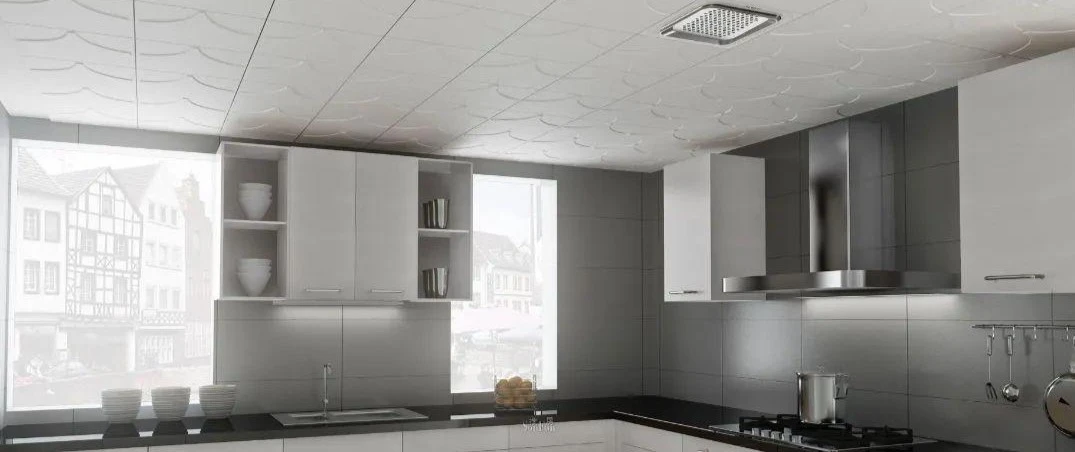
60×60 PVC ceiling tiles installed above a commercial cooking line. Steam, oil vapour, and cleaning chemical splashes leave no permanent mark. The non-porous surface wipes clean with standard kitchen degreasers.
The bathroom scenario is simpler: condensation, no grease, but continuous high humidity. A gypsum tile in a bathroom with poor ventilation absorbs moisture from the air. The paper facing feeds mould colonies. The tile sags between grid members. A PVC tile in the same bathroom experiences none of this. The material is non-porous. Mould spores that land on the surface find no organic material to consume. The tile does not sag because the PVC is dimensionally stable across the full humidity range. The acid and alkali resistance of PVC, a property largely irrelevant in living rooms and offices, becomes directly relevant in bathrooms where tile cleaners, bleach-based mould removers, and limescale descalers are used regularly. Splash a gypsum tile with bathroom cleaner and the surface etches. Splash a PVC tile with the same chemical and nothing happens.
The allergy and respiratory angle matters in these rooms as well. PVC ceiling tiles are odourless and inert at room temperature. They do not off-gas volatile organic compounds from binders or facing adhesives because there are none in the formulation. For households with occupants who are allergic to wood dust or sensitive to paint solvents, a PVC ceiling in the bedroom or kitchen eliminates a source of airborne irritants that a painted gypsum ceiling continuously emits during its curing period and potentially long afterward. The PVC ceiling panel maintenance guide covers the cleaning and care regimen that keeps the tiles looking new with no special products and no labour budget.
III. Drop-In, Lock-In, Walk Away: Why the Installation Arithmetic Favours PVC
The 60×60 centimetre format is a standard suspended-ceiling module worldwide. The T-bar grid that supports the tiles is identically sized across manufacturers. A PVC tile of this dimension drops into an existing grid as a direct replacement for a gypsum or mineral wool tile, or into a new grid as part of a fresh installation. No modification to the grid. No adapter clips. No shimming.
The installation sequence for a room of, say, forty square metres, roughly a standard commercial office or a large residential kitchen and dining area, goes as follows. The grid is levelled and suspended. The tiles are lifted from the pallet and placed into the grid openings. Each tile weighs under a kilogram, so one person carries four or five tiles at a time. A tile drops into its opening and settles onto the T-bar flange under its own weight. No adhesive. No fasteners. No joint tape between tiles. No compound. No sanding. No paint. The grid provides the alignment; the tile provides the surface; gravity provides the hold-down. Forty square metres of ceiling, approximately 112 tiles at the standard 60×60 module, installs in under three hours with a single installer who has done it before. The same area in gypsum tiles requires edge sealing, screw-fixing, taping, three coats of joint compound with drying time between each, sanding, priming, and two coats of paint. That is not a one-day job. It is not even a two-day job once drying times are included.

A 60×60 PVC tile being placed into a T-bar grid. The tile rests on the grid flange under its own weight. No tools, adhesive, or fasteners required. The room below stays clean. No dust, no compound, no paint overspray.
The DIY factor deserves a mention because PVC ceiling tiles have carved out a significant share of the home renovation market on the strength of this single property. A homeowner who would never attempt to hang and finish a drywall ceiling will install a grid and drop in PVC tiles over a weekend. The tools required are a spirit level, a drill for the grid suspension wires, a utility knife to trim perimeter tiles to width, and a straightedge. The learning curve is measured in the first three tiles. By tile ten, the rhythm is automatic. The PVC ceiling panel installation guide covers grid setup, tile trimming, and perimeter detailing for professional and DIY installations alike.
IV. Replacing One Tile Without Replacing the Whole Ceiling
Something hits the ceiling. A ladder slips during maintenance. A pipe fitting above the ceiling is replaced and the plumber's elbow goes through a tile. A water leak stains a single tile brown while the surrounding tiles are untouched. In a gypsum ceiling, replacing one damaged tile means cutting out the joint tape, removing the fasteners without damaging adjacent tiles, fitting a new tile, re-taping, re-compounding, re-sanding, re-priming, and re-painting. The repair blends in approximately never. The colour match between a freshly painted patch and the surrounding ceiling that has aged five years is visibly different from every angle.
In a PVC ceiling, replacing one tile takes sixty seconds. Lift the damaged tile out of the grid. Drop the replacement tile into the same grid opening. The repair is invisible because the replacement tile came from the same production batch as the originals, or from a batch that was colour-matched at the factory. The surrounding tiles do not need to be touched. The room is not taken out of service. No dust. No paint. No colour mismatch. In a commercial space where a damaged ceiling tile makes the whole business look neglected, the single-tile replaceability of a grid-mounted PVC panel is not a convenience feature. It is a facility management budget line item that disappears almost entirely. For a more detailed breakdown of installed cost versus material cost, why PVC ceiling board is the smart choice for cost-effective renovation covers the total-cost-of-ownership analysis that material-only comparisons consistently miss.
V. Finishes, Fire Ratings, and the Specifications That Separate a 2-Year Tile From a 20-Year One
Not all PVC ceiling tiles are the same product. The variables that determine whether a tile lasts two years or twenty are thickness, surface finish quality, and UV stabilisation. A tile that is too thin will sag across the 60-centimetre span under its own weight, particularly in warm ceiling cavities where the material approaches its softening temperature. A tile with a thin, low-quality surface finish will scratch during handling and show the marks permanently. A tile without UV stabilisers installed near a skylight or in a room with large windows will yellow over time.
The standard thickness for a 60×60 PVC ceiling tile that will span the full module without sagging is 5 mm to 7 mm. At 5 mm, the tile is rigid enough for standard grid spacing and light enough for single-person handling. At 7 mm, the added material provides a heavier, more solid feel and additional rigidity for larger grid modules. Both thicknesses cut with a utility knife and a straightedge. The surface finish options include smooth matte white, which is the default for most residential and commercial ceilings, embossed textures that add visual depth without collecting dust, and decorative finishes that mimic wood grain, brushed metal, or tin ceiling patterns. The decorative finishes allow a PVC tile to look like a material it is not, which is the entire point. A tin-look PVC tile in a heritage-style bar or restaurant delivers the visual character of a pressed metal ceiling at a fraction of the weight and with none of the corrosion risk. The article on PVC ceiling panels that look like real wood, tin, and plaster covers the decorative range in detail.
Fire performance for PVC ceiling tiles follows the same classification framework as other PVC building products. The standard grade achieves a Euroclass E rating. PVC is inherently self-extinguishing: the chlorine atoms in the polymer chain interfere with the combustion reaction, and the material stops burning when the flame source is removed. For projects that require a higher classification, a fire-retardant formulation achieving Euroclass B is available. The fire-retardant grade is chemically identical in appearance, weight, and handling characteristics. The cost differential is modest. The decision between standard and fire-retardant is driven entirely by the building code requirements for the occupancy type. Request the fire test certificate at the quotation stage if the project specification demands it.
The thickness of a PVC ceiling tile is not a cost decision. It is a span decision. A tile that sags across the grid opening was specified wrong, not manufactured wrong. Match the thickness to the grid module size at the quotation stage, and the sagging problem ceases to exist.
Quick Questions
Frequently Asked Questions About 60×60 PVC Ceiling Tiles
Quick answers for contractors, facility managers, and homeowners evaluating PVC grid ceiling tiles.
Q1: Are 60×60 PVC ceiling tiles compatible with standard T-bar grids?
A: Yes. The 60 cm × 60 cm module is a globally standard suspended-ceiling dimension. PVC tiles of this size drop into any standard 24 mm or 15 mm T-bar grid without modification. The tile rests on the grid flange. Confirm exact tile dimensions at the time of quotation to ensure fit with the specific grid profile on site.
Q2: How does the installed cost compare to gypsum tiles?
A: The per-tile material cost of PVC is lower than gypsum. The installed cost gap widens further because PVC requires no edge sealing, joint taping, compound application, sanding, priming, or painting. Labour is the dominant cost in ceiling installation. Eliminating the finishing cycle reduces total labour by more than half compared to a gypsum tile ceiling.
Q3: Can PVC ceiling tiles be used in kitchens above cooking equipment?
A: Yes. PVC is acid-resistant, alkali-resistant, and non-porous. Cooking vapours, aerosolized oil, and cleaning chemical splashes do not penetrate the surface. The tiles can be wiped down with standard kitchen degreasers without surface etching or discolouration. For commercial kitchens, confirm the fire rating classification against local health and safety code requirements.
Q4: What happens if one tile gets damaged?
A: Lift the damaged tile out of the grid. Drop a replacement tile into the same opening. The repair takes under a minute. No adhesive, no fasteners, no paint, no colour matching. If the replacement tile comes from the same production batch, the repair is invisible. Adjacent tiles are undisturbed.
Q5: Are PVC ceiling tiles safe for bedrooms and allergy-sensitive environments?
A: Yes. PVC ceiling tiles are odourless, non-toxic, and free of formaldehyde and volatile organic compounds at room temperature. They do not support mould growth. For allergy-sensitive occupants who react to paint solvents, wood dust, or mould spores, a PVC ceiling is a zero-emission surface that requires no chemical maintenance products.
Q6: What finishes are available and do they affect performance?
A: Available finishes include smooth matte white, embossed textures, woodgrain, brushed metal, and tin-look patterns. The decorative finishes are surface films thermally bonded to the PVC substrate. Performance in terms of waterproofing, mould resistance, and cleanability is identical across all finishes because the tile body is solid PVC regardless of the surface pattern. Choose the finish for the design requirement, not for the performance requirement.
60×60 PVC Ceiling Tiles - Factory Direct, Any Finish, Any Quantity
Matte white, embossed, woodgrain, metal-look, and custom finishes. Standard and fire-retardant grades. Thickness options from 5 mm to 7 mm. Tell us your finish, quantity, and grid type. Pricing, lead time, and a sample within 24 hours.
The Tile That Does Not Know What Water Damage Looks Like
The 60×60 PVC ceiling tile competes with gypsum and mineral wool not on any single metric but on the accumulation of failure modes it eliminates. It does not absorb water, so it survives leaks. It does not support mould, so it survives humidity. It does not require paint, so it survives the renovation cycle without scaffolding. It weighs under a kilogram, so it goes up with one hand. It lifts out of the grid, so one damaged tile does not become a ceiling-wide repair.
For the contractor, the value is installation speed: a ceiling that can be quoted at half the labour of a gypsum equivalent. For the building owner, the value is a ceiling that does not deteriorate in the rooms where deterioration is guaranteed. For the homeowner, the value is a ceiling that never needs painting, never stains from a bathroom leak, and can be updated one tile at a time if circumstances change. The tile is a simple product. The list of things it does not do is what makes it worth specifying.
YUPSENI Team
23 years in PVC building material extrusion and supply chain. PVC ceiling tiles, ceiling boards, foam boards, SPC flooring, wall panels, and fencing profiles manufactured in Shandong, China. More about YUPSENI
Disclaimer: Product specifications, fire ratings, pricing, and lead times are subject to confirmation at the time of order. Building code compliance must be verified against local regulations. Installation should be performed by qualified tradespersons in accordance with manufacturer instructions and applicable building codes.


