

PVC Laminated 5 mm Foam Board: Waterproof Sheet for Cabinets & Signage | YUPSENI
Jun 25, 2026
~4 min read · June 25, 2026 · By YUPSENI Team
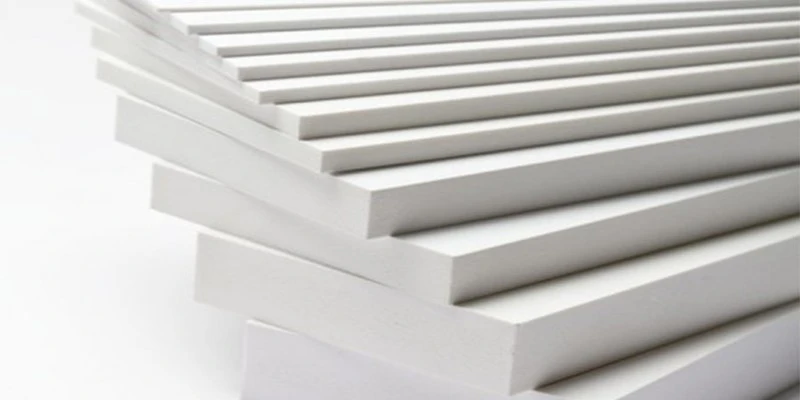
PVC laminated foam board at 5 mm. Solid PVC skins over an expanded foam core. Waterproof, rigid, lightweight, and arrives with a finished surface that needs no painting before fabrication.
MDF swells. Plywood delaminates. Particle board crumbles around the screws. These are not manufacturing defects. They are what happens when wood-based sheet materials meet water, and water finds every cut edge, every screw hole, and every seam eventually.
PVC laminated foam board replaces all three in one material. It is a three-layer sandwich: solid PVC skins bonded over an expanded PVC foam core. It is waterproof through the full thickness. It contains no formaldehyde. It processes on the same CNC routers and panel saws the shop already owns. And at 5 mm, it is the thickness that sign shops, cabinetmakers, and fit-out contractors keep coming back to. Browse the full PVC foam board range, from 1 mm to 20 mm across advertising, cabinet, and construction grades.
On This Page
- I. Six Materials, One Survivor: How PVC Foam Board Stacks Up
- II. Cabinets That Cannot Swell, in Rooms That Are Always Wet
- III. Outdoor Signs That Stay Flat When Plywood Would Warp
- IV. Cutting, Printing, Installing: How the Material Behaves Under the Tool
I. Six Materials, One Survivor: How PVC Foam Board Stacks Up
| Property | Solid Wood | Plywood | MDF | Particle Board | Gypsum | Laminated PVC Foam Board |
|---|---|---|---|---|---|---|
| Waterproof | No | No | No | No | No | Yes |
| Weatherproof | No | No | No | No | No | Yes |
| Never rots | No | No | No | No | No | Yes |
| Termite resistant | No | No | No | No | No | Yes |
| Moisture-proof | No | No | No | No | No | Yes |
| Non-toxic, formaldehyde-free | Yes | Contains formaldehyde | Contains formaldehyde | Contains formaldehyde | Fragile when wet | Yes |
| Lightweight | Yes | Yes | Conditional | Yes | No | Yes |
The table makes the specification argument without needing elaboration. When one material is the only one that is waterproof, rot-proof, termite-proof, and formaldehyde-free, the comparison conversation is short.
The construction is simple: two solid PVC skins thermally bonded to an expanded PVC foam core. The skins provide surface hardness, print compatibility, and a moisture barrier on both faces. The core provides rigidity at roughly one-third the weight of an equivalent MDF sheet. A standard 1,220 mm × 2,440 mm panel at 5 mm weighs approximately 4 to 5 kilograms. One person carries it across the shop under one arm.
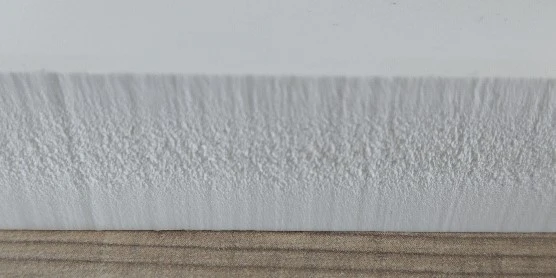
Three-layer cross-section. Solid PVC skins top and bottom over a closed-cell foam core. The layers are thermally fused - no adhesive, no delamination risk at the bond line.
II. Cabinets That Cannot Swell, in Rooms That Are Always Wet
A kitchen cabinet made of MDF lives above a sink. Steam rises. Water splashes. The edge banding is the only barrier between the substrate and the moisture that will destroy it. When the edge banding fails at the bottom joint, the panel absorbs water, swells, and cannot be dried back to its original dimension. The cabinet is permanently damaged. This failure mode is so predictable that cabinetmakers budget for it in their warranty calculations.
PVC laminated foam board eliminates this failure because there is no wood fiber in the panel to absorb water. The entire sheet, from top surface through foam core to bottom surface, is PVC. Water that pools on a cut edge evaporates without causing dimensional change. The edge does not need banding for moisture protection. Screw holes do not crumble because the foam core deforms elastically around the threads. A PVC cabinet board installed under a kitchen sink or in a bathroom vanity will outlast the plumbing it surrounds.
The formaldehyde angle is equally important in enclosed spaces. MDF and particle board off-gas urea-formaldehyde resin for years inside wardrobes and cabinets. PVC foam board contains no formaldehyde in its composition. The material is inert at room temperature. For wardrobe interiors and bedroom cabinetry, that single property is increasingly the one that wins the specification.

Bathroom vanity in woodgrain-laminated PVC foam board. Cut edges and fastener penetrations are immune to moisture. No swelling, no formaldehyde, no callbacks.
III. Outdoor Signs That Stay Flat When Plywood Would Warp
The signage industry adopted PVC foam board early. The smooth laminated surface accepts UV digital printing, screen printing, and self-adhesive vinyl with equal adhesion and no primer required. Standard applications include shopping mall directional signs, real estate boards, menu displays, and point-of-sale stands. The common factor is exposure: outdoor or semi-outdoor conditions where a printed MDF or plywood sign would absorb moisture through the cut edges and delaminate within a single season.
At 5 mm, the sheet is rigid enough to stand unsupported in a pavement sign frame and light enough to wall-mount with adhesive alone. Exhibition builders value the weight savings even more. A display that travels between venues accumulates freight and labor costs at every cycle. A PVC panel weighing one-third of the MDF equivalent saves money on every drayage charge and every setup crew hour. The PVC advertising board in a UV-printed outdoor application will show ink fading before it shows any substrate degradation. The board underneath stays flat, dry, and dimensionally stable.

UV-printed PVC foam board outdoor sign. The substrate remains flat through temperature and humidity cycles that warp plywood within days.
IV. Cutting, Printing, Installing: How the Material Behaves Under the Tool
PVC foam board processes on the same equipment the shop already owns for wood-based panels. A CNC router with a single-flute upcut bit cuts clean edges at feed rates comparable to MDF. A panel saw with a fine-tooth blade produces a finished edge. At 5 mm, a utility knife scores and snaps the sheet in a single pass, which makes on-site trimming fast and dust-free.
Two adjustments from wood-panel workflow: chip clearance and heat management. PVC produces a continuous chip rather than dust, so vacuum extraction at the tool tip prevents chips from re-welding onto the cut edge from frictional heat. The foam core softens above approximately 70 degrees Celsius, so feed rates and spindle speeds must keep the cut zone below that threshold. A sharp tool is essential. A dull bit generates enough frictional heat to soften the cut edge. The learning curve is short. A shop that processes its first sheet in the morning cuts it productively by the afternoon.
The workflow advantage is in what does not happen after cutting. The sheet arrives from the factory with the decorative surface already applied. Woodgrain, solid colour, high-gloss white, or custom film - the surface is finished before it reaches the fabrication bench. No priming. No painting. No drying time. The material goes from sheet to installed component in one operation.

CNC routing PVC foam board. Same machine, same toolpath files as MDF and plywood. Clean edges, minimal burr, no post-cut sanding required for non-visible edges.
Quick Questions
Frequently Asked Questions About PVC Laminated Foam Board
Quick answers for cabinetmakers, sign shops, and fit-out contractors.
Q1: What sizes are available?
A: Standard sheet is 1,220 mm × 2,440 mm (4×8). Other widths and lengths up to 3,050 mm available as running sizes. Cut-to-size service available for container-volume orders.
Q2: How does the cost compare to MDF?
A: Higher per-sheet material cost, lower total fabricated cost in wet-area applications. PVC arrives with a finished surface, needs no edge banding for moisture protection, and eliminates priming, painting, and sealing labor. When all finishing steps are included, the installed cost is often lower.
Q3: Is it fire-rated?
A: Standard grade achieves Euroclass E. PVC self-extinguishes when the flame source is removed. Fire-retardant formulations achieving Euroclass B are available for projects requiring higher ratings. Fire test certificates available on request.
Q4: Can it be used outdoors?
A: Yes. Interior-grade is suitable for covered outdoor areas. For fully exposed outdoor applications, specify the UV-stabilized formulation to prevent surface chalking and colour shift over extended sun exposure.
Q5: What fasteners and adhesives work best?
A: Polyurethane or modified acrylic construction adhesives provide the strongest bond. Coarse-thread screws designed for plastics hold well. For edge joining, PVC solvent cement creates a welded bond stronger than the surrounding material. Standard wood screws work but have lower pull-out strength than in solid timber.
PVC Laminated 5 mm Foam Board - Free Sample, Factory Direct
Laminated white, woodgrain, and custom finishes. Standard and fire-retardant grades. Tell us your dimensions, finish, and quantity. Pricing, lead time, and a sample within 24 hours.
One Material, No Compromises
PVC laminated 5 mm foam board does not do anything that plywood, MDF, and particle board cannot do. It just does it without the failure modes. Waterproof. Formaldehyde-free. Factory-finished on both faces. Processable on standard woodworking equipment. Light enough to carry, rigid enough to hold a screw, smooth enough to print without primer.
For the sign shop, it replaces ACM and MDO where weight and water resistance matter. For the cabinetmaker, it replaces MDF under sinks and in vanities where edge swelling is the number one warranty claim. For the fit-out contractor, it replaces plywood and gypsum where indoor air quality and installation speed win projects. The material is not new. The rate at which it is replacing wood-based panels in wet and semi-wet applications is.
YUPSENI Team
23 years in PVC building material extrusion and supply chain. PVC foam boards, wall panels, SPC flooring, ceiling boards, and fencing profiles manufactured in Shandong, China. More about YUPSENI
Disclaimer: Product specifications, pricing, and lead times are subject to confirmation at the time of order. Building code compliance must be verified against local regulations.


