

Why Do PS Grille Joints Open Up? Alignment Tolerance Explained
Sep 12, 2026
Why Do PS Grille Joints Open Up? A Field Guide to Alignment Tolerance
9 min read
By YUPSENI Team
A finished grille wall. Everything that could go wrong with joint alignment has already happened by the time this photograph was taken.
On This Page
The first three panels of a grille wall go up perfectly. The fourth is a fraction out. By the twelfth, the flutes no longer line up with the panel the installer started from, and the wall has developed a lean that nobody can explain and nobody can fix without taking it apart.
That progression is not a workmanship failure in the ordinary sense. It is tolerance accumulation, and grille panels are unusually good at exposing it. The PS wall panel range carries an interlocking profile on the long edges, which means every panel's position is set by the panel before it rather than by an independent fixing to the wall.
This piece works through where the error comes from, why a fluted face makes it visible, and what can actually be done about it on site.
I. The Joint Looks Fine Until You Count Them
Stand close to a single joint and run a finger along the flute line. Half a millimetre of step is almost impossible to feel. Step back three metres and it is obvious.
That is the first thing to understand about grille walls. The tolerance that matters is not the one you can measure at the joint. It is the one the eye reads across the whole run.
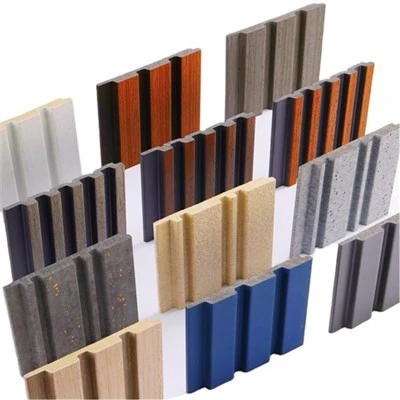
The flute lines are continuous across the panel face. When a joint is out of register, the line breaks, and the eye finds the break immediately.
Now do the arithmetic on a typical run. Take a wall of twenty panels. If each joint is out by half a millimetre in the same direction, the last panel sits ten millimetres off the line set by the first. On a panel with a ten-millimetre flute pitch, that is a full groove out of register. Nothing dramatic happened at any individual joint. The wall simply walked away from its own starting point.
The same arithmetic works in the installer's favour when the errors are random rather than systematic. Random error partly cancels. Systematic error accumulates in one direction and never recovers. Almost every badly aligned grille wall is a systematic error story, which is good news, because systematic errors have causes that can be found.
II. Where the Error Actually Comes From
Four sources account for most of it, and they are not equally common. Ranking them by how often they turn out to be the culprit is worth doing, because installers tend to blame the last one on the list and it is usually the first.
| Source | How it shows | Frequency |
|---|---|---|
| Pattern registered off the profile at the factory | Consistent step at every joint in the same direction | Common |
| Joint not fully seated | Visible gap, plus a step that varies joint to joint | Common |
| Start panel not plumb | Flutes run diagonally, joints stay parallel | Less common |
| Panels from different production runs mixed | Steps that appear only where batches change | Occasional |
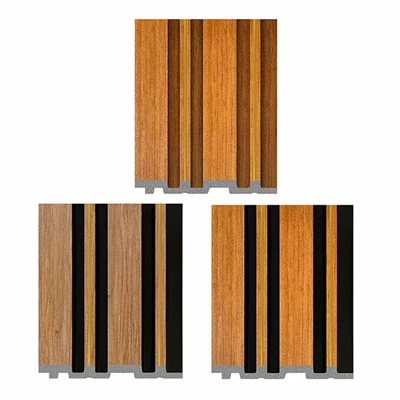
Viewed at a shallow angle, a systematic step at the joints reads as a single continuous fault rather than a series of small ones.
The first row is the one that gets missed. A grille profile is formed into the board, and the decorative pattern is applied to the face. The distance between the interlocking edge and the first flute is a manufactured dimension with its own tolerance. If that dimension drifts through a production run, every panel carries the same offset, and every joint steps in the same direction. No amount of careful installation fixes it, because the installer is being handed a stack of panels that are individually consistent and collectively wrong.
The second row is more common on site than anyone admits. An interlocking profile has to be engaged along its full length. Pressing a panel home from the middle seats the centre and leaves both ends fractionally proud. The panel looks fitted. The joint is not closed.
III. Why Grille Panels Show What Flat Panels Hide
A flat panel with a wood grain print forgives a great deal. The pattern is irregular, the eye has no reference line to follow, and a step at a joint disappears into the noise of the grain. A grille panel removes every one of those hiding places.

The shadow line is what the eye tracks. It is also what makes a misaligned joint impossible to overlook.
The flutes form a regular rhythm, and regularity is exactly what the human visual system is built to detect breaks in. A single line that steps by half a millimetre interrupts that rhythm, and the interruption is picked up before the viewer has consciously registered anything about the wall at all.
There is a second effect, and it is the one that turns a small problem into a complaint. The flutes cast shadows, and the shadow is what gives the wall its depth. At a joint that is out of register, two shadows meet at an angle instead of running as one line. Under directional light, that meeting point becomes the darkest spot on the wall. The defect does not merely exist. It draws attention to itself.
This is worth saying plainly to anyone specifying a grille wall for the first time. The product is less forgiving than a flat panel, not because it is made to a lower standard, but because it presents a regular geometric pattern that makes every deviation legible. The tolerance has to be managed rather than assumed.
IV. The Start Line Is the Only Cheap Correction
Once the second panel is locked into the first, the pair behaves as a single rigid unit. Correcting anything downstream means releasing the interlock, and releasing an interlock that has already been pressed home risks damaging the edge that carries the finish. That is why the first panel is the only one that can be adjusted at no cost.

A plumb start panel produces vertical flutes and parallel joints. Every later panel inherits whatever the first one established.
Set the start line with a spirit level, not by measuring across from the adjacent wall or up from the floor. Floors are rarely level and corners are rarely square. A start line taken off either one imports that error into the wall and then multiplies it by the number of panels.
Check the first panel in two directions before anything else goes on it. Plumb along its length, and square across its width. Then check the flute line against the level rather than against the panel edge, because on some profiles the flute is not perfectly parallel to the interlock, and the flute is what the viewer will judge.
V. Checking Alignment Without Pulling the Wall Apart
Checking against the panel immediately next to the one you just fitted tells you almost nothing, because adjacent panels can both be wrong in the same direction. Check back against the start.

On a long run, the only reliable check is against the start panel rather than against the previous joint.
Three practical methods, in order of how early they catch a problem. A laser line set parallel to the start panel gives a continuous reference across the whole wall and can be checked at any point in the run. A string line does the same job on a shorter wall and costs nothing. And on a small job, simply sighting along the wall from one end at a shallow angle will show a systematic step as a single continuous fault, which is easier to spot than a series of individual ones.
Whatever method is used, check every fourth or fifth panel rather than only at the end. A systematic error caught at panel five costs a few minutes. The same error found at panel twenty costs the wall.
VI. When the Problem Is the Panel, Not the Installer
There is a simple test that separates a factory fault from an installation fault, and it takes about two minutes.
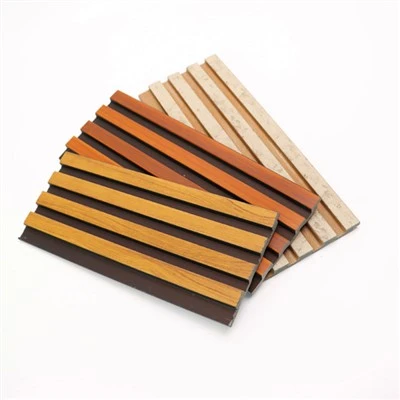
Lay three panels from the same bundle side by side and compare where the first flute sits relative to the interlocking edge.
Take three panels from the same bundle and lay them flat, face up, aligned on their interlocking edges. Compare the distance from that edge to the first flute on each. If the three measurements agree and the wall is still stepping, the problem is on site. If they disagree by a visible amount, the bundle carries the fault, and no installation technique will correct it.
That test is also the one to run before accepting a delivery, on a sample pulled from more than one bundle. Registration between the pattern and the profile is a manufacturing control, and it either holds across a run or it does not. Asking a supplier for the tolerance on that dimension before the order is a more useful question than most of what appears on a typical quotation.
Frequently Asked Questions
Grille Joint Alignment Questions
Questions from installers, contractors and importers dealing with grille panel alignment.
How much misalignment is acceptable at a grille joint?
There is no single figure, because the visible threshold depends on the flute pitch and the viewing distance. As a working rule, a step of under half a millimetre is hard to see at normal room distances, and a step above one millimetre is noticeable. What matters more is consistency: a wall where every joint steps by the same small amount reads worse than one where the steps vary, because the eye interprets the regular fault as a deliberate design feature that has gone wrong.
Can a misaligned joint be corrected after installation?
Generally no, not without releasing the panels either side of it. Once an interlocking profile has been pressed home and any adhesive has set, the joint cannot be adjusted in place. Attempting to force it usually damages the interlocking edge, which then affects every joint that panel takes part in. The practical answer is to remove and refit the affected section.
Should the wall be laid in one session?
Wherever possible, yes. A part-fitted section left overnight can move fractionally before the later boards lock it in place, and the point where work stopped is often visible afterwards as a step. On a large wall that cannot be completed in one day, stop at a natural break such as a corner or a door opening rather than mid-run.
Does temperature affect grille panel alignment?
It does. Polystyrene moves with temperature, so panels installed cold and then warmed by a heating system will expand slightly. A run locked tight between two walls has nowhere to go and will either bow or open a joint. Leaving a small allowance at the perimeter, covered by the finishing trim, removes the problem entirely.
Can panels from different production runs be mixed?
They can be installed, but they should not be mixed within a single visible run. Registration between the pattern and the interlocking profile is set per production run, so a change of run often introduces a step that appears only at the point where the batches meet. Where two runs have to be used on one project, keep each run to its own wall or its own room.
What should be asked before placing an order?
Ask for the tolerance on the distance between the interlocking edge and the first flute, and ask whether that tolerance is held across a full production run or only within a single bundle. Ask also whether the panels can be supplied from one run for the whole project. Both questions are more useful than a general statement about quality, because both describe something that can be measured on arrival.
The Short Version
Grille joints do not open up because installers are careless. They open up because an interlocking system passes every panel's position down the line, and a regular flute pattern makes the accumulated result visible. The mechanism is predictable, which means it is also manageable.
Set the first panel plumb, check it in two directions, sight back to it every few boards, and keep the whole wall to one production run. Do those four things and the wall stays in register. Skip them and the fault will not appear at the start, which is what makes it expensive.
Specifying a Grille Wall for a Project
Send us the wall dimensions and we will confirm flute spacing, panel layout and the registration tolerance held across the run.
Request a QuotationYUPSENI Team
23 years in PVC and PS building material manufacturing and supply chain. We help importers, distributors, and project buyers source wall panels, flooring, ceilings and fencing that pass compliance the first time. More about YUPSENI
© 2026 YUPSENI. All rights reserved. The information in this article is for general informational purposes only and does not constitute professional advice. Product specifications may vary by region and production batch. Always request current datasheets before making procurement decisions.


