SPC Flooring Impact Noise: What the Assembly Does, Not the Board | YUPSENI
Sep 14, 2026
SPC Flooring Impact Noise: What the Assembly Does That the Board Cannot
9 min read
By YUPSENI Team
On This Page
A tenant moves into a new apartment above someone else, and within a week the complaint arrives. Not about music, not about voices. About footsteps. The floor looks perfect and performs perfectly, and it is transmitting every step into the ceiling below.
This is the most common acoustic complaint in residential buildings, and it is almost never solved by changing the flooring product. The SPC flooring range is a rigid core product, and rigid cores transmit impact efficiently. What changes the outcome is the assembly underneath and around the floor, not the board itself.
Working out which part of the assembly does what is the only way to specify a floor that will actually be quiet, rather than one that carries an acoustic claim.
I. Two Kinds of Noise, One of Which Is Not the Floor's Problem
Acoustics separates sound that travels through the air from sound that travels through the structure. The distinction matters because a floor has almost no effect on the first and a large effect on the second.

Airborne sound is stopped by mass. An SPC plank has very little, which is why it contributes almost nothing to airborne performance.
Airborne noise is speech, television, music. What stops it is mass and airtightness. A six-millimetre SPC plank weighs a fraction of what a concrete slab or a screed weighs, so a floor covering of any kind contributes very little to airborne reduction. If the complaint is about hearing a neighbour's conversation through the floor, the solution is in the structure and the ceiling below, not in the surface above.
Impact noise is footsteps, dropped objects, furniture being moved. It arrives as mechanical energy in the structure, and it travels through the building as vibration rather than as sound in the air. This is where the floor covering matters, and where a specification can genuinely change the outcome. Almost every acoustic complaint about flooring is an impact noise complaint, and almost every acoustic product claim about flooring is an impact noise claim.
II. Why a Rigid Core Transmits Impact So Well
An SPC core is a dense composite of limestone powder and PVC resin, typically around two grams per cubic centimetre. That density is the product's main selling point for indentation resistance and dimensional stability. It is also the reason it is acoustically unforgiving.

A hard, dense, well-coupled surface transfers impact energy into the structure rather than absorbing it.
Think about what happens when a heel strikes the floor. The energy has to go somewhere. A soft surface deforms, and some of the energy is converted to heat inside the material. A rigid surface does not deform, so the energy passes through it almost unchanged and arrives at the substrate as a mechanical impulse. The denser and more tightly coupled the assembly, the more efficient that transfer becomes.
This is not a defect in SPC. It is the same property that makes the floor resistant to dents from furniture legs and stable enough to span small irregularities without a plywood subfloor. A floor cannot be both rigid under a chair leg and compliant under a footstep. The two requirements pull in opposite directions, and the product has to pick one.
The consequence for specification is straightforward. Because the board cannot absorb impact, the absorbing has to happen elsewhere in the assembly. That is what the backing pad and the underlay are for, and it is why the thickness of the board is not the variable that determines how loud the floor is.
III. The Backing Pad, and the Limits of What It Fixes
Many SPC planks are supplied with an IXPE foam pad pre-attached at the factory. It is usually offered in one of three thicknesses, and buyers frequently assume the thickest option gives the quietest floor. That assumption is half right and half expensive.
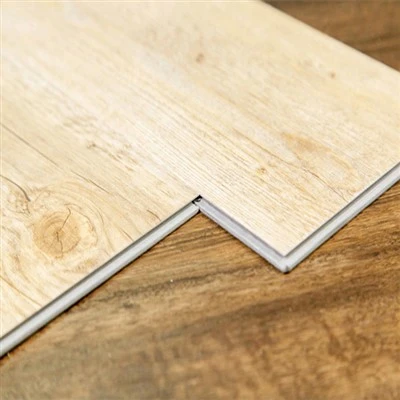
A pre-attached pad reduces impact noise and softens the feel underfoot. It does not turn a rigid core floor into an acoustic system.
The pad works by introducing a thin, compliant layer between the rigid core and the substrate. Impact energy that reaches the pad is partly absorbed before it enters the structure. A one-millimetre pad does very little of this. A two-millimetre pad does more. The relationship is real, and it is modest.
The trade-off is that foam compresses. A thicker pad under a rigid core gives the floor somewhere to move, and movement at the joints is what causes click-lock failures. A two-millimetre pad on a flat, sound substrate is fine. The same pad over a slab with a two-millimetre hollow will compress unevenly, and the joint above the hollow will eventually open.
There is also a common and avoidable mistake worth naming. If the planks arrive with a pad already fitted, adding a second underlay on site is not an upgrade. Two compliant layers behave unpredictably under load, and the result is usually a floor that feels soft, sounds hollow, and develops gapping. The pad is part of the assembly the manufacturer tested. Adding to it invalidates whatever that testing established.
IV. The Assembly Sets the Number
The same SPC plank laid on a concrete slab and on timber joists produces two entirely different acoustic results. Nothing about the plank changed.

The perimeter detail is part of the acoustic assembly. A floor that touches the wall bypasses the underlay entirely.
A concrete slab is heavy and stiff, and it absorbs impact energy poorly but transmits it slowly. A timber floor structure is lighter and more flexible, and it responds to impact differently. A floating floor over either one behaves as a system, and the system's performance cannot be predicted from the surface material alone.
Perimeter isolation is the part that gets skipped and matters most. A floating floor is supposed to be isolated from the walls and from every fixed element it meets. If the planks are pushed tight into a corner, or if a skirting is screwed down through the floor, impact energy takes a path around the underlay and straight into the structure. The underlay is still there. It is simply being bypassed.
This is why acoustic failures on new floors are so often traced to a detail rather than a material. A door threshold bridging the gap between two rooms, a kitchen island fixed down through the planks, a radiator pipe passing through with no isolation. Each one is a hard connection, and each one undoes a considerable amount of work done elsewhere.
V. Reading an Acoustic Report
Underlay acoustic claims are usually expressed as a single figure. Understanding what that figure describes is the difference between a specification and a hope.
| Term | What it describes | How to read it |
|---|---|---|
| Impact sound reduction, delta Lw | The improvement the underlay contributes, measured in a laboratory | A contribution figure, not a building performance figure |
| Impact insulation class, IIC | A rating for the complete floor and ceiling assembly | Describes the building, not the product |
| Field impact insulation class, FIIC | The same rating measured in a finished building | Always lower than the laboratory figure |

A laboratory figure describes the underlay. A field figure describes the building. Specifications are usually written against the first and judged against the second.
A delta Lw figure is measured on a reference floor in a laboratory, with the underlay installed exactly as the manufacturer specifies. It tells you what the underlay contributes under ideal conditions. It does not tell you what the finished apartment will achieve, because that depends on the slab, the ceiling below, the flanking paths through the walls, and the quality of the installation.
So when a supplier quotes a reduction figure, the useful follow-up questions are which standard the test followed, whether the figure was measured with the pad pre-attached or as a separate layer, and whether the same figure applies to the thickness being ordered. A report for a two-millimetre pad does not describe a one-millimetre pad, and a report for a separate underlay does not describe a pre-attached one.
VI. Where the Specification Usually Breaks
Three failure patterns account for most acoustic complaints on SPC installations, and none of them involve the board.
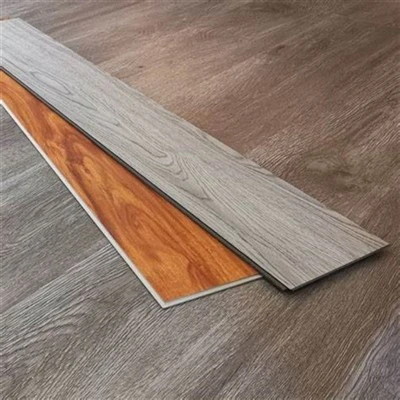
Most acoustic failures are traced to a hard connection somewhere in the assembly rather than to the flooring material.
The first is a hard connection that bypasses the underlay, usually at a threshold, a fixed cabinet or a pipe penetration. The second is an underlay chosen for its thickness rather than its tested performance, which produces a floor that feels soft and sounds no quieter. The third is a specification written against a laboratory figure with no allowance for field conditions, so the building is measured against a number it was never going to meet.
All three are design-stage problems. None can be fixed after the floor is down without lifting it. Which means the acoustic question belongs in the specification alongside the thickness, the wear layer and the finish, rather than arriving with the first complaint from the floor below.
Frequently Asked Questions
SPC Flooring Impact Noise Questions
Acoustic questions from specifiers, developers and importers working on multi-unit projects.
Does a thicker SPC board reduce impact noise?
Not meaningfully. A thicker core is denser in section and marginally stiffer, and it transmits impact at least as efficiently as a thinner one. Core thickness is specified for stability, indentation resistance and spanning ability. The variable that affects impact noise is the layer underneath the core, not the core itself.
Should I add a separate acoustic underlay if the planks have a pad attached?
No. Adding a second compliant layer under a pre-attached pad creates a soft, unstable base, and a rigid core over a soft base is what causes click joints to open. If the pre-attached pad does not provide the performance the project needs, the correct move is to order planks without a pad and specify a tested acoustic underlay as a single layer.
What is a good impact sound reduction figure?
For a thin pre-attached foam pad, a reduction in the low single digits is typical. Purpose-made acoustic underlays can reach considerably higher figures, but they are thicker and softer and change the installation requirements. The right figure depends on what the building has to achieve, which is usually set by a local code or by the developer rather than by the product.
Will the floor perform as well on site as the laboratory figure suggests?
Almost never, and the gap can be substantial. Laboratory testing uses a reference floor and a controlled installation. A real building has flanking paths through walls, junctions with other floor types, and services passing through. Field measurements are consistently lower than laboratory figures for the same assembly, which is why the two are reported separately.
Can impact noise be reduced after the floor is installed?
Only by addressing a specific hard connection. If the cause is a threshold bridging the perimeter gap, or a fixed unit screwed through the floor, that connection can sometimes be isolated retrospectively. If the cause is the underlay itself, the floor has to come up. Diagnosis usually starts with a visual inspection for anything that touches both the floor and the structure.
What should be asked before ordering?
Ask for the impact sound reduction figure, the standard it was tested to, and whether the test covered the pad as pre-attached or as a separate layer. Ask whether the same figure applies to the thickness being ordered. And ask what the manufacturer's installation requirements are for perimeter isolation, because a floor specified to a good figure and installed without isolation will not deliver it.
The Part That Actually Decides It
Impact noise is the one acoustic complaint that flooring can genuinely influence, and the influence does not come from the flooring itself. A rigid core transmits; the assembly absorbs. Every decision that changes the outcome sits below the surface or around its edge.
Specify the pad by tested performance rather than thickness, keep the perimeter isolated, and treat the floor as a system rather than a product. Do those three things and the apartment below stays quiet. The alternative is a very good floor and a very unhappy neighbour.
Specifying Flooring for a Multi-Unit Project
Tell us the acoustic target and the substrate and we will confirm the pad options that fit the assembly.
Request a QuotationYUPSENI Team
23 years in PVC building material manufacturing and supply chain. We help importers, distributors, and project buyers source SPC flooring, wall panels, ceilings and fencing that pass compliance the first time. More about YUPSENI
© 2026 YUPSENI. All rights reserved. The information in this article is for general informational purposes only and does not constitute professional advice. Acoustic requirements vary by jurisdiction and building type. Always confirm against local regulations and current test documentation before making procurement decisions.