

SPC vs Laminate vs Hardwood Flooring: Complete Material & Performance Comparison
Jun 21, 2026
SPC vs Laminate vs Hardwood: Which Floor Actually Fits
7 min read · June 21, 2026 · By YUPSENI Team
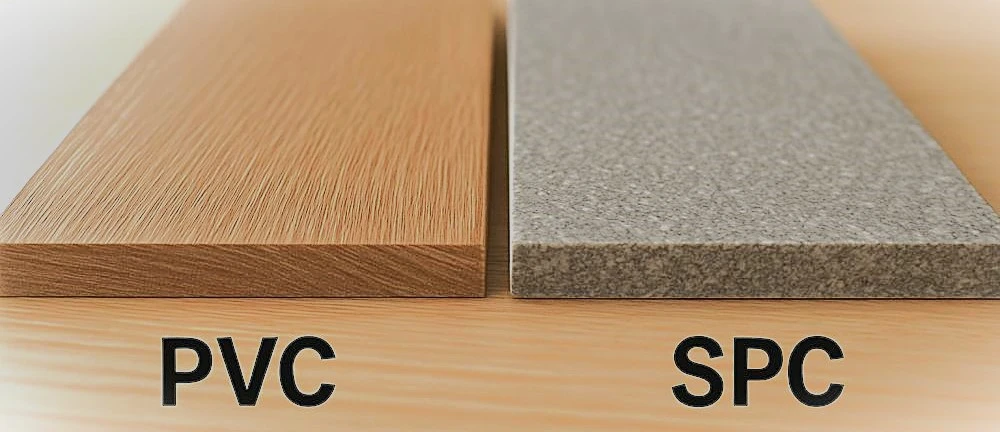
Flooring samples placed side by side. PVC on the left, WPC on the right. The differences that matter over a decade are not in the surface pattern but in the layers underneath.
On This Page
- I. The Core Decides Everything Else
- II. Water Eliminates Hardwood From Half the House
- III. Scratches, Dents, and the Decade They Take to Show
- IV. Click It Yourself, or Call the Installer
- V. The Hidden Maintenance Bill That Arrives at Year Five
SPC luxury vinyl, laminate, and traditional hardwood all sit on the same showroom floor and all promise a wood-look surface that transforms a room. At three meters, few can tell which is which. The differences that matter are underneath the pattern: the layers that determine what happens when a pipe leaks, a dog runs across the room, or a heavy piece of furniture sits in one place for five years.
This article compares the three across five dimensions: material composition as the root cause of all other differences, water resistance, durability across realistic timelines, installation complexity and cost, and the maintenance burden that accumulates after the floor has been down for years. No universal winner. Just a clearer picture of where each type wins so the choice matches the room and the life that will happen in it. For SPC flooring specifications across all wear layer grades and design collections, the rigid core vinyl flooring range includes technical data for every product line.
I. The Core Decides Everything Else
SPC flooring is built from the bottom up: a stone-plastic composite core of 60 to 75 percent calcium carbonate bound in a PVC matrix, a printed design film above it, and a transparent UV-cured wear layer on top. Laminate has a similar layered structure with one critical difference. The core is high-density fiberboard-wood fibers bonded with resin. HDF is stable but not waterproof. It swells at the edges when wet and does not recover. Traditional hardwood has no layers in this sense. Solid hardwood is one piece of milled wood, 18 to 20 millimeters thick, with the grain running through the entire thickness. The wood itself is the structure, the pattern, and the wear surface all in one.
The core material is the decision that makes all the other decisions. It determines water resistance, which determines which rooms the floor can enter. It determines impact response, humidity behavior, and thermal feel underfoot. Choosing a flooring type is choosing a core material first. The surface pattern is secondary, and it is the part all three types can imitate equally well.
SPC core = stone + polymer. Laminate core = wood fiber + resin. Hardwood = solid wood. Every comparison that follows-water, durability, installation, maintenance-traces back to this one difference in what sits beneath the surface.
II. Water Eliminates Hardwood From Half the House
The water resistance ranking is not close. SPC flooring is waterproof. The stone-polymer core does not absorb water, does not swell, and survives standing water for reasonable periods. A plumbing leak soaks the subfloor underneath but the flooring itself is undamaged. SPC goes into bathrooms, kitchens, laundry rooms, and basements-rooms where water is when, not if.
Laminate is water-resistant on the surface only. Spills wiped up quickly cause no damage. Water that penetrates the seams reaches the HDF core, which absorbs it, swells, and creates raised edges that cannot be repaired. Laminate manufacturers exclude water damage from warranties and specify dry, above-grade rooms only. Hardwood is the most vulnerable. It absorbs moisture from the air as well as from liquid water. Seasonal humidity opens and closes gaps between planks. A spill left for an hour leaves a permanent dark stain. A plumbing leak can destroy the floor entirely. Hardwood is not recommended for any room with plumbing, any room below grade, or any climate with large humidity swings.
The water question alone eliminates hardwood from kitchens, bathrooms, laundry rooms, basements, and entryways. That is roughly half the rooms in a typical home before the comparison even reaches durability or cost.
III. Scratches, Dents, and the Decade They Take to Show
Durability is two separate problems. Surface durability is the top layer's resistance to scratches and wear-through. Structural durability is the plank's resistance to dents, cracks, and joint failure. A floor can be excellent at one and poor at the other.
For surface durability, SPC with a 0.5-millimeter or thicker wear layer leads. The clear polymer layer resists scratching and does not wear through under normal residential traffic for 15 to 25 years. Laminate with an AC4 or AC5 overlay is comparable in scratch resistance but more vulnerable to edge chipping where the brittle melamine fractures under impact. Hardwood is the softest surface. It scratches from pet claws and furniture, and the scratches expose raw wood beneath the finish. The scratch on hardwood is visible from across the room. On SPC and laminate, a scratch that does not penetrate the wear layer is functionally invisible because there is no color change between surface and substrate.
For structural durability, the ranking shifts. SPC's stone-polymer core resists dents from dropped objects and heavy furniture better than laminate's HDF core or solid wood. A heavy appliance dropped on SPC may crack the wear layer but will not crater the plank. The same impact on hardwood leaves a permanent dent. Hardwood, however, has a durability advantage SPC and laminate lack: it is refinishable. A scratched hardwood floor can be sanded and refinished multiple times over a 50-year life. A worn SPC or laminate floor must be replaced plank by plank. The trade-off is refinishing costs versus replacement costs, and the timeline determines which is cheaper.

| Durability Factor | SPC Vinyl | Laminate | Hardwood |
|---|---|---|---|
| Scratch resistance | Excellent | Very Good | Moderate |
| Dent resistance | Excellent | Good | Moderate |
| Edge durability | Excellent | Moderate | Good |
| Wear layer life | 15–25 yrs | 10–20 yrs | 10–100+ yrs (refinishable) |
| Refinishable | No | No | Yes |
Hardwood's refinishability is its structural durability advantage. You sand it down and start over. SPC and laminate, once worn, are replaced.
IV. Click It Yourself, or Call the Installer
SPC and laminate share a click-lock floating installation system. Planks click together at the edges, forming a continuous surface not attached to the subfloor. No glue. No nails. No specialized tools beyond a utility knife, tapping block, and pull bar. A homeowner with basic DIY experience can install a room in a weekend. The subfloor must be flat and clean. The expansion gap at the perimeter must be maintained. Beyond those requirements, the installation is mechanically simple.
Traditional hardwood installation is a different category. Solid hardwood is nailed or stapled through the tongue into a wood subfloor, requiring a flooring nailer and the skill to use it without splitting the wood. Concrete subfloors require an additional plywood underlayment. Engineered hardwood can be floated, glued, or nailed depending on the product, which adds flexibility but also complexity. Professional installation is the standard method for hardwood, and the labor cost reflects it. A hardwood floor that costs the same as SPC per square foot in material will cost more per square foot installed, and that premium is part of the total project budget whether or not it was accounted for at the outset.
V. The Hidden Maintenance Bill That Arrives at Year Five
SPC flooring maintenance is close to zero. Sweep or vacuum to remove grit. Occasional damp mopping with a pH-neutral cleaner. No wax, no sealant, no refinishing schedule, no product that needs periodic application. A well-maintained SPC floor looks substantially the same in year ten as in year one.
Laminate maintenance is similar in daily routine but constrained by the material's water vulnerability. Laminate cannot be wet-mopped the way SPC can. Cleaning must be done with a damp-not wet-mop. The melamine wear layer, while hard, is brittle, and aggressive cleaning tools can create micro-scratches that dull the surface over time. Laminate cannot be refinished. A worn laminate floor is a replacement project.
Hardwood maintenance is the most demanding by a wide margin, and it is the cost most buyers underestimate at purchase. A polyurethane-finished hardwood floor requires re-coating every three to five years in high-traffic areas. Full sanding and refinishing is needed every ten to fifteen years-sooner with pets or children. The room is emptied, the floor sanded to bare wood, stain applied, and multiple coats of finish laid down with drying time between each. The room is unusable for days. Over a thirty-year ownership period, a hardwood floor will be refinished at least twice, and those costs equal or exceed the cost of installing a new SPC or laminate floor. For SPC flooring that eliminates this cycle entirely, the product specifications include wear layer data and expected service life per collection.
Quick Questions
Frequently Asked Questions About SPC vs Laminate vs Hardwood
Short answers to the most common flooring comparison questions.
Q1: Which adds the most resale value?
Hardwood commands the highest perceived resale value. SPC and laminate do not reduce home value but do not carry the same premium. For rental and commercial properties, SPC's durability often makes it the higher-value choice through lower maintenance costs.
Q2: Can you tell SPC from real wood by looking?
From standing height, high-quality SPC with registered embossing is hard to distinguish from hardwood. At close range, pattern repeats and seam depth give it away. The visual gap is smaller than the functional gap in water and scratch performance.
Q3: Is laminate ever the better choice?
Yes. For a dry, above-grade bedroom on a tight budget, entry-level laminate works. Laminate also accepts deeper surface embossing at lower cost. The trade-off is water vulnerability-if the room stays dry, it is defensible.
Q4: Does SPC feel colder underfoot than hardwood?
Yes. The stone-polymer core draws heat from bare feet faster than wood. Mitigate with a thermal underlayment, area rugs, or underfloor heating-which SPC conducts efficiently.
Q5: Which is best for homes with pets?
SPC. The wear layer resists claws. The waterproof core survives accidents. The dense core damps nail-click sounds. Hardwood scratches and stains from both.
SPC Flooring Built for Rooms Where Life Happens
Waterproof stone-polymer core. UV-cured wear layers. Wood and stone designs with registered embossed texture. Technical specifications for every product line.
The Floor That Matches the Room, Not the Brochure
SPC, laminate, and hardwood are not ranked better to worse. They are three materials with three different tolerance profiles, and the right choice matches the profile to the room. Hardwood belongs in a formal living room in a climate-controlled house where authenticity matters and the owner budgets for refinishing every decade. Laminate belongs in a dry bedroom where the budget is tight and water risk is near zero. SPC belongs in any room where water might appear, any room with pets or children, and any installation where the owner wants the floor to perform for twenty years without a maintenance schedule.
The common mistake is choosing by showroom appearance and discovering the limitations after installation. Hardwood in a kitchen is beautiful for a year and damaged for every year after. Laminate in a bathroom is cheap to install and expensive to replace when the toilet supply line leaks. SPC in a bedroom performs flawlessly and never quite feels as warm as wood under bare feet. Start with the room. Ask what it will face-water, traffic, claws, loads, temperature swings. Then pick the core material built for those conditions. The surface pattern can look like anything. The core decides whether it still looks good in year ten.
YUPSENI Team
23 years in PVC and SPC flooring manufacturing and supply chain. Rigid core vinyl flooring across residential, multi-family, and commercial grades. Full technical documentation and batch-traceable quality records for every product line. More about YUPSENI
© 2026 YUPSENI. All rights reserved. The information in this article is for general informational purposes only and does not constitute professional flooring specification or procurement advice. Product performance varies by manufacturer, product grade, installation quality, and service conditions. Always request current technical datasheets and warranty documentation for the specific product under consideration.


