

SPC Flooring Underlayment Guide: Cork vs Foam vs Rubber — Acoustic Ratings, Moisture & Installation | YUPSENI
Jun 23, 2026
SPC Underlayment: The Layer Nobody Sees, the One That Decides Whether the Floor Sounds Cheap
~10 min read · June 23, 2026 · By YUPSENI Team
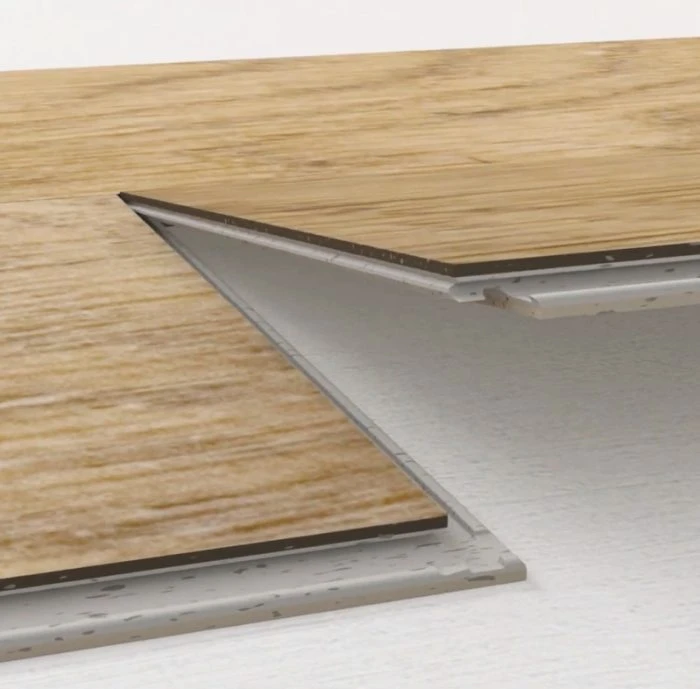
The underlayment sits between the subfloor and the SPC plank. It is never seen after installation. It is heard every time someone walks across the room. Its absence is louder than its presence.
SPC flooring buyers spend hours comparing wear layer thicknesses, plank dimensions, and wood-grain patterns. They open six sample boxes side by side on the living room floor and squint at the embossing registration under a phone flashlight.
Then they ask the installer to use whatever underlayment is cheapest.
This is not a rational sequence. The underlayment is the layer that determines whether an SPC floor sounds solid or hollow underfoot. It controls impact noise transmission to the room below, damps the click-clack of heels and dropped objects, and in basements and ground-floor installations it is the last line of defense between the subfloor moisture and the locking system. A plank with a 28-mil wear layer on the wrong underlayment performs worse acoustically than a 12-mil plank on the right one. Yet the underlayment is typically the least-researched line item in the entire flooring budget. This article covers the seven decisions that determine whether that thin, unseen layer does its job for the life of the floor. For SPC flooring specifications across wear layer grades and attached-pad options, the rigid core vinyl flooring range includes acoustic data for every product line.
On This Page
- I. The Underlayment Has Three Jobs, and Cushioning Is Not One of Them
- II. Cork, Foam, Rubber, Felt: Four Materials, Four Different Floors
- III. IIC and STC: The Two Numbers Your Downstairs Neighbor Already Knows
- IV. Underfloor Heating: When the Underlayment Becomes a Thermal Gatekeeper
- V. The Millimeter That Breaks the Budget: Thickness vs Door Clearance
- VI. Attached Pad vs Separate Underlayment: A Debate Nobody Warned You About
- VII. Concrete, Wood, and Basements: The Subfloor Decides the Spec
I. The Underlayment Has Three Jobs, and Cushioning Is Not One of Them
Most people think of underlayment as padding. They imagine it makes the floor softer. That expectation is wrong and it leads to the wrong purchase. SPC flooring is rigid by design. Its dimensional stability comes from the stone-plastic composite core. The underlayment does not soften the floor in any meaningful way. It has three real jobs, and none of them involve making a rigid plank feel like carpet.
Job one: acoustic decoupling. When a shoe strikes an SPC plank, the impact generates a sound wave that travels through the rigid core into the subfloor and, if there is a room below, into that room's ceiling cavity. The underlayment sits between the plank and the subfloor as a vibration isolator. It absorbs the energy before it reaches the structural floor. Without this layer, an SPC floor on a wood-framed upper story transmits footfall noise to the room below at levels that routinely generate complaints in multi-family buildings.
Job two: minor subfloor correction. SPC click-lock systems require a flat subfloor. The industry standard is within 3 millimeters of variation over a 3-meter span. The underlayment does not level a subfloor that is out of spec, and anyone who tells you otherwise is selling you a future seam failure. What it does is bridge the micro-texture of the subfloor surface: the sand-grain roughness of a concrete slab, the slight grain raise on an OSB panel, the residual trowel marks from a self-leveler.
Job three: moisture management. Concrete subfloors emit water vapor. The rate is measured in pounds per thousand square feet per 24 hours, and anything above 3 pounds requires a vapor barrier. Many underlayments integrate a moisture barrier film. Some do not. Installing an SPC floor on a concrete slab with no vapor barrier and no moisture-rated underlayment puts the locking system at risk of alkaline degradation from migrating moisture and dissolved salts.
The underlayment is not padding. It is an acoustic decoupler, a micro-texture bridge, and a moisture gate. Buy it for the wrong reason and you will buy the wrong product for all three jobs simultaneously.
II. Cork, Foam, Rubber, Felt: Four Materials, Four Different Floors
The underlayment aisle offers four material families. Each solves a different subset of the three jobs described above. Picking the wrong one is not a performance compromise. It is a specification error that produces a predictable failure.
Cork. Natural, compressed granulated cork bound with suberin, its own resin. Cork is the best acoustic performer in the category for impact sound reduction, and it has the advantage of not compressing over time the way foam does. It resists mold and mildew naturally. The limitation is moisture. Cork absorbs water if exposed to it repeatedly, and it is not suitable for below-grade installations unless paired with a separate vapor barrier underneath. Cork also costs more per square foot than foam. For an upper-floor SPC installation in a multi-family building where footfall noise is the primary concern, cork is the reference standard.
Cross-linked polyethylene foam. The most common SPC underlayment material by volume. It is inexpensive, lightweight, and easy to cut. Closed-cell foam does not absorb water, which makes it suitable for basements and ground-floor concrete. The performance variable is density. Low-density foam at 2 to 3 pounds per cubic foot compresses under the weight of furniture over several years, reducing its acoustic performance to near zero under heavy static loads. High-density foam at 5 to 6 pounds per cubic foot resists compression. The problem is that density is rarely printed on the packaging, and the buyer who chooses by price alone reliably ends up with the low-density product.
Rubber. Recycled or virgin rubber underlayment is the heaviest and most durable option. It delivers impact sound reduction comparable to cork, does not compress over time, and handles moisture without degradation. The trade-off is weight, cost, and a faint odor that off-gasses for the first few weeks after installation. Rubber underlayment is overkill for a bedroom and exactly right for a commercial SPC installation where foot traffic is heavy and acoustic performance must hold for a decade without degradation.
Felt. Recycled fiber felt is a niche product that sits between cork and foam in price and performance. It dampens sound well, does not compress significantly, and provides decent thermal insulation. Its limitation is moisture sensitivity. Felt absorbs water and must be protected with a vapor barrier film on the underside in any installation over concrete. It is most commonly specified in residential upper-floor installations where the buyer wants better acoustics than foam but does not want to pay for cork.
The short decision matrix: cork for the best acoustics on upper floors, high-density foam for basements and concrete, rubber for commercial and heavy-traffic residential, felt as a mid-range bridge between foam and cork. The one rule that overrides all four: always confirm that the underlayment manufacturer's data sheet lists a compression resistance value, and always reject any product that does not publish one.

III. IIC and STC: The Two Numbers Your Downstairs Neighbor Already Knows
Impact Insulation Class and Sound Transmission Class are the two acoustic ratings that appear on underlayment packaging. They measure different things, and confusing them leads to the wrong product for the wrong complaint.
IIC measures impact sound. Footsteps. Dropped objects. Furniture being moved. A chair scraping across the floor. It is measured in the room below the floor assembly, with a standardized tapping machine striking the floor above. The higher the IIC number, the less impact noise transmits downward. Building codes for multi-family construction typically require an IIC of 50 or higher. An SPC floor on a concrete slab with no underlayment might achieve IIC 35 to 40. Adding a high-quality underlayment can push that to IIC 55 to 60. The underlayment is doing the heavy lifting for IIC because the rigid SPC core transmits impact energy efficiently.
STC measures airborne sound. Voices. Television. Music. It is measured across the entire floor-ceiling assembly, and the underlayment contributes to it, but the primary STC determinants are the mass of the subfloor and the design of the ceiling below. An underlayment alone cannot meaningfully improve STC if the floor assembly is lightweight. A concrete slab with an air gap below it has high STC by default. A wood-framed floor with a single layer of gypsum on the ceiling below needs help from every layer, including the underlayment, and still may not meet code for multi-family STC.
The practical rule: for above-grade residential SPC installations, prioritize IIC. The complaint from the unit below will be about footsteps, not about conversation. For commercial SPC installations in open-plan offices, STC matters more because airborne noise from adjacent spaces is the primary distraction. Buy the underlayment that addresses the actual noise problem in the actual building, not the one with the highest combined number on the package.
| Material | Typical IIC Addition | Compression Resistance | Moisture Safe (Concrete) | Best Application |
|---|---|---|---|---|
| Cork | 18–22 pts | Excellent | With vapor barrier | Upper-floor residential |
| High-density foam | 12–16 pts | Good | Yes | Basement, concrete slab |
| Low-density foam | 8–12 pts initially | Poor | Yes | Budget; short-term only |
| Rubber | 16–20 pts | Excellent | Yes | Commercial, heavy traffic |
| Felt | 14–18 pts | Good | With vapor barrier | Upper-floor residential |
IIC values are additive to the floor assembly baseline. A concrete slab might start at IIC 30 and a cork underlayment brings it to IIC 50–52. The same underlayment on a wood subfloor starts from a lower baseline.
IV. Underfloor Heating: When the Underlayment Becomes a Thermal Gatekeeper
SPC flooring is one of the best floor coverings for underfloor heating. The stone-polymer core conducts heat efficiently and does not insulate the heating system from the room above the way thick carpet or hardwood does. The underlayment is the potential bottleneck.
Every underlayment material has a thermal resistance value, expressed as R-value or tog rating. The heating system produces a given wattage per square meter. The underlayment sits between the heating element and the room, blocking some fraction of that wattage from ever reaching the floor surface. The thicker and denser the underlayment, the higher the thermal resistance, and the longer the system takes to warm the room to the thermostat setpoint. In a worst-case scenario, a thick cork underlayment combined with a low-output electric heating mat results in a floor that never quite reaches the target temperature.
The industry guideline is that the combined thermal resistance of the underlayment and the SPC plank should not exceed 0.15 square-meter Kelvin per watt. Most SPC planks contribute approximately 0.05 to 0.07. That leaves about 0.08 to 0.10 for the underlayment. A 2-millimeter high-density foam underlayment fits within that window. A 6-millimeter cork underlayment may not. The underlayment manufacturer's data sheet must list the R-value or tog rating. If it does not, assume the product is not rated for underfloor heating and choose one that is.
The underfloor heating checklist: the underlayment must list an R-value below 0.10 m²K/W, must be rated by the manufacturer for the specific type of heating system (electric mat or hydronic), and must not contain a separate vapor barrier film that could trap heat and cause the heating element to overheat in a localized failure scenario.
V. The Millimeter That Breaks the Budget: Thickness vs Door Clearance
SPC underlayment typically ranges from 1 millimeter to 6 millimeters thick. The difference between 1 millimeter and 3 millimeters is acoustically significant. The difference between 3 millimeters and 6 millimeters can be mechanically catastrophic.
The problem is door clearance. A standard interior door in a residential building is hung with a gap of 12 to 18 millimeters between the bottom of the door and the finished floor. The SPC plank itself is 4 to 6.5 millimeters thick. Add a 6-millimeter underlayment, and the combined installed height is 10 to 12.5 millimeters. The door clears on paper. Then the floor settles. The underlayment compresses slightly under the plank weight. The door swings over a high spot in the subfloor. Suddenly the door drags.
The fix is trimming the door. A carpenter with a track saw can remove 3 to 5 millimeters from the bottom of every door in the house, but that cost was not in the budget submitted to the client. The safer approach is to measure all door clearances before selecting underlayment thickness and to add a 3-millimeter safety margin to the installed height calculation. In rooms with floor-mounted door stops, undercut the stop to accommodate the combined floor height rather than notching the underlayment around it.

The difference between a door that swings freely and one that drags is often 2 millimeters. Measure every door in the house before selecting underlayment thickness. The door that clears in the hallway may not clear in the bedroom where the subfloor is slightly higher.
VI. Attached Pad vs Separate Underlayment: A Debate Nobody Warned You About
Many SPC products now ship with a factory-attached acoustic pad laminated to the underside of the plank. It is typically 1 millimeter to 2 millimeters of cross-linked polyethylene foam. It adds acoustic performance without requiring the installer to roll out a separate underlayment, which saves labor and eliminates the risk of the installer choosing the wrong product.
The question that follows is whether an attached-pad SPC plank also needs a separate underlayment.
The answer depends on the subfloor and the acoustic requirement. On a wood subfloor in a single-family home, the attached pad is often sufficient. The IIC gain from the pad is modest but adequate when there is no occupied room below. On a concrete subfloor, the attached pad does not function as a vapor barrier, and a separate moisture-rated underlayment is still required underneath it. In a multi-family building with a code-mandated IIC minimum, the attached pad alone almost never meets the requirement. The assembly needs the pad plus a separate acoustic underlayment, and the combined thickness must still clear the doors.
The other factor that gets less attention is the pad's compression resistance. An attached pad is thin by necessity. A thin foam pad under a heavy static load, such as a kitchen island or a large sofa, can compress to near-zero thickness over five years. A separate underlayment with a published compression resistance value gives the buyer a documented number to evaluate. An attached pad rarely publishes that number. The trade-off is convenience versus documented long-term acoustic retention. For the SPC product specifications including attached-pad acoustic data, check the technical datasheet for each collection.
The decision logic for attached-pad SPC: single-family wood subfloor, no occupied room below = attached pad alone is sufficient. Concrete subfloor = always add a separate vapor-barrier underlayment. Multi-family = always add a separate acoustic underlayment with a published IIC value unless the building's floor-ceiling assembly already meets code without it.
VII. Concrete, Wood, and Basements: The Subfloor Decides the Spec
The subfloor is the variable that overrides every other underlayment decision. A cork underlayment that is the reference standard on a second-floor wood subfloor is the wrong product on a basement concrete slab. The underlayment selection sequence should start with the subfloor type and work upward from there.
Concrete slab, above grade. Moisture emission is the first check. Test the slab with a calcium chloride kit or an in-situ relative humidity probe. If the emission rate is below 3 pounds per thousand square feet per 24 hours, a high-density foam underlayment with an integrated vapor barrier is the standard specification. If the emission rate is above 3 pounds, treat the slab with a surface-applied moisture mitigation system before installing any flooring. No underlayment product fixes a wet slab.
Concrete slab, below grade. Basement concrete emits moisture at higher rates than above-grade slabs because the slab is in contact with the ground on the underside and the temperature differential between the cool slab and the warmer basement air drives condensation. The underlayment must include a vapor barrier rated for below-grade use, and the perimeter must be taped and sealed. High-density foam is the preferred material. Cork and felt are not suitable.
Wood subfloor, above grade. Moisture is less of a concern, but flatness is not. Wood subfloors have seams, fastener heads, and deflection between joists. The underlayment must bridge the micro-texture and prevent the SPC click-lock system from flexing at plank edges over subfloor seams. Cork and felt are both suitable. High-density foam works if the subfloor is flat and smooth. Rubber is excessive for most residential applications on a wood subfloor unless the room below is occupied and acoustically sensitive.

Quick Questions
Frequently Asked Questions About SPC Underlayment
Answers to the six questions installers, homeowners, and project managers ask most often when specifying underlayment for SPC flooring.
Q1: Can I install SPC flooring with no underlayment at all?
A: You can, but you should not on any subfloor where footfall noise or moisture matters. On a concrete slab above grade with a confirmed low moisture emission rate, a very flat surface, and no occupied room below, SPC can technically be installed directly on the slab. The floor will be louder, every dropped object will transmit impact noise more sharply, and any subfloor roughness will telegraph through the planks over time. The cost of underlayment is roughly 3 to 5 percent of the total flooring budget. Omitting it to save that amount is a decision most installers regret within the first week of occupancy.
Q2: What is the best underlayment for SPC on a basement concrete floor?
A: High-density cross-linked polyethylene foam with an integrated vapor barrier film. The foam must have a compression resistance value on the data sheet, and the vapor barrier must be rated for below-grade use. The seams must be taped. Cork and felt are not recommended for below-grade concrete because they absorb moisture. Rubber works but is unnecessarily expensive for most residential basements.
Q3: How do I know if my underlayment has enough compression resistance?
A: The manufacturer's data sheet should list a value. For foam, look for density above 5 pounds per cubic foot or a compression set below 10 percent after 24 hours under load. For cork, compression resistance is inherent in the material but confirm the thickness will not reduce by more than 0.5 millimeters under the rated static load. If the data sheet does not publish a compression value, ask the manufacturer for it directly. If they cannot provide one, treat the product as suitable for light residential use only and expect acoustic performance to degrade over five to seven years under heavy furniture.
Q4: Does thicker underlayment always mean better soundproofing?
A: No. Thickness and acoustic performance are not linearly related. A 3-millimeter high-density foam with a published IIC gain of 16 points outperforms a 6-millimeter low-density foam that compresses to 1 millimeter under load. The material's density and compression resistance determine acoustic retention over time. Thickness primarily affects door clearance and transition height. Buy for density and published acoustic data, not for thickness.
Q5: Can I use the same underlayment for SPC that I would use for laminate?
A: Usually yes, but confirm three things on the manufacturer's data sheet. The product must be rated for rigid core vinyl or SPC specifically, not just laminate. The compression resistance must be adequate for the heavier SPC plank weight versus laminate. And if the installation is over concrete, the vapor barrier specification must match the subfloor moisture conditions. Some laminate underlayments lack an integrated vapor barrier because laminate installations over concrete are rare due to the material's water sensitivity.
Q6: Does SPC with an attached pad need a vapor barrier on concrete?
A: Yes. The attached pad on an SPC plank is an acoustic layer, not a moisture barrier. It does not seal at the seams, and water vapor passes through the gaps between planks. Installations over concrete always require a separate underlayment with an integrated vapor barrier underneath the SPC planks, regardless of whether the planks have an attached pad. The vapor barrier must be continuous, with seams taped and the perimeter sealed.
SPC Flooring With Documented Acoustic Performance
Rigid core vinyl planks with attached-pad options, published IIC and STC assembly data, and full technical specifications. Request samples and acoustic test reports for your project.
The Layer That Earns Its Cost in the First Week
The underlayment is three to five percent of the flooring budget and roughly one hundred percent of the acoustic experience after installation. Nobody walks into a room and says the underlayment looks beautiful. But everyone notices within the first day whether the floor sounds solid or hollow, whether footsteps echo or dampen, whether the room below is livable or unlivable after the flooring goes in.
The seven decisions covered here reduce to a short checklist: identify the subfloor type first, measure moisture emission on concrete, select the material that matches the acoustic and moisture requirements of that specific subfloor, confirm the compression resistance on the data sheet, verify the R-value if underfloor heating is present, measure every door clearance before choosing thickness, and add a separate vapor-barrier underlayment on concrete regardless of whether the SPC plank has an attached pad. Follow that sequence and the underlayment will still be doing its job when the wear layer above it finally shows its age.
Skip the sequence and the floor will tell you what you missed. It will tell you within the first week.
YUPSENI Team
23 years in SPC and PVC flooring manufacturing and supply chain. Rigid core vinyl planks with documented wear layer, acoustic, and dimensional stability specifications across residential, multi-family, and commercial product lines. Technical datasheets include IIC and STC assembly test results for every collection. More about YUPSENI
Disclaimer: This article provides general guidance on underlayment selection for SPC flooring. Acoustic performance, moisture conditions, and code requirements vary by building type, jurisdiction, and specific product specifications. Always consult the underlayment manufacturer's written installation instructions and the project's structural engineer or acoustical consultant for multi-family and commercial applications. Performance values cited are typical ranges from published manufacturer data and may not apply to all products within a material category.


