Real Estate Sign Posts: The Complete Guide to the Only Marketing Tool That Works 24 Hours a Day
Aug 02, 2026
Real Estate Sign Posts: The Complete Guide to the Only Marketing Tool That Works 24 Hours a Day
Read time: 9 minutes | By: YUPSENI Team
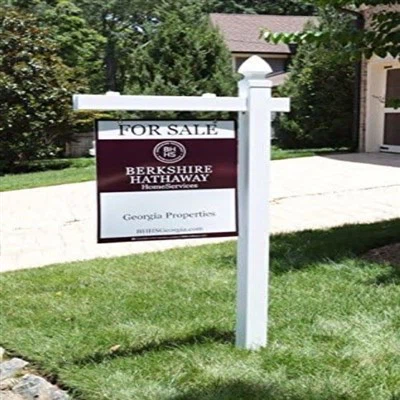
A complete vinyl sign post system: post, arm, stake, stainless hardware, cap, and optional solar lighting-every component engineered for one job that runs unattended for years.
On This Page
- I. The Only Advertisement That Works While You Sleep
- II. Why Vinyl Is the Only Material Without a Built-In Expiration Date
- III. Anatomy of a Sign Post: Six Parts, One Job
- IV. The Hammer-Only Installation Hiding Engineering in Plain Sight
- V. Customisation: When Your Logo Sets the Specification
- VI. Solar LED: The Second Shift Nobody Prices
- VII. The Order Sheet: Six Questions Before You Buy
A real estate sign post is a marketing device that runs itself. It needs no electricity, no wifi, no campaign manager, no content calendar. It stands in front of a listed property and broadcasts the same message to every passerby, every hour, every day, in weather that would stop a tradesman from working. For the price of a modest dinner, it delivers thousands of impressions over the life of a listing-and then it moves to the next property and does it again.
That is the theory. The practice is uglier. Most yard sign posts fail the job within a few seasons-the wood post rots below the ground line and leans, the metal hardware rusts and stains the sign face, the arm droops and the sign sags, the paint peels and the whole assembly tells every driver that this agent does not take care of details. This guide covers the complete system: the materials, the six components, the installation, the customisation options, and the buying decisions that separate a sign post that lasts ten years from one that lasts ten months. The full product range-four styles, three cap options, custom arm lengths-is on the real estate sign posts product page.
I. The Only Advertisement That Works While You Sleep
Do the arithmetic on a corner lot. A sign post in front of a busy street sees thousands of vehicles per day. Over a 90-day listing, that is hundreds of thousands of exposures-not to a targetable audience, but to a geographically perfect one. Every driver who passes is, or knows, someone who might buy or sell in that neighbourhood. Digital ads can target by location too, but they cannot stand in front of the property and speak to the neighbours who see the listing activity every day. The yard sign reaches the people the digital campaign cannot: the ones who were not searching, but who are driving past.
The economics compound when the post survives multiple listings. A quality vinyl post is not a consumable-it is capital equipment with a service life measured in years and a cost per impression that approaches zero by the third listing. The disposable post, replaced or repaired every season, costs more in aggregate and produces worse impressions, because a leaning, faded, rusty sign post does not advertise the property. It advertises the agent's standards.
The conclusion is uncomfortable for anyone who buys sign posts by price alone: the cheapest post is the most expensive marketing decision a broker makes, because it is the one piece of equipment that visibly represents them every single day.
II. Why Vinyl Is the Only Material Without a Built-In Expiration Date
Every material used for sign posts has a failure mode that is written into its chemistry. Wood absorbs water; water feeds fungi; fungi break down cellulose; the post rots. Metal reacts with oxygen and moisture; the reaction products are called rust; rust weakens the section and stains the surface. Paint and powder coating are sacrificial layers that postpone these failures without preventing them, because the failure begins beneath the coating.
Vinyl-specifically the UV-stabilised PVC used in premium sign posts-has none of these mechanisms. It does not absorb water, so nothing rots. It contains no iron, so nothing rusts. Its colour is compounded into the material during extrusion rather than painted on, so there is no coating to peel, blister, or fade to a different shade. The list of properties that a quality vinyl post will not do is the entire list of ways that wood and metal posts die:
No peeling
Colour is in the material
No denting
Rigid profile holds its shape
No rotting
Nothing for fungi to consume
No blistering
No coating to lift off
No warping
Stable through temperature swings
No cracking
Flexes instead of splitting
No insect damage
Nothing edible inside the material
None of these properties are marketing claims invented for the product page. They are consequences of material chemistry. A fungus needs food and water; PVC offers neither. An insect needs cellulose; PVC has none. Ultraviolet radiation degrades unprotected polymers, which is why premium vinyl is compounded with UV stabilisers at the extrusion stage-the protection is inside the material, not on its surface, so it cannot wear off. For the deeper material science, our wood trim failure guide explains the same mechanism across the trim and moulding product family.
III. Anatomy of a Sign Post: Six Parts, One Job
A sign post is not a single piece of material. It is a small system of six components, each with a specific engineering role. When a sign post fails, it fails at a component boundary-the stake slipping, the hardware corroding, the arm flexing-so the quality of each part determines the life of the whole.
The Stake
The buried anchor. Standard specification: galvanised steel, driven with a hammer, sized to hold the post square against wind load. The stake is the only load-bearing connection to the ground-everything above it depends on this part.
The Post
Standard: 4"x4"x72" rigid vinyl. Hollow construction slides over the stake, so the post is supported along its full buried-to-ground length rather than resting on a point. The 4-inch section resists bending without the weight of a solid timber post.
The Arm
The horizontal member that carries the sign. Two standard lengths: 2"x3.5"x36" for standard signs, 2"x3.5"x47" for wider or double-sided signs. Custom lengths available to match logo width exactly so the sign hangs centred.
The Hardware
Two eye bolts thread into the arm at sign-centring positions; two S-hooks pass through the sign holes and into the eye bolts. Specified in stainless steel-anti-rust-because this is the only metal exposed to rain and coastal salt.
The Cap
Seals the top of the hollow post so water cannot enter and pool inside. Three styles: England, Gothic, and Flat. The cap also finishes the visual profile-the detail that makes the post look like a product rather than a pole.
The Light (Optional)
A solar LED post light with an adjustable sign-mounting bracket. Charges by day, auto-on at dusk, auto-off at dawn. Effectively doubles the hours the sign can be seen-covered in depth in Section VI.
The design logic connecting these six parts is consistent: every component is replaceable, every component is accessible without special tools, and every component is specified so that the system fails gracefully-or not at all-rather than collapsing as a unit. The sign itself is the only consumable. The post system is the permanent asset.
IV. The Hammer-Only Installation Hiding Engineering in Plain Sight
The installation sequence is deliberately short: drive the stake, slide the post over it, thread the eye bolts, hang the sign. No digging. No concrete. No curing time. No post hole auger in the boot of the car. The sign is up minutes after the installer arrives-which matters when the listing agent needs the property signed the same day the listing goes live.
The simplicity is the engineering. The stake has a point designed to penetrate soil cleanly when struck, so the hammer blow goes into driving depth rather than bending the shaft. The post is sized to slide over the stake with a tolerance that holds it square without rattling. The fit between stake and post is a deliberately engineered clearance-too tight and the post binds during installation, too loose and the post rocks in wind. The person installing the post never thinks about any of this, which is exactly the point.
Installation sequence, in the order that works
1. Drive the stake: Hammer the stake into the ground, keeping it level as it is driven. Correct any lean before the stake is fully seated-it cannot be straightened afterwards.
2. Slide the post over the stake: The post seats over the driven stake. No further fixing required-the stake holds it.
3. Thread the eye bolts: Two eye bolts go into the two arm locations that best centre your sign.
4. Hang the sign: Thread the S-hooks into the holes on your sign, then into the eye bolts. The sign hangs free and lifts off easily for the next listing.
Two soil conditions deserve a note. On hard, compacted, or rocky ground, wet the soil first or pre-drive a pilot hole with a steel bar to protect the stake tip. On soft or sandy soil, where the stake holds less firmly, a longer stake provides the extra depth needed to resist wind leverage. Installers who work a consistent territory will learn which of these applies to their soil type and will adjust in advance rather than after the first windy week.
V. Customisation: When Your Logo Sets the Specification
The standard system-4"x4"x72" post with a 36-inch arm-fits the standard corrugated yard sign. Real listings are rarely standard. A brokerage with a wide double-sided sign needs the 47-inch arm. A property on a wide setback needs a taller post so the sign clears sight lines. A sign with an unusually shaped logo needs the eye bolt positions adjusted so the sign hangs balanced rather than drooping on one side. Every one of these variables is adjustable at the factory, and the specification starts with the logo.
The customisation menu has four levels. Post height and arm length-the dimensions that determine whether the sign sits at the right height and hangs flat. Post style-four profiles available, each with a different visual character suited to different neighbourhood aesthetics. Cap style-England, Gothic, or Flat, which finishes the top of the post and contributes more to the overall look than most buyers expect. And the hardware positions-the eye bolt locations along the arm, which are set to centre the sign perfectly. The rule for ordering: measure the sign first. Width, height, and the distance between its mounting holes. Everything else in the specification follows from those three numbers.
Standard specifications at a glance
Post: 4"x4"x72" • Arm: 2"x3.5"x36" or 2"x3.5"x47" • Caps: England / Gothic / Flat • Styles: 4 • All sizes customisable
One customisation trap to avoid: a post made taller than necessary. A taller post increases the leverage applied to the stake in wind and raises the sign into sight lines where it may be blocked by landscaping. The correct height is the minimum that clears the obstruction. The correct arm length is the minimum that centres the sign without overhang. Buyers who specify to the minimum get a system that is stronger, cheaper, and less likely to require a service call after a storm.
VI. Solar LED: The Second Shift Nobody Prices
The hours between dusk and the last evening commute are prime sign-viewing time, and they are invisible to an unlit sign. A solar LED post light extends the sign's useful day by roughly half, and it does so with zero wiring, zero electrician, and zero recurring power cost. The math is straightforward: a sign visible for 12 hours a day works twice as hard as one visible for 8.
The operating behaviour is fully automatic. The solar cell charges through daylight hours. At dusk the light switches on; at dawn it switches off. There is no timer to set, no switch to remember, no battery to replace seasonally in normal service. The adjustable sign-mounting bracket aims the beam at the sign face rather than scattering light into the yard-the difference between a lit sign and a lit lawn. The weather-resistant housing keeps the electronics dry through rain and snow, and the same post-and-light assembly travels between properties with the sign itself.
For property managers running multiple listings, the solar light changes the cost model of the whole system. A portfolio of lit signs creates evening impressions that a dark sign simply cannot produce, and because the hardware is reusable across listings, the per-listing cost of the light approaches zero by the second use. The light is the option that pays for itself the fastest.
VII. The Order Sheet: Six Questions Before You Buy
Before the first inquiry goes out, the buyer who answers these six questions will get a quote that fits the job on the first pass:
1. Sign dimensions: Width, height, and mounting-hole spacing of the sign that will hang on the arm. These determine arm length and eye bolt position.
2. Post height requirement: The minimum height that clears sight lines at the typical installation site. Specify the minimum, not a round number.
3. Cap style: England, Gothic, or Flat. Match the visual character of the neighbourhoods where the posts will be placed.
4. Post style: One of the four available profiles. The style is a branding decision as much as a structural one.
5. Hardware specification: Confirm stainless steel-anti-rust-eye bolts and S-hooks. In coastal areas, this is not optional.
6. Lighting: Solar LED with adjustable bracket, or unlit? For corner lots and high-traffic streets, the light pays for itself in one listing.
The answers to these six questions convert a catalogue item into a specification. Buyers who order the standard system for a non-standard sign, or who skip the stainless hardware to save a dollar per post, are optimising the wrong number. The sign post product page lists the four styles and three caps with the standard dimensions; custom configurations are quoted on the same basis as the standard ones, with the same delivery window. For volume buyers-brokerages, sign companies, property management firms running dozens of listings-consolidated pricing and mixed-configuration containers are available. Contact our sales team with your sign measurements and quantities for a configured quote. Free samples for qualified buyers.
Frequently Asked Questions
Frequently Asked Questions About Real Estate Sign Posts
Common questions from real estate brokers, sign companies, and property managers about yard sign post systems.
Q1: How long does a vinyl sign post last outdoors?
A: The vinyl post and arm are specified for 10 years or more of outdoor service. The material does not rot, rust, warp, or fade because its colour and UV protection are compounded into the material rather than applied to its surface. The components most likely to need attention over that period are the metal parts-which is why the hardware is specified in stainless steel-and the solar light battery, which is the only component with a defined service life.
Q2: Can I move a sign post between properties, or is it permanent?
A: Fully reusable. The post lifts off the stake, and the stake can be worked free of the soil with a rocking motion or a pry bar. The sign lifts off the S-hooks. The whole system moves to the next listing in minutes. The stainless hardware and vinyl material are unaffected by repeated installation and removal cycles, which is the design intent-this is a reusable marketing asset, not a one-listing consumable.
Q3: Does the solar light work in winter or on cloudy days?
A: Yes. The solar cell charges on whatever daylight is available-even overcast winter days produce enough charge for a shorter evening cycle. On consistently low-light periods, the light still switches on at dusk but may run for fewer hours. The weather-resistant housing is rated for rain and snow, and the auto-on/auto-off behaviour requires no seasonal adjustment.
Q4: What is the minimum order quantity for custom configurations?
A: Custom arm lengths and eye bolt positions can be produced on standard production runs without a minimum quantity penalty in most configurations. For fully custom post heights or non-standard profiles, the MOQ is typically one container, which suits brokerages and sign companies ordering seasonally. Trial orders and sample configurations are available for qualified buyers. Contact our sales team with your configuration and volume for a precise quote.
Q5: Can the sign itself be supplied with the post?
A: The post system is supplied as the hardware-post, arm, stake, caps, eye bolts, and S-hooks-and the sign face is printed separately to your artwork. We can advise on corrugated plastic sheet sourcing and sign printing specifications that match the standard hanging hardware, but most buyers already have a sign supplier for the printed face. The two parts of the system-the printed sign and the permanent post-are designed to be sourced separately.
One Post System. Ten Listings. Zero Maintenance.
Four styles, three caps, custom arm lengths, stainless hardware, optional solar LED. Hammer-in installation with no digging and no concrete. Free samples for qualified buyers.
View Sign Post RangeYUPSENI Team
23 years in PVC building material manufacturing and supply chain. We help real estate professionals, sign companies, and distributors source yard sign systems that stay straight and stay presentable through every season. More about YUPSENI
© 2026 YUPSENI. All rights reserved. Product specifications may vary by production batch and configuration. Always request current datasheets and physical samples before making procurement decisions.