I. What the Material Actually Is
Before anyone can evaluate whether a given PVC railing will hold up, it helps to know what the material actually is - because the word "plastic" carries baggage that this generation of products has largely shed. Contemporary PVC railing starts with rigid PVC resin, the chemical designation uPVC - unplasticized polyvinyl chloride, to separate it from the flexible PVC used in plumbing and wire jacketing. Into that resin, the formulation compounder adds impact modifiers that absorb shock energy without cracking, thermal stabilizers that protect the polymer chain during high-temperature extrusion and later during sun exposure, UV stabilizers - a combination of titanium dioxide opacifier, organic UV absorber, and hindered amine light stabilizer - and pigments dispersed into the melt. This compound exits an extruder through a profile die at roughly 180 to 200 degrees Celsius, emerging as a continuous hollow or multi-chamber structural shape that gets cooled, calibrated, and cut to length.
The products that earn the label "premium" take one further step: they embed an aluminum square tube inside the PVC profile - either as a continuous full-length core running from post base to post cap, or as a reinforcing channel inside the top handrail. This composite structure splits the duties: the aluminum carries bending moments and lateral loads, while the PVC shell handles weather exposure and provides the aesthetic surface. Neither material, alone, could deliver both functions. Together, they produce a railing that outperforms wood and iron on maintenance while matching them on structural rigidity.
The practical implication for a buyer is straightforward. When you encounter a PVC railing product, the first question to ask is not "how much does it cost per linear foot" but "show me the cross-section." A cut-off piece of the actual production profile reveals more about the product's engineering in five seconds than a brochure reveals in fifty pages. You can see whether the wall thickness is uniform. You can see whether an aluminum core exists and how thick its own walls are. You can see whether the internal chambers are cleanly formed or riddled with voids from a rushed extrusion line. A supplier who cannot or will not provide a cross-section sample is, by that refusal alone, telling you something about the product. YUPSENI ships cross-section samples with specification sheets for every railing profile in the catalog.
Compared to wood, PVC railing does not rot, does not attract insects, and never needs a paintbrush. Compared to iron, it does not conduct galvanic corrosion currents, and a scratch across its surface does not expose raw metal waiting to oxidize. The color is part of the material itself - not a coating that can peel. But every one of these advantages depends on the formulation and structure being well-executed in the first place. A poorly formulated PVC railing will still disappoint; it will just disappoint through different failure modes than wood or iron.
II. Where Wobble Really Comes From - And the Four Places to Check Before You Buy
A railing that trembles under hand pressure is often more unsettling than one that has visibly cracked. The mind registers the vibration as a structural warning before the eye can locate any damage. And the thing about wobble is that the material is almost never the root cause. A PVC post, even without internal reinforcement, has enough inherent stiffness at short spans to resist casual hand pressure. The wobble enters through four specific decisions - all of them measurable, all of them verifiable before a single component leaves the warehouse.
The first lives in wall thickness. PVC railing profiles in the quality tier carry walls roughly between a millimeter and a half and two and a third. Products that dip below that floor belong on decorative garden edging, not on a guardrail that might one day need to catch a stumbling adult. A quick field check that needs no tools: press your thumb firmly into the center of a railing section. If the wall deflects under that pressure alone, the profile is under-spec. A more definitive approach - and the one that separates a serious buyer from someone comparison-shopping by price - is to bring a digital caliper to the supplier's showroom and measure a cross-section directly.
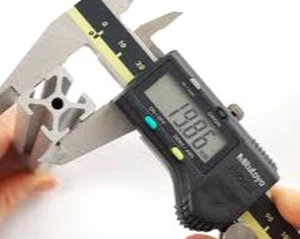

A cross-section sample and a caliper answer more questions in thirty seconds than a full product catalog answers in an hour. Uniform wall thickness, clean internal chamber formation, and visible aluminum core thickness - all confirmed or disproven at a glance.
Post cross-section is the second variable. The industry benchmark for main structural posts sits at roughly ten centimeters by ten centimeters - the familiar four-by-four. Posts that measure slimmer than that demand an internal aluminum core as a non-negotiable condition. Without it, the reduced section modulus means lateral loads produce deflection the hand will feel. This is not a matter of "heavy-duty" versus "standard" product tiers. It is a matter of whether the post cross-section, at the height and span it will serve, has the geometric stiffness to keep deflection below the threshold of human perception.
The third variable - and the one responsible for roughly half of all wobble complaints that manufacturers receive - lives beneath the deck surface. A post can house a solid billet of aircraft aluminum inside it; if its connection to the deck relies on two undersized screws in a thin base plate, the entire assembly will shimmy in wind. Three anchoring methods appear in practice, and they are not interchangeable:
| Anchoring Method | When It Applies | What Makes It Work | What Makes It Fail |
|---|---|---|---|
| Cast-in-place embedment | New concrete pour - post set directly into wet slab | Monolithic concrete-to-post connection; zero mechanical joints to loosen over time | Post not braced plumb during pour and cure - the concrete sets and the lean is permanent |
| Base plate with expansion anchors | Existing concrete deck - plate bolted to cured slab | Four or more stainless anchors of sufficient diameter through a plate thick enough not to flex under bolt torque | Two-anchor plates; zinc-plated fasteners; plates thinner than they should be |
| Sleeve-insert into cored hole | Existing concrete where a visible base plate is unwanted | Embedment depth at least one-quarter to one-third of above-ground post height | Shallow holes; relying on adhesive alone without mechanical keying into the concrete bore wall |
A detail that experienced installers learn to check immediately: post verticality. A post leaning even slightly off plumb rewrites the entire railing assembly's stress distribution. Connections designed for symmetrical vertical loading suddenly carry torsional moments they were never engineered for. The wobble that results worsens with every thermal cycle as the stressed connectors work-harden and develop play. A laser level or a long spirit level applied to every post in two perpendicular planes, before the railing sections are mounted, costs five minutes per post and prevents a progressive degradation that no subsequent tightening can reverse.
The fourth variable sits in the connectors - the brackets joining posts to rails, the corner pieces at handrail returns, the glass clamps if glass infill panels are specified. These are the smallest, cheapest components in a railing assembly, and they are routinely the first to fail in ways that create both wobble and noise. Metal connectors should be stainless steel - the kind with a matte, warm silver-white tone, not the bright sparkly bluish-chrome cast of zinc-plated steel. Plastic connectors should feel thick-walled and burr-free, with reinforcement ribbing visible on the back face. Fastener torque matters enormously: a screw driven until it strips its thread in a PVC boss becomes the origin point of progressive loosening across the entire connected assembly.
Wobble is almost never a single-point failure. It accumulates - a slightly undersized post base combined with anchors that lost a quarter-turn of preload over two winters, combined with a connector bracket torqued to "feels tight enough" rather than a specification. Each factor alone is barely noticeable. Together, they produce the tremor a homeowner feels when they lean against the top rail on a windy evening. The same specification discipline applies to PVC fencing - our seven-point selection framework covers the parallels.
III. The Sun Is a Chemical Reactor. Your Railing's Color Lives Inside It.
There is a particular disappointment that homeowners describe with almost identical language across climates and product brands: the railing looked showroom-perfect for the first year, started looking tired by year three, and by year five had faded into a chalky, patchy ghost of its original color - at which point the owner began mentally pricing a replacement. This trajectory is so common in low-cost PVC products that it has become the material's public reputation, despite the fact that the chemistry to prevent it has been well understood for decades.
What happens at the molecular level is this: ultraviolet photons carry enough energy to break carbon-chlorine bonds in the PVC polymer backbone. The dehydrochlorination reaction that follows releases hydrogen chloride, which in turn catalyzes further degradation in a self-accelerating cascade. Macroscopically, the material yellows, chalks at the surface, and loses impact strength. Stopping this chain requires three chemical components working in sequence. First, rutile-grade titanium dioxide - loaded generously into the formulation - acts as a physical UV opacifier, reflecting and scattering photons before they reach the polymer matrix. Second, organic UV absorbers capture the energy in the critical UV wavelength window and dissipate it as harmless low-grade heat. Third, hindered amine light stabilizers - HALS in industry shorthand - scavenge the free radicals that UV exposure generates, interrupting the degradation cascade before it propagates through the material. Remove any one of these three, and the clock starts ticking on the railing's appearance. Remove two, and the ticking becomes audible within two summers.
A buyer who wants to verify that a given railing product actually deploys this triple-defense system has two practical paths. The first is to request accelerated weathering test data - specifically, QUV or xenon-arc testing with color-shift values reported at a thousand hours of exposure or more. A well-formulated product will show color drift below the threshold of casual human perception at that benchmark. Test reports that reference industry-standard methods for color measurement are what you are looking for. The second path is simpler: ask whether the manufacturer provides a written warranty of ten years or longer that specifically names color retention. A company that stakes its warranty terms on fade resistance has internal accelerated-aging data that supports the claim. A company that avoids the subject in its warranty language is, by that omission, communicating the limits of its formulation budget.
There is also a manufacturing-process dimension. Premium vinyl railing uses co-extrusion - what the industry calls capstock technology. During profile extrusion, a secondary extruder applies a thin layer - a fraction of a millimeter - of highly UV-concentrated, pigment-rich formulation onto the profile surface while both layers are still molten. The two layers fuse molecularly into a single inseparable unit. The capstock concentrates the expensive UV protection exactly where it is needed - at the exposed surface - rather than distributing it wastefully through the entire profile cross-section. A fingernail scratch across an inconspicuous back surface reveals which technology is in play: if the scratch mark is white against a colored surface, you are looking at a capstock product; if the scratch matches the body color, the product uses through-body pigmentation, which trades off differently between scratch invisibility and long-term UV endurance.
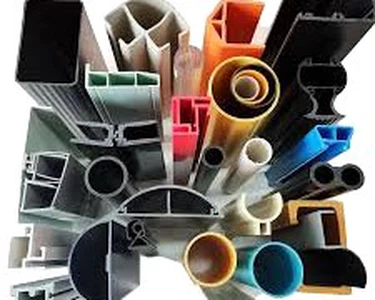

Co-extrusion cross-section: the thin outer capstock layer carries the concentrated UV-defense chemistry, fused to a structural PVC core that handles the mechanical loads.
A physical reality that no formulation can entirely override: dark colors absorb more solar infrared radiation than light colors. Surface temperatures on a dark-colored PVC railing in summer sun can climb past seventy degrees Celsius - a temperature regime that accelerates every degradation pathway simultaneously. In hot, high-sun regions, the simplest and most effective color-retention strategy is to choose white, cream, light gray, or cool beige. If a project's design language absolutely requires a dark railing, three confirmations become essential: the product must be labeled as a dark-color formulation with additional heat stabilizers and reflective pigments; every load-bearing member must include aluminum reinforcement, because PVC loses stiffness as temperature rises and dark profiles run hotter; and the manufacturer must provide dark-color-specific warranty terms that acknowledge the more demanding service environment. One practice to avoid entirely: spraying a white PVC railing with dark paint after installation. The paint's absorption characteristics were never factored into the PVC formulation's thermal budget, and the thermal expansion mismatch between paint film and PVC substrate will produce peeling and cracking within one to two seasons.
A design compromise that sidesteps the dark-PVC thermal challenge: white PVC structural posts and top rail for maximum solar reflectivity, paired with dark powder-coated aluminum balusters. The aesthetic impact of a dark railing, without imposing the thermal penalty on the PVC structure.
IV. Rust Happens. Even on a Product Marketed as Rust-Proof.
The PVC body of a railing cannot rust - polymer chains do not participate in electrochemical oxidation. The rust hazard lives entirely in the metal hardware components that connect, anchor, and trim the assembly. And it is remarkable how often an otherwise well-specified railing is brought down by a single category of underspecified fastener.
There is a visual check that takes five seconds at the hardware kit and spares the owner years of rust-streak regret. Place a stainless steel screw next to a zinc-plated screw on a white sheet of paper. The stainless fastener has a matte, warm silver-white tone - the natural color of the alloy. The zinc-plated fastener has a bright, sparkly, bluish-chrome cast - the signature of electroplated zinc. Under that thin zinc layer sits ordinary carbon steel. Once weather, salt, or an installation scratch breaches the plating, the steel rusts, and rust-colored water will streak down the white PVC post face, depositing iron-oxide stains that no consumer-grade cleaner removes completely.
This check costs nothing. It requires no tools. And it prevents the single most common and visually offensive long-term failure in PVC railing assemblies.
For coastal properties - anywhere within a few kilometers of breaking surf - or regions where winter road salt aerosol reaches the deck, the hardware specification needs to go one grade further. Standard stainless hardware resists atmospheric corrosion adequately in inland, low-chloride environments. The upgraded marine grade adds molybdenum to the alloy - typically two to three percent - which dramatically improves resistance to the chloride-ion pitting that salt spray and de-icing chemicals induce. The price difference between these two grades, applied to the total fastener cost of a typical residential railing, is negligible. The consequence of choosing the lower grade in a salt environment is rust streaks appearing within eighteen months.
Beyond fasteners, aluminum components - reinforcing cores that extend to exposed ends, base plates, connector brackets - need their own corrosion consideration. Untreated aluminum does not produce red iron rust, but it does oxidize into a gray-white powder that transfers to hands and clothing on contact. The correct specification is anodized or powder-coated aluminum for any aluminum surface that will be touched or that faces outward. Anodizing builds a controlled oxide layer into the metal surface itself; powder coating applies a baked-on polymer film. Both work.
One indirect rust hazard catches homeowners by surprise: contamination from adjacent structures. If a neighbor's rusting wrought-iron balcony sits above your PVC railing, or if a steel downpipe bracket overhead is shedding corrosion particles, iron-oxide-laden water will drip onto the PVC surface and deposit stubborn orange-brown stains. The PVC itself remains unaffected - this is a cosmetic problem, not a material failure - but the stains are real and stubborn. Prevention involves confirming during installation that the top handrail has a drip groove or canted drainage profile that sheds water quickly and directionally, and committing to an annual soap-and-water wash that keeps the surface smooth enough for contaminated droplets to bead and roll off rather than spread and evaporate in place.
V. Height Codes, Infill Choices, and the Shape of the Handrail - Getting the Secondary Decisions Right
Beyond the three headline performance criteria, a handful of secondary decisions separate a railing that reads as a cohesive architectural element from one that reads as a product bolted to a deck.
Height compliance is the non-negotiable starting point. North American residential codes set deck and porch guardrail minimums at thirty-six inches, with balcony railings at forty-two inches. International codes commonly require about a meter and five centimeters for low-rise residential and a meter and ten centimeters for high-rise. The requirement that accompanies height minimums - and the one that gets overlooked most often - is the maximum sphere-passing opening between balusters, typically four inches, preventing a small child's head from passing through. Quality PVC railing systems ship with code-compliance documentation. Confirming that the documentation references your jurisdiction's specific code version is a step worth taking before the railing leaves the warehouse.
Infill selection - the material filling the space between posts and beneath the top rail - affects both aesthetics and wind load. Vertical balusters at four-inch spacing are the most common choice, and the check here is simple: confirm the baluster wall thickness matches the system standard. Some manufacturers ship thinner-walled balusters than posts as a cost-reduction measure, and the difference is invisible once installed but meaningful over time. Tempered glass panels deliver unobstructed sightlines but require dedicated glass-clamp hardware rated for the glass thickness and the local wind load. PVC decorative lattice panels offer high privacy and wind resistance but exert significant leverage on their mounting brackets - the bracket specification deserves as much scrutiny as the post anchors.
Handrail geometry is an ergonomic variable that most buyers notice only after installation, when a poorly shaped profile announces itself through discomfort. A cross-section that is oval or generously radiused rectangular invites a confident grip; a sharp-edged flat rectangle registers as unpleasant under prolonged hand contact. The best systems wrap an aluminum core with a PVC outer shell at the handrail - the aluminum provides structural continuity, the PVC ensures the surface never becomes painfully hot in summer sun or painfully cold in winter frost. Real metal and unclad wood both lack this sensory advantage.
After installation, a ten-minute systematic walk-through catches the issues that will otherwise announce themselves gradually over the first year. Push firmly at mid-span on the top rail. Grip each baluster and attempt to twist it. Sight down the top rail length. Verify that all post caps, rail end caps, and trim covers are fully seated with no gaps that could admit driven rain. Check that every visible screw head sits flush with its surrounding surface and that none show stripped-thread damage. Each item on this list that passes now is a service call that will not happen later.
VI. What Fifteen Years of Ownership Actually Asks of You
A correctly specified and properly installed PVC railing system asks for almost nothing across its service life. The annual maintenance ritual fits in a single sentence: wash with mild soapy water and a soft cloth or sponge, rinse with a garden hose. No sanding. No staining. No rust-scraping. No paint. Across fifteen years, the labor differential between PVC and its traditional alternatives - costed at any reasonable hourly rate - exceeds the entire material cost of the PVC system. A homeowner who would have spent two weekends per year maintaining a wood railing will spend roughly one hour per year maintaining PVC.
For deposits that soap and water do not remove - bird droppings that have baked on, pollen residue in shaded corners - a non-abrasive vinyl cleaner formulated for PVC building products handles what soap leaves behind. What should never touch the surface: strong acidic cleaners, abrasive pads or steel wool, and pressure washers at close range. High-pressure water can force moisture past trim seals into the post interior, where trapped condensation becomes a long-term substrate issue. If a railing section sustains a deep scratch or impact gouge, minor surface marks can be wet-sanded with fine-grit paper and treated with a vinyl restoration compound. A severely damaged individual component - a single cracked baluster, a gouged post sleeve - can be removed and replaced in isolation without disturbing the rest of the assembly. This modular repairability is a structural advantage that welded iron and continuously-run wood railing systems cannot offer. YUPSENI stocks individual replacement components for every railing profile in production.
When the full-cycle costs are projected across a decade and a half, a properly specified PVC railing system typically emerges as the cheapest to own - not because the product itself is the cheapest to buy, but because the ownership experience does not generate recurring maintenance invoices. Wood railing requires re-staining every two to three years. Iron requires repainting every three to five years, plus occasional weld repairs when rust finds the joints. Both materials degrade from the surface inward; both force the owner into a maintenance calendar that tends to slip as the years accumulate. PVC railing, by contrast, asks for soap, water, and roughly one hour of labor per year. The polymer body cannot rot or rust. The co-extruded capstock keeps color shift below the threshold of casual perception for a decade or more. The stainless hardware continues to do what stainless does. The maintenance differential is categorical, not incremental.