

SPC Flooring Click Lock: Why the Lock Decides Whether It Fails | YUPSENI
Oct 15, 2026
The Lock Nobody Checks: The Click System That Decides SPC Floor Failure
The interlocking edge of an SPC plank - the part most buyers never inspect.
On This Page
You can feel a wear layer with a fingernail and read a thickness with a caliper. But the part of an SPC floor that decides whether it stays together is the lock milled into the plank edge - and almost nobody looks at it.
A click lock is a small thing: a few millimetres of profile cut into a stone-filled core, holding planks together without glue. When it fails, the floor does not fail gracefully. It peels, pops, and cracks along the one seam you were promised would stay invisible.
I. The Part Everyone Feels, the Part Nobody Looks At
Walk into a showroom and the ritual is predictable. People kneel down, drag a thumbnail across the surface, ask about the wear layer, compare thicknesses with a look of deep concentration.
Nobody specs the lock.
That is odd, because the lock is the only part of the floor that is load-bearing in two directions at once. The surface just has to resist scratches. The core just has to hold its shape. But the lock has to keep two rigid planks mechanically married while the whole assembly flexes under foot traffic, breathes with temperature, and rides on whatever subfloor happens to be underneath.
It is also the part where an SPC plank is at its most fragile. The lock profile is cut into a core that is mostly limestone powder bound with PVC resin. That material is strong in compression and stiff in bending, but it is not forgiving. Mill a sharp-cornered groove into it, apply a levering force, and the core can only do one of two things: hold, or snap.
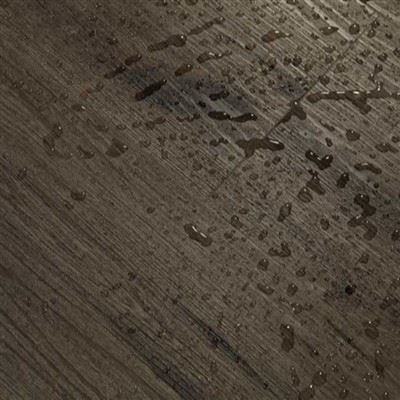
The lock profile is milled directly into the stone-filled core - the same material everyone judges by density, not by toughness.
II. What Happens to a Lock the Moment You Walk on It
Most people imagine a click lock simply sitting there, holding two planks side by side. That mental picture is wrong in a specific, mechanical way.
When a heel comes down near a joint, the plank on one side dips a fraction of a millimetre. The adjacent plank does not dip in perfect sync, because the subfloor underneath is never perfectly flat and the load is never perfectly even. The result is a tiny difference in height across the seam - and that difference converts a downward footstep into a sideways pull and a twisting force concentrated exactly where the lock tongue meets the lock groove. Over thousands of steps a day, the lock is not holding planks together so much as being pried apart, minutely, again and again, by a lever arm measured in millimetres. A well-cut lock with a tight profile and a resilient core absorbs this by flexing within its elastic range. A poor one passes a small amount of that energy straight into the sharpest corner of the milled groove. Stress concentrates. And in a brittle material, concentrated stress is a countdown rather than a warning.
Temperature does the same job more slowly. A rigid stone-composite plank does not move much, but it does move. Seasonal expansion and contraction push and pull every joint, and the lock is the only place that movement can go.
So the lock is not a static fastener. It is a tiny spring that every footstep and every degree of temperature asks to bend - and the question is whether it bends, or breaks.
A click lock is a spring, not a nail. It survives by flexing within its elastic limit - and by having a core tough enough to flex back.
III. The Fracture That Starts at the Groove, Not the Face
When an SPC floor fails, the complaint usually arrives as one of three visible symptoms - and none of them is a worn surface.
| Symptom | What the buyer sees | What is actually happening |
|---|---|---|
| Peaking | A seam that rises into a ridge | The lock is levered upward and can no longer hold the planks flat |
| Gapping | A joint that opens over time | The lock tongue has slipped or snapped out of the groove |
| Chipping | Crumbled edges along the seam | The core fractured at the root of the milled groove, not at the face |
Notice the pattern. In every one of these, the damage is at the edge, inside the joint, where the eye cannot see it until the failure has already happened. The visible surface - the part every buyer inspected so carefully in the showroom - is intact.
And the deeper pattern is this: a snapped lock is rarely the lock's fault. The profile did not change shape overnight. What changed is that the core finally stopped flexing and started fracturing, because the material around the groove could no longer absorb the repeated prying without giving way.
That is the uncomfortable truth most datasheets avoid: a click lock cannot be stronger than the core it is cut from.
IV. A Cheaper Core Breaks the Exact Same Lock
Here is where the comparison gets uncomfortable, because it undercuts the way most flooring is priced.
Two factories can buy the same lock profile design - the same angles, the same geometry, cut on similar tooling. One plank snaps its lock on day one. The other survives years of a hallway full of traffic. The difference is not the shape of the lock. It is what the lock is cut into.
SPC cores are a recipe, and the recipe has a cost lever built into it. Limestone powder is cheap. PVC resin is the expensive part. Push the stone content up and the resin content down, and the core gets cheaper, denser, and more brittle in the same motion. It also gets heavier and stiffer - two things a naive buyer misreads as quality. But stiffness is not toughness, and a dense, brittle core will shatter at the groove root long before a slightly softer, resin-rich core would.
This is the quiet scandal of the lock: the exact same profile can be a lifetime joint or a warranty claim, depending entirely on a material property that is rarely printed on any label. You can read about SPC core density and still learn nothing about whether the edge will hold, because density and toughness are two different dials.
The takeaway is blunt: judge a lock by the core it lives in, not the shape you can see.
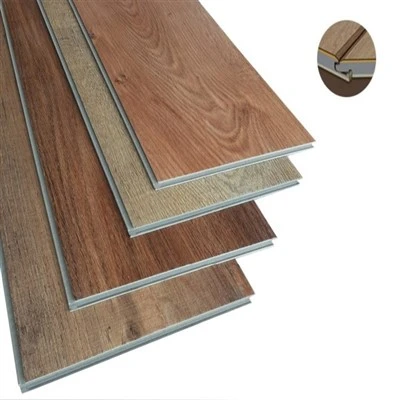
Two identical lock profiles: one holds for a decade, the other shatters at the root - the core decides which.
V. What to Ask Before You Trust the Click
If you cannot read a core's toughness off a label, what do you actually do? You ask three questions that force the truth out.
One, what is the lock's pull strength? A competent supplier can state the tensile force the joint withstands before the tongue separates or the groove breaks. Ask for the number, and ask how it was measured.
Two, what is the tooling tolerance? The gap between a milled tongue and groove decides whether force concentrates on a point or spreads along the whole edge. A sloppy fit is a stress concentrator even in a tough core.
Three, does the core bend before it breaks? This is the question most suppliers never get, because most buyers never think to ask. A simple bend test tells you more about the future of your floor's edges than any density figure on a spec sheet.
None of these three appears on the average product page, which is exactly why they are the three worth asking. And when you do install, the lock's worst enemy is not a bad product but a bad subfloor - a point covered in more detail in this installation guide, because even a perfect lock cannot save a plank laid over a bump.

A floating floor lives and dies by its locks - the subfloor underneath decides which one it is.
The Part You Cannot Afford to Skip
Every flooring decision starts with a surface, because a surface is what you see. But a floor is only as strong as the seam between its planks, and the seam is only as strong as the lock - which is only as strong as the core it is cut from.
The lock is the part everyone feels the benefit of and nobody inspects the cause of. That asymmetry is exactly why it is worth five minutes of your attention before the floor goes down, and why it will cost you far more than five minutes after.
Spec the lock, not just the surface
Ask for pull strength, tooling tolerance, and a bend test before you order.
Request a Quotation Browse SPC FlooringFrequently Asked Questions About SPC Click Locks
Answers to the questions that come up most when buyers start looking at the lock instead of the surface.
Q1: What is a click lock on SPC flooring?
A: A click lock is the interlocking profile milled into the edge of each plank. A tongue on one edge snaps into a groove on the next, holding the planks together without glue.
Q2: Why does the lock matter more than the wear layer?
A: The wear layer protects the surface from scratches, but a failed lock pulls the whole floor apart. A worn surface is cosmetic; a broken lock is structural.
Q3: What causes a click lock to crack or peel?
A: Usually the core, not the lock profile. A brittle, stone-heavy core fractures at the root of the milled groove when the joint is repeatedly flexed under traffic or seasonal movement.
Q4: How can I tell if a lock is well made before buying?
A: Ask for the lock's pull strength, the tooling tolerance, and whether the core bends before it breaks. These three tell you more than any density figure on a label.
Q5: Does a thicker plank mean a stronger lock?
A: Not necessarily. Thickness adds rigidity, but a thicker brittle core can still shatter at the groove. Toughness of the core matters more than thickness alone.
YUPSENI Team
23 years in PVC building material manufacturing and supply chain. We help importers, distributors, and project buyers source SPC flooring, PVC foam boards, wall panels, and fencing that pass compliance the first time. More about YUPSENI
© 2026 YUPSENI. All rights reserved. The information in this article is for general informational purposes only and does not constitute professional advice. Product specifications may vary by region and production batch. Always request current datasheets before making procurement decisions.


