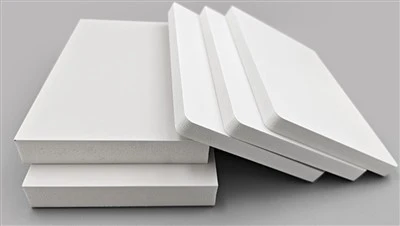
PVC Foam Board Warping: Why Internal Stress Beats Density | YUPSENI
Oct 16, 2026
Why PVC Foam Boards Warp: Internal Stress Beats Density on Flatness
A flat sheet is a promise about symmetry, not just density.
On This Page
A warped PVC foam board is the most complained-about defect that no datasheet ever lists. A buyer checks density, thickness, and colour, the sheet arrives, gets leaned against a wall overnight, and by morning it has bowed like a drawn bow.
The instinct is to blame low density. It is almost always the wrong suspect.
I. Warping Is Not a Density Problem
Ask someone why a plastic sheet bows and the answer comes fast: it must be too soft, too light, too low in density. The logic feels airtight, which is precisely why it survives despite being wrong.
Warping is not a measure of how much material is in the board. It is a measure of how unevenly that material behaves. A sheet bends when its two faces shrink at different rates and pull against each other. If both faces shrink the same amount, the board stays flat no matter how dense or light it is.
Flatness is a symmetry problem, not a density problem.
That reframing matters, because it changes what you should be checking. A high-density board with a lopsided structure will curl just as surely as a light one - sometimes worse, because it has more stiffness to turn a small imbalance into a big, permanent bend.

A board stays flat when both faces behave the same - a property density alone never guarantees.
II. The Stress That Gets Locked In While the Sheet Cools
If warping is a symmetry problem, then the real question is where the asymmetry comes from. The answer starts in the moment the sheet leaves the die, still hot, still soft, still settling into its final shape.
A freshly extruded board does not cool evenly. The face against a cooling roller or a water bath loses heat faster than the face exposed to still air. The side that cools first contracts first and locks into its final dimensions. The slower side is still warm, still shrinking - and as it finally catches up, it pulls against a face that can no longer move. The result is a stress that never quite resolves. It gets frozen into the sheet, invisible, waiting.
That stored energy is the real culprit. On the factory floor the board looks flat, because it is clamped in a stack or leaning with its own weight holding it straight. The moment it is leaned against a wall on a warm afternoon, or laid flat under a hot light, that trapped stress is released - and the board bends toward whichever face had been pulling harder all along.
The skin makes it worse. A celuka board carries a hard surface layer on each face, and if those two skins come out even slightly different in thickness, the two faces shrink at different rates by design. You can read about the difference between celuka and free-foam surfaces and see why a skin imbalance is a built-in bow waiting to happen.
So a warped board is not a weak board. It is a board carrying a frozen argument between its two faces - and that argument always ends the same way.
A board can sit flat in the warehouse for weeks and still bow the moment it's mounted - because the stress that bends it was already inside, waiting for heat and time to release it.
III. How Flat Is Flat Enough, and Why It Suddenly Isn't
"Flat" sounds like an absolute, but it is not. It is a tolerance, and the tolerance depends entirely on what the board has to do next.
| Application | What a bow costs you | How flat it needs to be |
|---|---|---|
| UV printing & advertising | Suction cups lose grip, print blurs | Tightest |
| Cabinet doors & panels | Doors stop closing, seams open | Very tight |
| Shelving & partitions | Bend worsens under load | Moderate |
| Backing & lining boards | Can be pulled flat by fixings | Most forgiving |
The same sheet that is perfectly fine as a backing board is a disaster on a flatbed printer. A small bow that a cabinet maker can clamp out becomes a blurry, half-printed panel the moment a print head passes over the high spot.
This is why the first question should never be "is it flat?" but "is it flat enough for what I'm doing?" - and the second question should be how the factory actually measures it, because "flat enough" only means something when a number is attached to it.
A straightedge laid across the face, with a feeler gauge slipped under the worst gap, turns an opinion into a measurement. Ask for that measurement, not for a promise.

For printing, "flat enough" is measured in fractions of a millimetre - not in good intentions.
IV. One Sheet Bows, Its Neighbour Doesn't
Here is the part that drives buyers to despair: two sheets from the same batch, same density, same thickness, same truck. One stays flat for years. The other curls within a week. How?
Because internal stress is not a property of the recipe - it is a property of the process, and the process wobbles. Cooling water temperature drifts by a few degrees. A fan runs unevenly. Extrusion speed ticks up or down. Each tiny fluctuation changes how asymmetrically any given sheet cools, which changes how much stress gets frozen into it. Two neighbours on the same production line can leave the factory carrying very different loads.
Good factories know this, which is why they add a step the brochure never mentions: they let the boards rest. Stacked and held flat, sheets are aged until the trapped stress relaxes before the board ever ships. This is the difference between a board that bows in your warehouse and one that bows in the factory's warehouse, where nobody is paying for it.
If a supplier cannot describe what they do between extrusion and packing, they are selling you a sheet that is still settling - and you are the one who gets to watch it happen.
Resting a stack flat before packing is the quiet step that separates a board that bows at the factory from one that bows at your site.
V. The Spec Line That Catches a Warped Sheet Before It Ships
All of this collapses into a short list of questions that will separate a flat board from a promise of one.
First, what is the flatness tolerance, and how is it measured? A number, a straightedge, and a feeler gauge. If they cannot give you all three, treat the board as unproven.
Second, is the board conditioned after extrusion? Ask how long sheets rest before packing. A factory that ages its boards is paying to move the risk off your floor.
Third, are the two skins symmetric? For celuka sheets, an even skin on both faces is the difference between a board that stays flat and one that is born bowed. This connects directly to how the extrusion variables are controlled, and it is worth asking about in the same breath.
None of these three lines appears on a standard quotation. That is exactly why they are the three worth requesting - because a warped board is cheapest to catch before it ever gets wrapped in plastic.

Flatness is verified before packing, not promised after delivery.
The Board Was Never Flat. It Was Just Patient.
A warped PVC foam board rarely warps in front of you. It was carrying the bend from the moment it cooled, and it simply waited until heat, time, and gravity gave it permission to show it.
Once you see flatness as a question of symmetry and stored stress rather than density, the whole picture shifts. You stop asking how heavy a board is and start asking how evenly it was cooled, how symmetric its skins are, and how long it rested before it was packed. Those are the questions a flat board answers in the affirmative - and a bowed one never could.
Spec flatness, not just density
Ask for a tolerance, a measurement method, and a conditioning step before you order.
Request a Quotation Browse PVC Foam BoardsFrequently Asked Questions About PVC Foam Board Warping
Answers to the questions that come up when a sheet that looked flat in the warehouse suddenly isn't.
Q1: Does higher density stop a PVC foam board from warping?
A: Not reliably. Warping comes from the two faces shrinking at different rates, not from how much material is in the board. A dense board with an uneven structure can bow worse than a lighter one.
Q2: What actually causes a foam board to bow?
A: Uneven cooling during extrusion freezes internal stress into the sheet. When heat or time later releases that stress, the board bends. An uneven skin on celuka sheets makes it worse.
Q3: Why does a board bow days or weeks after delivery?
A: The stress was already inside it. Held flat in a stack, it looked straight. Leaned against a wall or laid under heat, the trapped stress is released and the bend appears.
Q4: How can I check a board is flat before ordering?
A: Ask for the flatness tolerance and how it is measured, whether the board is conditioned after extrusion, and whether the two skins are symmetric. A straightedge and feeler gauge turn "flat" into a number.
Q5: Does every application need the same flatness?
A: No. UV printing and cabinet panels need the tightest tolerance, while backing boards are far more forgiving. Match the flatness spec to what the board has to do.
YUPSENI Team
23 years in PVC building material manufacturing and supply chain. We help importers, distributors, and project buyers source SPC flooring, PVC foam boards, wall panels, and fencing that pass compliance the first time. More about YUPSENI
© 2026 YUPSENI. All rights reserved. The information in this article is for general informational purposes only and does not constitute professional advice. Product specifications may vary by region and production batch. Always request current datasheets before making procurement decisions.