How much do you know about advertising printing?
Sep 26, 2025
How much do you know about advertising printing?(Ⅱ)
06 Mesh Cloth
The grid fabric is made of high-strength polyester or polyester fiber as the base material, with a PVC coating on the surface to form a hollow grid structure. The mesh diameter is 2-5mm, and the wind resistance coefficient is 40%-60% lower than that of ordinary lamp fabric. The thickness is 0.4-0.6mm, and the tensile strength is ≥350N/5cm. It features weather resistance, UV resistance (no fading for 3 to 5 years outdoors), water resistance and tear resistance. Its hollowed-out design not only ensures the display effect of the picture but also reduces the impact of strong winds on the billboard. It is suitable for environmental scenarios such as exterior wall advertisements of high-rise buildings, large outdoor fences, cross-street banners, and hanging curtains, and is also often used as a background for temporary exhibitions to reduce construction costs. According to the grid density, they are classified into open-hole type (mesh size > 4mm, wind resistance grade ≥8) and close-hole type (mesh size ≤3mm, suitable for wind areas below grade 5). According to their functions, they are divided into waterproof type (with water-resistant agent added to the coating) and flame-retardant type (conforming to GB8624-B1 grade standard).
When installing, it is necessary to pay attention to the frame flatness error being no more than 3mm. Evenly tensioning through edge buttoning holes can prevent picture distortion. When cleaning, use a high-pressure water gun to wash away surface dust. It is a cost-effective advertising medium in outdoor windy environments.
07KT Board
KT board is an advertising board made of polystyrene foam board as the base material and coated with grid-like PVC film or glass fiber mesh fabric on the surface. Its thickness is usually 5-10mm and the density is 200-350g/cm³. Its core feature lies in the fact that the grid structure enhances the bending strength of the board (the bending strength is 30% higher than that of ordinary KT boards), while maintaining a lightweight characteristic (weighing only 1/5 of wooden display boards). The surface grid texture can enhance the three-dimensional effect of the picture and is suitable for UV printing or spray painting. The application scenarios include exhibition display boards, promotional signs in shopping malls, event background walls, etc. It is especially suitable for medium-sized displays that need to be hung or supported (the recommended size of a single piece is ≤1.2m×2.4m). According to the grid process, it is divided into surface embossed type (grid depth 0.3-0.5mm, enhancing touch) and composite reinforced type (built-in glass fiber grid cloth, tear resistance ≥15N). According to function, it is divided into waterproof type (surface covered with PVC waterproof film) and flame-retardant type (conforming to GB8624-B2 grade standard).
When in use, be careful to avoid scratches from sharp objects. During installation, fix it with corner codes to prevent edge lifting. It is suitable for short-term indoor display (suggested usage period ≤6 months) and is a commonly used material for low-cost and lightweight advertising display.
08PVC Board
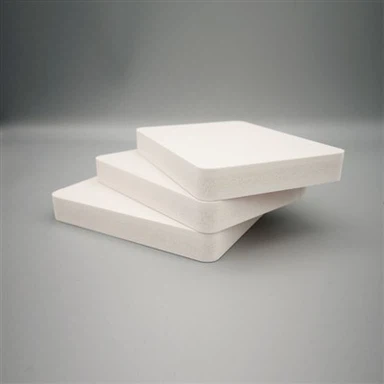
The advertising material PVC board is made from polyvinyl chloride as the base material through extrusion or calendering processes. Its density ranges from 0.4 to 1.5g/cm³, and the thickness is available from 1 to 20mm. The surface can be treated with a glossy film, matte film or frosted finish. It features high hardness (Shore hardness 60-90A), weather resistance and UV resistance (no fading for 5-8 years outdoors), water and moisture resistance, flame retardancy and other physical properties. It supports UV printing, engraving cutting and thermal bending forming, with a printing accuracy of 1440dpi and a color saturation of over 95%. This type, which is only as heavy as glass, is suitable for outdoor signs, exhibition displays, retail terminals, and special craft carving shapes. It is classified by density into low and high-density boards, and by surface treatment into glossy, matte, and frosted finishes. There are also functional extension types such as anti-static and scratch-resistant.
When installing, it is necessary to pay attention to construction at a temperature of ≥10℃, reserve expansion gaps, and use neutral cleaning agents for cleaning. It is a cost-effective material for all-scenario coverage in advertising projects, especially suitable for long-term outdoor displays and complex shape requirements.
09 Acrylic
Advertising material acrylic (PMMA, polymethyl methacrylate) is polymerized from methyl methacrylate, with a density of 1.18-1.2g/cm³ and a thickness of 1-30mm available. Its light transmittance exceeds 92%, and after surface hardening, its Shore hardness is 70-90A. It features weather resistance and UV resistance (no yellowing for 3-5 years outdoors), impact resistance 10 to 15 times that of glass, and a weight of only half of it. It supports laser cutting, thermal bending forming, and 1440dpi precision UV printing, with a color retention period of ≥5 years.
It is suitable for high-end signs (10-20mm transparent plates with electroplated edges), illuminated advertisements (light-guiding type with a light transmittance of 75-85%), exhibition displays (5-10mm frosted plates), and three-dimensional engravings, etc. It is classified by transparency into transparent, semi-transparent, and colored types. According to surface treatment, there are glossy, frosted, and textured types. There are also functional types such as anti-static, scratch-resistant, and flame-retardant
Installation should be carried out at a temperature of ≥15℃ and an expansion gap should be reserved. Cleaning should be done with alcohol. Although the cost is 2-3 times that of PVC boards, it has become the preferred material for high-end advertising due to its high light transmittance, weather resistance and processing flexibility.
10 Soft Film
The advertising material soft film is made of polyvinyl chloride (PVC) as the base material and treated with a special coating. Its thickness is 0.18-0.3mm, and the light transmittance reaches 70%-90% (light-transmitting type). It features flexibility and stretchability (tensile strength ≥15MPa), weather resistance and UV resistance (5-8 years indoors and 2-3 years outdoors without fading), and a fire resistance rating of B1. It supports UV printing (precision 1440dpi) and thermoplastic forming (heat bending temperature 110-130℃). It can be adapted to arc-shaped and irregular-shaped frames, suitable for indoor light boxes (with light-transmitting film and LED light sources), commercial space ceilings (with matte film to create a soft atmosphere), exhibition background walls (with glossy film to enhance color impact), and other scenarios It is classified by function into light-transmitting film (light transmittance ≥80%), matte film (gloss ≤15°), and glossy film (gloss ≥90°). During installation, it needs to be fixed through the edge of the keel in an environment of ≥15℃. For cleaning, it should be wiped with neutral detergent. With its lightweight, high light transmittance and flexible shape, it has become a commonly used material for high-end indoor advertising decoration and lighting display.