SPC Flooring Colour: Why It Looks Different at Home | YUPSENI
Nov 25, 2026
You Chose the Colour. You Bought the Light: Why Floors Change at Home
On This Page
The sample looked warm in the showroom, a soft oak with a hint of honey. In the house it looked grey. Nothing about the plank had changed. It was the same product, cut from the same batch, laid by the same installer. What had changed was the light. The showroom was lit by high-output lamps with a warm colour temperature and a high colour rendering index, and the floor was standing in the middle of an open space with white walls. The house had a north-facing window and a pale blue wall, and the same plank was reflecting a different spectrum back to the eye. The floor was never one colour. It was a surface that reflected whatever light was offered to it.
The buyer chose a colour. The room chose another.
I. Colour Is Not a Property of the Board
A surface does not have a colour in the way it has a thickness. It has a reflectance spectrum, which is a description of which wavelengths it absorbs and which it sends back. The colour you see is the result of that spectrum being illuminated by a particular light and interpreted by a human eye. Change the light, and the same spectrum produces a different colour. This is not an optical trick or a defect in the product. It is how colour works, and it applies to every material in the building.
The practical consequence is that a floor sample is not a colour reference in the way a paint chip is. A paint chip is viewed under the same conditions as the wall it will cover, so the comparison is direct. A floor sample is viewed in a showroom and then installed in a room with different light, different walls, and different furniture. The comparison is between two conditions, not between two objects, and the result is the disappointment that most buyers experience at least once.
The board reflects. The light decides.

A floor has a reflectance curve. The colour is what the eye makes of it.
II. What the Showroom Light Does
A showroom is engineered for display, and its lighting is chosen to make products look their best. The lamps are usually high output, which makes the surface bright and the grain visible. They are usually specified at a colour temperature that flatters wood tones, which means warm rather than neutral. And they are often chosen for a high colour rendering index, which means the material's own spectrum is presented faithfully rather than being distorted by the light.
| Light source | Colour temperature | Effect on floor |
|---|---|---|
| Incandescent | 2700K | Warm, yellow |
| Halogen | 3000K | Warm, slightly yellow |
| LED neutral | 4000K | Neutral |
| Daylight | 5000-6500K | Cool, blue |
None of this is dishonest. A showroom has to display products under conditions that let a customer see them, and those conditions differ from a living room by design. The problem is that the customer treats the display as a prediction. The showroom is not wrong about the floor. It is telling the truth about the floor in the showroom. The customer is applying that truth to a different room, and the truth does not transfer.
There is also a simple brightness effect. A showroom is brighter than a home, and a brighter surface appears lighter and more saturated. The same plank in a dimmer room looks deeper and greyer, not because it has changed but because the eye adapts to the lower light level and reads the surface differently. This alone accounts for a large part of the "it looked warmer in the shop" complaint.
The showroom was not lying. It was a different room.

Showrooms are lit to sell. Homes are lit to live.
III. When Daylight Changes the Floor
Daylight is not a single light. It changes through the day, through the year, and with the weather, and each of those changes alters the spectrum that reaches the floor. Morning light is warmer and lower in intensity. Midday light is cooler and brighter. Evening light is warmer again, and in some rooms it takes on an orange cast that makes a neutral floor look distinctly yellow. A floor that looked correct at ten in the morning can look wrong at six in the evening, and neither view is inaccurate.
The orientation of the window matters as much as the time of day. A north-facing room receives indirect light that is cooler and more even, which tends to make floors look grey and slightly blue. A south-facing room receives direct light for much of the day, which warms the floor and increases contrast in the grain. East and west rooms shift between the two as the sun moves, so the floor changes character twice a day. None of this is visible in a showroom with no windows at all.
The comparison with timber and tile is useful here, because timber has the same property and the trades that sell it have learned to warn customers about it. A timber floor is always described as changing with the light, and buyers accept that. A vinyl floor is described as having a colour, and buyers expect it to be stable. The material behaves the same way. Only the expectation differs.
The floor looked different at six. It was the same floor.

A north window cools the floor. A south window warms it. The plank did neither.
IV. Why Two Rooms, One Floor, Two Colours
The most confusing case is a single floor laid through several rooms, where the same material appears to change from one room to the next. The cause is reflection. Light that reaches the floor does not only come from the window or the lamp; it also comes from the walls, the ceiling, and the furniture, and those surfaces carry their own colour. A pale blue wall reflects blue light onto the floor beside it. A warm wooden cabinet reflects warm light. A white ceiling reflects white light downwards.
This is why a floor can look grey in one room and honey in the next without any change in the product. The room with the blue wall is adding blue to the light that reaches the floor, and the floor's reflectance spectrum sends that blue back to the eye. The room with the wooden furniture is adding warm tones. The effect is strongest near the reflecting surface and fades with distance, which is why the floor sometimes looks different at the edges of a room than in the centre.
Surface finish adds another variable. A matte floor scatters light and shows its colour relatively evenly. A floor with more sheen reflects the room and the light source directly, so its apparent colour includes a reflection of whatever is opposite it. In a room with a bright window, a glossy floor near the window will look lighter than the same floor in the corner, and the difference is the reflection rather than the material.
The floor was one colour. The rooms were not.
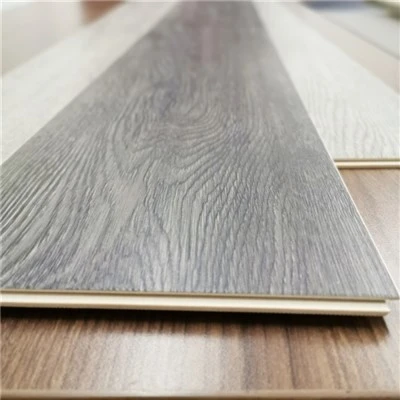
The wall beside the floor is part of the light that reaches it.
V. Choose Under the Light You Will Live In
The buyer who has followed the argument knows that floor colour is a relationship rather than a specification. The sample is not the answer; the sample in the room is the answer. A few practical steps turn the relationship into a decision that holds up after installation.
Take the sample home. Leave it in the room for a full day, and look at it in the morning, at midday, and in the evening. The three views are the three floors you are considering.
Look at it beside the wall and the furniture. The reflection from those surfaces is part of the light the floor will receive. A sample on a white table tells you less than a sample against the actual wall.
Check the light you actually use. If the room is lit by warm lamps in the evening, judge the floor under those lamps rather than under the showroom's display lighting.
The sample was right. The room had not been asked.
Judge a floor sample in the room where it will be installed, under the light it will receive, beside the surfaces that will reflect onto it. The showroom view is a starting point, not a prediction.
The Room Is Part of the Product
The disappointment that follows a floor installation is rarely about the product. It is about a comparison that was made under the wrong conditions, and a colour decision that treated a relationship as a fixed value. Once the relationship is understood, the decision becomes easier rather than harder: there is no single correct floor colour, only a correct floor for a particular room, light, and wall.
The room-by-room specification is a useful frame here, because it treats each room as its own set of conditions rather than applying one choice across a whole house. Different rooms have different windows, different walls, and different uses, and a floor that suits one may not suit another for reasons that have nothing to do with the material.
The buyer chose a colour. What they installed was a colour and a light.
See the floor in your own light
Order a sample and judge it in the room, at the window, and under your evening lamps.
Request a Sample Browse SPC FlooringFrequently Asked Questions About Floor Colour
Answers to the questions that come up when the floor looks different than expected.
Q1: Why does my SPC flooring look different at home?
A: Because colour depends on the light. Showrooms use bright, warm, high-rendering lamps, and homes have different windows, walls, and light levels. The plank did not change.
Q2: What is colour temperature and why does it matter?
A: It describes how warm or cool a light source is, measured in kelvin. Warm light makes a floor look yellow, cool light makes it look blue. The floor reflects whatever it is given.
Q3: Should I take a sample home before buying?
A: Yes. Leave it in the room for a full day and look at it in the morning, at midday, and in the evening. Those three views are the three floors you are considering.
Q4: Does the direction of a window change the floor colour?
A: Yes. North-facing rooms receive cooler, more even light and tend to make floors look grey. South-facing rooms are warmer. East and west rooms change through the day.
Q5: How do I choose the right floor colour?
A: Judge the sample in the room, beside the walls and furniture that will reflect onto it, under the light you actually use. A showroom view is a starting point, not a prediction.
YUPSENI Team
23 years in PVC building material manufacturing and supply chain. We help importers, distributors, and project buyers source SPC flooring, PVC foam boards, wall panels, and fencing that pass compliance the first time. More about YUPSENI
© 2026 YUPSENI. All rights reserved. The information in this article is for general informational purposes only and does not constitute professional advice. Product specifications may vary by region and production batch. Always request current datasheets before making procurement decisions.