⏱ ~13 min read Updated: May 25, 2026 By YUPSENI Team
On This Page
- I. The Decision That Happens Before the Print File Opens
- II. What Each Material Refuses to Do - and Why That Matters More Than the Spec Sheet
- III. The Skin Between the Board and the Ink
- IV. When a Sign Leaves the Shop and Meets the Weather
- V. What Your Cutting Table Knows That the Data Sheet Doesn't Tell You
- VI. A Cost Table That Includes the One Variable Most Quotes Leave Out
- VII. Choosing for the Job, Not the Shelf
- FAQ

A sheet of rigid foam PVC board loaded onto a UV flatbed printer. What happens in the next ninety seconds - whether the ink bites into the surface or sits on top of it like a sticker waiting to peel - was decided weeks earlier, when someone chose the substrate without ever seeing the print file. This guide is about that decision.
I spent a morning last year in a sign shop in Chicago's West Loop - the kind of place where the floor has a permanent layer of vinyl offcut confetti and the smell of UV-cured ink hangs in the air like a trade secret. The owner, a man named Marco who has been running a flatbed printer for eleven years, keeps a cross-section sample of every substrate he has ever printed on in a drawer under the machine. When a new customer walks in with a job spec, he pulls out the drawer, picks up the relevant sample, and taps it with his fingernail. "Hear that?" he said, tapping a piece of corrugated plastic. "That's a sign that will be in a dumpster by November." He picked up a sheet of rigid foam board - the kind YUPSENI extrudes with a dense Celuka skin on both faces. The tap was quieter, deader, a sound that doesn't echo. "That one," he said, "will still be hanging in a restaurant window when the restaurant changes owners."
The conversation about signage substrates, he told me, ends the moment someone touches the board. Not reads the spec sheet - touches it. The weight, the surface texture, the way it flexes or refuses to flex, the sound it makes when you rap it with a knuckle. These are the data points that sign makers trust because they are the data points that predict whether a print job will become a portfolio piece or a reprint request. Every other substrate decision flows from that tactile first impression, and the four materials that dominate the conversation - PVC foam board, acrylic, aluminum composite panel, and corrugated plastic - each deliver a completely different answer to the same unspoken question: What happens to this sign after it leaves my shop?
This article is a side-by-side examination of those four substrates, written from the perspective of the person standing next to the printer, not the person writing the marketing brochure. It covers what each material does to your ink, your cutting tools, your installation crew, and your reputation - and it includes a cost comparison that accounts for the reprint you hope you never have to order. For a deeper look at the specific density grades and surface finishes available within the foam board category, see our guide to choosing PVC advertising board by density and print compatibility.
I. The Decision That Happens Before the Print File Opens
Most sign buyers think the critical decisions happen in Adobe Illustrator. The sign maker knows better. The substrate choice - what the printed graphic is mounted to, printed directly onto, or routed out of - determines more about the final product than the resolution of the source file. Get the substrate wrong, and a 1200-dpi print on a $60,000 flatbed looks worse after six months than a 720-dpi print on the right board. Get it right, and the sign does its job quietly, for years, without anyone thinking about what it is made of.
The substrate decision is rarely made in isolation. It is a three-way negotiation between the sign maker's equipment capability, the client's budget, and the environment the sign will occupy. A UV flatbed printer can lay ink onto all four of these materials. That does not mean all four will perform identically once the sign is installed above a sun-blasted storefront window or bolted to a post in a parking lot. The question is not "can I print on this." The question is "will the ink still be bonded to the surface, and the surface still be flat, in the specific conditions this sign will face."
There is also a fourth party in the negotiation that nobody talks about: the person who installs the sign. A 4-by-8-foot sheet of acrylic weighs approximately four times what the same-size sheet of foam PVC weighs. If the install involves climbing a ladder, working overhead, or mounting onto a surface that was not designed as a sign substrate, the weight difference stops being a spec-sheet number and becomes a safety consideration, an extra pair of hands, and an installation bill that is higher than the client budgeted for. Marco, the sign shop owner in Chicago, put it this way: "I've had jobs where the board cost was fine, the print was perfect, and the install ate the entire margin because the substrate was too heavy for a two-man crew. The client never sees that line item. They just see the total, and the total is higher than the other guy's quote. And the other guy quoted foam board."
II. What Each Material Refuses to Do - and Why That Matters More Than the Spec Sheet
Every substrate has strengths that its manufacturer is eager to list. Those strengths are easy to find. What is harder to find - and what sign makers learn through years of reprints and field failures - is what each material refuses to do. Those refusals, not the strengths, define the material's actual performance envelope. Here are the four main contenders on a sign maker's shelf, described not by their best-case scenario but by the failure mode each one carries into every job.
1. PVC Foam Board - The Workhorse That Hates Solvent
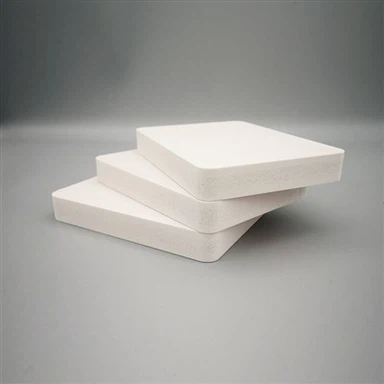
Rigid foam PVC board - sometimes called expanded PVC, foam PVC sheet, or by the Celuka process name for boards with a dense integral skin - is a closed-cell foam core sandwiched between two solid surface layers. It is lightweight enough for one person to carry a full sheet, rigid enough to stand upright without support framing in smaller sizes, and receptive to UV-curable ink without a primer or adhesion promoter on properly formulated surfaces. The foam core absorbs vibration during routing, which means it cuts cleanly without the chatter marks that harder materials produce on worn tooling. It can be scored and snapped with a utility knife for straight cuts on thin gauges. It does not dent on impact the way aluminum composite does, because the foam core distributes impact energy through compression rather than plastic deformation.
What it refuses to do: it will not tolerate solvent-based ink systems without surface preparation, and it will not retain structural flatness in continuous high-heat conditions above approximately 65–70°C. The first limitation matters for sign shops running solvent or eco-solvent printers - the solvents can attack the PVC surface, causing it to soften or develop a texture during printing. A adhesion promoter or a factory-applied print-receptive coating solves this, but it is an extra step that must be factored into the production workflow. The second limitation matters for signs installed in direct sunlight inside enclosed, unventilated spaces - like a sign mounted inside a sealed window box in Phoenix in July. The board won't melt, but it can develop a gentle wave if the thermal expansion has nowhere to go. In properly designed installations with room for expansion, this is a non-issue. In installations where the board is rigidly constrained on all four edges, it is a callback waiting to happen. The foam board YUPSENI supplies for advertising applications, manufactured with a dense Celuka skin layer on both faces, ships with batch-level density certification that lets the sign maker verify the surface quality before the sheet ever meets the printer. See the full specification range for advertising-grade foam PVC sheets.
2. Acrylic - The Showpiece That Hates Being Dropped
Acrylic sheeting, cast or extruded polymethyl methacrylate, is the substrate sign makers reach for when the sign needs to look expensive. It has a surface gloss that foam board cannot match, an optical clarity that makes it the default choice for backlit and edge-lit signage, and a density that gives it a reassuring heft - it feels substantial in a way that lighter materials do not. UV ink bonds well to acrylic, and the material's inherent UV resistance means the substrate itself will not yellow or degrade outdoors for a decade or more under most conditions.
What it refuses to do: acrylic will not absorb impact, will not flex without cracking, and will not forgive a single dropped sheet. The brittleness of acrylic is not a manufacturing defect; it is the physical consequence of the same molecular rigidity that gives acrylic its optical clarity and surface hardness. A corner impact that a foam PVC sheet would shrug off can spider-crack an acrylic sheet. During fabrication, the heat generated by a CNC router bit or a table saw blade can cause micro-crazing along the cut edge if the feed rate is wrong or the tooling is dull. Acrylic also generates significant static charge during cutting and printing, which attracts dust and debris to the surface - a problem that is manageable but must be managed, not ignored.

Fig.1-A sign maker comparing substrate samples at the cutting table. The sheet in hand is rigid foam PVC - lighter than acrylic, more dimensionally stable than corrugated plastic, and far easier to fabricate on standard shop tooling than aluminum composite.
3. Aluminum Composite Panel - The Outdoor Specialist That Hates Being Bent Back
Aluminum composite panel, or ACM - a polyethylene core bonded between two thin aluminum skins - is the substrate of choice for permanent outdoor signage, building-mounted identification, and any application where flatness over large dimensions is non-negotiable. The aluminum skins provide a smooth, rigid surface that takes paint and digital print equally well. The polyethylene core keeps the panel lightweight relative to solid aluminum sheet. ACM does not warp under its own weight in large formats the way thinner gauges of foam board can. It does not care about UV exposure, rain, or temperature swings within the range of normal terrestrial weather. A properly installed ACM sign will outlast the business it advertises.
What it refuses to do: ACM will not forgive a fabrication error, will not cost what foam board costs, and will not look good after a single sharp impact. The aluminum skin is thin - typically 0.2 to 0.3 mm per side. A dent from a tool drop, a cart collision, or a hailstorm is permanent and visually conspicuous because the aluminum deforms plastically while the polyethylene core beneath it compresses and stays compressed. Fabrication requires specialized tooling: routing ACM generates aluminum chips that are conductive and must be kept out of electrical enclosures; saw-cutting leaves a burr on the aluminum edge that must be filed or routed off. The material also requires edge sealing or a routed return for a clean finished appearance, because the exposed polyethylene core at the cut edge is not a surface anyone wants visible on installed signage. And the per-square-meter material cost of ACM is significantly higher than foam PVC - typically two to three times, depending on thickness and brand - which pushes it out of consideration for budget-sensitive short-term campaigns.
4. Corrugated Plastic - The Temporary Solution That Hates Being Called Permanent
Corrugated plastic, commonly known by the brand name Coroplast, is a twin-wall polypropylene sheet - essentially plastic cardboard. It is the cheapest rigid signage substrate by a wide margin, the lightest by an even wider margin, and the material of choice for short-term applications: election signs, real estate signage, event wayfinding, construction site notices. It can be screen-printed, digitally printed with UV or latex ink, or left blank and covered with adhesive vinyl. It cuts with a utility knife. It can be stapled to a wooden stake and hammered into the ground in thirty seconds.
What it refuses to do: corrugated plastic will not stay flat in wind, will not hold fine detail, will not survive a single season outdoors without visible degradation, and will not look professional up close. The fluted internal structure means the surface between the ribs is unsupported. A heavy ink laydown can cause the surface to sag slightly between the flutes, creating a subtle but visible corrugation pattern in the printed image. The polypropylene surface has inherently low surface energy, which means ink adhesion without a corona treatment or adhesion promoter is poor - and even with treatment, the bond is never as robust as what is achievable on PVC or acrylic. UV exposure degrades polypropylene quickly: after three to six months outdoors, the material becomes brittle, the color fades, and the flutes begin to delaminate. Corrugated plastic is not a bad material. It is a material with a specific, narrow performance window, and problems arise only when it is asked to perform outside that window.
The single most expensive mistake in sign substrate selection is not choosing the wrong material for the application. It is choosing the cheapest material and then being surprised when it behaves like the cheapest material. A real estate sign printed on corrugated plastic and left in a yard for two years will look terrible after three months. The sign maker knows this. The client may not. The conversation about substrate choice is, at its core, a conversation about managing expectations - and the sign maker who fails to have that conversation at the quoting stage will have a much less comfortable version of it six months later, when the client calls to ask why their sign looks like something left behind after a storm.
III. The Skin Between the Board and the Ink
Surface energy is the least visible variable in substrate selection and the one that causes the most print failures. It describes how receptive a material's surface is to wetting by a liquid - in this case, ink. A high-surface-energy surface pulls ink droplets flat, encouraging them to spread into a continuous film that bonds mechanically and chemically to the substrate. A low-surface-energy surface causes ink to bead up like water on a waxed car hood. The droplets cure as individual dots rather than a continuous film, and the resulting print has poor adhesion, low color saturation, and a mottled appearance that looks fine from ten feet away and terrible from two.
The four substrates inhabit completely different regions of the surface-energy spectrum. Acrylic sits at the high end - properly cleaned acrylic has excellent surface energy and takes UV ink with minimal preparation. PVC foam board, with a well-formulated surface skin, sits in the middle-to-high range; a quality advertising-grade sheet with a dense Celuka surface layer will print cleanly without a primer on UV flatbed systems, though the specific formulation of the surface skin matters enormously and varies between manufacturers. Aluminum composite panel, with its factory-coated aluminum surface, also prints well on UV systems provided the surface is free of oils and handling residue. And corrugated polypropylene sits at the bottom - its surface energy is so low that untreated material will produce visibly inferior ink adhesion on almost any digital printing system.
Marco, the Chicago sign shop owner, described his approach to surface testing with the economy of someone who has learned the hard way. "I keep a bottle of distilled water on the bench next to the printer. Before I run a job on an unfamiliar batch of board, I flick a few drops of water onto the surface and watch what happens. If the water beads up and sits there like a dome, I know the surface energy is low and I reach for the adhesion promoter. If it spreads out flat, I know I can run the job without it. The test takes three seconds. It costs nothing. And it has saved me more reprints than every spec sheet I have ever read combined."
This is not folklore. The water-drop test is a crude proxy for contact-angle measurement - the same principle that laboratory goniometers use to quantify surface energy in dynes per centimeter. A surface that causes water to bead has a surface energy below roughly 36 dynes/cm, which is the threshold below which most UV inkjet inks begin to struggle with adhesion. A surface that causes water to spread has a surface energy above that threshold. The test will not give you a number to two decimal places, but it will tell you whether the board in your hands belongs anywhere near the job you are about to quote. For a deeper dive into the surface characteristics that differentiate advertising board grades, our guide to the four key indicators in PVC foam board selection covers density, surface hardness, and print compatibility in detail.

Fig.2-A close look at UV-cured ink on an advertising-grade foam PVC board surface. The ink film is continuous, the edges are sharp, and there is no visible beading or mottling - the signature of a surface with adequate surface energy to receive the ink properly. This level of print quality is achievable on rigid foam board without an adhesion promoter when the surface skin is formulated correctly. On untreated corrugated polypropylene, the same print file would produce visibly inferior results.
IV. When a Sign Leaves the Shop and Meets the Weather
A sign looks perfect in the controlled environment of a print shop: 21°C, 45% relative humidity, fluorescent lighting at a flattering color temperature. Then it gets mounted above a south-facing storefront window in Dallas in August, or bolted to a post facing the North Sea in January, and the conversation about substrate quality becomes a conversation about whether the sign will survive its first season.
The outdoor performance of signage substrates hinges on three environmental variables that rarely appear on product data sheets in a useful form: thermal cycling range, moisture exposure duration, and UV dosage per square meter per year. A material that handles any one of these in isolation - dry heat, say, or rain without sun - may fail catastrophically when all three arrive together, which is exactly what happens outdoors in most inhabited latitudes.
| Material |
UV Resistance |
Moisture Tolerance |
Thermal Stability |
Typical Outdoor Life |
PVC Foam Board
(advertising grade, UV-ink printed) |
Moderate-High |
Excellent - waterproof |
Stable to ~65°C; allow for expansion |
2–5 years (direct exposure) |
| Acrylic |
Excellent |
Excellent |
Stable to ~80°C |
5–10+ years |
| Aluminum Composite (ACM) |
Excellent |
Excellent |
Stable to ~100°C+ |
10–20+ years |
| Corrugated Plastic |
Poor - degrades rapidly |
Waterproof but flutes trap water |
Softens above ~50°C |
3–12 months (direct exposure) |
The table reveals a pattern that experienced sign makers internalize: the cost of the substrate and its outdoor service life are roughly correlated, but the correlation is not linear. ACM costs perhaps three times what foam board costs per square meter, but its outdoor service life is five to ten times longer. Acrylic costs more than foam board and lasts longer, but the weight penalty and fabrication difficulty mean it is rarely the optimal choice for large-format outdoor signage that does not require backlighting. Corrugated plastic is in a category of its own - a material whose outdoor life is measured in months, not years, and whose appropriate use case is "I need a sign to last for this election cycle, this construction project, or this weekend's open house."
An observation that surprises people outside the sign trade: foam PVC board, when printed with UV-cured ink and installed with appropriate expansion allowance, often performs better outdoors than its reputation suggests. The material will not match ACM for longevity, but for applications with a two-to-five-year intended service life - retail promotional signage, restaurant menu boards in covered outdoor areas, directional signage on corporate campuses - a properly specified advertising-grade sheet is often the sweet spot of the cost-to-performance curve. The key phrase is "properly specified." A budget foam board with a thin, inconsistent surface skin printed with low-quality ink will look degraded within a single summer. A dense, Celuka-grade board with a formulated print surface, printed with proper UV ink adhesion, will still be legible and presentable when the marketing campaign it was created for is a distant memory.
V. What Your Cutting Table Knows That the Data Sheet Doesn't Tell You
The substrate decision does not end when the print is dry. It continues at the cutting table, the router bed, and the installation site. A material that prints beautifully but fights every fabrication step adds labor cost that the quote did not account for. A material that fabricates easily but weighs too much for the installation crew generates a different kind of cost - the kind that shows up as an extra pair of hands on the invoice.
The fabrication behavior of the four substrates diverges sharply, and the divergence is not captured by standard spec-sheet parameters. What matters is how the material interacts with the specific tooling in a specific shop.
Foam PVC board is the most fabrication-friendly of the four. It can be cut with a utility knife and a straight edge on gauges up to roughly 6 mm, with a table saw or panel saw on thicker gauges, and with a CNC router for any thickness including complex contour cuts. The foam core is forgiving of slightly incorrect feed rates - it cuts rather than melts, and it does not generate the hard, sharp chips that aluminum composite produces. Edge finishing is fast: a light sanding removes any tool marks, and the cut edge has a consistent matte appearance that does not require edge banding or painting for most indoor applications. The dust generated during cutting is heavier than air, settles quickly, and can be managed with standard dust collection.
Acrylic is the least fabrication-forgiving of the four. It requires sharp, acrylic-specific tooling; a dull router bit generates heat that causes edge melting and micro-crazing. Feed rates must be dialed in precisely - too slow and the bit dwells, generating heat; too fast and the acrylic chips rather than cuts. Saw-cut edges on cast acrylic are frosted white and require flame-polishing or edge-finishing if they will be visible. The static charge that acrylic accumulates during fabrication draws dust from every surface in the shop, which means the material must be cleaned again after cutting, before any secondary printing or mounting step.
Aluminum composite panel sits in the middle of the fabrication-difficulty spectrum. A CNC router with a single-flute upcut bit designed for aluminum cuts ACM cleanly and quickly. A table saw with a triple-chip-grind blade also works. The challenge is not the cutting itself but the aftermath: the aluminum chips are conductive, sharp, and must be thoroughly cleaned from the shop floor and from any electrical equipment in the vicinity. The exposed polyethylene edge after cutting is visually unacceptable for most applications and must be concealed - either by a routed fold-and-return detail, an applied edge cap, or a frame that covers the perimeter.
Corrugated plastic is the fastest material to cut and the fastest to ruin. A sharp utility knife and a straight edge produce a clean cut in seconds on material up to roughly 6 mm. But the fluted structure means the cut quality varies with the direction of the cut relative to the flutes. Cutting parallel to the flutes produces a clean edge. Cutting perpendicular to the flutes leaves a ragged edge where the knife blade bridges the open channels. For signs where edge quality matters - which is most signs that will be viewed from closer than ten feet - this limitation is significant. CNC routing corrugated plastic is possible but requires careful hold-down because the lightweight sheet lifts easily under vacuum, and the polypropylene material melts at routing temperatures, gumming up the bit.
VI. A Cost Table That Includes the One Variable Most Quotes Leave Out
Sign substrate pricing, as presented on most supplier websites, is a per-sheet number. That number is useful for inventory budgeting and useless for job costing. What matters is the total cost of getting a sign from the print file to the installation location, including the cost of a reprint if the substrate fails. A quote that assumes everything goes perfectly the first time is not a quote; it is a best-case scenario dressed up as a commitment.
The table below compares the four substrates across five cost components that together determine the real cost of a signage job. The per-sheet material cost is included, but it is only one column among five.
| Cost Factor |
PVC Foam Board |
Acrylic |
ACM |
Corrugated Plastic |
| Material cost per m² |
Low-Medium |
High |
Medium-High |
Very Low |
| Print preparation required |
None on quality surfaces |
None (clean surface) |
None (clean surface) |
Adhesion promoter often needed |
| Fabrication labor |
Low - cuts easily, edges finish fast |
High - slow, tooling-sensitive |
Medium - aluminum chips, edge finishing |
Very Low - knife-cut, but edge quality limited |
| Installation difficulty |
Low - lightweight, one-person handling |
High - heavy, brittle, multi-person lift |
Medium - rigid but manageable weight |
Very Low - nearly weightless |
| Reprint risk (2-year outdoor) |
Low |
Very Low |
Very Low |
Extremely High |
The reprint-risk row is the one most quotes ignore and the one that determines whether the job is profitable. A sign priced on corrugated plastic for an outdoor application with a two-year intended life has a near-certain probability of requiring at least one reprint - and possibly more - within that period. If the sign maker absorbs that cost, the job loses money. If the client pays for it, the relationship sours. Either way, the "cheapest" substrate turned out to be the most expensive once the full cost picture came into view. The foam board YUPSENI manufactures for the advertising sector is priced above corrugated plastic and below ACM - a position that makes it, in Marco's words, "the substrate I quote when I want to be sure the client calls me back for the next job, not about the last one."
For projects where the substrate decision intersects with durability requirements for cabinetry or wet-area applications rather than advertising, the waterproof PVC cabinet board range applies the same Celuka rigid-foam technology to a different end use, with corresponding differences in surface finish and thickness availability.
VII. Choosing for the Job, Not the Shelf
If there is a single idea that separates experienced sign makers from novices, it is this: the substrate decision is not about what the material is. It is about what the sign needs to survive. A sign mounted in a climate-controlled indoor retail environment, viewed from two feet away, replaced every six months when the promotion changes, needs a completely different substrate than a sign bolted to a highway-facing exterior wall, viewed from sixty feet at 80 kilometers per hour, expected to last five years without a single maintenance visit.
The indoor promotional sign can be printed on almost anything flat, including corrugated plastic, and it will perform adequately for its intended service window. The highway-facing exterior sign cannot be printed on corrugated plastic, should probably not be printed on foam board in gauges below 5 mm without a supporting frame, and will look best on ACM or acrylic depending on budget and weight constraints. The substrate choice follows from the application, not the other way around.
Here is the quiet truth that this entire comparison points toward: for the broad middle of the signage market - retail point-of-purchase displays, restaurant menu boards, trade show graphics, indoor directional signage, short-to-medium-term outdoor promotional signs, real estate office displays, corporate lobby installations - a quality advertising-grade foam PVC board is the substrate that balances print quality, fabrication ease, installation practicality, and total job cost more evenly than any of the alternatives. It will not outlast ACM outdoors. It will not match the premium feel of acrylic in a high-end retail setting. It costs more than corrugated plastic. But across the widest range of real-world sign-making applications, it is the board that generates the fewest reprint calls, the fewest broken-sheet replacements, and the fewest installation-day surprises - and that aggregate of avoided problems is, for a sign maker running a business rather than a hobby, worth more than any per-sheet price difference.
Marco keeps a sign in his office that he printed seven years ago on a sheet of advertising-grade foam board. It hangs above the door to the production floor, in indirect sunlight from a north-facing window, with no lamination and no frame - just a sheet of board with UV ink on it, mounted with standoffs. The colors have shifted. They have not faded. The board is still flat. The edges are still clean. "I keep it there," he said, "so when a customer asks me why they should pay for the good board instead of the cheap one, I don't have to say anything. I just point."
Find the Right Board for Your Next Print Job
YUPSENI manufactures advertising-grade rigid PVC foam board in densities from 0.35 to 0.80 g/cm³, with Celuka-surface formulations optimized for UV, latex, and screen-print compatibility. Batch-level density certification, ISO 9001 and ISO 14001 manufacturing across 30+ extrusion lines, and technical support for sign makers and print service providers in over 100 countries.
Browse Advertising Board Specifications Request a Sample Pack
Frequently Asked Questions About Sign Substrate Selection
Direct answers to the questions sign makers and print buyers ask most often when comparing PVC foam board, acrylic, aluminum composite panel, and corrugated plastic for signage applications.
Q1: What is the main difference between PVC foam board and ACM for outdoor signage?
A: The primary differences are longevity and cost. ACM, with its aluminum skins and polyethylene core, will last 10 to 20 years or more in direct outdoor exposure with minimal visible degradation. Foam PVC board, printed with UV-cured ink on a quality advertising-grade surface, will perform reliably for 2 to 5 years outdoors before noticeable color shift or surface change occurs. ACM costs approximately two to three times what foam board costs per square meter. The decision between them is a decision about the intended service life of the sign and the budget available to achieve it. For a building-mounted identification sign expected to last a decade, ACM is the standard choice. For a retail promotional sign with a two-year campaign window, foam board hits the sweet spot of adequate durability at a significantly lower material cost. See the full advertising board specification range for density grades suitable for outdoor use.
Q2: Can you print directly on corrugated plastic, or does it need an adhesion promoter?
A: Corrugated polypropylene has inherently low surface energy, which means ink adhesion is poor without pretreatment. On UV flatbed systems, some printers can achieve acceptable results without an adhesion promoter by adjusting lamp intensity and cure settings, but the bond will never be as robust as what is achievable on PVC foam board or acrylic. On solvent, eco-solvent, and latex systems, an adhesion promoter or a factory-applied print coating is strongly recommended. Even with treatment, the fluted internal structure means the unsupported surface between ribs can produce a subtle corrugation pattern visible in heavy ink coverage areas. For any sign that will be viewed from closer than ten feet or must survive more than a few months outdoors, corrugated plastic is rarely the right substrate regardless of whether an adhesion promoter is used.
Q3: Is acrylic always more expensive than PVC foam board for signage?
A: Yes, and the cost gap extends beyond the per-sheet material price. Acrylic sheet is more expensive per square meter than foam PVC of equivalent thickness, sometimes by a factor of two to four depending on thickness and grade. But the material cost is not the full story. Acrylic is heavier - roughly four times the weight of foam board of the same dimensions - which increases shipping cost and often requires additional labor for handling and installation. Acrylic fabrication is slower and more tooling-sensitive, which increases shop labor cost per finished piece. And acrylic's brittleness means sheet breakage during handling and fabrication is a real cost that must be factored into job pricing. The exception is backlit signage, where acrylic's optical clarity and light-transmission properties make it the only viable choice among rigid substrates, and the cost premium is accepted as the price of the application requirement.
Q4: Which substrate is easiest to CNC rout for intricate shapes?
A: Rigid PVC foam board is the most CNC-friendly of the four substrates for intricate contour routing. The foam core cuts cleanly without melting at standard routing speeds, the material does not generate the conductive metal chips that ACM produces, and it is far more forgiving of slightly suboptimal feed rates than acrylic. The cutting dust is manageable with standard dust collection. Edge quality after routing is consistent and matte, requiring only light sanding for most applications. Acrylic ranks second for achievable edge quality but requires precise feed rates and sharp, acrylic-specific tooling to avoid edge melting and micro-crazing. ACM routes well with the correct single-flute upcut bit but leaves the polyethylene core edge exposed and requires post-routing edge cleaning to remove aluminum burrs and chips. Corrugated plastic routes poorly because the lightweight sheet lifts under vacuum hold-down and the polypropylene material melts at routing temperatures, gumming up the bit.
Q5: How long will a PVC foam board sign last outdoors with UV-cured ink?
A: A properly specified advertising-grade PVC foam board printed with quality UV-cured ink and installed with appropriate expansion allowance will perform for 2 to 5 years in direct outdoor exposure before noticeable degradation. The specific duration depends on the board density and surface formulation, the ink system and cure quality, the local UV index and temperature range, and whether the sign receives direct or indirect sun exposure. A 0.55 g/cm³ board with a dense Celuka surface skin printed on a well-maintained UV flatbed, installed under an awning with partial shade, will outlast a 0.40 g/cm³ economy board printed on an under-curing lamp in full Phoenix sun by a factor of three or more. The UV stabilizers and titanium dioxide content in the board's formulation are the variables that separate a two-year outdoor sign from a five-year one, and they are variables that a per-sheet price comparison does not reveal.
Q6: When should I use corrugated plastic for signage instead of PVC foam board?
A: Use corrugated plastic when three conditions are all true: the sign has a short intended service life measured in weeks or months, not years; the sign will be viewed from a distance where surface quality and edge finish are not scrutinized; and the budget is the dominant constraint. Election signage, weekend event wayfinding, construction site notices, and short-term real estate signs are the classic appropriate applications. If any one of these three conditions is not met - if the sign needs to last more than six months, or it will be viewed up close, or the budget can accommodate a modest increase for dramatically better durability - foam PVC board is the better substrate choice. The cost difference between corrugated plastic and entry-level foam board is often smaller than clients expect, and the step up in perceived quality and actual durability is large enough to be immediately visible to anyone who handles both materials side by side. For the full range of foam board options, explore YUPSENI PVC foam board products.
The Reprint That Never Happened
The four substrates discussed in this article - rigid PVC foam board, acrylic, aluminum composite panel, and corrugated plastic - each have a legitimate place in the sign-making industry. There is no single correct choice. There is only the choice that fits the specific intersection of print technology, installation environment, intended service life, and budget that defines each individual job.
What separates a substrate decision that works from one that doesn't is rarely visible on installation day. It becomes visible six months later, or two years later, when the sign is still doing its job or isn't. The sign maker who chooses the substrate based on the job requirements rather than the per-sheet price is, in effect, buying insurance against the phone call that begins with the words "the sign you printed for us last year." That insurance is not free, but it is almost always cheaper than the reprint it prevents.
The best substrate for a sign is the one that disappears from the conversation after the job is complete - the one the client never thinks about again because the sign is still flat, the colors are still right, and there is no reason to revisit the material decision that was made months or years earlier. That silence, in the sign business, is the sound of a substrate doing exactly what it was chosen to do.
View YUPSENI Advertising Board Specifications | Request Technical Data Sheets
YUPSENI Team
With over 23 years of rigid PVC extrusion expertise across a 111,480 m² manufacturing facility running 30+ production lines, the YUPSENI technical team supplies advertising-grade foam PVC sheets, Celuka-surface boards, and specialty substrate products to sign makers, print service providers, and fabrication shops in more than 100 countries. ISO 9001 and ISO 14001 certified manufacturing ensures batch-to-batch consistency in density, surface finish, and print receptivity. Explore the full advertising board product range.
Learn more about YUPSENI
Disclaimer: This article provides general comparative guidance on signage substrate materials for educational purposes. Actual print performance, outdoor durability, and fabrication behavior depend on specific product formulations, ink system compatibility, equipment calibration, installation conditions, and local climate factors. Always test substrate and ink compatibility on your specific equipment before committing to a production run. YUPSENI New Material Co., Ltd. assumes no liability for print outcomes based solely on the general information presented herein.
© 2026 YUPSENI New Material Co., Ltd. Reprints must credit the source.