

Are you familiar with PVC ceilings?
May 09, 2026
Introduction
Do you know what medical infusion tubes are made of? Do you know what you are stepping on in a hospital? Do you know what is laid on the bus floor? Then we have to mention PVC, and PVC flooring.
PVC flooring is a very popular new type of lightweight floor covering material in the world today, also known as "lightweight flooring". The main raw material for producing PVC flooring is polyvinyl chloride, which is an environmentally friendly, non-toxic, and renewable resource. It has long been widely used in daily life, such as in tableware, medical infusion tubes and bags, so its environmental friendliness is beyond doubt. However, for PVC flooring to be truly non-toxic and environmentally friendly, the plasticizer used is key. PVC itself is a rigid material; adding plasticizers makes it soft, easy to bend, fold, and elastic, facilitating shaping.
Production Process of PVC Flooring
1.Raw Material Batching and Pretreatment
Main material: Polyvinyl chloride (PVC) resin powder (50%-70% by weight), using either suspension method or emulsion method resin depending on product type.
Auxiliary materials: Plasticizers (DOP/epoxidized soybean oil to enhance flexibility), stabilizers, calcium carbonate filler (to reduce cost and increase hardness), flame retardant (aluminum hydroxide), pigments (color powder or masterbatch).
Pretreatment: Raw materials are sieved and dried (humidity ≤0.3%) and then precisely weighed according to the formula to ensure batch consistency.
2.High-Speed Mixing and Plasticization
Mixing: Raw materials are fed into a high-speed mixer (speed ≥1000 r/min), and the temperature is raised to 100-120℃, allowing the PVC resin and plasticizers to fully melt and form a uniform paste.
Plasticization: The mixture is transferred to an internal mixer or twin-screw extruder, where it is further plasticized at 150-180℃ to eliminate bubbles and improve material density.
Forming Process
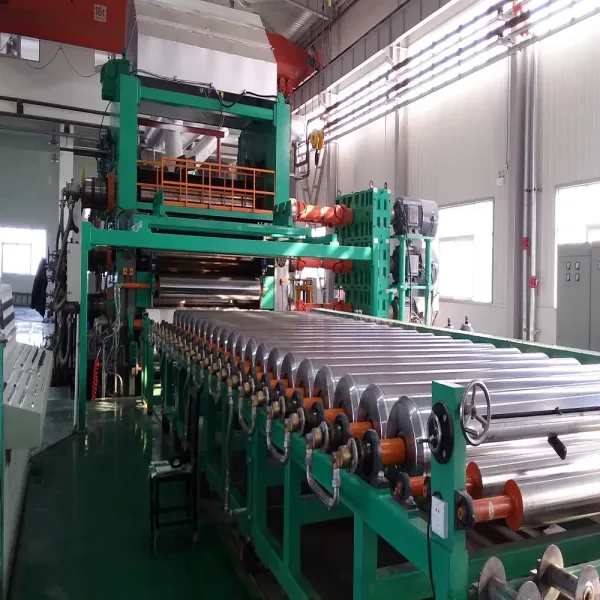
Calendering (Rolls)
Multi-layer composite: The plasticized PVC material passes through multi-roll calenders (roll temperature 160-190℃) to sequentially form the base layer (foam layer), printing layer, and wear layer (transparent PVC + aluminum oxide).
Foam layer treatment: The base layer is expanded in a foaming furnace (200-220℃) to form an elastic closed-cell structure with a density of 0.6-0.9 g/cm³.
Extrusion (Sheets)
Co-extrusion: Using a multi-layer co-extrusion die, the wear layer, print layer, and core layer (high-density PVC + fiberglass mesh reinforcement) are extruded simultaneously, then cooled by sizing rollers and cut into base boards.
3.Surface Treatment
UV coating: A UV-curable coating (thickness 0.2-0.5 mm) is applied to the wear layer by curtain coating or roller coating to improve scratch resistance (reaching T-grade wear resistance).
Embossing: Steel roller embossing or laser engraving is used to imitate wood grain, stone, and other three-dimensional textures, while simultaneously enhancing slip resistance (wet state R9 grade).
Post-Processing and Quality Inspection
Aging/Stress relief: Finished products are left to stand in a constant temperature and humidity workshop for 48 hours to release internal stress and prevent deformation.
Quality inspection: Tests include abrasion resistance (Taber method), tensile strength of locking system (≥1500 N/m), fire rating (cone calorimeter test for B1 grade), etc. Qualified products are packaged and stored.
Advantages
1.PVC ceilings offer a rich variety of patterns and a wide selection of colors and styles, giving consumers many options to choose from.
2.PVC ceilings perform well in various aspects, such as being lightweight, easy to install, waterproof, and soundproof. Since most PVC ceilings today are made with flame-retardant materials, they also provide good fire resistance, making them safer to use.
3.Due to their relatively low production cost, PVC ceilings are much cheaper than other types of ceilings, making them suitable for ordinary households.
Conclusion
In developed countries, PVC flooring has largely replaced ceramic tiles and wooden flooring. Coupled with their high environmental awareness and concern for personal health, PVC flooring has become a mature industry in developed countries. It is the preferred floor covering for public spaces with high safety requirements, such as airports, hospitals, kindergartens, and schools. The wear layer on the surface of PVC flooring has special slip-resistant properties; compared to ordinary flooring materials, PVC flooring feels even more gripping when wet, making it less likely to cause slipping. In environments that require quiet, such as hospital wards, school libraries, lecture halls, and cinemas, PVC flooring provides sound insulation effects that ordinary flooring materials cannot match-no tapping sound when high heels walk on it. Additionally, PVC flooring has antibacterial properties, something that bamboo and solid wood flooring can hardly achieve.


